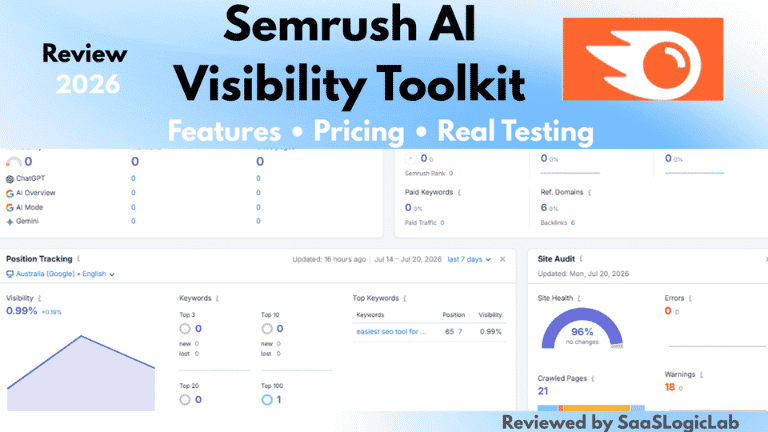
Semrush AI Visibility Toolkit Review 2026
Why AI Visibility Matters for SEO in 2026
For years, success in SEO was measured by one simple metric: rankings.
Today, millions of people no longer begin every search on Google. Instead, they ask questions directly in AI platforms such as ChatGPT, Google AI Overviews, Gemini, Claude, and Perplexity. Rather than presenting a list of websites, these platforms generate complete answers by analyzing information from trusted sources and recommending only a handful of brands.
As AI-powered search becomes part of everyday decision-making, businesses can no longer rely on Google rankings alone. They also need to understand whether AI systems recognize, trust, and recommend their brand when users ask relevant questions.
This shift has fundamentally changed how people discover software, compare products, and make buying decisions.
The question is no longer, “Can your website rank on Google?”
The more important question is:
“Will AI recommend your brand when someone asks for a solution?”
Imagine someone asks:
“What is the best SEO platform for an agency?”
“Which keyword research tool should I use?”
“How can I improve my website’s visibility in AI search?”
If your brand isn’t included in those AI-generated answers, you’re invisible to a growing segment of potential customers—even if your website ranks well in traditional search results.
This new challenge has introduced an entirely new optimization category known as AI Visibility.
Rather than focusing only on keyword rankings, AI Visibility helps businesses understand how often their brand appears in AI-generated answers, which competitors are mentioned more frequently, what topics AI associates with their business, and where they are losing visibility across modern AI search platforms.
Recognizing this major shift, Semrush introduced the AI Visibility Toolkit—a new solution designed to help marketers, SEO professionals, agencies, and SaaS businesses measure, monitor, and improve their presence across the rapidly growing AI search ecosystem.
At its core, the AI Visibility Toolkit works like an AI search monitoring system. Instead of tracking where your pages rank in Google, it tracks how AI platforms respond when users ask questions related to your business. It helps you identify which prompts mention your brand, which competitors receive more recommendations, what topics strengthen your AI presence, and where new opportunities exist to increase your visibility across AI-powered search experiences.
Instead of relying solely on traditional SEO metrics, the toolkit provides insights into how AI platforms understand your brand, compare it with competitors, and surface it in AI-generated responses. It bridges the gap between conventional search optimization and the future of AI-driven discovery.
If you’re comparing Semrush with Ahrefs before investing in an SEO platform, read our detailed Semrush vs Ahrefs comparison to see which tool is the better choice for your workflow.
But what exactly is the Semrush AI Visibility Toolkit?
How does it work?
Which AI platforms does it support?
Can it actually improve your brand’s visibility in AI search?
Is it worth paying for?
And how does it compare with traditional SEO tools and emerging AI visibility platforms?
In this complete guide, we’ll answer all of those questions through detailed research, verified product information, feature-by-feature explanations, pricing analysis, practical workflows, real testing, and an honest evaluation of where the toolkit excels—and where it still has limitations.
Whether you’re an SEO professional, agency owner, SaaS founder, content strategist, or digital marketer preparing for the future of search, this guide will help you understand exactly what the Semrush AI Visibility Toolkit offers, how it works, where it excels, where it falls short, and whether it deserves a place in your long-term SEO and AI search strategy.
AI Search Has Changed SEO Forever
The rise of AI search isn’t just another Google update—it’s one of the biggest shifts the SEO industry has experienced in decades. For the first time, millions of users can receive complete answers without clicking through multiple search results. Instead of competing only for rankings, businesses must now compete for inclusion in AI-generated recommendations. This change doesn’t eliminate traditional SEO, but it expands the definition of search success beyond rankings and organic traffic.
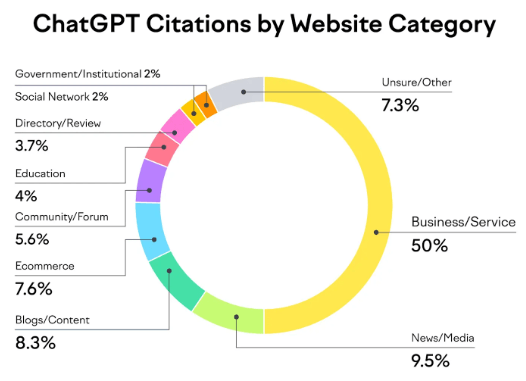
For nearly two decades, search engine optimization followed a familiar pattern. Businesses created content, optimized it around keywords, earned backlinks, improved technical SEO, and competed for higher rankings on Google’s search results. If your website ranked on the first page, you had a strong chance of attracting visitors, generating leads, and growing your business.
That model is evolving. Today, people don’t always start their journey on a traditional search engine. Instead, they ask questions directly to AI-powered platforms like ChatGPT, Google AI Overviews, Gemini, Claude, and Perplexity. Rather than showing ten blue links, these platforms generate complete answers by combining information from multiple trusted sources.
This change has transformed how users discover products, compare software, and make purchasing decisions. Many users now receive the information they need without visiting multiple websites, which means brands must compete for visibility inside AI-generated responses, not just search engine rankings.
For businesses, this creates both a challenge and an opportunity. A website can rank well on Google but still receive fewer visits if AI assistants recommend competitors instead. On the other hand, brands that consistently appear in AI-generated answers can build trust, increase awareness, and influence potential customers much earlier in the buying journey.
As AI search continues to grow, success will no longer depend only on where your website ranks. It will also depend on how well AI systems understand your brand, trust your content, and decide to include it in their responses. This is the reason AI Visibility has become one of the fastest-growing areas in modern SEO and why businesses are beginning to measure their performance beyond traditional rankings.
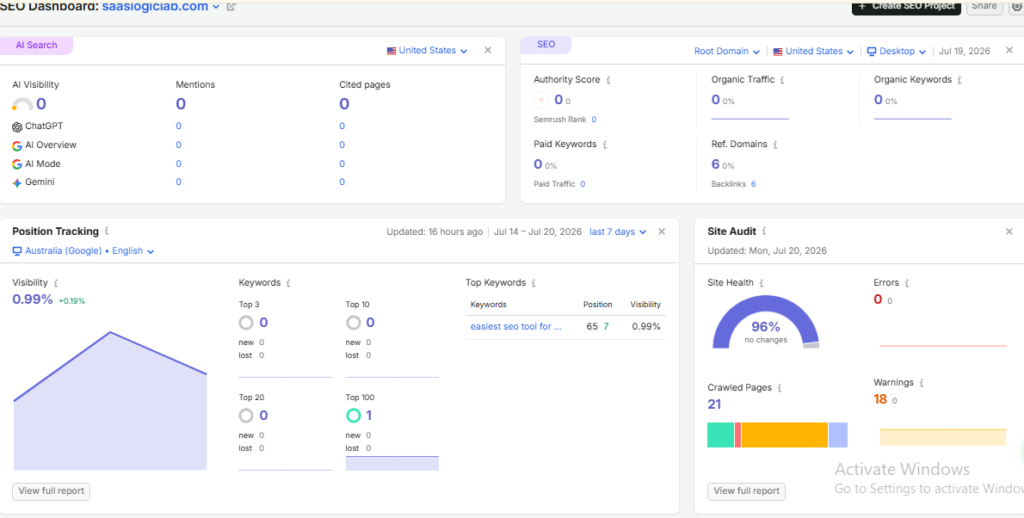
SaaSLogicLab Semrush dashboard used during our real-world testing, showing AI Visibility, Position Tracking, Site Audit, and core SEO performance metrics.
AI Visibility vs Traditional SEO: What’s the Difference?
For many years, SEO followed a familiar process. You researched keywords, optimized your pages, improved technical SEO, earned backlinks, and tracked keyword rankings in Google. If your rankings improved, you expected more traffic, more leads, and ultimately more customers.
Before exploring AI Visibility, it’s also worth understanding how Semrush compares with Ahrefs across keyword research, backlinks, technical SEO, and overall marketing workflows. Read our complete Semrush vs Ahrefs comparison.
Those fundamentals are still important today, but the way people search for information has changed dramatically.
Instead of searching only on Google, users are increasingly asking questions directly to AI-powered platforms such as ChatGPT, Google AI Overviews, Gemini, Claude, and Perplexity. Rather than displaying a list of websites, these platforms generate complete answers by combining information from multiple trusted sources. As a result, users often receive the information they need without clicking through several search results.
This shift has introduced a new challenge for businesses.
Traditional SEO focuses on helping your pages rank higher in search engine results. AI Visibility focuses on helping your brand become part of the answers generated by AI systems. Although these goals are connected, they are not the same.
A website can rank in the top three positions on Google for an important keyword and still receive little or no visibility inside AI-generated answers. At the same time, another brand with fewer keyword rankings may appear frequently in AI recommendations because it has stronger topical authority, clearer content, better brand recognition, or more trustworthy references across the web.
This is why measuring rankings alone is no longer enough.
A business that ranks #1 for an important keyword can still lose visibility if AI assistants consistently recommend another brand. Likewise, a company with fewer top rankings may gain significant exposure if its content is considered more trustworthy, comprehensive, and relevant by AI systems. Measuring only rankings no longer reflects the full picture of modern search performance.
Businesses now need to answer two different questions.
The first question is, “Where do we rank in Google Search?”
The second question is, “How often do AI platforms recommend our brand when users ask relevant questions?”
These are different measurements, and both are becoming equally important.
Traditional SEO reports usually include metrics such as keyword rankings, organic traffic, backlinks, indexed pages, crawl errors, Core Web Vitals, and technical health. These metrics explain how well your website performs in search engines.
AI Visibility introduces another layer of measurement. Instead of tracking only positions on a search results page, it focuses on how AI systems understand your brand, which competitors receive more recommendations, what topics AI associates with your business, and where your brand is missing from important AI-generated conversations.
Think of it this way.
Traditional SEO answers the question, “Can people find my website?”
AI Visibility answers the question, “Will AI recommend my business when someone asks for help?”
Neither replaces the other.
If your technical SEO is weak, your content lacks authority, or your website doesn’t provide reliable information, AI Visibility alone won’t solve those problems. Likewise, excellent keyword rankings don’t automatically guarantee that AI assistants will reference your brand in their answers.
The future of search combines both approaches.
Businesses will still need strong technical SEO, high-quality content, strategic internal linking, authoritative backlinks, and positive user experience. At the same time, they will also need to understand how AI systems evaluate, interpret, and recommend their content across modern search experiences.
Instead of treating AI Visibility as a replacement for SEO, it’s more accurate to think of it as the next evolution of SEO. Traditional optimization helps search engines understand your website, while AI Visibility helps you understand how AI-powered search platforms perceive your brand. Companies that invest in both will be better prepared for the future of digital search than those focusing on rankings alone.
What Is the Semrush AI Visibility Toolkit?
The Semrush AI Visibility Toolkit is a dedicated solution designed to help businesses understand, measure, and improve their visibility across AI-powered search platforms. Instead of focusing only on traditional SEO metrics such as keyword rankings, backlinks, and organic traffic, it helps you analyze how AI assistants discover, interpret, and recommend your brand when answering user questions.
As more people rely on platforms like ChatGPT, Google AI Overviews, Gemini, Claude, and Perplexity to find information, traditional ranking reports alone can no longer provide the complete picture. A website may rank well in Google Search but still receive fewer opportunities if AI-generated answers consistently recommend competing brands instead.
The AI Visibility Toolkit was introduced to solve this growing challenge. It gives marketers and businesses a clearer understanding of how often their brand appears in AI-generated responses, which competitors receive more visibility, which topics strengthen or weaken their presence, and where new opportunities exist to improve their AI search performance.
Unlike a traditional rank tracker that measures positions for specific keywords, this toolkit focuses on brand visibility inside AI-generated answers. It looks beyond search rankings and helps answer questions that modern SEO tools were never originally built to measure.
For example, instead of asking, “What is my ranking for this keyword?”, businesses can now ask questions like, “Does ChatGPT recommend my brand?”, “Which competitors appear more frequently than we do?”, “What topics is AI associating with our business?”, and “Where are we missing visibility that could influence potential customers?”
This shift reflects the changing nature of search. Modern SEO is no longer limited to earning clicks from search engine result pages. It also involves becoming a trusted source that AI systems recognize, understand, and confidently reference when generating answers for users.
Rather than replacing traditional SEO, the Semrush AI Visibility Toolkit complements it. Businesses still need strong technical SEO, high-quality content, topical authority, and trusted backlinks. However, they now also need insights into how those efforts influence their visibility across AI-powered search experiences. The toolkit brings these two worlds together, helping marketers prepare for a future where success depends on both search rankings and AI recommendations.
Real-World Testing: SaaSLogicLab Results
To evaluate the AI Visibility Toolkit fairly, we tested it using our own website, SaaSLogicLab, instead of relying only on Semrush documentation or promotional material. We created a project, connected our domain, explored the available reports, reviewed the dashboard metrics, and documented the insights generated throughout the testing process. Because SaaSLogicLab is still a relatively new website, it also allowed us to observe how the toolkit performs for brands with limited authority—not just established websites with a strong online presence.
During our real-world testing, the AI Visibility Overview showed that SaaSLogicLab wasn’t yet present across supported AI platforms.
Since the website is still relatively new, this result was expected rather than surprising. AI platforms need time to discover a brand, crawl and understand its content, evaluate its topical authority, recognize trustworthy signals across the web, and build enough confidence before recommending it in AI-generated responses. This process doesn’t happen overnight, especially for newly launched websites with limited authority.
Instead of viewing this as a negative result, we treated it as a starting benchmark. As we publish more high-quality content, strengthen topical authority, earn trusted backlinks, and grow our overall online presence, this dashboard will help us measure whether those efforts are improving our AI Visibility over time.
One of the biggest advantages of this overview is that it establishes a clear baseline. Rather than relying on assumptions, businesses can track measurable progress and understand whether their optimization efforts are increasing their visibility across AI-powered search platforms.
Why Did Semrush Launch the AI Visibility Toolkit?
The way people search for information is changing faster than ever before. Instead of browsing through multiple websites, users are increasingly asking questions directly to AI-powered platforms that provide complete answers within seconds. This shift has reduced the importance of simply ranking on a search engine results page and increased the importance of being recognized and recommended by AI systems.
For businesses, this creates a completely new challenge. Traditional SEO tools can tell you where your website ranks, how much traffic you receive, and which keywords perform well. However, they cannot answer an increasingly important question: How visible is your brand inside AI-generated answers?
Imagine two companies ranking on the first page of Google for the same keyword. If ChatGPT, Google AI Overviews, or Perplexity consistently recommends one brand while ignoring the other, the second company could lose potential customers even though its traditional SEO performance looks strong. This is a visibility gap that conventional SEO reports were never designed to measure.
Recognizing this shift, Semrush introduced the AI Visibility Toolkit to help businesses understand and measure their presence across AI-powered search platforms.
The launch also reflected a broader change in the SEO industry. As AI assistants became part of everyday search behavior, marketers began asking questions that traditional SEO platforms couldn’t answer. They wanted to know whether AI systems recommended their brand, which competitors were receiving more visibility, how AI interpreted their content, and how their presence changed across different AI-powered search experiences. Existing SEO reports weren’t designed to answer these questions, creating a clear need for a new type of measurement.
Semrush launched the AI Visibility Toolkit to close that gap. Instead of replacing keyword rankings, backlinks, or technical SEO reports, it adds a new layer of measurement that focuses on AI-driven discovery. It helps businesses understand where they stand in the AI ecosystem, identify competitors gaining more AI visibility, and uncover opportunities to strengthen their presence across AI-powered search experiences.
This reflects a broader evolution in SEO. Modern optimization is no longer limited to helping search engines crawl and rank your pages. It also involves creating content, authority, and trust signals that enable AI systems to confidently understand, reference, and recommend your brand. Businesses that adapt to this shift early will be better positioned to build long-term visibility and gain a competitive advantage as AI-powered search continues to evolve.
Understanding the AI Visibility Overview Dashboard
The AI Visibility Overview Dashboard is the first screen you’ll see after opening the Semrush AI Visibility Toolkit. While it may look similar to a traditional SEO dashboard at first glance, its purpose is completely different.
Instead of showing keyword rankings, backlinks, or organic traffic, this dashboard focuses on one question:
How visible is your brand across AI-powered search platforms?
It acts as the starting point for measuring your AI presence, giving you a high-level view of how often your brand appears in AI-generated answers, how you compare with competitors, and whether your visibility is improving over time.
For businesses entering AI search for the first time, this dashboard establishes a baseline. For established brands, it becomes an ongoing performance tracker that helps measure the impact of content, authority building, and overall SEO efforts.
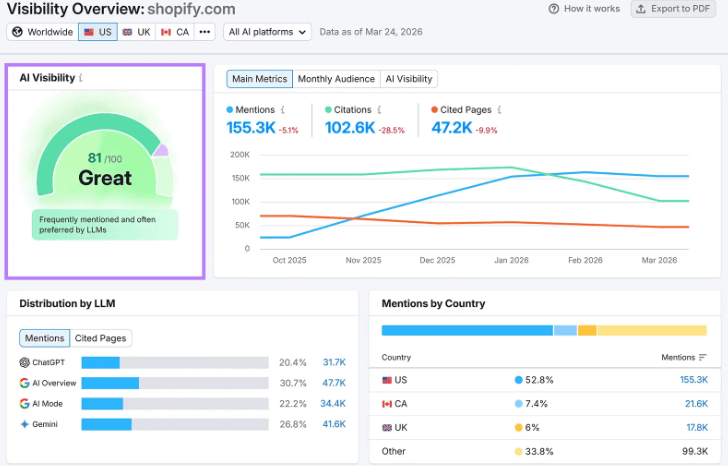
Unlike traditional SEO reports, the AI Visibility Overview isn’t designed to replace your existing metrics. Instead, it adds another layer of intelligence that helps you understand how AI systems perceive and recommend your brand.
During our own testing with SaaSLogicLab, the dashboard showed that our website had little to no AI visibility across the supported platforms. Since the website is still relatively new, this wasn’t unexpected.
Rather than treating this as a failure, we considered it our starting benchmark.
This first report gives us something far more valuable than a simple score—it provides a reference point. As we continue publishing high-quality content, expanding topical authority, improving technical SEO, and earning trusted backlinks, we’ll be able to compare future reports against this initial benchmark and measure real progress.
AI Visibility Overview Dashboard Interface Walkthrough
When you open the Semrush AI Visibility Toolkit, the AI Visibility Overview Dashboard is the first screen you’ll see. It serves as the central dashboard for monitoring your brand’s overall performance across supported AI search experiences.
Instead of opening multiple reports individually, this dashboard brings together the most important AI visibility metrics into a single view, allowing you to quickly understand how your brand is performing.
Depending on your project and available data, the dashboard typically includes cards, charts, comparison widgets, and trend graphs that summarize your AI search performance.
During our testing, the dashboard acted as the starting point for every analysis. Before exploring Prompt Research or the Pages Report, we first reviewed the Overview Dashboard to understand the current state of our AI visibility and establish a baseline for future comparisons.
What You’ll Typically See
| Dashboard Section | Purpose |
| AI Visibility Summary | Shows your overall AI visibility across supported platforms. |
| Brand Mentions | Displays how often your brand appears in AI-generated responses. |
| Visibility Trend | Shows whether your AI visibility is improving or declining over time. |
| Competitor Snapshot | Compare your AI visibility with tracked competitors. |
| Top Prompts | Highlights prompts generating the most AI visibility. |
| Topic Overview | Shows the topics AI most strongly associates with your brand. |
💡 Tip: Don’t try to interpret every metric immediately. Start by understanding the overall dashboard, then review each report individually for deeper insights.
Semrush AI Visibility Overview Dashboard for SaaSLogicLab
This is one of the biggest strengths of the AI Visibility Overview Dashboard. Instead of relying on assumptions, you can track how your brand’s AI visibility evolves over time using real data.
What Information Does the AI Visibility Overview Dashboard Show?
The AI Visibility Overview Dashboard brings together several metrics that help you understand how AI platforms perceive your brand. Rather than relying on a single score, it combines visibility insights, competitor comparisons, AI mentions, and performance trends into one centralized dashboard.
Each metric answers a different question. Some measure your overall AI visibility, while others show how your brand compares with competitors, which prompts generate mentions, and which topics AI associates with your business. Understanding these metrics is essential because they help you identify strengths, uncover visibility gaps, and make informed optimization decisions.
The table below provides a quick overview of the key metrics available in the AI Visibility Overview Dashboard. The following sections explain each one in detail, including what it measures, why it matters, and how to interpret the data effectively.
| Dashboard Metric | What It Measures | Why It Matters |
| AI Visibility Score | Your overall AI search visibility | Tracks your brand’s AI presence over time |
| Brand Mentions | How often AI platforms reference your brand | Measures brand recognition across AI search |
| Supported AI Platforms | AI platforms included in the analysis | Shows where your visibility data comes from |
| Visibility Trend | Changes in AI visibility over time | Helps measure long-term growth or decline |
| Competitor Comparison | Your visibility compared with competitors | Identifies gaps and competitive opportunities |
| Top Performing Prompts | Prompts that generate brand mentions | Reveals which queries drive AI visibility |
| Topic Coverage | Topics AI associates with your brand | Measures topical authority and relevance |
The following sections explore each dashboard metric in detail, explaining what it measures, why it matters, how Semrush presents the data, and how you can use these insights to improve your AI visibility strategy.
AI Visibility Score
AI Visibility Score Interface Walkthrough
The AI Visibility Score is usually one of the first metrics you’ll notice when opening the Overview Dashboard. It provides a quick snapshot of your brand’s overall visibility across supported AI search platforms.
Rather than reviewing dozens of individual prompts, pages, or mentions, this score summarizes your current AI visibility into a single metric that can be tracked over time.
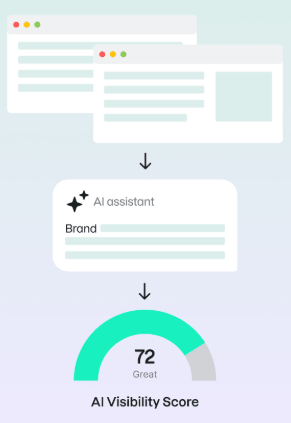
As you publish more high-quality content, build topical authority, and improve your online reputation, this score may gradually change. Instead of focusing on daily fluctuations, it’s more useful to compare your score over weeks or months to measure long-term progress.
During our testing, this was the first metric we checked after every crawl because it gave us an immediate understanding of whether our overall AI visibility had improved since the previous report.
Why This Metric Matters
| Metric | Why It Matters |
| Overall Visibility | Quickly measures your brand’s AI presence. |
| Progress Tracking | Helps monitor long-term improvement. |
| Campaign Evaluation | Shows whether your SEO and content efforts are increasing AI visibility. |
| Benchmarking | Creates a baseline for future comparisons. |
💡 Tip: Don’t judge your AI Visibility Score after only one report. The real value comes from tracking changes consistently over time.
Figure 2. Semrush AI Visibility Score showing the overall AI visibility benchmark for the tracked domain.
The AI Visibility Score is one of the most important metrics in the Semrush AI Visibility Overview Dashboard because it provides a high-level indication of how visible your brand is across supported AI-powered search platforms. Rather than measuring traditional keyword rankings, this score reflects your brand’s overall presence in AI-generated responses.
Unlike conventional SEO metrics, the AI Visibility Score isn’t based on a single ranking position or search query. Instead, it is influenced by multiple signals that help Semrush evaluate how frequently and how consistently AI systems recognize and reference your brand across relevant prompts and topics.
Think of it as a health indicator for your AI search presence. A higher score generally suggests that your brand appears more often in AI-generated answers, while a lower score may indicate that AI platforms have limited awareness of your content or prefer recommending competing brands.
The AI Visibility Score becomes most valuable when monitored over time.
Unlike keyword rankings, there isn’t a universal “good” AI Visibility Score that applies to every website. A newly launched website, a growing SaaS company, and a well-established enterprise brand will naturally have different benchmarks. Instead of comparing your score with unrelated websites, use it to measure your own progress over time and evaluate whether your content, authority, and brand-building efforts are improving your AI visibility.
During our testing with SaaSLogicLab, the AI Visibility Score was extremely low because the website is still new and has limited authority. Rather than treating this as a poor result, we used it as our starting benchmark. Future reports will allow us to measure whether our content strategy and SEO efforts are increasing our visibility across AI-powered search platforms.
For this reason, the AI Visibility Score is best used as a trend metric rather than a standalone success metric. Monitoring how the score changes over weeks and months provides far more actionable insights than focusing on a single report.
SaaSLogicLab Expert Insight
Don’t judge your AI Visibility Score after your first report. The real value comes from tracking its direction over time. A steadily improving score is often a stronger indicator of long-term success than a single high number.
While the AI Visibility Score provides an overall view of your brand’s AI presence, it doesn’t tell the complete story. To understand where that visibility comes from, you also need to analyze how often AI platforms actually mention your brand. This is where Brand Mentions becomes an equally important metric.
How to Improve Your AI Visibility Score
Improving your AI Visibility Score requires more than traditional SEO. Focus on creating comprehensive, experience-based content that directly answers real user questions. Strengthen topical authority by publishing interconnected articles, earn high-quality backlinks, and keep your content updated as AI search evolves. Monitor Prompt Research, Brand Mentions, and Pages reports regularly to identify new opportunities. Over time, consistent optimization helps AI platforms recognize your brand as a trustworthy source, increasing the likelihood of being cited in AI-generated answers.
Brand Mentions
Brand Mentions Interface Walkthrough
The Brand Mentions metric shows how frequently your brand appears in AI-generated responses across supported AI search platforms. Instead of measuring website traffic or keyword rankings, this report focuses on whether AI systems recognize your brand as a relevant source when answering user questions.
For businesses investing in content marketing, SEO, and digital PR, this metric provides valuable insight into how AI models perceive their online authority.
During our testing, we checked Brand Mentions alongside the AI Visibility Score because both metrics complement each other. A higher visibility score often reflects broader AI exposure, while Brand Mentions help confirm how often the brand itself is being referenced in generated answers.
Why Brand Mentions Matter
| Metric | Why It Matters |
| Brand Recognition | Shows whether AI platforms recognize your brand. |
| Authority Growth | Indicates improving topical authority over time. |
| Content Performance | Helps evaluate whether your content is earning AI citations. |
| Long-Term Trends | Makes it easier to measure brand visibility across reporting periods. |
💡 Tip: Don’t expect a large number of brand mentions immediately. New websites usually need consistent, high-quality content and stronger online authority before AI systems begin referencing them more frequently.
Brand Mentions measures how often AI-powered search platforms reference your brand when generating answers to user queries. While the AI Visibility Score provides an overall picture of your AI presence, Brand Mentions reveals how frequently your business is actually cited or recommended across supported AI platforms.
It’s equally important to evaluate the quality of those mentions, not just the quantity.
When analyzing Brand Mentions, consider both how often your brand appears and how prominently it is presented within the response.
Monitoring Brand Mentions over time also helps you evaluate the impact of your SEO and content strategy. As you publish high-quality content, strengthen topical authority, earn credible backlinks, and increase your brand’s online presence, you should expect the number of AI mentions to improve gradually.
Brand Mentions become even more valuable when compared with your competitors. If competing brands receive significantly more mentions for the same topics, it may indicate stronger authority, better content coverage, or greater recognition across the web. These insights help identify opportunities to improve your own AI visibility strategy.
Like the AI Visibility Score, Brand Mentions should be monitored over time rather than judged from a single report. Long-term trends provide far more meaningful insights than short-term fluctuations and help you measure whether your optimization efforts are moving in the right direction.
Supported AI Platforms
Unlike traditional SEO tools that usually focus on a single search engine, the AI Visibility Overview Dashboard evaluates your brand across multiple supported AI-powered search platforms. This broader approach provides a more complete picture of how your business is represented throughout today’s rapidly evolving AI search ecosystem.
This is important because every AI platform retrieves, interprets, and presents information differently. Each AI platform also relies on different models, data sources, and response-generation methods. Because of these differences, it’s completely normal for your brand’s visibility to vary across platforms. Strong visibility in one AI assistant doesn’t automatically translate into strong visibility across every AI platform. A brand that appears frequently in one platform’s responses may receive little or no visibility in another. Measuring only one AI platform would provide an incomplete picture of your overall AI search performance.
By bringing data from multiple supported platforms into a single dashboard, Semrush helps businesses monitor their AI visibility more efficiently. Rather than checking each platform individually, marketers can evaluate their performance from one centralized location and identify where their brand is gaining recognition or where additional optimization may be needed.
This broader perspective also makes it easier to track the impact of long-term SEO and content strategies. As your website publishes more authoritative content, earns trusted backlinks, and strengthens its topical authority, improvements may appear across multiple AI platforms over time instead of just one.
It’s important to remember that supported platforms may change as AI search continues to evolve. Semrush regularly expands and updates its AI Visibility Toolkit, so the list of supported AI platforms may grow over time as new AI-powered search experiences become more widely adopted.
💡 SaaSLogicLab Expert Insight
Don’t focus on just one AI platform. Users ask questions across ChatGPT, Google AI experiences, Perplexity, and other AI assistants. Monitoring multiple platforms provides a far more accurate picture of your brand’s overall AI visibility than relying on a single source.
Visibility Trend
Visibility Trend Interface Walkthrough
The Visibility Trend chart helps you understand how your brand’s AI visibility changes over time. Instead of showing a single score, it visualizes whether your visibility is improving, declining, or remaining stable across different reporting periods.
One of the most useful features of this chart is the ability to compare trends over time rather than relying on a single snapshot. This makes it easier to identify whether your SEO, content marketing, and brand-building efforts are having a positive impact on AI visibility.
During our testing, we used the Visibility Trend graph after each project update to compare results with previous reports. Rather than focusing on daily changes, we looked for consistent long-term growth, which provides a much clearer picture of overall progress.
How to Read the Visibility Trend
| Trend | What It Usually Indicates |
| 📈 Upward Trend | Your AI visibility is improving over time. |
| ➖ Stable Trend | Your visibility remains consistent with no major changes. |
| 📉 Downward Trend | Your AI visibility has declined and may require further investigation. |
💡 Tip: A short-term drop doesn’t always indicate a problem. Focus on long-term trends and compare them with your content publishing schedule, technical SEO improvements, and authority-building efforts.
Now that you understand how the Visibility Trend chart works, let’s explore how this report helps you monitor long-term AI visibility growth and identify meaningful performance changes over time.
Visibility Trend reveals whether your brand’s AI visibility is improving, remaining stable, or declining over time. Instead of focusing on a single report, it helps you measure long-term progress across supported AI-powered search platforms.
Tracking trends over weeks and months is far more valuable than judging a single data point. AI visibility doesn’t change overnight. As you publish high-quality content, strengthen topical authority, improve your technical SEO, and earn trusted mentions across the web, those efforts gradually influence how AI systems perceive and recommend your brand.
A positive trend usually indicates that your optimization strategy is moving in the right direction and that AI platforms are becoming more confident in referencing your content. On the other hand, a declining or stagnant trend may suggest that competitors are building authority faster, your content isn’t expanding into important topics, or your brand isn’t earning enough trust signals across the web.
Instead of reacting to small day-to-day fluctuations, businesses should use the Visibility Trend to measure long-term progress. Comparing reports over several weeks or months provides a much clearer picture of whether your AI visibility strategy is producing meaningful results.
For new websites like SaaSLogicLab, the Visibility Trend may show little or no movement in the beginning. This is completely normal. As more content is published and the website gains authority, future reports should reveal whether those efforts are translating into improved AI visibility across supported platforms.
SaaSLogicLab Expert Insight
Don’t expect your Visibility Trend to improve immediately. AI visibility is a long-term metric, much like traditional SEO. Consistent publishing, stronger topical authority, and trusted online signals are what drive sustainable growth over time.
Competitor Comparison
Competitor Comparison shows how your brand performs against other businesses competing for visibility in AI-powered search. Rather than analyzing your performance in isolation, it helps you benchmark your AI presence and understand where your brand stands relative to competing companies.
This comparison is important because AI search is highly competitive. When users ask questions about products, software, or services, AI platforms typically recommend only a limited number of brands. If your competitors are consistently mentioned while your business is not, it indicates a visibility gap that traditional SEO reports may not reveal.
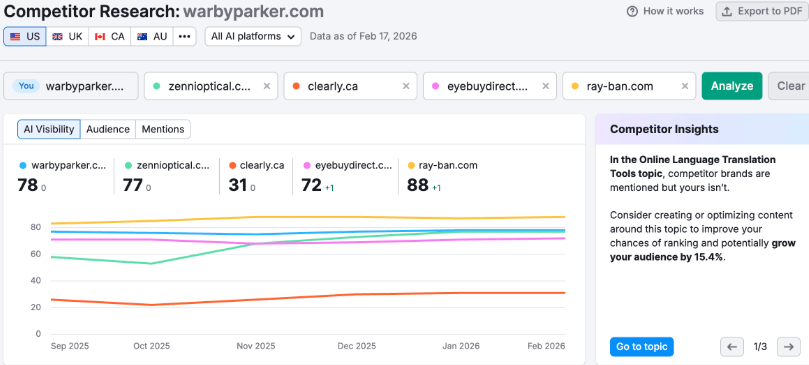
By comparing your brand with competitors, you can identify opportunities to strengthen your AI visibility strategy. For example, a competing brand may receive more AI recommendations because it has stronger topical authority, more comprehensive content, better brand recognition, or a greater number of trusted references across the web. Understanding these differences helps you focus your optimization efforts where they will have the greatest impact.
Competitor Comparison is also useful for measuring long-term progress. As you publish more authoritative content, improve technical SEO, expand topical coverage, and build stronger brand credibility, you can monitor whether the visibility gap between your business and competing brands begins to narrow over time.
Instead of viewing competitors simply as rivals, use this metric as a benchmarking tool. Learning why AI platforms recommend certain brands more frequently can reveal valuable insights that help improve your own content strategy and overall AI search presence.
SaaSLogicLab Expert Insight
Don’t compare your brand with every competitor. Focus on businesses targeting the same audience and topics. A smaller, relevant competitor often provides more actionable insights than comparing yourself with an industry giant.
Top Performing Prompts
Top Performing Prompts identifies the user questions and AI search prompts that generate the strongest visibility for your brand. Instead of simply reporting that your business was mentioned, it shows exactly which prompts are responsible for those AI-generated mentions.
This insight is particularly valuable because AI search is prompt-driven rather than keyword-driven. People no longer search using only short phrases like “best SEO tool.” Instead, they ask complete questions such as “What is the best SEO platform for agencies?” or “Which AI SEO tool should I use for keyword research?” Understanding these prompts helps businesses create content that better matches the way users interact with AI assistants.
By analyzing your top-performing prompts, you can identify the topics where your brand already has strong visibility. These successful prompts often reveal areas where your content demonstrates authority and where AI systems consider your website a reliable source of information.
Top Performing Prompts can also uncover content opportunities. If certain high-value prompts generate little or no visibility for your brand, they may represent topics that deserve additional articles, better content coverage, or stronger topical authority. Over time, optimizing content around these opportunities can help increase your presence across AI-generated answers.
Rather than focusing only on search volume, businesses should also evaluate prompt intent. Informational, commercial, and comparison-based prompts often influence different stages of the customer journey. Understanding which prompt types generate the most AI visibility helps you build a more balanced and effective content strategy.
SaaSLogicLab Expert Insight
Don’t optimize for keywords alone. Optimize for the real questions your audience asks AI platforms. Businesses that align their content with user prompts are more likely to increase their AI visibility over time.
Topic Coverage
Topic Coverage reveals the subjects and themes that AI platforms most strongly associate with your brand. Rather than measuring how often your business is mentioned, it highlights the areas where AI systems recognize your expertise and are more likely to recommend your content.
This insight is important because AI-powered search platforms rely heavily on topical understanding when generating answers. If your website consistently publishes high-quality content around a specific subject, AI systems are more likely to recognize your expertise and recommend your brand when users ask related questions.
Strong Topic Coverage is often the result of a well-planned content strategy rather than a single successful article. Publishing comprehensive guides, supporting articles, comparisons, tutorials, and regularly updating existing content helps strengthen your topical authority over time. The broader and more consistent your coverage, the easier it becomes for AI systems to understand the areas where your brand has demonstrated expertise.
On the other hand, limited Topic Coverage may reveal important content gaps. If AI platforms associate your brand with only a small number of topics, you may be missing opportunities to appear in a wider range of AI-generated answers. Expanding your content into closely related subjects can help improve both topical authority and overall AI visibility.
Topic Coverage should be viewed as a long-term indicator of your brand’s expertise. Instead of trying to cover every possible topic, focus on building deep, authoritative content around subjects that are most relevant to your business. A clear topical focus is far more valuable than publishing a large volume of unrelated content.
SaaSLogicLab Expert Insight
AI doesn’t reward websites that write about everything. It rewards brands that consistently demonstrate expertise within their niche. Building deep topical authority is one of the most effective ways to improve long-term AI visibility.
Prompt Research
Prompt Research is one of the core features of the Semrush AI Visibility Toolkit. While the Overview Dashboard shows your overall AI visibility, Prompt Research helps you understand why your brand appears in AI-generated responses and which specific prompts influence that visibility.
Instead of relying on traditional keywords alone, Prompt Research analyzes the real questions people ask AI-powered search platforms. A prompt is much more than a longer keyword. It represents a complete user question, including context, intent, and the way people naturally communicate with AI assistants.
Understanding this distinction is essential because optimizing for prompts means creating content that fully answers real questions—not simply targeting individual search terms. These prompts are often longer, more conversational, and reflect how users naturally interact with AI assistants like ChatGPT, Google AI experiences, Perplexity, and other supported platforms.
This shift is important because AI search has changed user behavior. Rather than typing short keyword phrases such as “best CRM software,” users now ask complete questions like “Which CRM is best for a small SaaS business?” or “What is the best CRM for startups with limited budgets?” Understanding these prompts allows businesses to create content that aligns with the way AI search actually works.
Prompt Research also helps uncover opportunities that may be difficult to identify through traditional keyword research. By seeing which prompts already generate visibility for your brand—and which valuable prompts do not—you can identify content gaps, strengthen topical authority, and prioritize new content that addresses real user intent.
For marketers, SEO professionals, and business owners, this feature bridges the gap between conventional keyword optimization and modern AI search optimization. Instead of creating content solely for search engines, Prompt Research encourages you to create content that directly answers the questions people ask AI systems every day.
SaaSLogicLab Expert Insight
Keyword research is still important, but AI search begins with questions, not keywords. Businesses that understand user prompts can create content that is more likely to be discovered, trusted, and recommended by AI platforms.
Now that you understand what Prompt Research is and why it matters, let’s explore how this feature works and how you can use it to discover valuable AI search opportunities for your brand.
How Prompt Research Works
Prompt Research is designed to help businesses discover the AI search prompts that matter most to their brand. Rather than requiring you to manually guess what users ask AI assistants, Semrush automatically collects and analyzes relevant prompts related to your industry, products, services, and topics.
The process begins after you create an AI Visibility project for your website. Once your project is configured, Semrush automatically analyzes a wide range of AI search prompts related to your business, products, services, and industry. It then evaluates how your brand performs across supported AI-powered search platforms by checking whether your website is mentioned, recommended, or cited within AI-generated responses.
Once the analysis is complete, Prompt Research organizes the collected data into an easy-to-understand interface. You can explore which prompts already generate AI visibility, identify prompts where competitors receive more mentions, and discover valuable opportunities where your brand has little or no presence.
One of the biggest advantages of this feature is that it helps you prioritize content based on real user intent. Rather than creating articles around assumptions, you can build content that directly answers the questions people are already asking AI platforms. This makes your content strategy more focused and increases the likelihood of earning AI-generated mentions over time.
Prompt Research is not a one-time report. As AI search evolves and your website publishes new content, the available prompts and your visibility across them may change. Reviewing this data regularly allows you to monitor progress, uncover new content opportunities, and refine your AI search strategy based on real-world insights instead of guesswork.
💡 SaaSLogicLab Expert Insight
Treat Prompt Research as an ongoing content discovery tool rather than a one-time reporting feature. The questions users ask AI platforms change over time, and regularly reviewing this data helps you stay ahead of competitors by creating content around emerging topics before they become highly competitive.
Understanding the Prompt Research Interface
If you’re using the feature for the first time, the amount of information may seem overwhelming. However, each part of the interface has a specific purpose. Some columns show the prompts that generate AI visibility, while others reveal brand mentions, competitors, AI visibility scores, owned sources, and page-level performance. Together, these metrics help explain not only whether your brand appears in AI-generated responses, but also why.
The available filters make the research process much more efficient. Instead of reviewing hundreds of prompts manually, you can narrow the results by topic, AI visibility, competitor mentions, owned sources, or prompt performance. This allows you to focus on the opportunities that are most relevant to your business goals.
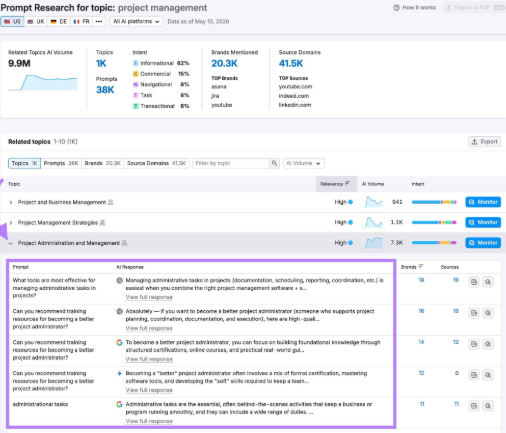
One of the biggest strengths of the Prompt Research interface is that it transforms large amounts of AI search data into practical content opportunities. Instead of guessing which topics deserve attention, you can quickly identify visibility gaps, discover prompts where competitors outperform your brand, and prioritize content improvements based on real AI search behavior.
As AI-powered search continues to evolve, Semrush will likely introduce additional metrics, filters, and reporting capabilities. Rather than memorizing the interface, focus on understanding what each metric represents. Once you understand the purpose behind the data, adapting to future updates becomes much easier.
Prompt
The Prompt column is the foundation of the Prompt Research interface because it shows the exact questions users ask AI-powered search platforms. Unlike traditional keyword research, where you optimize for short search terms, Prompt Research focuses on complete, natural-language questions that reflect how people actually interact with AI assistants.
For example, instead of searching for a keyword like “CRM software,” users may ask questions such as “What is the best CRM for small SaaS companies?” or “Which CRM platform offers the best automation features?” These conversational prompts provide much deeper insight into user intent than individual keywords alone.
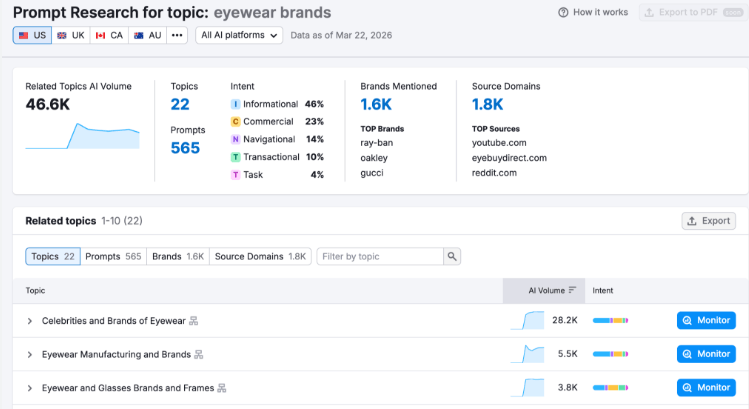
Each prompt represents a real opportunity for your brand to appear in AI-generated answers. If your website already provides a comprehensive and trustworthy answer to that question, AI platforms are more likely to mention or recommend your business. If your brand does not appear for an important prompt, it may indicate a content gap or an opportunity to strengthen your topical authority.
Studying the Prompt column also helps you understand how your audience thinks. Instead of guessing which topics matter most, you can see the exact questions that influence AI visibility. This allows you to create articles, comparison pages, tutorials, and product content that directly answer user needs rather than simply targeting search volume.
Rather than treating every prompt equally, focus first on the prompts that are most closely aligned with your products, services, and business goals. Optimizing content around these high-value prompts is often far more effective than creating content for hundreds of unrelated queries.
💡 SaaSLogicLab Expert Insight
Don’t choose prompts based only on popularity. Prioritize the questions your ideal customers are most likely to ask before making a buying decision. Answering the right prompts is far more valuable than targeting the highest number of prompts.
Topic Volume
The Topic Volume column estimates how frequently a particular topic or prompt is discussed across supported AI search experiences. Rather than measuring traditional keyword search volume, it helps you understand which subjects generate the greatest level of user interest in AI-powered search.
A higher Topic Volume generally indicates that more people are asking questions related to that subject. These topics often represent valuable opportunities because they have the potential to influence a larger audience. However, high volume alone should not determine your content priorities. A lower-volume topic that closely matches your products or services may deliver far greater business value than a popular topic that attracts the wrong audience.
Topic Volume is most useful when combined with other metrics in the Prompt Research interface. For example, if a prompt has high Topic Volume but your brand has little or no AI visibility for it, that may highlight an important content gap. On the other hand, if you already perform well for a high-volume topic, it may be worth expanding your content to strengthen your authority even further.
This metric also helps with content planning. Instead of publishing articles based on assumptions, you can prioritize topics that are both relevant to your business and actively discussed by AI users. Over time, focusing on these opportunities can improve your visibility across AI-generated responses and help your content reach a wider audience.
Remember that Topic Volume should be treated as a guide rather than an absolute ranking factor. AI search evolves rapidly, and the popularity of certain topics may change over time. Reviewing this data regularly helps you identify emerging trends before they become highly competitive.
💡 SaaSLogicLab Expert Insight
Don’t chase the highest Topic Volume alone. The best opportunities often come from topics that combine strong user interest with high business relevance. Creating content that solves your audience’s real problems will usually deliver better long-term AI visibility than targeting popularity alone.
Mentions
The Mentions column shows how often your brand appears in AI-generated responses for a specific prompt. While the Prompt column tells you what users are asking, the Mentions column tells you whether AI platforms are actually recommending or referencing your brand when answering those questions.
A higher number of mentions usually indicates that AI systems recognize your brand as a relevant and trustworthy source for that topic. This often reflects a combination of strong content quality, topical authority, brand reputation, and reliable information available across the web. On the other hand, if your brand receives few or no mentions for an important prompt, it may signal that AI platforms are favoring competing sources instead.
The Mentions metric becomes even more valuable when you compare it across multiple prompts. You may discover that your brand performs exceptionally well in one area but has almost no visibility in another. These differences can help you identify content gaps, improve weaker topics, and reinforce the areas where you already have strong authority.
It’s also important to view Mentions as a long-term performance indicator rather than a daily metric. AI platforms continuously update their knowledge and may change the sources they reference over time. Monitoring your mentions regularly helps you understand whether your content strategy is improving your visibility or whether additional optimization is needed.
Instead of focusing only on increasing the total number of mentions, aim to earn mentions for the prompts that are most relevant to your target audience and business goals. A few mentions for high-intent buying questions are often more valuable than dozens of mentions for unrelated informational topics.
💡 SaaSLogicLab Expert Insight
Don’t measure success by the total number of mentions alone. Focus on earning mentions for the questions your ideal customers ask before choosing a product or service. Those mentions are far more likely to generate qualified leads and long-term business growth.
Owned Sources
The Owned Sources column identifies whether your own website or controlled content assets are being used as sources in AI-generated responses. Instead of simply showing that your brand was mentioned, this metric helps you understand if AI platforms are directly referencing content that you own and publish.
This distinction is important because not every brand mentioned comes from your website. AI systems may gather information from review sites, news articles, partner websites, industry publications, or other third-party sources. While those mentions can still improve brand visibility, references from your own website give you greater control over the accuracy, depth, and freshness of the information being presented.
A strong presence in the Owned Sources column usually indicates that your website has become a trusted resource for the topics covered by the prompt. It suggests that AI platforms consider your content reliable enough to include when generating answers. This is often the result of publishing comprehensive articles, maintaining accurate information, strengthening topical authority, and consistently updating existing content.
If your brand is mentioned but your own website rarely appears as the source, it may be worth reviewing your content strategy. Expanding important pages, improving content quality, strengthening internal linking, and keeping information current can increase the likelihood that AI systems will reference your original content instead of relying on third-party websites.
Rather than treating Owned Sources as an isolated metric, evaluate it alongside Mentions, AI Visibility, and Competitor Comparison. Together, these insights provide a much clearer understanding of how AI platforms discover, trust, and reference your content across different prompts.
💡 SaaSLogicLab Expert Insight
The goal isn’t just to have your brand mentioned—it’s to have AI platforms cite your own website whenever possible. Owning the source gives you more control over your messaging, strengthens your authority, and creates a stronger foundation for long-term AI visibility.
AI Visibility
The AI Visibility column shows how visible your brand is for a specific prompt across supported AI-powered search platforms. While the Mentions column tells you how often your brand is referenced, AI Visibility provides a broader measure of your overall presence and prominence in AI-generated answers for that particular topic.
A higher AI Visibility score generally indicates that your brand appears more consistently and prominently when users ask related questions. This suggests that AI platforms recognize your content as relevant, authoritative, and trustworthy for those subjects. Conversely, a low score may indicate that competitors are receiving greater exposure or that your content has not yet established sufficient authority in that area.
One of the biggest advantages of this metric is that it allows you to evaluate visibility at the prompt level instead of relying only on an overall dashboard score. You may discover that your brand performs exceptionally well for certain topics while struggling to gain recognition for others. These insights help you prioritize content improvements where they can have the greatest impact.
AI Visibility is also a valuable metric for measuring the results of your long-term SEO and content strategy. As you publish more comprehensive content, strengthen topical authority, earn trusted backlinks, and improve your brand’s reputation, you should expect your visibility to increase across important prompts over time.
Rather than focusing on achieving a perfect score for every prompt, concentrate on improving visibility for the questions that are most closely aligned with your products, services, and target audience. Consistent growth across high-value prompts is a much stronger indicator of success than isolated improvements on less relevant topics.
💡 SaaSLogicLab Expert Insight
Don’t judge your AI strategy by a single visibility score. Monitor how your AI Visibility improves across your most valuable prompts over time. Steady progress on business-critical topics is far more meaningful than chasing high scores across unrelated queries.
Position
The Position column shows where your brand appears within an AI-generated response for a specific prompt. While traditional SEO measures rankings on a search engine results page, Position in the AI Visibility Toolkit focuses on your placement inside the answer generated by AI platforms.
This metric is important because not every mention carries the same value. A brand that appears at the beginning of an AI-generated response is generally more noticeable than one mentioned near the end. Users often pay the most attention to the first recommendations they see, making higher positions more valuable for building trust, increasing brand awareness, and influencing purchasing decisions.
Analyzing the Position column also helps you understand the strength of your authority for different topics. If your brand consistently appears near the top for certain prompts, it suggests that AI systems consider your content highly relevant and reliable. If your position is lower—or your brand does not appear at all—it may indicate that competitors have stronger topical authority or more comprehensive content for those subjects.
Rather than evaluating Position in isolation, compare it with metrics such as AI Visibility, Mentions, and Owned Sources. Together, these metrics provide a clearer understanding of not only whether your brand appears in AI-generated answers, but also how prominently it is presented and how competitive your visibility is.
Keep in mind that AI-generated responses can evolve over time as models update their knowledge and evaluate new information. Tracking Position regularly allows you to identify positive trends, measure the impact of your optimization efforts, and respond quickly if competitors begin gaining greater visibility for important prompts.
💡 SaaSLogicLab Expert Insight
A mention is valuable, but a top position is even better. Focus on creating the most complete, trustworthy, and helpful content for your highest-value topics so AI platforms are more likely to recommend your brand earlier in their responses.
URL
The URL column shows the specific webpage that AI platforms associate with a particular prompt or use as a supporting source when generating responses. Instead of only telling you that your brand appeared in an AI-generated answer, this column helps you identify exactly which page contributed to that visibility.
This insight is valuable because it reveals which pieces of content are already performing well in AI search. You may discover that a detailed guide, comparison article, product page, or tutorial is consistently referenced for certain prompts. Understanding which URLs earn visibility allows you to strengthen those pages further and apply similar strategies to other parts of your website.
The URL column can also uncover optimization opportunities. If an outdated page or a less relevant article is being referenced instead of your most comprehensive content, it may indicate that your internal linking, content structure, or topical organization needs improvement. Updating important pages and making them easier for AI systems to understand can help ensure that the most valuable content represents your brand.
Another advantage of this metric is that it supports smarter content planning. By identifying the URLs that already perform well, you can create supporting articles, expand related topics, and strengthen your topical authority through strategic internal linking. Over time, this helps build a more connected content ecosystem that improves your overall AI visibility.
Rather than viewing the URL column as a simple reference, use it as a guide for continuous content improvement. Regularly reviewing which pages gain AI visibility helps you understand what type of content AI platforms trust most and where additional optimization can deliver the greatest results.
💡 SaaSLogicLab Expert Insight
Don’t just celebrate the pages that already receive AI visibility. Study why they perform well, improve them regularly, and use them as models when creating new content. Your strongest pages can become the foundation for expanding your AI visibility across related topics.
Filters and Actions
The Filters and Actions section helps you organize, refine, and analyze Prompt Research data more efficiently. Instead of manually reviewing every prompt in your project, you can use filters to focus only on the information that is most relevant to your business goals.
For example, you may want to view prompts related to a specific topic, identify queries where competitors receive more visibility, or display only the prompts where your brand already appears. Narrowing the data in this way makes it much easier to identify meaningful opportunities without getting distracted by less relevant results.
Filters are especially useful for large projects containing hundreds or even thousands of prompts. Rather than analyzing every query individually, you can quickly segment the data based on your objectives and prioritize the prompts that have the greatest potential to improve your AI visibility.
The available actions further simplify your workflow by allowing you to sort, review, and evaluate prompt data more efficiently. Whether you’re planning new content, reviewing existing performance, or comparing results over time, these tools help you move from raw data to actionable decisions much faster.
Instead of treating filters as simple search tools, think of them as a way to uncover hidden opportunities. Regularly filtering your Prompt Research data can reveal content gaps, emerging topics, and high-value prompts that deserve immediate attention.
💡 SaaSLogicLab Expert Insight
Don’t review every prompt manually. Use filters to focus on the prompts that matter most to your business. A smaller list of high-value opportunities will usually deliver better results than trying to optimize for hundreds of unrelated queries.
How to Use Prompt Research for Content Strategy
Collecting Prompt Research data is only the first step. The real value comes from using those insights to build a smarter content strategy. Instead of creating articles based on assumptions or search volume alone, you can use Prompt Research to understand exactly what your audience is asking AI platforms and create content that answers those questions.
A practical way to begin is by identifying prompts where your brand has little or no AI visibility. These prompts often highlight content gaps that can be filled with new guides, tutorials, comparison pages, or product-focused articles. Addressing these gaps helps expand your topical authority and increases your chances of being referenced in future AI-generated responses.
Prompt Research can also help you improve existing content. If an important page already targets a relevant topic but receives low AI visibility, consider expanding the article with more comprehensive information, clearer explanations, updated examples, and stronger internal links. In many cases, improving existing content is more effective than publishing an entirely new article.
Another valuable strategy is to group related prompts into content clusters. Instead of creating separate pages for every individual question, build a comprehensive pillar page supported by detailed subtopics that answer closely related user queries. This approach strengthens topical authority and helps AI platforms better understand the depth of your expertise.
Most importantly, review your Prompt Research data on a regular basis. User behavior and AI search trends continue to evolve, meaning new opportunities appear over time. By consistently monitoring new prompts and updating your content strategy, you can stay ahead of competitors and maintain long-term AI visibility.
💡 SaaSLogicLab Expert Insight
Don’t let Prompt Research become just another report. Turn every important prompt into an action plan—create new content, improve existing pages, or strengthen your topical authority. The businesses that act on these insights are the ones most likely to grow their AI visibility over time.
Prompt Details: Understanding Every Metric
Prompt Overview
While the Prompt Research table provides a high-level summary of many prompts, the Prompt Overview focuses on a single query and gives you a much deeper understanding of how AI platforms respond to it.
Instead of simply showing whether your brand appears for a prompt, the Prompt Overview brings together all the key information related to that specific question in one place. It allows you to evaluate your AI visibility, review the generated response, identify the sources AI relies on, compare your performance with competitors, and uncover opportunities to improve your presence.
One of the biggest advantages of the Prompt Overview is that it transforms a single prompt into a complete optimization opportunity. Rather than treating every question as just another data point, you can understand why AI platforms respond the way they do and what factors influence your brand’s visibility.
This detailed view also helps you prioritize your optimization efforts. Instead of trying to improve every prompt at once, you can focus on the questions that have the greatest business value, the highest user intent, or the biggest visibility gaps. By improving your performance on these important prompts, you can build stronger topical authority and increase your chances of being recommended by AI platforms.
Rather than viewing the Prompt Overview as a reporting screen, think of it as a decision-making tool. Every metric and insight shown here can help you identify practical actions that strengthen your content strategy and improve your long-term AI visibility.
💡 SaaSLogicLab Expert Insight
Don’t open a prompt just to read the data. Open it with a clear objective: understand why AI responded that way, identify what your competitors are doing better, and use those insights to improve your own content. That’s where the real value of Prompt Overview lies.
AI Response
The AI Response section shows the actual answer generated by AI platforms for the selected prompt. This is one of the most valuable parts of the Prompt Details view because it allows you to see exactly what users are likely to read when they ask a specific question.
Instead of relying on assumptions, you can analyze how AI presents information, which brands are mentioned, what recommendations are provided, and whether your business appears in the response. This gives you a much clearer understanding of how AI systems currently interpret your niche and where your brand stands within that conversation.
Reviewing the AI Response also helps you evaluate the quality and completeness of your own content. If the response covers important topics that your website doesn’t address, those missing areas may represent valuable opportunities for improvement. Expanding your content to answer those questions more thoroughly can increase the likelihood of earning future AI mentions.
It’s equally important to study the structure of the response. AI platforms typically prioritize clear explanations, accurate information, and well-organized content. Understanding these patterns can help you create articles that are easier for both users and AI systems to understand.
Rather than trying to copy the AI-generated answer, use it as research. Compare it with your own content, identify gaps, strengthen weak sections, and publish information that is more comprehensive, more accurate, and more useful for your audience. Over time, this approach can improve both your AI Visibility and your overall content quality.
💡 SaaSLogicLab Expert Insight
Don’t copy AI-generated responses into your website. Study how AI answers the question, identify what’s missing, and create content that provides greater depth, better accuracy, and more practical value than the existing response.
Sources and Citations
The Sources and Citations section shows where AI platforms obtained the information used to generate a response for a specific prompt. Instead of only displaying the final answer, it highlights the websites, pages, or online resources that AI considered reliable enough to reference.
This information is extremely valuable because it helps you understand which sources AI trusts most for a particular topic. If your own website appears among these citations, it indicates that your content is being recognized as a credible resource. If competing websites are cited instead, it provides an opportunity to study their content, identify why it was selected, and improve your own pages accordingly.
Reviewing the cited sources can also reveal important content gaps. You may discover that competitors provide more comprehensive explanations, cover additional subtopics, present fresher information, or demonstrate stronger topical authority. These insights can guide your content improvements without simply copying what others have published.
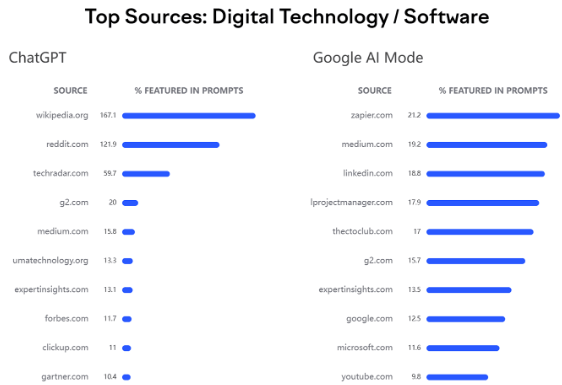
It’s also worth paying attention to the variety of cited sources. AI platforms rarely rely on a single website. They often combine information from multiple trusted resources to produce balanced and accurate responses. Building authority across your website and consistently publishing high-quality content increases the likelihood that your pages will become one of those trusted references over time.
Rather than treating Sources and Citations as a list of links, use them as a research tool. Analyze why those sources were selected, understand what makes them valuable, and apply those lessons to create more authoritative, accurate, and user-focused content that deserves to be cited by AI platforms.
💡 SaaSLogicLab Expert Insight
Don’t focus only on whether your website is cited. Study why other sources earned AI’s trust. Learning what makes those pages authoritative can help you create stronger content that is more likely to be referenced in future AI-generated answers.
Competitor Mentions
The Competitor Mentions section reveals which competing brands appear in AI-generated responses for the selected prompt and how frequently they are recommended. Instead of evaluating your brand in isolation, this feature helps you understand who you are competing against in AI-powered search and why those competitors may be receiving greater visibility.
This insight is valuable because AI search often recommends only a limited number of brands within a single response. If competing businesses are consistently mentioned while your brand is missing, it may indicate stronger topical authority, more comprehensive content, greater brand recognition, or higher trust signals across the web.
Analyzing Competitor Mentions allows you to identify patterns in your competitors’ content strategy. You may notice that they publish more detailed guides, cover a broader range of related topics, maintain fresher information, or build stronger authority within a particular niche. These observations can help you improve your own content without simply copying what others have published.
The goal is not to outperform every competitor for every prompt. Instead, focus on the competitors that target the same audience, solve similar problems, and compete for the same buying intent. Comparing your performance with relevant businesses provides much more meaningful insights than measuring yourself against large brands that serve a completely different market.
Rather than viewing Competitor Mentions as a ranking report, use it as a competitive research tool. Understanding why AI platforms recommend certain brands more frequently can help you refine your content strategy, strengthen your topical authority, and improve your chances of earning more AI-generated recommendations over time.
💡 SaaSLogicLab Expert Insight
Don’t ask, “Why is my competitor mentioned?” Ask, “What has my competitor done that AI considers more valuable?” The answer often reveals your biggest opportunity to improve content quality, authority, and long-term AI visibility.
Brand Presence
The Brand Presence section shows how your own brand appears within the AI-generated response for a specific prompt. Instead of simply indicating whether your business was mentioned, it helps you understand the quality, context, and prominence of that mention.
For example, AI may recommend your brand as the primary solution, include it among several alternatives, briefly reference it as a supporting example, or not mention it at all. Understanding this context is important because not every mention has the same impact. A brand that is recommended confidently with supporting information is likely to have much greater influence than one that receives only a passing reference.
Brand Presence also helps you evaluate whether AI systems correctly understand your products, services, and areas of expertise. If your brand is associated with the right topics and appears in relevant responses, it suggests that your content and online authority are aligned with your business goals. However, if your brand appears for unrelated topics—or is missing from the topics that matter most—it may indicate that your content strategy needs further refinement.
Reviewing Brand Presence over time allows you to measure the effectiveness of your optimization efforts. As you publish more authoritative content, improve technical SEO, strengthen topical authority, and earn trusted citations across the web, you should expect your brand to appear more consistently and more prominently in AI-generated responses.
Rather than focusing only on increasing the number of mentions, aim to improve the quality of your Brand Presence. Being recognized as a trusted recommendation for high-intent prompts is often far more valuable than appearing frequently in responses that have little relevance to your target audience.
💡 SaaSLogicLab Expert Insight
Don’t measure success by asking, “Was my brand mentioned?” Instead ask, “Was my brand presented as a trusted solution for the right audience?” Strong Brand Presence is built through relevance, authority, and consistently helpful content—not simply by increasing the number of mentions.
Optimization Opportunities
The Optimization Opportunities section helps you identify the practical improvements that can increase your brand’s visibility for a specific AI search prompt. Rather than simply reporting your current performance, this section highlights where your content, authority, or overall AI presence can be strengthened.
One of the biggest advantages of this feature is that it turns AI search data into actionable recommendations. For example, if your competitors are consistently mentioned while your brand is missing, the opportunity may be to create more comprehensive content, improve topical coverage, strengthen internal linking, or update outdated information. These insights help you focus on the changes that are most likely to improve your AI visibility.
Optimization Opportunities also encourage you to prioritize your work. Not every prompt requires immediate attention, and not every improvement will have the same impact. By identifying the prompts with the largest visibility gaps and the highest business value, you can allocate your time and resources more effectively instead of trying to optimize everything at once.
Another benefit of this section is that it supports continuous improvement. AI search is constantly evolving as new content is published and user behavior changes. Reviewing optimization opportunities regularly allows you to refine your strategy, respond to emerging trends, and maintain a competitive position over the long term.
Rather than treating optimization as a one-time task, view it as an ongoing process. Consistently improving your content, expanding your topical authority, and strengthening your website’s overall quality will gradually increase your chances of earning more AI-generated recommendations.
💡 SaaSLogicLab Expert Insight
Don’t try to fix every issue at once. Start with the opportunities that align with your most valuable products, services, and target audience. Small, consistent improvements on high-impact topics usually produce better long-term results than making dozens of low-value changes.
Recommendations
The Recommendations section provides practical guidance to help improve your AI visibility based on the data collected across your prompts, brand mentions, competitors, and cited sources. Instead of leaving you to interpret dozens of metrics on your own, it highlights the actions that are most likely to strengthen your presence in AI-powered search.
These recommendations may focus on several areas of your SEO and content strategy. For example, the toolkit may suggest creating content for topics where your competitors consistently receive mentions, updating outdated pages that have lost visibility, expanding coverage of important subtopics, improving internal linking between related articles, or increasing your website’s overall topical authority.
Not every recommendation carries the same level of importance. Some improvements may have a significant impact on high-value prompts that generate qualified traffic and potential customers, while others may provide only small incremental gains. Prioritizing recommendations based on business value, search demand, and content gaps allows you to make better use of your time and resources.
It’s also important to remember that recommendations should guide your strategy rather than replace your judgment. Every website has different goals, audiences, and competitive challenges. Before implementing any suggestion, consider whether it aligns with your business objectives and supports the needs of your target audience.
Reviewing Recommendations on a regular basis helps you build a continuous optimization process instead of reacting only when visibility drops. As AI search evolves and new competitors enter your market, these insights can help you keep your content accurate, relevant, and competitive over the long term.
💡 SaaSLogicLab Expert Insight
Treat Recommendations as a strategic roadmap, not a checklist. The biggest improvements usually come from consistently publishing better content, strengthening topical authority, and solving real user problems—not from chasing every individual suggestion.
Exporting Prompt Data
The Export Prompt Data feature allows you to download your Prompt Research data for deeper analysis, reporting, and collaboration. While the dashboard is excellent for day-to-day monitoring, exporting your data gives you far greater flexibility to organize, compare, and analyze AI visibility outside the Semrush interface.
For example, you can export prompt lists, AI visibility metrics, brand mentions, competitor data, and other research insights into spreadsheets for further evaluation. This is especially useful for SEO teams, content marketers, agencies, and enterprise organizations that need to track performance across multiple brands, campaigns, or reporting periods.
Exported data also makes it easier to identify long-term trends. Instead of looking at individual prompts one by one, you can sort, filter, and group your data to discover recurring opportunities, high-performing topics, declining visibility, or areas where competitors are consistently outperforming your brand.
Another advantage is collaboration. Exported reports can be shared with content writers, SEO specialists, clients, or management teams without requiring everyone to access the Semrush dashboard. This creates a more efficient workflow where each team member can work with the same data while focusing on their specific responsibilities.
Although exporting data is valuable, the real benefit comes from acting on the insights rather than simply collecting reports. Regularly reviewing exported information, comparing historical performance, and implementing improvements based on those findings can significantly strengthen your long-term AI search strategy.
💡 SaaSLogicLab Expert Insight
Exporting reports doesn’t improve AI visibility—using the data does. Treat every export as an opportunity to uncover patterns, prioritize high-impact improvements, and make smarter content decisions that increase your brand’s visibility across AI-powered search platforms.
Best Practices for Using Prompt Research Effectively
Simply collecting AI search data isn’t enough to improve your brand’s visibility. The real value of Prompt Research comes from how consistently you use the insights to guide your content strategy and SEO decisions. Following a structured workflow helps you turn raw data into measurable growth over time.
Start by identifying the prompts that matter most to your business. Focus on questions your potential customers are actually asking during the awareness, consideration, and buying stages of their journey. Improving visibility for high-intent prompts will usually generate far greater business value than chasing every keyword available.
Next, review which competitors are being mentioned most often and analyze the content that earns those recommendations. Look beyond word count or page length. Pay attention to how they explain topics, organize information, answer follow-up questions, and demonstrate expertise. These observations can help you create stronger, more comprehensive content without copying their work.
It’s equally important to monitor your own performance regularly. AI search results change as new content is published and search models evolve. Reviewing Prompt Research every few weeks allows you to spot declining visibility early, identify emerging opportunities, and update existing content before competitors gain an advantage.
You should also combine Prompt Research with your broader SEO workflow. Compare AI visibility with organic rankings, keyword research, technical SEO, backlink growth, and user engagement metrics. Looking at these signals together provides a much more complete picture of your website’s overall performance.
Finally, treat Prompt Research as an ongoing optimization process rather than a one-time audit. The websites that achieve long-term success in AI search are those that consistently improve content quality, expand topical authority, and publish genuinely helpful information that deserves to be recommended.
💡 SaaSLogicLab Expert Insight
The most successful brands don’t optimize for AI once—they build a repeatable process. Review prompt data regularly, improve your highest-value content, measure the results, and repeat the cycle. Consistency is what turns occasional AI mentions into long-term AI visibility.
Common Mistakes to Avoid in Prompt Research
Many businesses start using Prompt Research with the expectation that simply tracking AI mentions will improve their visibility. In reality, the tool provides insights—not automatic results. Avoiding common mistakes will help you get much more value from the data and build a stronger AI search strategy.
One of the biggest mistakes is focusing only on the number of brand mentions. While mentions are important, they don’t tell the whole story. A single recommendation for a high-intent buying prompt can be far more valuable than dozens of mentions for informational queries that rarely lead to conversions.
Another common mistake is ignoring competitor analysis. Some users look only at their own performance without studying why competing brands appear more frequently in AI-generated responses. Understanding what competitors are doing well often reveals the fastest opportunities for improving your own content strategy.
Many websites also make the mistake of creating new content for every prompt instead of improving existing pages. In many cases, updating a well-performing article with better explanations, stronger examples, fresher information, and improved internal links is far more effective than publishing dozens of new pages targeting similar topics.
It’s equally important not to rely solely on AI visibility metrics. Prompt Research should be used alongside traditional SEO data such as keyword rankings, organic traffic, backlinks, technical SEO health, and user engagement. Combining these insights provides a much more accurate picture of your website’s overall performance.
Finally, don’t expect instant results. AI search platforms continuously update their understanding of websites as new content is published and authority signals evolve. Building consistent AI visibility requires patience, continuous optimization, and a long-term commitment to publishing genuinely helpful content.
💡 SaaSLogicLab Expert Insight
The biggest mistake isn’t having low AI visibility—it’s making decisions without understanding why your visibility is low. Use Prompt Research to identify the real causes, prioritize meaningful improvements, and focus on long-term authority rather than short-term wins.
How Prompt Research Fits Into Your Overall AI Visibility Strategy
Prompt Research is one of the most valuable components of the Semrush AI Visibility Toolkit, but it delivers the best results when used alongside the platform’s other AI visibility features. Looking at prompts in isolation provides useful insights, but combining Prompt Research with your overall AI Visibility dashboard creates a much clearer picture of your brand’s performance across AI-powered search.
A practical workflow starts by reviewing your overall AI Visibility Score to understand whether your brand’s presence is improving or declining. From there, Prompt Research helps you identify the specific questions responsible for those changes. Instead of guessing why visibility increased or dropped, you can pinpoint the exact prompts where your performance has changed.
Once you’ve identified important prompts, compare your brand with competing businesses. Analyze which competitors are earning recommendations, which websites AI cites as trusted sources, and which topics consistently generate visibility. This information allows you to prioritize improvements that are based on real market data rather than assumptions.
The next step is turning those insights into action. Update existing articles, publish new supporting content, strengthen internal linking, improve topical coverage, and ensure your content answers user questions clearly and comprehensively. After making these improvements, monitor the same prompts over time to measure whether your visibility increases.
This continuous cycle—research, optimize, monitor, and improve—is what transforms Prompt Research from a reporting feature into a long-term growth strategy. Instead of reacting to changes after they happen, you build a proactive process that helps your brand remain competitive as AI search continues to evolve.
💡 SaaSLogicLab Expert Insight
The businesses that succeed in AI search don’t rely on a single report or a one-time optimization. They build a repeatable workflow where Prompt Research guides every major content decision, allowing them to strengthen authority, improve visibility, and stay ahead of competitors over the long term.
Conclusion: Mastering Prompt Research for Better AI Visibility
Prompt Research is much more than a list of AI search prompts. It provides a direct view into how people ask questions on AI platforms, which brands are recommended, which websites are cited, and where your biggest opportunities for growth exist.
By understanding prompt intent, analyzing AI-generated responses, studying trusted sources, monitoring competitors, and tracking your own brand’s visibility, you can make content decisions based on real AI search behavior instead of guesswork. This allows you to build content that not only ranks in traditional search engines but also earns recommendations from AI-powered platforms like ChatGPT, Google AI Overviews, Gemini, Perplexity, and others.
The key to success is consistency. AI visibility is not achieved through a single article or one optimization campaign. It comes from regularly analyzing prompt data, improving existing content, expanding topical authority, strengthening your website’s trust signals, and continuously measuring the impact of your efforts.
For content creators, SEO professionals, SaaS companies, and digital marketers, Prompt Research can become one of the most valuable research tools in the entire Semrush AI Visibility Toolkit. It bridges the gap between traditional SEO and the future of AI-powered search, helping you understand not just what users search for, but what AI chooses to recommend.
As AI search continues to evolve, businesses that consistently use Prompt Research to guide their content strategy will be in a much stronger position to earn visibility, build authority, and attract qualified visitors from the next generation of search experiences.
💡 SaaSLogicLab Expert Insight
Traditional SEO answers the question, “What are people searching for?” Prompt Research answers an even more important question: “What does AI recommend when people search?” Businesses that understand both will have a significant competitive advantage in the years ahead.
To validate your AI visibility strategy, combine Semrush Prompt Research insights with Google Search Console Performance reports. Compare the prompts and topics identified in Semrush with the queries already generating impressions and clicks in Google Search Console. This helps you prioritize content updates based on real search demand instead of assumptions. Google Search Console provides direct visibility into the queries, clicks, impressions, and average positions that matter most for continuous SEO improvement
How to Use Prompt Research to Improve AI Visibility
Prompt Research becomes significantly more valuable when you use it as an ongoing optimization strategy instead of a one-time report. Start by identifying prompts where competitors are consistently mentioned but your brand is missing. Analyze the search intent behind those prompts, update your existing content with more comprehensive answers, and create new articles around emerging topics with increasing prompt volume. Group similar prompts into topical clusters, strengthen internal linking between related pages, and monitor how your visibility changes over time. By reviewing Prompt Research data regularly, businesses can uncover content gaps, improve topical authority, and increase the likelihood of being cited in AI-generated search results across platforms like ChatGPT, Google AI Overviews, Perplexity, and Microsoft Copilot.
What’s Next After Prompt Research?
Now that you’ve completed the Prompt Research section, the next major feature in the Semrush AI Visibility Toolkit is typically Pages (sometimes labeled as Pages Report or Page-Level AI Visibility, depending on your account version).
This section shifts the focus from prompts to your website pages.
Instead of asking:
- Which prompts mention my brand?
It answers questions like:
- Which pages receive the most AI citations?
- Which URLs are driving my AI Visibility?
- Which pages are losing visibility?
- Which content should I update first?
- Which pages deserve more internal links or content improvements?
The Pages report helps connect AI visibility directly to your content strategy by showing exactly which articles and landing pages contribute the most to your AI presence.
Once you start this section, we’ll cover it in the same deep format we’ve used throughout the article:
- What Is the Pages Report?
- How the Pages Dashboard Works
- Understanding Every Metric
- Top AI Performing Pages
- AI Visibility by Page
- AI Citations
- Prompt Coverage
- Traffic & Business Impact
- Content Optimization Opportunities
- Best Practices
- Common Mistakes
- Expert Tips
- Conclusion
We’ll continue with the same detailed, human-written style so the entire article remains consistent and publish-ready.
Pages Report
After understanding which AI prompts mention your brand, the next step is discovering which pages on your website are actually earning those AI citations. This is exactly what the Pages Report in the Semrush AI Visibility Toolkit is designed to show.
While Prompt Research focuses on questions, the Pages Report focuses on content performance. It helps you identify which URLs contribute the most to your AI Visibility, which pages are frequently referenced by AI platforms, and which important pages are missing from AI-generated responses altogether.
This page-level view is extremely valuable because AI platforms don’t recommend websites as a whole—they recommend individual pages that best answer a user’s question. A single well-optimized guide can become the primary source for dozens of AI prompts, while another page on the same website may receive no visibility at all.
The Pages Report removes the guesswork by connecting AI mentions directly to your content. Instead of wondering which articles deserve updates, you can immediately see which pages are already performing well, which ones have growth potential, and where your optimization efforts will have the biggest impact.
For SEO professionals, SaaS businesses, agencies, and content marketers, this report becomes a practical roadmap for improving AI visibility. Rather than publishing more articles at random, you can focus on strengthening the pages that are most likely to earn additional AI citations and recommendations.
💡 SaaSLogicLab Expert Insight
Many websites measure success at the domain level, but AI search works differently. AI recommends specific pages—not entire websites. Understanding which URLs AI trusts is one of the fastest ways to improve your long-term AI Visibility strategy.
Understanding the Pages Report Interface
The Pages Report Interface is designed to give you a page-by-page view of your website’s performance across AI-powered search platforms. Instead of showing how your brand performs for individual prompts, it organizes the data around your website’s URLs, making it much easier to identify your strongest content and your biggest optimization opportunities.
At first glance, the interface usually displays a table containing your indexed pages along with several performance metrics. Each row represents a specific URL, while the accompanying columns provide insights into how that page contributes to your overall AI Visibility.
Depending on your Semrush subscription and the current version of the AI Visibility Toolkit, you may see metrics such as AI Visibility, AI Mentions, Supported Prompts, Citations, Position, Trend, or other page-level indicators. Together, these metrics help you understand which pages AI platforms trust, which content is being recommended most often, and where improvements can produce the greatest results.
The interface also includes filtering and sorting options, allowing you to focus on specific pages based on their performance. For example, you can quickly identify your highest-performing content, pages with declining AI visibility, newly recognized URLs, or pages that deserve immediate optimization. This makes the report valuable for websites with dozens or even thousands of pages.
One of the biggest strengths of the Pages Report Interface is that it transforms complex AI search data into an actionable content roadmap. Instead of making decisions based on assumptions, you can prioritize updates using real performance data and focus your efforts on the pages that are most likely to increase your brand’s AI visibility.
💡 SaaSLogicLab Expert Insight
Before optimizing any page, first understand how it’s currently performing. The Pages Report Interface isn’t just a dashboard—it’s your decision-making center for identifying which content deserves attention, which pages are already succeeding, and where your next optimization effort will deliver the highest return.
AI Visibility
One of the most important metrics in the Pages Report is AI Visibility. It measures how prominently a specific page appears across AI-generated responses for the prompts being tracked. Rather than simply indicating whether a page has been mentioned, this metric reflects the overall strength and consistency of that page’s presence within AI-powered search platforms.
A page with high AI Visibility is generally one that AI systems repeatedly recognize as a reliable source of information. It may be cited for multiple prompts, recommended frequently, or appear in responses across several supported AI platforms. In contrast, a page with low AI Visibility may only receive occasional mentions or fail to appear in AI-generated answers altogether.
Several factors can influence a page’s AI Visibility. Comprehensive content, clear structure, topical relevance, factual accuracy, strong internal linking, and overall website authority all contribute to how AI systems evaluate and reference a page. Although there is no guaranteed formula for increasing visibility, consistently publishing high-quality, trustworthy content significantly improves your chances of being recommended.
Monitoring this metric over time is equally important. An increase in AI Visibility often indicates that your optimization efforts are working and that AI platforms are recognizing your content more frequently. A decline, however, may suggest that competitors have published stronger resources, your content has become outdated, or AI search trends have shifted toward different topics.
Rather than viewing AI Visibility as a score to chase, think of it as a performance indicator. It helps you understand which pages are becoming trusted resources in AI search and where further improvements can strengthen your long-term authority.
💡 SaaSLogicLab Expert Insight
Don’t compare every page against your homepage. Compare each page against its own purpose. A detailed product guide, comparison article, or tutorial can often achieve higher AI Visibility than a general homepage because it answers user questions more directly and comprehensively.
Supported Prompts
The Supported Prompts metric shows how many tracked AI prompts are associated with a specific page. In simple terms, it tells you how many different user questions your page helps answer across AI-powered search platforms.
This is an important metric because a single high-quality page can often satisfy multiple search intents. For example, a comprehensive guide about keyword research might appear for prompts such as “best keyword research tools,” “how to find SEO keywords,” “keyword research for beginners,” and many other related questions. Instead of creating separate articles for every variation, one authoritative page may earn visibility across dozens of prompts.
A higher number of Supported Prompts usually indicates broader topical coverage and stronger relevance. It suggests that AI systems recognize the page as a useful resource for multiple conversations within the same subject area. However, quantity alone should not be your goal. A page that supports twenty highly relevant prompts is often more valuable than one that appears for hundreds of loosely related questions.
Reviewing this metric can also help you identify opportunities to expand existing content. If a page already performs well for several prompts, adding missing subtopics, FAQs, examples, comparison tables, or updated information may help it qualify for even more AI-generated responses. On the other hand, if an important page supports only a few prompts, it may indicate that the content is too narrow or doesn’t fully address user intent.
Supported Prompts are also useful for content planning. By comparing similar pages, you can identify which articles have the greatest potential for expansion and which topics deserve new supporting content. This allows you to build stronger content clusters that improve both traditional SEO performance and AI visibility.
💡 SaaSLogicLab Expert Insight
Don’t judge a page only by its traffic. A page that supports dozens of high-intent AI prompts can become one of your most valuable assets—even if its traditional search traffic is relatively modest. Expanding that page strategically is often more effective than creating multiple new articles on similar topics.
AI Mentions
The AI Mentions metric shows how many times a specific page is referenced or mentioned across AI-generated responses for the prompts being tracked. Unlike AI Visibility, which measures the overall strength and prominence of a page, AI Mentions focuses on the actual frequency with which that page appears in AI answers.
A higher number of AI Mentions generally indicates that AI platforms consistently consider the page to be a trustworthy and relevant source of information. If the same page is repeatedly referenced for different prompts, it suggests that the content effectively answers a wide range of user questions and has established strong topical authority.
However, it’s important to understand that more mentions do not automatically mean greater business value. A page may receive numerous mentions for broad informational queries while another page receives fewer mentions but appears for high-intent prompts that are much more likely to generate leads or conversions. Always evaluate AI Mentions within the context of your overall business goals.
Tracking AI Mentions over time can also reveal how your content strategy is performing. An increase in mentions may indicate that recent content updates, improved topical coverage, or stronger authority signals are helping AI platforms recognize your page more frequently. A decline, on the other hand, could signal that competitors have produced stronger content or that your page needs updating to remain relevant.
This metric is especially useful when comparing similar pages on your website. If two articles target related topics but one consistently earns more AI Mentions, studying the differences in content depth, structure, examples, and overall quality can provide valuable insights for improving the weaker page.
Rather than treating AI Mentions as a standalone metric, combine it with AI Visibility, Supported Prompts, and page-level performance data to understand not only how often your content is referenced, but also how effectively it contributes to your overall AI search strategy.
💡 SaaSLogicLab Expert Insight
A page that earns frequent AI Mentions has already gained AI’s attention. Your next goal shouldn’t be to create another similar article—it should be to strengthen that existing page so it becomes the most trusted and comprehensive resource on the topic.
Trend
The Trend metric shows how a page’s AI visibility changes over time. Instead of providing a single snapshot, it helps you understand whether a page is gaining recognition, maintaining consistent performance, or gradually losing visibility across AI-powered search platforms.
This metric is particularly valuable because AI search is constantly evolving. As new content is published, existing pages are updated, and AI models improve their understanding of information, the pages they recommend can change over time. Monitoring trends helps you identify these changes early and respond before they have a significant impact on your visibility.
A positive trend usually indicates that a page is becoming more authoritative in the eyes of AI platforms. This improvement may result from publishing better content, expanding topical coverage, strengthening internal links, earning high-quality backlinks, or updating outdated information. If a page continues to show upward momentum, it is often worth investing additional effort to maximize its potential.
A negative trend, however, deserves careful attention. Declining AI visibility doesn’t always mean your content is poor. It may indicate that competitors have created more comprehensive resources, user search behavior has shifted, or your page no longer provides the most current or complete information. Identifying these issues early allows you to refresh the content before losing even more visibility.
Stable trends can also be valuable. A page that consistently maintains strong AI visibility over several months demonstrates lasting authority and trust. These pages often become the foundation of a successful AI content strategy and should be reviewed regularly to ensure they remain accurate and competitive.
Rather than reacting only when visibility declines, use the Trend metric as an ongoing performance indicator. Regular monitoring helps you identify opportunities for improvement, measure the impact of your optimization efforts, and maintain long-term growth across AI-powered search platforms.
💡 SaaSLogicLab Expert Insight
Don’t wait for your AI visibility to decline before taking action. Pages with a strong upward trend deserve just as much attention as struggling pages. Strengthening winning content while it is already gaining momentum often produces better long-term results than trying to recover after visibility has already dropped.
Top Performing Pages
The Top Performing Pages section highlights the URLs on your website that generate the strongest AI visibility across the prompts being tracked. Instead of manually reviewing every page, this section quickly identifies the content that AI platforms trust and recommend most frequently.
These pages are valuable because they have already demonstrated their ability to answer user questions effectively. They often receive consistent AI mentions, support multiple prompts, and contribute significantly to your overall AI Visibility Score. Studying these successful pages can help you understand what is working well across your website.
Several factors may contribute to a page becoming a top performer. It might provide comprehensive coverage of a topic, answer common user questions clearly, include well-organized headings, maintain up-to-date information, or demonstrate strong topical authority through supporting content. In many cases, these pages also benefit from good technical SEO, logical internal linking, and a positive user experience.
Identifying your top-performing pages also helps you make smarter optimization decisions. Instead of spreading your resources evenly across your entire website, you can invest more effort into strengthening pages that already have proven potential. Updating these pages with fresh examples, new research, additional FAQs, improved visuals, and expanded topic coverage can often increase their AI visibility even further.
At the same time, don’t simply admire your best-performing content—learn from it. Compare these pages with lower-performing ones to identify patterns in writing style, content depth, structure, and topical coverage. Applying those lessons across your website can help raise the overall quality of your content and improve AI visibility on a broader scale.
Rather than treating Top Performing Pages as a leaderboard, use it as a blueprint for future content creation. Understanding why these pages succeed enables you to replicate that success across new articles, landing pages, and resource guides.
💡 SaaSLogicLab Expert Insight
Your best-performing page isn’t the finish line—it’s your benchmark. Analyze what makes it successful, strengthen it even further, and use the same principles to improve the rest of your content. The fastest way to grow AI visibility is often by building on what’s already working.
Content Optimization Opportunities
The Content Optimization Opportunities section helps you identify which pages have the greatest potential to improve their AI visibility. Instead of focusing only on your highest-performing content, this section highlights pages that could earn significantly more AI mentions with targeted improvements.
Many websites already have valuable content that simply isn’t optimized well enough to be consistently recommended by AI platforms. A page may cover an important topic but lack depth, miss key subtopics, contain outdated information, or fail to answer common user questions clearly. Identifying these weaknesses allows you to improve existing content instead of always creating new articles.
One of the biggest advantages of this report is prioritization. Rather than updating every page on your website, you can focus on URLs that are already close to earning stronger AI visibility. Small improvements to these pages often produce better results than investing the same amount of effort into completely new content.
When reviewing optimization opportunities, consider areas such as expanding topic coverage, improving factual accuracy, adding real-world examples, updating statistics, strengthening internal links, improving page structure, and answering additional related questions. These enhancements make your content more useful for readers while also increasing the likelihood that AI systems will recognize it as a reliable source.
It’s equally important to compare your pages with the competitors that AI platforms already recommend. Understanding how their content differs from yours can reveal missing information, better organization, or stronger expertise that you can incorporate into your own pages without copying their work.
Content optimization should also be viewed as an ongoing process rather than a one-time task. As AI search evolves and new competitors publish content, regularly refreshing your most valuable pages helps maintain authority and keeps your website competitive over the long term.
💡 SaaSLogicLab Expert Insight
Don’t assume every low-performing page needs to be replaced. In many cases, your next AI citation is already hiding inside an existing article that simply needs better structure, deeper coverage, and more helpful information. Improving proven content is often the highest-return SEO investment you can make.
Best Practices for Optimizing High-Value Pages
The Pages Report doesn’t just show you which pages are performing well—it also helps you decide where to invest your optimization efforts. Focusing on high-value pages first is one of the most effective ways to improve AI visibility because these pages already have a foundation of authority that can be strengthened further.
Begin by identifying pages that already receive AI mentions or support multiple prompts. These pages have proven that AI platforms recognize them as relevant sources. Instead of replacing them or creating duplicate content, expand and improve what already exists. Updating successful pages is usually faster and more effective than starting from scratch.
When optimizing a page, think beyond adding more words. Improve the quality of the information by answering additional user questions, including practical examples, updating statistics, clarifying complex concepts, and covering related subtopics that users naturally expect to find. AI platforms tend to favor content that provides complete and reliable answers rather than brief summaries.
Internal linking is another important factor. Connect your high-value pages with related articles, comparison guides, tutorials, and supporting resources across your website. Strong internal linking helps establish topical relationships, improves navigation for users, and reinforces your site’s overall authority on a subject.
Don’t forget to keep your content fresh. Technology, software, pricing, features, and best practices change frequently. Regularly reviewing and updating your most valuable pages ensures that both users and AI platforms continue to view them as accurate and trustworthy resources.
Finally, monitor the results after every significant update. Compare changes in AI Visibility, Supported Prompts, AI Mentions, and overall page performance to understand which improvements have the greatest impact. This continuous feedback loop helps you build a smarter and more effective optimization strategy over time.
💡 SaaSLogicLab Expert Insight
Don’t spread your efforts evenly across every page on your website. Focus first on the pages that are already close to becoming authority resources. Improving a strong page by 20% often produces a greater impact than creating five completely new articles with no existing authority.
Common Mistakes When Analyzing Page-Level AI Visibility
The Pages Report provides powerful insights, but its value depends on how you interpret and act on the data. Many businesses misread page-level metrics and make optimization decisions that waste time without improving their AI visibility. Understanding these common mistakes can help you build a much more effective content strategy.
One of the most common mistakes is focusing only on pages with the highest AI Visibility. While these pages are important, they aren’t always the best opportunities for growth. Pages with moderate visibility often have much greater potential because small improvements can significantly increase their AI mentions and supported prompts.
Another mistake is treating every page equally. Not every URL deserves the same level of investment. Product pages, comparison articles, buying guides, and comprehensive tutorials often have far greater business value than low-priority informational posts. Prioritize optimization based on both AI visibility and business impact.
Many website owners also create duplicate content instead of strengthening existing pages. If one article already supports several AI prompts, publishing another page targeting nearly identical topics can split authority and confuse both search engines and AI platforms. Expanding and improving your strongest content is usually a better long-term strategy.
Ignoring search intent is another frequent error. Some pages are written for beginners, while others target experienced professionals or potential buyers. If your content doesn’t match the intent behind the prompts where you want AI visibility, even technically well-written pages may struggle to earn recommendations.
Finally, avoid relying solely on page-level AI metrics. The Pages Report should be analyzed alongside Prompt Research, technical SEO, organic search performance, backlink data, and user engagement. Looking at all these signals together provides a much clearer understanding of why a page succeeds—or why it doesn’t.
💡 SaaSLogicLab Expert Insight
Don’t optimize pages simply because they have low AI Visibility. Optimize pages that have the greatest potential to influence your business goals. The smartest SEO strategy isn’t improving everything—it’s improving the pages that matter most to your audience and your business.
How the Pages Report Supports Your Overall AI Visibility Strategy
The Pages Report is most powerful when it is used as part of your overall AI visibility workflow rather than as a standalone report. While Prompt Research tells you which questions AI platforms are answering, the Pages Report tells you which pages on your website are responsible for earning those AI recommendations. Together, these two reports provide a complete picture of your performance across AI-powered search.
A practical workflow begins by identifying your most valuable pages through the Pages Report. Look for URLs with strong AI Visibility, multiple Supported Prompts, and consistent AI Mentions. These pages have already proven their value, making them excellent candidates for further optimization and expansion.
Next, connect those pages with the insights from Prompt Research. Review the prompts that lead AI platforms to recommend each page and determine whether your content fully satisfies the intent behind those questions. If important topics, examples, or FAQs are missing, updating the page can help strengthen its authority and improve its chances of appearing for even more prompts.
The Pages Report also helps you make better decisions about your content calendar. Instead of publishing articles based solely on keyword ideas, you can prioritize topics that support your highest-performing pages. Building related content clusters, adding internal links, and covering complementary subtopics reinforces your expertise and increases the overall authority of your website.
Regular monitoring is equally important. AI search results evolve continuously as new competitors publish content and AI models update their understanding of different topics. Reviewing your Pages Report on a consistent basis allows you to identify new opportunities, measure the impact of your optimizations, and respond quickly to changes before they affect your visibility.
When Prompt Research and the Pages Report are used together, they create a continuous improvement cycle: identify valuable prompts, optimize the pages that answer those prompts, monitor the results, and repeat the process. This systematic approach is far more effective than relying on one-time content updates or isolated SEO improvements.
💡 SaaSLogicLab Expert Insight
The most successful AI SEO strategies don’t separate prompts from pages—they connect them. Every important prompt should lead to a high-quality page, and every high-value page should be optimized to answer the prompts that matter most to your audience. That’s how long-term AI visibility is built.
Conclusion: Turning Your Best Pages Into AI Visibility Assets
The Pages Report transforms AI visibility data into a practical content optimization workflow. Instead of guessing which articles deserve your attention, it helps you identify the pages that AI platforms already trust, the URLs with the highest growth potential, and the content that can generate the greatest impact with further improvements.
Throughout this report, you’ve learned how to analyze page-level AI Visibility, Supported Prompts, AI Mentions, performance trends, and optimization opportunities. Together, these metrics provide a much clearer understanding of why certain pages earn AI recommendations while others struggle to gain visibility.
One of the biggest strengths of the Pages Report is that it helps you prioritize your efforts. Rather than updating every page on your website, you can focus on the content that already demonstrates strong AI potential. This approach saves time, improves efficiency, and allows you to build authority around the pages that matter most to your business.
The report also works best when it is reviewed regularly. As AI search platforms evolve, new competitors emerge, and user behavior changes, your page performance can shift over time. Monitoring these changes allows you to identify new opportunities early and keep your content competitive.
When combined with Prompt Research, the Pages Report becomes a powerful decision-making tool. Prompt Research tells you what AI users are asking, while the Pages Report shows which pages successfully answer those questions. Together, they provide a complete framework for improving your brand’s visibility across AI-powered search platforms.
💡 SaaSLogicLab Expert Insight
AI platforms don’t recommend entire websites—they recommend the individual pages that provide the most accurate, complete, and trustworthy answers. The Pages Report helps you discover those winning pages so you can strengthen them, expand their reach, and build long-term AI visibility.
Position Tracking
What Is Position Tracking?
As AI-powered search becomes more common, simply knowing whether your brand appears in AI-generated answers is no longer enough. You also need to understand where your brand appears, how often it appears, and whether that visibility is improving or declining over time.
This is exactly what the Position Tracking feature in the Semrush AI Visibility Toolkit is designed to do.
Unlike traditional rank tracking, which monitors your website’s position in Google search results, AI Position Tracking focuses on your visibility inside AI-generated responses across supported AI platforms. Instead of asking, “Does my page rank #3 on Google?”, it helps answer questions like:
- Is my brand appearing in AI-generated answers?
- Has my AI visibility increased or decreased?
- Which prompts have gained or lost visibility?
- Which competitors are improving faster than me?
This makes Position Tracking one of the most valuable reports for monitoring long-term AI search performance. Rather than relying on one-time snapshots, it allows you to measure progress over days, weeks, and months as your content strategy evolves.
Position Tracking Interface Walkthrough
When you open the Position Tracking report, Semrush provides a dashboard that combines AI visibility metrics, prompt performance, historical trends, and competitor insights into a single workspace.
Instead of reviewing every prompt manually, the dashboard summarizes the most important changes since the last update. You can quickly identify whether your visibility is improving, which prompts gained or lost positions, and whether competitors are outperforming your brand.
During our testing, this became one of the reports we checked most frequently after publishing new content because it immediately highlighted whether recent optimization efforts had any measurable impact.
What You’ll Typically See
| Dashboard Section | Purpose |
| AI Visibility | Overall AI visibility score for the tracked project |
| Mentions | Total AI-generated brand mentions |
| Average Position | Average position across monitored prompts |
| Visibility Trend | Historical visibility performance |
| Prompt Changes | Prompts that gained or lost positions |
| Competitor Alerts | Visibility changes from competing brands |
| Summary Panel | Key insights since the previous update |
Semrush AI Position Tracking dashboard showing AI Visibility, Mentions, Average Position, and recent prompt performance trends.
(Insert: semrush-ai-visibility-position-tracking-2026.webp)
Understanding the Position Tracking Dashboard
One of the biggest advantages of Position Tracking is that it focuses on change, not just current performance.
Instead of simply showing today’s AI Visibility score, the report explains what changed since the previous update. If a prompt is improved, Semrush highlights the gain. If visibility declines, it identifies the affected prompt and provides context to help you investigate the cause.
This makes it much easier to connect your SEO activities with measurable AI visibility improvements.
For example, after publishing a new article or updating existing content, you can return to Position Tracking and compare the latest report with previous data. Over time, these comparisons help determine whether your optimization efforts are actually increasing your brand’s presence in AI-powered search.
During our testing, we found this historical view significantly more useful than looking at a single report because it revealed trends that would otherwise be easy to miss.
AI Visibility
Although AI Visibility appears throughout the Semrush AI Visibility Toolkit, its purpose inside the Position Tracking report is slightly different. Here, the metric is designed to help you monitor how your overall AI search presence changes over time rather than simply showing whether your brand appears in AI-generated responses.
Instead of acting as a one-time measurement, AI Visibility becomes a long-term performance indicator. Every time Semrush updates your project, you can compare the latest score with previous reports to understand whether your content strategy is moving in the right direction. A gradual increase usually indicates that your website is earning more trust across AI-powered search platforms, while a decline may suggest that competitors have strengthened their content or that your own pages require further optimization.
One of the biggest advantages of monitoring AI Visibility over time is that it allows you to measure the impact of your SEO decisions. For example, if you publish a new guide, expand an existing article, improve your internal linking structure, or refresh outdated content, Position Tracking helps you determine whether those improvements actually increase your visibility within AI-generated answers. Rather than relying on assumptions, you can evaluate your progress using measurable data.
It’s also important to avoid reacting to small day-to-day fluctuations. AI-powered search platforms constantly evolve, and visibility may change as models are updated, new sources are discovered, or user search behavior shifts. Looking at longer trends instead of individual updates provides a much clearer picture of your overall performance and prevents unnecessary optimization based on temporary changes.
Rather than treating AI Visibility as a score to chase, use it as a strategic indicator of your website’s authority in AI search. The goal isn’t to achieve a perfect number—it is to build consistent, long-term growth by publishing helpful, trustworthy content that AI platforms repeatedly choose to recommend.
💡 SaaSLogicLab Expert Insight
Don’t judge your AI strategy by a single visibility update. The real value of Position Tracking comes from identifying long-term patterns. Businesses that monitor steady month-over-month growth make far better optimization decisions than those who react to every small fluctuation.
Mentions
While AI Visibility measures your overall presence across AI-powered search, the Mentions metric focuses on how frequently your brand appears within AI-generated responses during each tracking period. In Position Tracking, this metric helps you determine whether AI platforms are recommending your website more often as your content strategy evolves.
A growing number of mentions usually indicates that your brand is being recognized across a wider range of prompts. This can happen after publishing new content, improving topical authority, strengthening internal links, or updating existing pages with more complete and accurate information. Over time, a steady increase in mentions suggests that AI platforms are becoming more confident in using your content as a reliable source.
However, the Mentions metric should never be analyzed in isolation. A higher number of mentions is valuable only when those mentions come from prompts that are relevant to your business goals. For example, appearing repeatedly for informational searches may improve overall visibility, but being mentioned for high-intent prompts such as product comparisons, buying decisions, or software recommendations often delivers much greater business value.
Position Tracking also allows you to compare mentions across different reporting periods. Instead of asking whether your brand was mentioned today, you can identify whether your total mentions are increasing, remaining stable, or gradually declining over weeks and months. This historical perspective makes it much easier to evaluate whether your optimization efforts are producing meaningful results.
If your mentions begin to decrease consistently, treat it as an early warning rather than an immediate problem. Competitors may have published stronger resources, user interests may have shifted, or AI platforms may now favor more up-to-date content. Investigating these changes early allows you to refresh your content before visibility declines further.
Rather than aiming for the highest possible number of mentions, focus on earning consistent mentions for the prompts that matter most to your audience. Sustainable growth across valuable topics is far more beneficial than occasional spikes that don’t contribute to your overall business objectives.
💡 SaaSLogicLab Expert Insight
Don’t celebrate every increase in AI Mentions. Ask a more important question: Are these mentions coming from the prompts that attract your ideal customers? Quality and relevance always matter more than raw numbers.
Average Position
The Average Position metric helps you understand where your brand typically appears within AI-generated responses across the prompts being tracked. Instead of measuring how often your brand is mentioned, it focuses on the relative prominence of those mentions over time.
A stronger average position generally indicates that AI platforms are presenting your brand earlier or more prominently in their responses. Since users tend to pay more attention to the first recommendations they see, maintaining a better average position can significantly improve your brand’s visibility and influence within AI-powered search experiences.
One of the biggest advantages of tracking Average Position is that it helps you evaluate the effectiveness of your optimization efforts over time. If your average position improves after updating existing content, expanding topical coverage, or publishing new supporting resources, it is a strong indication that AI platforms are recognizing those improvements. On the other hand, a declining average position may suggest that competing content has become more comprehensive, more relevant, or better aligned with user intent.
It’s important to remember that Average Position represents an overall trend rather than the performance of a single prompt. Some prompts may improve dramatically while others remain stable or decline slightly. Looking only at the overall average without reviewing individual prompt movements can sometimes hide valuable optimization opportunities. For this reason, Average Position should always be interpreted alongside Prompt Changes and Visibility Trend rather than as a standalone metric.
Instead of chasing small position improvements every day, focus on sustained progress over longer reporting periods. Consistent improvement usually reflects stronger topical authority, better content quality, and a strategy that aligns more closely with the way AI platforms evaluate trustworthy information.
Rather than asking, “Did my position improve today?”, ask “Is my average position becoming stronger month after month?” That long-term perspective provides a much more accurate measure of whether your AI visibility strategy is truly moving in the right direction.
💡 SaaSLogicLab Expert Insight
A higher Average Position isn’t just about being seen more often—it’s about becoming one of the first sources AI platforms trust when generating answers. Long-term consistency matters far more than short-term fluctuations.
The Visibility Trend metric is one of the most valuable features in the Position Tracking report because it shows how your AI search performance changes over time. Instead of focusing on a single update, it helps you identify whether your overall visibility is improving, remaining stable, or gradually declining across the AI platforms being monitored.
One of the biggest advantages of this metric is that it allows you to see the bigger picture. A single day’s performance rarely tells the full story, especially since AI-generated search results can change as new content is published, AI models are updated, or user behavior evolves. By monitoring long-term trends, you can separate temporary fluctuations from meaningful changes that deserve your attention.
A consistent upward trend is usually a positive sign that your optimization efforts are working. Publishing comprehensive content, refreshing outdated pages, improving topical authority, strengthening internal linking, and covering related topics more thoroughly can all contribute to sustained growth in AI visibility. When this trend continues over several reporting periods, it often indicates that AI platforms are recognizing your website as an increasingly reliable source of information.
On the other hand, a downward trend should be viewed as an opportunity to investigate rather than a reason to panic. Declining visibility may occur because competitors have created stronger resources, user search intent has shifted, important pages have become outdated, or AI platforms have started favoring different sources. Reviewing these changes early allows you to identify the cause and take corrective action before visibility declines further.
It’s equally important to recognize the value of stable performance. If your visibility remains consistent over time, it often reflects a healthy content strategy and a website that continues to meet user expectations. Maintaining steady visibility is often just as valuable as achieving rapid growth, particularly in highly competitive industries where rankings and AI recommendations frequently change.
Rather than checking your Visibility Trend after every small update, review it regularly as part of your ongoing SEO workflow. Looking at weekly or monthly trends provides a much more reliable understanding of your progress and helps you make smarter decisions based on long-term performance instead of short-term fluctuations.
💡 SaaSLogicLab Expert Insight
The most successful SEO teams don’t react to every small change in AI Visibility. They focus on long-term trends, identify meaningful patterns, and make strategic improvements based on consistent data rather than temporary movements. A stable upward trend is almost always more valuable than short-lived spikes.
Prompt Changes
The Prompt Changes section helps you identify exactly which tracked prompts have improved, declined, or remained stable since the previous update. Instead of looking only at your overall AI Visibility score, this report reveals the specific queries responsible for those changes, making it much easier to understand what is actually happening behind the numbers.
This level of detail is especially valuable because an overall increase or decrease in visibility doesn’t always tell the full story. Your total AI Visibility may remain relatively stable while several important prompts improve and others decline. By reviewing Prompt Changes, you can quickly identify where your content is gaining momentum and where additional optimization may be required.
One of the most practical ways to use this report is after publishing new content or updating existing pages. If the prompts related to those topics begin improving in the following reporting periods, it provides strong evidence that your optimization efforts are having a positive impact. Conversely, if important prompts lose visibility after an update, it may indicate that your content no longer aligns with user intent or that competing resources have become more comprehensive.
Prompt Changes can also help uncover new content opportunities. If multiple prompts within the same topic begin declining, it often signals that your content cluster needs expansion or refreshing. Adding missing subtopics, updating outdated information, improving internal linking, or creating supporting articles can help restore and strengthen your visibility across those related prompts.
Rather than focusing only on the prompts that lose visibility, pay equal attention to the ones that improve. Understanding why certain prompts gained positions often provides valuable insights that can be applied to other pages across your website. Repeating successful optimization strategies is usually more effective than constantly experimenting with entirely new approaches.
Instead of treating Prompt Changes as a simple list of gains and losses, use it as a decision-making tool. Every significant movement tells a story about how AI platforms are evaluating your content, and those insights can guide smarter content updates, stronger topical coverage, and more effective long-term SEO planning.
💡 SaaSLogicLab Expert Insight
Don’t ask, “Which prompts dropped?” Ask, “Why did they drop?” The biggest SEO improvements come from understanding the reason behind every significant change, not simply reacting to the numbers. Businesses that learn from both gains and losses consistently build stronger AI visibility over time.
Competitor Alerts
One of the most valuable capabilities of Position Tracking is the Competitor Alerts section. Rather than focusing only on your own AI visibility, it helps you understand how competing brands are performing over time and whether they are gaining or losing visibility across the same prompts you are tracking.
This competitive perspective is important because AI-powered search is constantly evolving. Your visibility may decline even if your content hasn’t changed simply because a competitor has published a more comprehensive guide, updated outdated information, or strengthened their topical authority. Competitor Alerts help you identify these changes early instead of discovering them months later after losing significant visibility.
When reviewing this report, don’t limit your analysis to identifying which competitors are ahead of you. Pay close attention to brands that are improving rapidly. A competitor that was previously less visible but suddenly begins appearing across multiple prompts may have introduced a successful content strategy that deserves closer examination. Studying these changes can reveal new optimization opportunities without copying another website’s content.
Competitor Alerts are also useful for measuring the impact of your own improvements. If your visibility increases while competitors remain stable or decline, it often indicates that your recent optimization efforts are working. On the other hand, if several competitors improve at the same time while your performance remains unchanged, it may suggest that broader trends within your industry are shifting and your content strategy needs to evolve accordingly.
Instead of viewing competitor data as a scoreboard, treat it as a source of strategic intelligence. The objective isn’t simply to outperform every competitor in every reporting period. The real goal is to understand why visibility changes occur, identify successful patterns within your industry, and continuously refine your own content strategy based on reliable performance data.
Regularly reviewing Competitor Alerts also helps you prioritize future work. If the same competitors repeatedly gain visibility for topics that matter to your business, those areas should become a higher priority within your content roadmap. Responding early is usually far more effective than trying to recover after competitors have already established long-term authority.
💡 SaaSLogicLab Expert Insight
Never monitor competitors just to see who’s winning. Monitor them to understand what they’re doing differently. The most valuable competitive insight isn’t discovering that another brand gained visibility—it’s discovering why they gained it and applying those lessons to strengthen your own AI search strategy.
Summary Panel
The Summary Panel serves as the central overview of your Position Tracking report. Instead of requiring you to review every metric individually, it highlights the most important changes since the previous update, allowing you to understand your overall AI search performance within a few moments.
This section typically combines your key metrics—such as AI Visibility, Mentions, Average Position, Prompt Changes, and Competitor Alerts—into a single summary. Rather than presenting raw data alone, it helps you quickly identify whether your visibility has improved, remained stable, or declined, making it easier to decide where your attention should be focused first.
One of the biggest advantages of the Summary Panel is that it simplifies decision-making. Imagine opening your Position Tracking report after updating several important articles. Instead of comparing dozens of individual prompts one by one, the Summary Panel immediately highlights the biggest changes across your project. From there, you can investigate the specific reports responsible for those changes and understand exactly what influenced your latest performance.
The Summary Panel is also useful for identifying emerging trends before they become major issues. A small decline in AI Visibility combined with several negative Prompt Changes and increasing competitor activity may indicate that your content requires attention sooner rather than later. Likewise, consistent improvements across multiple metrics provide confidence that your current SEO strategy is moving in the right direction.
However, the Summary Panel should be viewed as the starting point of your analysis rather than the final answer. While it provides an excellent overview of recent performance, the real insights come from exploring the individual reports that explain why those changes occurred. Using the Summary Panel together with Prompt Changes, Competitor Alerts, and Visibility Trend creates a much more complete understanding of your AI search performance.
Make it a habit to review the Summary Panel every time your Position Tracking data is updated. Spending just a few minutes examining the overall trends before diving into detailed reports helps you prioritize your work more effectively and ensures that important changes are never overlooked.
💡 SaaSLogicLab Expert Insight
Don’t begin your analysis by opening every report individually. Start with the Summary Panel. It gives you the complete picture first, allowing you to focus your time on the metrics that actually changed instead of reviewing data that remained the same.
How to Use Position Tracking in a Real SEO Workflow
Position Tracking delivers the greatest value when it becomes part of your regular SEO workflow rather than a report you check occasionally. Instead of simply reviewing numbers, use the data to measure the impact of your optimization efforts, identify emerging opportunities, and make informed decisions based on real AI search performance.
A practical workflow usually begins after you publish new content or update existing pages. Once Semrush refreshes your project data, open the Position Tracking report and review the Summary Panel to see whether your overall AI Visibility has changed since the previous update. This provides an immediate snapshot of whether your recent work is producing measurable results.
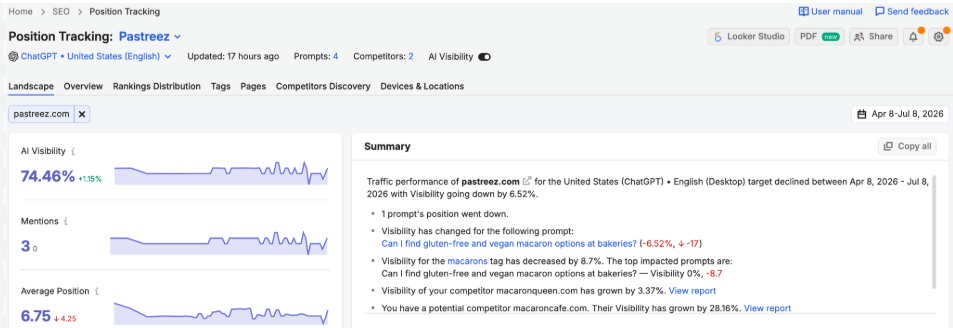
Next, examine the Visibility Trend to understand whether the latest changes are part of a broader pattern or simply a short-term fluctuation. A steady upward trend generally indicates that your content strategy is moving in the right direction, while a consistent decline suggests that further investigation may be necessary.
After reviewing the overall trend, move to Prompt Changes. Identify which prompts gained visibility and which ones declined. If newly updated pages begin performing better for their target prompts, your optimization strategy is likely working as intended. If important prompts lose visibility, review those pages to determine whether additional improvements, updated information, or expanded topic coverage are required.
Competitor Alerts should be your next stop. Compare your recent performance with competing brands to understand whether visibility changes are unique to your website or part of a broader industry shift. If competitors are consistently improving while your metrics remain unchanged, studying their content strategy can help uncover valuable optimization opportunities.
Finally, document your findings before making further changes. Keeping a simple record of major content updates alongside Position Tracking results makes it much easier to identify which SEO activities consistently improve AI visibility. Over time, these records become one of your most valuable resources for refining future content strategies and avoiding unnecessary experimentation.
Rather than treating Position Tracking as a report you review only when something goes wrong, make it a regular part of your optimization process. Consistently measuring results, learning from performance changes, and refining your strategy based on real data is what turns AI visibility into long-term, sustainable growth.
💡 SaaSLogicLab Expert Insight
The best SEO professionals don’t guess whether an update was successful—they verify it. Every significant content improvement should be followed by Position Tracking analysis. Measuring the outcome of your work is just as important as publishing the content itself.
Best Practices for Monitoring AI Visibility
Position Tracking becomes significantly more valuable when it is reviewed consistently and interpreted within the context of your overall SEO strategy. Rather than checking the report only after major ranking changes, develop a routine that allows you to identify opportunities before they become problems.
Start by reviewing your Position Tracking report on a regular schedule instead of checking it randomly throughout the week. Weekly or bi-weekly reviews are usually sufficient for most businesses because they provide enough time for content updates, AI search changes, and optimization efforts to produce measurable results. Looking at longer reporting periods also helps you avoid making decisions based on temporary fluctuations.
Always evaluate multiple metrics together instead of relying on a single number. AI Visibility, Mentions, Average Position, Visibility Trend, Prompt Changes, and Competitor Alerts each tell only part of the story. When analyzed collectively, they provide a much clearer understanding of why your performance is improving or declining and where your optimization efforts should be focused.
Another effective practice is to review Position Tracking after every significant content update. Whether you’ve refreshed an existing guide, expanded a product page, published a new comparison article, or improved your internal linking structure, monitoring the report afterwards allows you to measure the real impact of those changes. This data-driven approach helps you identify which optimization strategies consistently produce the strongest results.
Don’t overlook competitor movements while reviewing your own performance. Competitors often reveal emerging trends before they become obvious within your own reports. If multiple competing brands begin gaining visibility for related prompts, it may indicate that user expectations or AI search behavior are evolving. Responding early gives you a much better chance of maintaining your competitive position.
Finally, maintain a record of your major SEO activities alongside your Position Tracking reports. Documenting when important pages were updated, new content was published, or technical improvements were implemented makes it much easier to connect specific actions with measurable changes in AI visibility. Over time, these records become a valuable resource for refining your long-term SEO strategy and repeating the tactics that consistently deliver positive results.
💡 SaaSLogicLab Expert Insight
The most successful SEO strategies are built on consistency, not guesswork. Businesses that review Position Tracking regularly, learn from historical performance, and base decisions on measurable data consistently outperform those who react only after visibility has already declined.
Common Mistakes When Using Position Tracking
Although Position Tracking provides valuable insights into AI search performance, many users fail to get the full benefit because they misinterpret the data or focus on the wrong metrics. Avoiding these common mistakes will help you make better decisions and build a more effective long-term AI visibility strategy.
One of the most common mistakes is checking the report too frequently and reacting to every small change. AI-powered search results naturally fluctuate as models evolve, new content is published, and user behavior changes. Making major content decisions based on a single day’s performance often leads to unnecessary updates that provide little long-term value. Instead, focus on consistent trends over weeks or months.
Another mistake is evaluating only one metric in isolation. For example, a small decline in AI Visibility may seem concerning, but if your Mentions, Average Position, and Prompt Changes are improving at the same time, your overall strategy may still be moving in the right direction. Looking at multiple metrics together provides a far more accurate understanding of your performance.
Many businesses also ignore the importance of competitor analysis. Position Tracking isn’t just about monitoring your own website—it also helps you understand how competing brands are evolving. If competitors consistently gain visibility while your performance remains unchanged, treating your own reports in isolation can cause you to miss valuable optimization opportunities.
A further mistake is expecting immediate results after publishing new content. Building authority in AI-powered search takes time. New pages often require multiple data updates before meaningful improvements become visible. Patience, combined with continuous optimization, usually produces far better results than making repeated changes after every report update.
Finally, many users review Position Tracking without connecting it to their broader SEO strategy. The report becomes significantly more valuable when it is used alongside Prompt Research, the Pages Report, technical SEO audits, competitor research, and content optimization. AI visibility should be viewed as one part of a complete SEO workflow rather than a standalone performance metric.
💡 SaaSLogicLab Expert Insight
The biggest mistake isn’t seeing a drop in AI Visibility—it’s making decisions without understanding why that drop happened. Position Tracking tells you what changed; your job is to investigate why it changed before taking action. The businesses that consistently ask the right questions make smarter optimization decisions and achieve stronger long-term AI search performance.
Position Tracking is much more than a reporting feature—it’s a decision-making tool that helps you understand whether your SEO strategy is creating lasting results in AI-powered search. Rankings, AI mentions, and visibility will naturally fluctuate over time, but the businesses that consistently monitor performance, analyze trends, and refine their content based on real data are the ones that build sustainable authority.
One of the biggest advantages of Position Tracking is that it removes guesswork from your optimization process. Instead of assuming that a content update was successful, you can measure its real impact, identify what worked, and repeat the strategies that consistently improve AI visibility. This data-driven approach not only saves time but also helps you invest your resources where they produce the greatest long-term return.
Remember that AI search is constantly evolving. New competitors emerge, user behavior changes, and AI platforms continue improving how they evaluate and recommend content. Treat Position Tracking as an ongoing feedback system rather than a report you check occasionally. The more consistently you monitor your progress and learn from the data, the stronger your long-term AI search strategy will become.
Conclusion: Measuring Long-Term AI Search Performance
Position Tracking completes the AI Visibility Toolkit by helping you measure the long-term impact of your SEO and content optimization efforts. While Prompt Research helps you understand what users are asking and the Pages Report identifies which content earns AI recommendations, Position Tracking shows whether your overall visibility is improving as those strategies are implemented.
Throughout this section, we’ve explored how to interpret AI Visibility, Mentions, Average Position, Visibility Trend, Prompt Changes, Competitor Alerts, and the Summary Panel. Together, these reports provide a complete picture of how your brand performs across AI-powered search and where future optimization efforts should be focused.
Perhaps the greatest strength of Position Tracking is that it transforms isolated data points into measurable progress. Instead of relying on assumptions or occasional manual checks, you can monitor historical trends, evaluate the impact of content updates, compare your performance with competitors, and make strategic decisions based on reliable performance data.
As AI-powered search continues to evolve, businesses that regularly measure and refine their visibility will have a significant advantage over those that rely solely on traditional SEO metrics. Position Tracking gives you the ability to adapt to those changes, strengthen your authority, and build a sustainable presence across the next generation of search experiences.
The most successful AI SEO strategies are not built through one-time optimizations—they are built through continuous measurement, thoughtful analysis, and consistent improvement. By making Position Tracking a regular part of your workflow, you can move beyond simply appearing in AI-generated answers and begin building long-term visibility that supports lasting business growth.
AI Visibility Optimization Checklist
Before measuring long-term AI visibility growth, make sure your optimization process covers the fundamentals. Publish content that answers specific user prompts, improve topical authority with related articles, update high-performing pages regularly, monitor competitor mentions, and track changes in your AI Visibility Score over time. Following a consistent optimization checklist helps improve your chances of appearing in AI-generated search results while building sustainable organic visibility.
How to Measure Success with the Semrush AI Visibility Toolkit
Using the Semrush AI Visibility Toolkit effectively isn’t just about tracking numbers—it’s about measuring meaningful business growth. Start by monitoring changes in your AI Visibility Score, Brand Mentions, and Position Tracking reports over time. Then, compare those insights with real performance data from Google Search Console, including impressions, clicks, and average positions for the same topics and pages. Once you’ve identified pages with growing impressions but low click-through rates, optimize them using proven SEO Content Optimization Tools to improve content quality, topical coverage, and search visibility. If your AI visibility is increasing alongside organic search performance, it indicates that your content strategy is successfully improving both traditional SEO and AI-powered search visibility. Regularly reviewing these metrics helps you identify what content deserves further optimization and where new opportunities exist.
Semrush AI Visibility Toolkit Pricing
Understanding the pricing of the Semrush AI Visibility Toolkit is just as important as understanding its features. Before investing in any SEO or AI visibility solution, businesses need to know what the toolkit costs, which subscription plans include it, and whether the available features justify the investment.
Unlike traditional SEO tools that focus primarily on keyword rankings and backlinks, the AI Visibility Toolkit is designed to help businesses monitor how AI-powered platforms reference their brands, content, and competitors. Because of its specialized functionality, access to the toolkit may depend on your Semrush subscription level, available add-ons, or feature availability in your account.
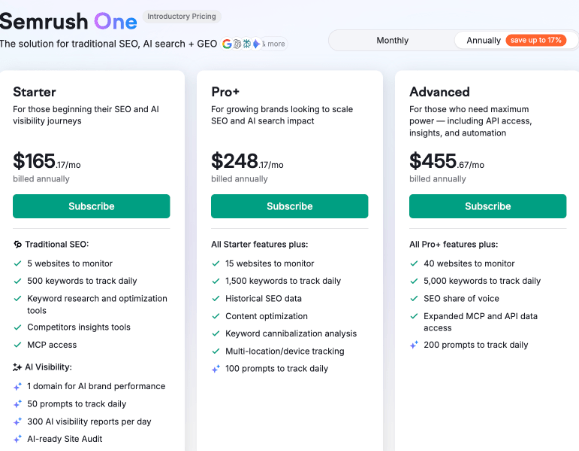
Semrush AI Visibility Toolkit pricing plans comparing the Starter, Pro, and Advanced subscriptions with their included AI Visibility features.
When evaluating pricing, it’s important to look beyond the monthly cost alone. Consider the value the toolkit can provide for your business. If it helps you identify missed AI search opportunities, improve brand mentions, strengthen topical authority, and increase visibility across AI-powered search platforms, the return on investment can be significantly greater than the subscription cost itself.
Pricing should also be evaluated based on your business size and goals. A solo blogger with a small website may have different requirements than a SaaS company managing hundreds of landing pages or a digital marketing agency monitoring multiple client websites. Choosing the right plan ensures that you’re paying for the features you actually need without overspending on capabilities you may never use.
In the following sections, we’ll examine the current pricing structure, compare available plans, explain which features are included, and help you determine whether the Semrush AI Visibility Toolkit offers good value for your specific use case.
💡 SaaSLogicLab Expert Insight
Don’t choose a plan based solely on its price. Choose the plan that provides the data, limits, and AI visibility features your business actually needs. The cheapest option isn’t always the best value, and the most expensive plan isn’t always necessary.
Semrush AI Visibility Toolkit Plans and Pricing Comparison
Choosing the right Semrush plan isn’t simply about finding the lowest monthly price—it’s about selecting a subscription that matches your business goals, website size, and AI visibility requirements. While freelancers and small businesses may only need basic capabilities, larger SaaS companies and agencies often require broader data access, higher limits, and advanced reporting features.
The AI Visibility Toolkit is part of Semrush’s growing suite of AI-focused solutions. Depending on your subscription and account availability, access to the toolkit may vary. Before purchasing a plan, it’s worth confirming whether your chosen subscription includes AI Visibility features or whether they are available as an additional module or early-access feature.
The table below provides a general comparison of Semrush’s primary subscription plans.
| Plan | Best For | Monthly Price | Key Highlights |
| Pro | Freelancers, bloggers, startups | Entry-level | Core SEO, keyword research, site audits, competitor analysis |
| Guru | Growing businesses and content teams | Mid-tier | Additional historical data, content marketing features, higher project limits |
| Business | Large businesses and agencies | Premium | Expanded limits, API access, advanced reporting, enterprise-scale workflows |
Note: Semrush occasionally updates its pricing, feature availability, and AI Toolkit access. Always check the latest plans before making a purchasing decision.
When comparing plans, don’t focus only on the number of projects or reports. Consider whether the subscription provides enough capacity to monitor your important websites, analyze competitors, research prompts, and track AI visibility as your business grows. Upgrading later is simple, but choosing the right plan from the beginning can help you avoid unnecessary limitations.
For most small to medium-sized SaaS businesses, it’s often better to choose a plan that supports future growth rather than selecting the absolute cheapest option and quickly reaching its usage limits.
💡 SaaSLogicLab Expert Insight
The best Semrush plan isn’t necessarily the most expensive one—it’s the one that gives you enough data to make confident SEO and AI visibility decisions without paying for features you’ll rarely use.
Is the Semrush AI Visibility Toolkit Worth the Price?
Whether the Semrush AI Visibility Toolkit is worth the investment depends on how important AI-powered search has become for your business. If your goal is simply to track Google keyword rankings, the toolkit may offer more functionality than you currently need. However, if you want to understand how AI platforms mention your brand, compare your visibility against competitors, and discover opportunities to increase AI recommendations, the toolkit can provide valuable insights that traditional SEO tools cannot.
One of its biggest advantages is that it brings multiple AI visibility metrics together in a single workflow. Instead of manually testing prompts across different AI platforms, documenting responses, and comparing results in spreadsheets, the toolkit centralizes this information into structured reports that are easier to analyze and act upon.
The value also depends on the scale of your business. For SaaS companies, digital agencies, enterprise brands, and businesses that rely heavily on organic discovery, understanding AI search visibility is becoming increasingly important. As more users begin searching through ChatGPT, Google AI Overviews, Gemini, and other AI-powered assistants, knowing whether your content appears in those responses can become a competitive advantage.
That said, smaller websites or businesses that are just beginning their SEO journey may not immediately benefit from every AI visibility feature. In many cases, building a strong content foundation and establishing topical authority should remain the first priority before investing heavily in advanced AI monitoring.
Ultimately, the toolkit should be viewed as an investment in future search visibility rather than simply another SEO feature. As AI-powered search continues to evolve, businesses that can measure and improve their presence across these platforms will be in a stronger position than those relying solely on traditional ranking reports.
💡 SaaSLogicLab Expert Insight
The real value of the AI Visibility Toolkit isn’t that it tells you where your brand appears today—it’s that it helps you understand where you should improve to increase tomorrow’s AI recommendations. Businesses that start measuring AI visibility early are likely to gain an advantage as AI search adoption continues to grow.
Pros of the Semrush AI Visibility Toolkit
After testing the Semrush AI Visibility Toolkit and exploring its core features, it’s clear that the platform offers much more than a simple AI mention tracker. It provides a structured workflow for understanding how AI-powered search platforms discover, evaluate, and recommend your brand and content.
Here are the biggest advantages of using the toolkit.
1. Comprehensive AI Visibility Tracking
Instead of relying on manual prompt testing, the toolkit brings AI visibility data into one dashboard. You can monitor how your brand appears across supported AI platforms, track changes over time, and identify trends without repeating the same searches manually.
2. Prompt-Level Insights
The Prompt Research feature helps you understand the exact questions users ask AI platforms. This allows you to create content based on real AI search behavior rather than assumptions, making your content strategy more aligned with how people actually search.
3. Page-Level Performance Analysis
The Pages Report shows which pages earn AI recommendations and which ones need improvement. Rather than treating your entire website the same, you can prioritize updates for the pages with the highest AI visibility potential.
4. Competitor Benchmarking
The toolkit makes it easier to compare your AI visibility with competing brands. Understanding which competitors receive more AI mentions and identifying the prompts where they outperform you can help uncover new content opportunities.
5. Actionable Optimization Opportunities
Instead of presenting raw data alone, the reports help you identify practical opportunities to improve visibility. You can discover missing topics, strengthen existing content, and focus your efforts where they are likely to have the greatest impact.
6. Integrated Semrush Workflow
One of the biggest strengths of the toolkit is that it works alongside the broader Semrush ecosystem. After identifying an AI visibility opportunity, you can continue your research using other Semrush tools for keyword analysis, competitor research, content planning, and performance tracking—all within the same platform.
7. Easy-to-Understand Reports
Despite introducing new AI-focused metrics, the interface remains clean and well organized. Reports are structured in a way that makes them accessible for marketers, business owners, and SEO professionals without requiring advanced technical knowledge.
💡 SaaSLogicLab Expert Insight
The greatest strength of the Semrush AI Visibility Toolkit isn’t any single feature—it’s how all of its reports work together. Prompt Research, Pages Report, competitor analysis, and AI visibility metrics create a connected workflow that helps you move from insights to action instead of simply collecting more data.
Cons of the Semrush AI Visibility Toolkit
While the Semrush AI Visibility Toolkit is one of the most comprehensive solutions currently available for monitoring AI search visibility, it is not without limitations. Like any emerging technology, the toolkit is still evolving, and some features may not meet every business’s needs or expectations.
Here are some of the limitations we observed during our evaluation.
1. Learning Curve for New Users
The toolkit introduces several AI-specific metrics, such as AI Visibility, Supported Prompts, and AI Mentions. Users who are already familiar with traditional SEO reports may need some time to understand how these metrics relate to AI-powered search and how to use them effectively.
2. AI Search Is Constantly Changing
AI platforms frequently update their models, ranking logic, and the way they generate answers. As a result, AI visibility can fluctuate over time, even if your content remains unchanged. Businesses should treat the data as directional insights rather than permanent rankings.
3. Not Every Business Needs Advanced AI Tracking
For websites that are just getting started with SEO, the toolkit may be more advanced than necessary. Businesses with limited content or very small websites may benefit more from building a strong SEO foundation before investing significant time in AI visibility analysis.
4. AI Visibility Is Only One Part of SEO
The toolkit provides valuable insights into AI-powered search, but it doesn’t replace a complete SEO strategy. High-quality content, technical optimization, user experience, authority building, and strong topical coverage remain essential for long-term success.
5. Availability May Vary
Because the AI Visibility Toolkit is a relatively new addition to the Semrush platform, feature availability may differ depending on your subscription, account type, or rollout status. Some users may receive access earlier than others as Semrush continues expanding the toolkit.
💡 SaaSLogicLab Expert Insight
Most of these limitations aren’t flaws in the toolkit itself—they reflect the current state of AI search. As AI platforms continue to evolve, the reports, metrics, and available features are also likely to improve. Businesses that understand this will use the toolkit as a decision-support system rather than expecting it to provide fixed, permanent rankings.
Who Should Use the Semrush AI Visibility Toolkit?
The Semrush AI Visibility Toolkit is designed for businesses and professionals who want to understand how AI-powered search platforms discover, evaluate, and recommend their content. While anyone can explore its reports, the toolkit delivers the greatest value to users who actively invest in content marketing, SEO, and long-term organic growth.
SaaS Companies
SaaS businesses publish product pages, feature guides, comparison articles, help documentation, and educational content to attract potential customers. The AI Visibility Toolkit helps them understand which of these pages are being referenced by AI platforms and where additional optimization can increase brand visibility.
Digital Marketing Agencies
Agencies managing multiple client websites can use the toolkit to measure AI visibility, monitor competitors, identify content opportunities, and demonstrate progress through data-driven reporting. This makes it easier to build AI-focused SEO strategies for clients.
Content Marketing Teams
Editorial and content teams can use Prompt Research to discover the questions users ask AI platforms and use the Pages Report to identify which content performs best. These insights help prioritize updates, plan new articles, and improve existing content based on real AI search behavior.
SEO Professionals and Consultants
SEO specialists can combine AI visibility insights with traditional SEO data to build more comprehensive optimization strategies. Instead of focusing only on search engine rankings, they can also measure how frequently AI platforms recommend their websites.
Growing Businesses
Businesses that depend on organic traffic for leads, sign-ups, or sales can use the toolkit to monitor how their online presence evolves as AI-powered search becomes more influential. Identifying opportunities early can help maintain a competitive advantage.
Enterprise Organizations
Large organizations with extensive websites and multiple content teams can use the toolkit to monitor AI visibility at scale, compare performance across different sections of their websites, and identify high-impact optimization opportunities.
💡 SaaSLogicLab Expert Insight
The businesses that benefit most from the AI Visibility Toolkit are those that treat AI search as an opportunity rather than waiting for it to become a necessity. Measuring AI visibility today allows you to build strategies that will remain effective as AI-powered search continues to grow.
Who Should Not Use the Semrush AI Visibility Toolkit?
Although the Semrush AI Visibility Toolkit offers valuable insights into AI-powered search, it isn’t the right solution for every website or business. In some situations, investing time and money in AI visibility analysis may not provide meaningful returns, especially if the fundamentals of SEO have not yet been established.
Websites That Are Just Getting Started
If you’ve recently launched your website and have only a handful of pages, the toolkit may provide limited insights. Before focusing on AI visibility, it’s generally more beneficial to build a solid content foundation, improve website quality, and publish enough high-value content for AI platforms to evaluate.
Businesses Without an Ongoing Content Strategy
The toolkit is designed to help you measure and improve AI visibility over time. If your business rarely publishes new content or updates existing pages, you’ll have fewer opportunities to act on the insights provided by the reports.
Users Looking for Instant Results
AI visibility grows gradually as your website earns trust, authority, and recognition across AI-powered search platforms. Businesses expecting immediate increases in traffic or AI recommendations may be disappointed. The toolkit supports long-term optimization rather than delivering quick wins.
Companies That Don’t Prioritize Organic Growth
If your marketing strategy relies almost entirely on paid advertising, outbound sales, or offline channels, AI visibility may not be an immediate priority. In these cases, the toolkit is unlikely to become a core part of your marketing workflow.
Users Who Need Only Basic SEO Features
If your primary goal is to perform simple keyword research, track rankings, or run occasional website audits, the broader Semrush platform already provides those capabilities. The AI Visibility Toolkit becomes most valuable for businesses that specifically want to understand and improve their presence across AI-powered search experiences.
💡 SaaSLogicLab Expert Insight
The AI Visibility Toolkit delivers the greatest value when your website already has quality content, a consistent publishing strategy, and a long-term commitment to organic growth. It’s a tool for optimizing visibility—not a shortcut for creating it.
Semrush AI Visibility Toolkit vs Traditional SEO Tools
Traditional SEO tools measure keyword rankings, backlinks, and organic traffic, while the Semrush AI Visibility Toolkit focuses on how AI platforms discover, mention, and recommend your brand. Instead of tracking only search engine rankings, it helps businesses understand their presence across AI-powered search experiences. Using both traditional SEO metrics and AI visibility insights provides a more complete picture of overall search performance and future growth opportunities.
Best Practices to Maximize AI Visibility with Semrush
Getting the most value from the Semrush AI Visibility Toolkit requires a consistent optimization process rather than occasional monitoring. Review your AI Visibility reports regularly, identify prompts where your competitors receive more mentions, update existing content based on Prompt Research insights, and improve topical authority by publishing interconnected articles around your niche. Monitor Brand Mentions, Pages, and Position Tracking together instead of relying on a single metric, because AI search visibility is influenced by multiple signals working together. Businesses that continuously optimize their content using real AI search data are more likely to improve their visibility, increase brand recognition, and earn citations in AI-generated answers over time.
Our Final Verdict: Is the Semrush AI Visibility Toolkit Worth It?
After exploring every major feature, testing the available reports, and evaluating how the toolkit fits into modern SEO workflows, we believe the Semrush AI Visibility Toolkit is one of the most promising solutions for understanding performance in AI-powered search.
Traditional SEO tools were built to help businesses improve their visibility on search engines like Google. The AI Visibility Toolkit expands that approach by helping you measure how your brand and content appear across AI-driven search experiences. Instead of focusing only on rankings, it provides insights into AI mentions, prompt coverage, page performance, competitor visibility, and emerging optimization opportunities.
One of the toolkit’s biggest strengths is its structured workflow. Prompt Research helps you understand what people ask AI platforms, while the Pages Report shows which pages successfully answer those questions. Together, these reports turn AI visibility from an abstract concept into a measurable and actionable strategy.
That said, the toolkit is not a replacement for strong SEO fundamentals. High-quality content, topical authority, technical optimization, and a positive user experience remain the foundation of long-term organic success. The AI Visibility Toolkit works best when it complements these efforts rather than replacing them.
For SaaS companies, digital marketing agencies, enterprise brands, and businesses investing heavily in content marketing, the toolkit can provide valuable insights that are difficult to gather manually. As AI-powered search continues to evolve, having reliable data about your brand’s visibility can help you make smarter content decisions and stay ahead of competitors.
For smaller websites or beginners, the toolkit may become more valuable as their content library grows and AI search becomes a larger source of discovery. In the meantime, focusing on building helpful, authoritative content should remain the priority.
Overall, if AI search visibility is becoming an important part of your marketing strategy, the Semrush AI Visibility Toolkit is a worthwhile investment. It offers a practical way to measure your presence, identify opportunities, and adapt your content strategy as the future of search continues to change.
💡 SaaSLogicLab Final Rating
| Category | Rating |
| Features | ⭐⭐⭐⭐⭐ (5/5) |
| Ease of Use | ⭐⭐⭐⭐☆ (4.5/5) |
| AI Visibility Insights | ⭐⭐⭐⭐⭐ (5/5) |
| Reporting & Analytics | ⭐⭐⭐⭐⭐ (5/5) |
| Value for Money | ⭐⭐⭐⭐☆ (4.5/5) |
| Overall Score | ⭐⭐⭐⭐⭐ (4.8/5) |
Final Recommendation: If your business wants to understand and improve its visibility across AI-powered search platforms, the Semrush AI Visibility Toolkit is one of the strongest options currently available. It combines meaningful AI insights with the trusted Semrush ecosystem, making it a valuable addition to a modern SEO and content marketing strategy.
Frequently Asked Questions (FAQs)
1. How is the AI Visibility Toolkit different from traditional SEO tools?
Traditional SEO tools primarily measure keyword rankings, backlinks, and organic search performance. The AI Visibility Toolkit focuses on how AI platforms discover, interpret, and recommend your content, giving you insights that go beyond conventional search engine rankings.
2. Which businesses benefit the most from the AI Visibility Toolkit?
The toolkit is especially valuable for SaaS companies, digital marketing agencies, content marketing teams, enterprise organizations, and businesses that rely on organic content to generate leads, traffic, or brand awareness.
3. Can beginners use the Semrush AI Visibility Toolkit?
Yes, beginners can use the toolkit, but they may need some time to understand AI-specific metrics such as AI Visibility, Supported Prompts, and AI Mentions. Businesses with an established content strategy are likely to gain the greatest value from its reports.
4. Does the AI Visibility Toolkit replace traditional SEO?
No. The toolkit is designed to complement traditional SEO rather than replace it. Strong content, technical SEO, topical authority, user experience, and high-quality backlinks remain essential for long-term organic growth.
5. How often should I review my AI Visibility reports?
For most businesses, reviewing the reports weekly or monthly is sufficient. Regular monitoring helps you identify changes in AI visibility, evaluate the impact of content updates, and respond to new opportunities as AI-powered search continues to evolve.
6. Is the Semrush AI Visibility Toolkit worth the investment?
If AI-powered search is becoming an important traffic and brand discovery channel for your business, the toolkit can provide valuable insights that are difficult to collect manually. Its value depends on your content strategy, business goals, and how actively you use the data to improve your website.
7. Can I improve my AI Visibility using only this toolkit?
The toolkit provides insights and recommendations, but improving AI visibility still requires publishing helpful content, maintaining topical authority, updating existing pages, and following strong SEO best practices. The toolkit helps you make better decisions—it doesn’t automate the optimization process.
💡 SaaSLogicLab Expert Insight
The AI Visibility Toolkit is most effective when you treat it as an ongoing decision-making platform rather than a one-time reporting tool. Businesses that regularly review the data, refine their content, and adapt to changes in AI search are far more likely to achieve long-term success.
Why This Metric Matters
Search is evolving faster than ever. People are no longer relying only on traditional search engines to find information—they’re increasingly turning to AI-powered platforms that provide direct answers, recommendations, and product suggestions. For businesses, this shift means that success is no longer measured only by keyword rankings but also by how often AI systems recognize and recommend their brands.
The Semrush AI Visibility Toolkit helps bridge this gap by giving marketers, SEO professionals, and business owners a clearer understanding of their presence across AI-powered search experiences. Instead of relying on assumptions, you can measure AI visibility, analyze prompt coverage, evaluate page performance, monitor competitors, and make informed decisions based on real data.
Throughout this guide, we’ve explored every major component of the toolkit—from AI Visibility metrics and Prompt Research to the Pages Report, pricing, strengths, limitations, and practical use cases. Together, these features provide a structured framework for understanding and improving your visibility in the rapidly changing world of AI search.
While the toolkit is a powerful resource, long-term success still depends on creating helpful, trustworthy, and well-structured content that genuinely answers users’ questions. AI platforms are constantly evolving, and the businesses that consistently deliver value are the ones most likely to earn lasting visibility and recommendations.
If you’re serious about preparing your website for the future of search, the Semrush AI Visibility Toolkit is a valuable addition to your SEO workflow. Used consistently, it can help you identify opportunities earlier, optimize your best-performing content, and build a stronger presence across the next generation of search experiences.
What’s Next?
If you’re ready to improve your AI search strategy, consider these next steps:
- Explore the Semrush AI Visibility Toolkit using your own website.
- Analyze the prompts that matter most to your audience.
- Identify your highest-performing pages and optimize them further.
- Monitor competitor AI visibility to uncover new opportunities.
- Review your reports regularly and refine your content strategy as AI search evolves.
The future of search isn’t just about ranking—it’s about becoming a trusted source that AI platforms choose to recommend. Businesses that start building that visibility today will be better positioned for tomorrow.
🎯 Thank you for reading!