15 Best SEO Content Optimization Tools for Agencies (2026 Guide)
SEO agencies do not need another tool that simply produces a draft and calls it optimized. They need software that helps teams understand search intent, build useful briefs, spot content gaps, guide writers, and improve pages across multiple client accounts.
The difficulty is that these tools are not built for the same job. Some focus on real-time content scoring and SERP analysis. Others are better at briefs, content planning, AI-assisted writing, team collaboration, publishing, or AI search visibility. Pricing can also become confusing once seats, credits, reports, websites, and workspaces are added.
This guide compares 15 SEO content optimization tools that agencies can realistically use in 2026. We looked at content guidance, team access, integrations, usage limits, pricing, scalability, and how well each platform fits a real agency workflow.
Looking for a broader setup? Read our best SEO tools guide or explore top SEO content optimization tools options to manage your entire agency workflow.
For agencies, the best SEO content optimization tools should improve content quality without slowing down writers, editors, or client approvals.
We gave more weight to SEO content optimization tools that remain practical as client numbers, team members, and monthly content volume increase.
The list includes dedicated optimization platforms such as Rankability, Surfer SEO, Clearscope, and Frase, along with automation tools, AI writing platforms, and WordPress plugins. The goal is not to force one winner on every agency. It is to help you choose the tool that fits your clients, writers, publishing process, and budget.
When comparing SEO content optimization tools, agencies should prioritize workflow fit, useful integrations, and scalable limits instead of chasing the highest content score.
Best SEO Content Optimization Tools: Quick Picks
Rankability is the best overall option for agencies that want content optimization, AI visibility tracking, and client workflows in one platform. It is especially useful for teams managing several clients rather than a single website.
Surfer SEO is a strong choice for agencies that need a reliable content editor, clear SERP-based recommendations, and easy collaboration through Google Docs or WordPress.
Clearscope is better suited to larger editorial teams that care more about consistency and content quality than low pricing. Its unlimited users and projects make it easier to standardize briefs across multiple writers.
Frase works well for agencies that want to move quickly from keyword research to briefs, drafts, publishing, and content refreshes without switching between several tools.
MarketMuse is a strong fit for large content libraries, especially when the challenge is deciding what to publish, update, consolidate, or prioritize next.
NeuronWriter is the value pick. It gives smaller agencies useful semantic optimization and team features without the higher entry cost of Clearscope or Surfer SEO.
Scalenut is worth considering when AI-assisted writing and GEO workflows matter as much as traditional content optimization.
AirOps is better for agencies building custom, high-volume content workflows than for writers who only need a simple optimization editor.
Rank Math is the practical WordPress option for agencies managing many client sites and needing a reliable final on-page optimization layer.
SEO Content Optimization Tools Comparison
Prices alone do not tell the full story. Some tools charge by articles or credits, while others limit seats, websites, tracked prompts, or client workspaces. Use this table as a starting point, then compare the limits that affect your agency’s actual monthly workload.
You can also browse our broader software comparisons to evaluate other SEO and SaaS platforms side by side.
| Tool | Best for | Starting price | Agency note |
| Rankability | Multi-client SEO workflows | $99/month | Unlimited users and clients, with credit-based usage |
| Surfer SEO | SERP-based content optimization | $49/month, billed yearly | Higher plans add more seats, workspaces, AI tracking, and integrations |
| Clearscope | Enterprise editorial consistency | $129/month | Unlimited users and projects, but draft limits still apply |
| Frase | Briefs, publishing, and content refreshes | $49/month | Higher plans support more seats, sites, articles, and client-ready exports |
| MarketMuse | Content planning and topical authority | Free plan; paid pricing by demo | Best suited to teams managing large content inventories |
| Semrush SEO Writing Assistant | Existing Semrush users | $249.95/month on Guru | Content optimization is included within the wider Semrush toolkit |
| NeuronWriter | Budget semantic optimization | $23/month | Unlimited team members begin on the Gold plan |
| Scalenut | AI writing and GEO workflows | $59/month | Professional adds unlimited workspaces and team members |
| Dashword | Simple briefs and writer collaboration | $99/month | Startup includes 30 reports and five seats |
| AirOps | Custom content automation | Custom or task-based pricing | Pro supports unlimited seats and higher production limits |
| Writesonic | AI visibility and content production | $79/month, billed yearly | The entry plan includes one user and 15 AI articles per month |
| GrowthBar | Lightweight AI writing and optimization | $36/month | Higher plans increase article, audit, and generation limits |
| Rank Math | WordPress agencies managing client sites | €7.99/month, billed yearly | Business and Agency plans support 100 and 500 client sites |
| Yoast SEO | Basic WordPress content checks | $9.90/month, billed annually | Easy to use, but not a deep SERP optimization platform |
| AIOSEO | WordPress agencies needing broader SEO controls | $49.50/year | Elite supports 100 sites and adds client-management features |
Pricing and plan limits were checked in July 2026. Vendors may change prices, promotions, credits, and feature access, so agencies should confirm current terms before subscribing.
What Is an SEO Content Optimization Tool?
An SEO content optimization tool helps improve a page by comparing it with the pages already performing well in search.
Most tools analyze the top-ranking results for a target keyword and look for patterns in search intent, headings, related topics, content depth, and commonly used terms. They then turn those patterns into practical recommendations for the writer or editor.
That does not mean the software can decide what a good article should say. A tool may show that competing pages cover pricing, integrations, or common use cases, but your team still has to decide what deserves more detail, what should be removed, and what will actually help the reader.
For agencies, the most useful platforms go beyond a content score. They also support briefs, writer access, client organization, content refreshes, exports, approval workflows, and integrations with tools such as Google Docs or WordPress.
This is where generic AI writers usually fall short. They can produce drafts quickly, but they do not always provide a reliable framework for search intent, topic coverage, editing, and quality control.
The best results usually come from combining software guidance with human judgment. The tool highlights patterns and gaps. The strategist decides what matters, and the writer turns that into content worth reading.
Core Features to Look For
When comparing SEO content optimization tools, focus on features that directly improve your content workflow instead of the longest feature list. Look for accurate search intent analysis, SERP-based recommendations, semantic keyword suggestions, content briefs, competitor comparisons, readability guidance, collaboration features, CMS integrations, and performance tracking. The best platforms help writers create more useful content while making it easier for editors and SEO teams to maintain consistent quality across every published page.
How We Evaluated These Tools
We did not rank these platforms by content score alone. That would be too narrow for agencies, where the real value of a tool becomes clear only after multiple writers, clients, websites, and approval steps are added.
We focused on four areas that matter most in everyday agency work.
Content and SERP Guidance
A useful optimization tool should do more than suggest a list of keywords. We looked for platforms that help with search intent, topic coverage, headings, semantic gaps, competitor patterns, and content updates without encouraging obvious keyword stuffing.
Team and Client Organization
Agencies need to know how many users, projects, websites, and workspaces a plan actually supports. We also considered whether each tool makes it easy to share briefs, manage writer access, separate client work, and keep projects organized as the workload grows.
Integrations and Publishing Workflow
Google Docs, WordPress, CMS integrations, exports, and shareable links can save more time than another AI feature. We gave more weight to tools that fit into an existing editorial process instead of forcing the whole team to work inside a closed platform.
Pricing and Scalability
The cheapest plan is not always the cheapest option for an agency. We checked seat limits, article allowances, credits, reports, tracked pages, websites, and upgrade costs. We also noted where public pricing was unavailable or where the features agencies actually need only appeared on a higher plan.
This comparison is based on official pricing, published feature limits, product documentation, and how well each platform fits a realistic agency workflow.
For a wider comparison beyond content optimization, see our guide to the best SEO tools for beginners, businesses, and agencies
What Makes a Great SEO Content Optimization Tool?
The best SEO content optimization tools do much more than suggest keywords. They help teams understand search intent, identify content gaps, improve topical coverage, optimize page structure, and create content that satisfies both users and search engines. Modern platforms also provide AI-assisted recommendations, competitor analysis, workflow collaboration, and performance insights, making them valuable for agencies and businesses that publish content consistently. Selecting the right tool depends on your workflow, publishing goals, and the level of optimization your content strategy requires.
The 15 Best SEO Content Optimization Tools for Agencies (2026 Guide)
1. Rankability — Best Overall for Agencies
Rankability is the strongest overall option for agencies that want content optimization, AI visibility tracking, and multi-client management in one platform.
Its main advantage is that every paid plan includes unlimited users and unlimited clients. That matters more than it may seem. Many competing tools become expensive once an agency adds writers, editors, strategists, and separate client accounts. Rankability avoids that seat-based pricing problem and instead bases usage mainly on monthly credits.
The platform is designed around practical SEO workflows. Teams can research topics, build optimized content, monitor performance, and organize client work without paying separately for each user. Monthly credits also roll over for one month, which gives agencies some flexibility when production volume changes.
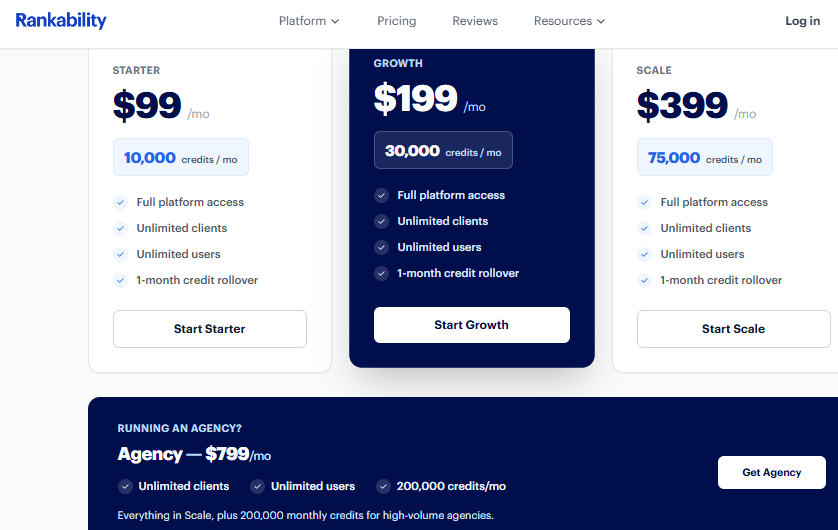
Rankability starts at $99 per month for the Starter plan, which includes 10,000 monthly credits. Growth costs $199 per month with 30,000 credits, Scale costs $399 with 75,000 credits, and Agency costs $799 with 200,000 credits.
The annual plans lower the effective monthly cost. Starter drops to $83 per month, Growth to $166, and Scale to $333 when billed annually.
Rankability is best suited to agencies that manage several clients and want one shared platform for strategists, writers, and editors. It is less attractive for a freelancer or small business that only needs to optimize a few articles each month, because cheaper tools can handle that narrower workload.
The main limitation is the credit system. Unlimited users do not mean unlimited usage, so agencies still need to estimate how quickly research, optimization, and AI features will consume credits.
Overall, Rankability offers the best balance of optimization features, agency access, client scalability, and predictable plan tiers in this comparison.
2. Surfer SEO — Best for Scalable Content Optimization
Surfer SEO is one of the better-known content optimization platforms, and for agencies its main strength is consistency. It gives writers and editors a shared framework for improving drafts without turning every article into a separate research project.
The content editor compares a page against top-ranking results and provides guidance on terms, headings, structure, and overall coverage. That makes it useful for agencies producing content at scale, especially when several writers need to follow the same process.
Surfer also fits well into existing workflows. Google Docs and WordPress integrations make it easier for writers to work in familiar tools, while higher plans add more seats, workspaces, tracking limits, and broader integrations.
The pricing page lists Discovery at $49 per month when billed yearly. Standard costs $99 per month, Pro costs $182, and Peace of Mind costs $299, all shown as monthly equivalents with annual billing. Enterprise pricing starts at $999 per month and is tailored to larger teams.
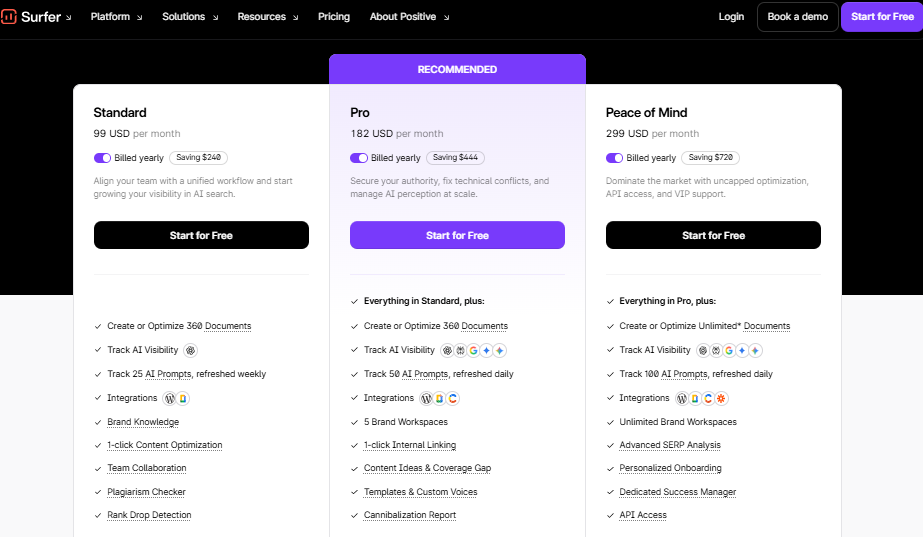
For most agencies, Standard or Pro will be the realistic starting point. Standard includes three seats, while Pro increases the seat count and adds more AI prompt capacity and workspaces. Agencies with heavier production volumes may need Peace of Mind for unlimited documents and broader collaboration limits.
Surfer is a strong choice when the main goal is to improve content quality and keep writers aligned. It is less suitable for agencies that need advanced client management, deep content planning, or highly customized automation.
The biggest limitation is cost. The platform becomes more useful as you move up the pricing tiers, so teams should check document limits, seats, workspaces, and integrations before choosing a plan.
Overall, Surfer SEO is best for agencies that want a dependable content editor, clear optimization guidance, and a workflow that can scale across multiple writers.
3. Clearscope — Best for Enterprise Editorial Teams
Clearscope is built for teams that care about editorial consistency and content quality more than low-cost production. It is a better fit for established agencies, in-house content departments, and publishers with several writers working across the same content standards.
The platform helps teams create briefs, optimize drafts, explore related topics, and track how content performs across both traditional search and AI-driven discovery. Its recommendations are designed to support editorial judgment rather than replace it, which makes Clearscope especially useful for experienced content teams.
One of its strongest agency advantages is unlimited users and unlimited projects on the main paid plans. That removes the usual seat-pricing problem when strategists, writers, editors, and client stakeholders all need access.
The Essentials plan costs $129 per month. It includes 50 tracked prompts, 50 pages, 20 Topic Explorations, and 20 drafts per month. Business costs $399 per month and increases the limits to 300 tracked prompts, 300 pages, 50 Topic Explorations, and 20 drafts, while also adding a dedicated account manager.
Enterprise pricing is custom. Agencies can also purchase extra page and draft capacity, although those add-ons increase the total monthly cost.
Clearscope is best for agencies that need a structured editorial process and want several team members working from the same briefs and optimization standards. It is less suitable for small teams that mainly want inexpensive AI writing or high-volume draft generation.
The main limitation is value at lower usage levels. Essentials is relatively expensive, and its monthly draft allowance may feel restrictive for agencies producing a large number of articles.
Overall, Clearscope is a strong choice for agencies that prioritize reliable editorial guidance, unlimited collaboration, and consistent content quality across multiple writers.
4. Frase — Best for Briefs and Multi-Site Content Workflows
Frase is a practical option for agencies that want to move from keyword research to briefs, drafting, optimization, and publishing without using a separate tool for every step.
Its strongest feature is workflow coverage. Teams can research a topic, build a content brief, create or improve a draft, audit existing pages, and publish through supported CMS integrations. That makes Frase more flexible than tools that only provide a content score.
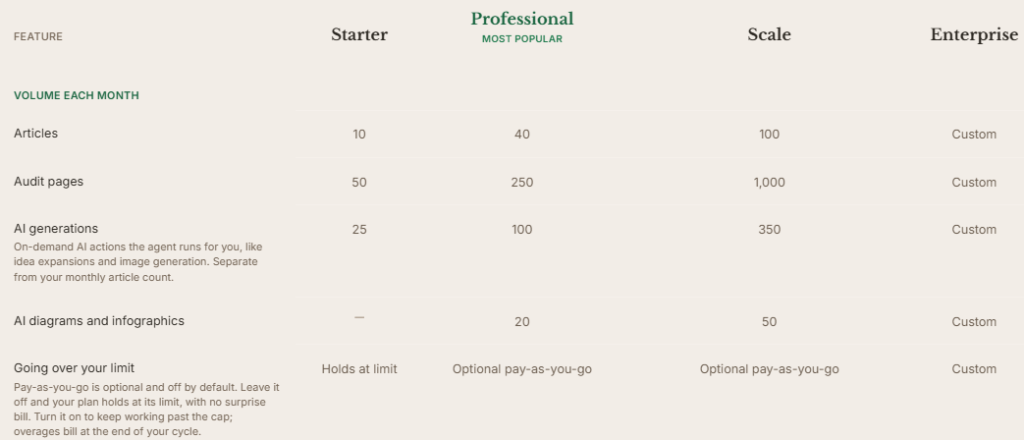
The Starter plan costs $49 per month and includes one seat, one website, 10 articles, 50 audited pages, and limited AI generation. Professional costs $129 per month and expands access to three seats, five websites, 40 articles, 250 audited pages, and more AI usage.
Scale costs $299 per month and is the most relevant plan for larger agencies. It includes five seats, 10 domains, 100 articles, 1,000 audited pages, higher AI limits, and client-ready exports. Additional seats cost $29 per month on supported plans.
Annual billing lowers the effective monthly cost to $39 for Starter, $103 for Professional, and $239 for Scale. Frase also offers a seven-day free trial without requiring a credit card.
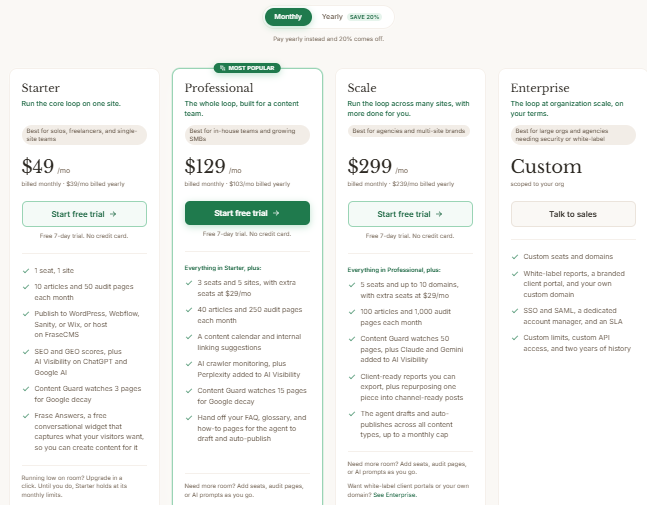
The platform supports WordPress, Webflow, Sanity, Wix, and Frase CMS, which gives agencies more publishing flexibility than many content optimization tools.
Frase works best for agencies that value speed and want briefs, optimization, content audits, and publishing support in one place. It is especially useful for teams managing several websites with repeatable editorial workflows.
The main limitation is that lower plans quickly become restrictive once more writers, websites, and articles are added. Agencies may need Professional or Scale much earlier than expected.
Overall, Frase is a strong all-round choice for teams that want a connected content workflow rather than a standalone optimization editor.
5. MarketMuse — Best for Topical Authority and Content Planning
MarketMuse is a stronger fit for agencies that manage large content libraries and need help deciding what to create, update, consolidate, or remove.
Unlike tools that focus mainly on improving a single draft, MarketMuse looks at the wider content inventory. It helps teams identify topic gaps, assess existing coverage, prioritize opportunities, and build content plans around authority rather than isolated keywords.
That makes it especially useful for agencies working with established websites. When a client already has hundreds or thousands of pages, the main challenge is often not writing another article. It is deciding which pages deserve investment and how new content should support the existing site.
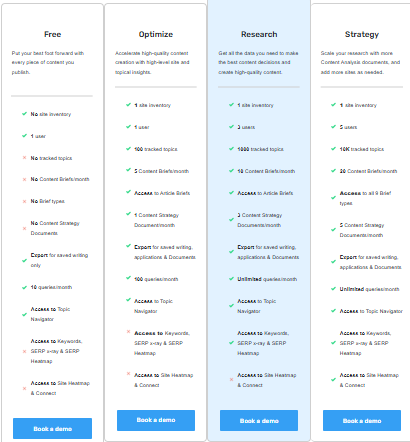
MarketMuse offers a limited free plan with one user and 10 queries per month. Its paid plans include Optimize, Research, and Strategy, but public dollar pricing is not listed. Paid access is handled through a demo or custom sales process.
The plans scale by tracked topics, briefs, users, strategy documents, and query limits. Optimize supports one site, one user, 100 tracked topics, and five briefs per month. Research increases that to three users, 1,000 topics, and 10 briefs. Strategy supports five users, 10,000 topics, and 20 briefs, along with access to all brief types.
MarketMuse is best for agencies that need site-wide planning, topical authority analysis, and content prioritization. It is less practical for small teams that only want a simple editor or a low-cost way to optimize a few articles.
The main limitation is pricing transparency. Agencies cannot estimate the full cost without speaking to sales, and the platform may be more complex than necessary for smaller content programs.
Overall, MarketMuse is a strong strategic platform for agencies managing mature websites where planning and prioritization matter as much as writing.
6. Semrush SEO Writing Assistant — Best for Existing Semrush Users
Semrush SEO Writing Assistant makes the most sense for agencies that already use Semrush for keyword research, competitor analysis, site audits, and position tracking.
For a broader look at the platform’s SEO, competitive research, and agency features, read our full Semrush review 2026
Its main advantage is convenience. Instead of adding another standalone platform, teams can use content optimization inside the wider Semrush workflow. The tool helps writers review readability, originality, tone, and SEO recommendations based on the target keyword and competing pages.
For a closer look at Semrush’s AI-focused tracking and brand visibility features, see our Semrush AI Visibility Toolkit review
For agencies, this can reduce tool switching. A strategist can research the keyword in Semrush, prepare the content direction, and then pass the draft into the Writing Assistant for optimization. It also works with Google Docs and WordPress, which makes it easier to fit into an existing publishing process.
The important pricing detail is that content optimization tools are included from the Guru plan, not Pro. Guru costs $249.95 per month, or $208.33 per month when billed annually. It supports up to 15 websites and also includes historical data and multi-location tracking.
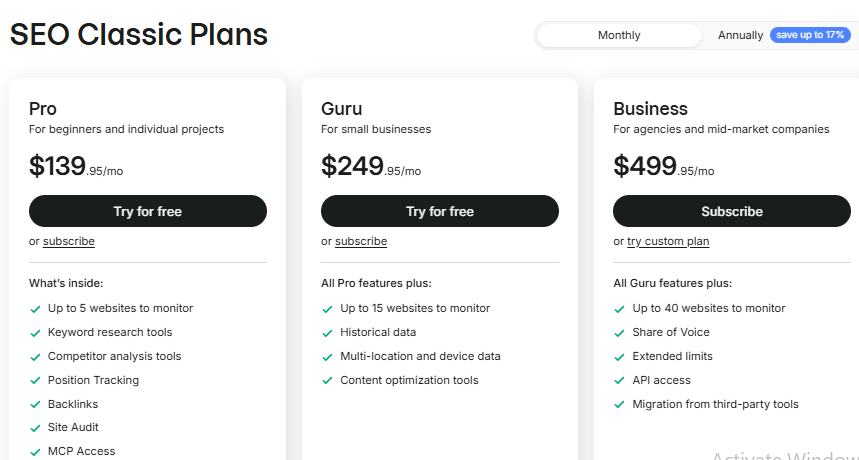
The Business plan costs $499.95 per month, or $416.66 per month when billed annually. It supports up to 40 websites and adds higher limits, API access, and broader agency features.
Additional users start at $45 per month. Reporting add-ons also cost extra, including Base Report at $10 per month and Pro Report at $20 per month.
Semrush SEO Writing Assistant is best for agencies that already rely on the Semrush ecosystem and want content optimization without introducing another major subscription.
The main limitation is value for content-only teams. Paying for Guru just to access the Writing Assistant is difficult to justify if the agency does not also use Semrush for research, audits, backlinks, and tracking.
Overall, it is a sensible add-on for existing Semrush users, but not the most cost-effective standalone content optimization choice.
7. NeuronWriter — Best Budget Semantic Optimization Tool
NeuronWriter is one of the more affordable options for agencies that want SERP analysis, semantic recommendations, and team collaboration without paying Clearscope or Surfer-level prices.
The platform analyzes competing pages and suggests terms, topics, headings, and content improvements based on what already ranks. It also includes AI writing credits, content planning features, and integrations on higher plans.
The Bronze plan starts at $23 per month. It supports two projects, 25 content analyses, 15,000 AI credits, and read-only sharing. Silver costs $45 per month and increases usage to five projects, 50 analyses, and 30,000 AI credits.
Gold costs $69 per month and is the most relevant starting point for agencies. It includes 10 projects, 75 analyses, 45,000 AI credits, unlimited team members with permissions, advanced templates, Content Designer, and 75 plagiarism checks.
Platinum costs $93 per month and adds 25 projects, 100 analyses, 60,000 AI credits, 100 plagiarism checks, and integrations with Google Search Console, WordPress, and Shopify. Diamond costs $117 per month and expands the limits to 50 projects, 150 analyses, and 75,000 AI credits.
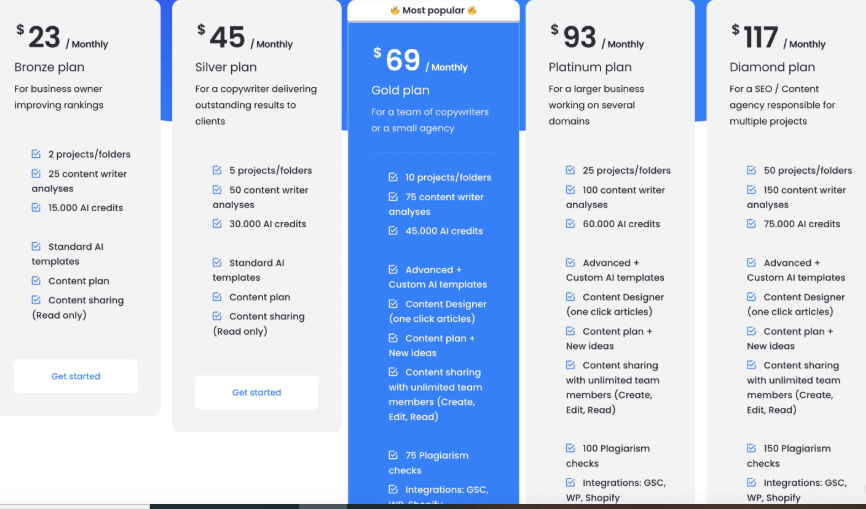
NeuronWriter is best for smaller agencies that need useful optimization guidance and team access at a lower monthly cost. The Gold plan is particularly attractive because unlimited team members begin there.
The main limitation is that the interface and workflow may feel less polished than premium platforms. Agencies should also check analysis and AI-credit limits carefully, as higher content volumes may require Platinum or Diamond.
Overall, NeuronWriter offers strong value for agencies that want practical semantic optimization without committing to a high-priced enterprise tool.
8. Scalenut — Best for AI Writing and GEO Workflows
Scalenut is a better fit for agencies that want to combine content planning, AI-assisted writing, traditional SEO optimization, and generative engine optimization in one platform.
Its workflow covers more than a standard content editor. Teams can research topics, build clusters, create optimized articles, audit existing pages, and track how content may perform across search and AI-driven discovery. That makes it useful for agencies trying to manage both conventional SEO and newer AI visibility work.
The Starter plan costs $59 per month. It includes one workspace, 10 tracked prompts per week, five GEO articles, five optimizations, and five topic clusters. This is enough for light use, but the limits are restrictive for an active agency.
Plus costs $89 per month and is more practical for small teams. It supports two workspaces, four team members, 25 tracked prompts, 30 GEO articles, 30 optimizations, 30 topic clusters, and a 200-page audit. It also adds WordPress and Shopify publishing, internal linking, and topic-gap features.
Professional costs $199 per month and is the strongest agency option. It includes unlimited workspaces and team members, 100 tracked prompts, 75 GEO articles, 75 optimizations, and a 1,000-page audit. It also adds content cannibalization analysis and customer success support.
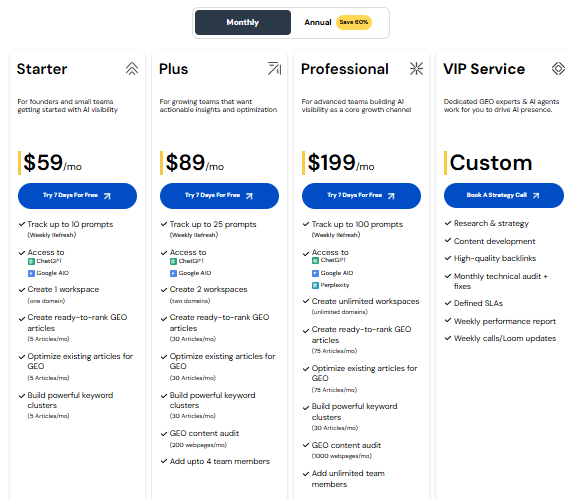
VIP pricing is custom and intended for larger organizations with more complex requirements.
Scalenut works best for agencies that want AI-assisted production and GEO features alongside standard content optimization. It is less attractive for teams that only need a focused content editor and do not plan to use the wider AI workflow.
The main limitation is that useful agency capacity sits on the higher plans. Teams should also check whether promotional pricing is temporary before calculating long-term costs.
Overall, Scalenut is a strong option for agencies that want to connect content creation, optimization, publishing, and AI visibility in one workflow.
9. Dashword — Best for Simple Briefs and Writer Collaboration
Dashword is a good choice for agencies that want a straightforward content workflow without the complexity of a larger SEO platform.
Its core strength is simplicity. Teams can research a topic, build a brief, optimize a draft, and share clear guidance with writers without forcing everyone to learn a complicated interface. That makes it useful for agencies that work with freelancers or external writers who only need access to the brief and editor.
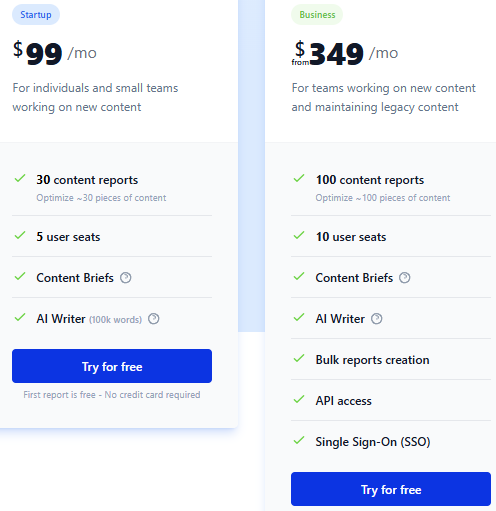
The Startup plan costs $99 per month. It includes 30 content reports, five user seats, content briefs, and 100,000 words of AI writing. Dashword also offers the first report free without requiring a credit card.
The Business plan costs $349 per month. It increases the allowance to 100 reports and 10 seats, while adding bulk report creation, API access, and single sign-on.
Dashword is best for agencies that value a clean process and want to move quickly from research to writer-ready briefs. It can be especially useful when the team does not need a full SEO suite or a highly technical content planning platform.
The main limitation is pricing at higher volume. Startup is reasonable for a small team, but agencies producing more than 30 reports per month may need the much more expensive Business plan.
It also offers fewer advanced planning and automation features than platforms such as MarketMuse, Frase, or AirOps.
Overall, Dashword is a practical option for agencies that want simple briefs, clear optimization guidance, and an easy collaboration experience for writers.
10. AirOps — Best for Custom Content Automation
AirOps is different from most tools in this list. It is not mainly a content editor. It is better suited to agencies that want to build repeatable AI workflows for research, content production, optimization, and large-scale updates.
The platform lets teams connect prompts, data sources, knowledge bases, and approval steps into custom workflows. That can be useful for agencies producing large numbers of landing pages, refreshing content libraries, creating briefs, or standardizing work across several clients.
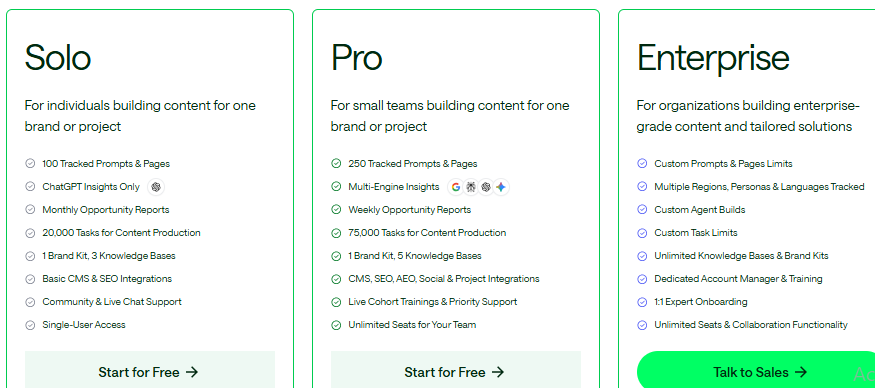
The Solo plan includes 100 tracked prompts or pages, monthly reports, 20,000 production tasks, one brand kit, three knowledge bases, basic integrations, and one user. Public pricing is not clearly listed on the current plan page.
The Pro plan increases capacity to 250 tracked prompts or pages, weekly reporting, 75,000 production tasks, five knowledge bases, broader integrations, and unlimited seats. Enterprise pricing is custom and designed for teams with more advanced security, support, and workflow requirements.
AirOps also offers a 14-day free trial without requiring payment details. Some accounts may receive test credits, while additional usage can be charged by production task. Agencies should confirm current limits and overage terms before committing.
AirOps is best for teams that already understand their content process and want to automate it. It is less suitable for a writer who simply wants to open an editor, enter a keyword, and receive straightforward optimization suggestions.
The main limitation is setup complexity. Custom workflows can save significant time, but they require more planning than a standard content optimization platform.
Overall, AirOps is a strong choice for agencies that need flexible, high-volume content automation rather than another basic SEO writing assistant.
11. Writesonic — Best for AI Visibility and Content Production
Writesonic is a better fit for agencies that want AI-assisted content production and AI visibility features in the same platform.
The workflow combines article generation, content optimization, site audits, and tracking for how a brand appears across AI search environments. That makes it more useful for teams that are not only producing content, but also monitoring how that content supports visibility beyond traditional Google rankings.
The Starter plan costs $79 per month when billed annually. It includes 50 tracked prompts, 15 AI articles, 10 site audits, one user, and one project.
Basic costs $199 per month and increases the limits to 100 tracked prompts, 25 articles, 20 audits, two users, and one project.
Growth costs $399 per month. It includes 200 tracked prompts, 50 articles, 50 audits, three users, multiple projects, and priority support. Enterprise pricing is custom for larger teams with higher usage and support requirements.
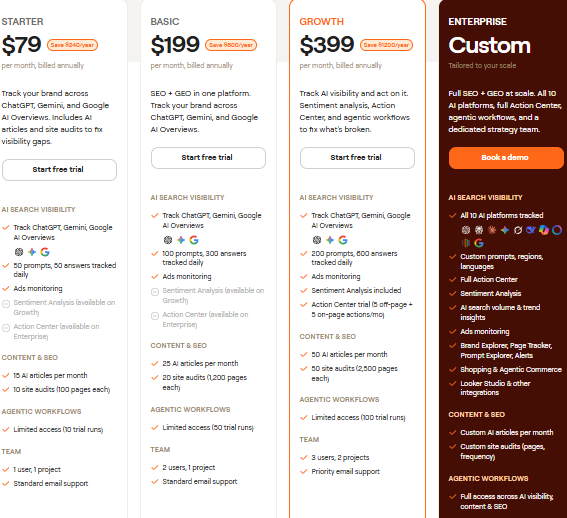
Writesonic also offers agency-focused plans. Agency Starter is listed at $200 per month when billed annually and includes up to 20 pitch projects, 2,000 tracked answers, and unlimited users. Agencies should compare the standard and agency plans carefully because the best option depends on whether the priority is content production, client reporting, or AI visibility work.
Writesonic is best for agencies that want to combine AI writing with broader visibility tracking. It is less suitable for teams that only need a focused SERP-based content editor.
The main limitation is that the platform covers many use cases, so teams may end up paying for features they do not need. Article, prompt, audit, and project limits should also be checked against real monthly production.
Overall, Writesonic is a strong option for agencies that want AI-assisted publishing and AI visibility inside one broader content platform.
12. GrowthBar — Best for Lightweight AI Writing and Optimization
GrowthBar is a practical option for smaller agencies that want basic content research, AI writing, and optimization without paying for a more advanced platform.
Its main appeal is simplicity. Teams can create article outlines, generate draft sections, review content recommendations, and run basic audits from one interface. It is easier to learn than some enterprise tools, which can make it useful for small teams, freelancers, or agencies with a limited content operation.
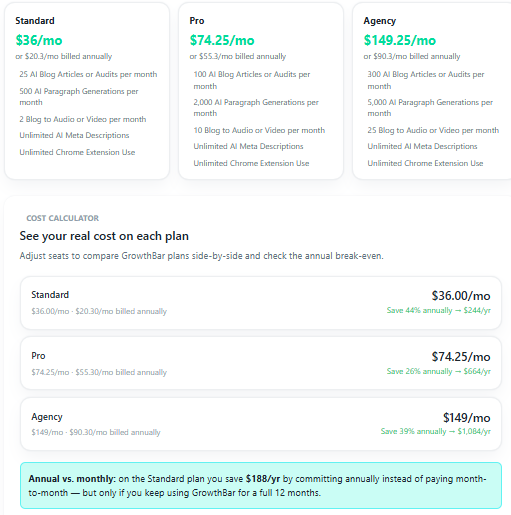
The Standard plan costs $36 per month. It includes 25 AI articles or audits, 500 paragraph generations, two audio or video content tools, unlimited meta descriptions, and access to the Chrome extension.
Pro costs $74.25 per month and increases the limits to 100 articles or audits, 2,000 paragraph generations, and 10 audio or video content tools.
The Agency plan costs $149.25 per month. It includes 300 articles or audits, 5,000 paragraph generations, and 25 audio or video content tools.
Annual billing lowers the effective monthly price to about $20.30 for Standard, $55.30 for Pro, and $90.30 for Agency.
GrowthBar is best for agencies that need a lightweight tool for briefs, AI-assisted writing, and basic optimization. It is less suitable for teams that need deep SERP analysis, advanced topic modeling, client workspaces, or detailed editorial controls.
The main limitation is depth. It can support a simple content process, but it does not offer the same level of optimization guidance as Surfer SEO, Clearscope, or Rankability.
Overall, GrowthBar is a sensible lower-cost option for smaller agencies that want to speed up content production without adding a complex enterprise platform.
13. Rank Math — Best for Advanced WordPress Agency Optimization
Rank Math is not a direct replacement for Surfer SEO or Clearscope. It is a WordPress SEO plugin that helps agencies manage on-page optimization, schema, indexing, redirects, and site-level SEO across client websites.
Its main advantage is scale. The Business plan supports up to 100 client websites, while the Agency plan supports up to 500. That makes Rank Math more practical than per-site plugins for agencies managing a large WordPress portfolio.
The plugin works inside the WordPress editor and gives writers checks for titles, meta descriptions, keyword usage, links, schema, and other on-page elements. It also includes tools for rank tracking, advanced schema, and technical SEO management, depending on the plan.
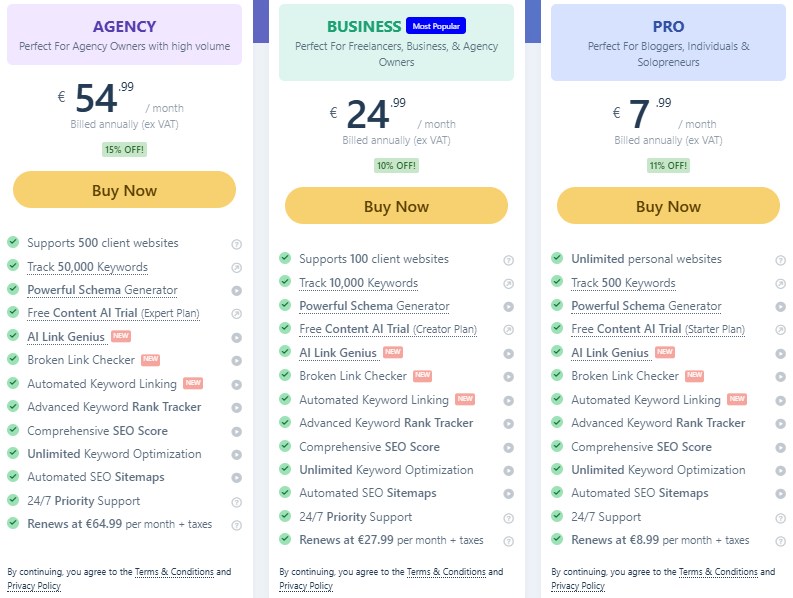
The Pro plan costs €7.99 per month when billed annually, excluding VAT. It is designed for unlimited personal websites and includes tracking for up to 500 keywords.
Business costs €24.99 per month when billed annually. It supports 100 client websites and up to 10,000 tracked keywords. Agency costs €54.99 per month when billed annually and supports 500 client websites with tracking for up to 50,000 keywords.
The listed renewal prices are higher than the introductory rates. Pro renews at €8.99 per month, Business at €27.99, and Agency at €64.99, plus applicable taxes.
Rank Math is best for agencies that need a scalable WordPress optimization layer across many client sites. It is especially useful at the publishing stage, where writers and editors need clear checks inside WordPress.
The main limitation is content depth. Rank Math does not provide the same level of SERP analysis, semantic recommendations, or content briefing as a dedicated optimization platform.
Overall, Rank Math works best as the final WordPress SEO layer in an agency workflow, not as the only tool used for content strategy and optimization.
14. Yoast SEO — Best for Basic WordPress Content Checks
Yoast SEO is one of the most familiar WordPress plugins for on-page optimization. It is easy to use, widely supported, and useful for teams that want simple guidance inside the WordPress editor.
The plugin checks elements such as title tags, meta descriptions, keyword usage, internal links, readability, and basic technical SEO settings. For agencies, that makes it a practical publishing tool when writers and editors need a consistent checklist before a page goes live.
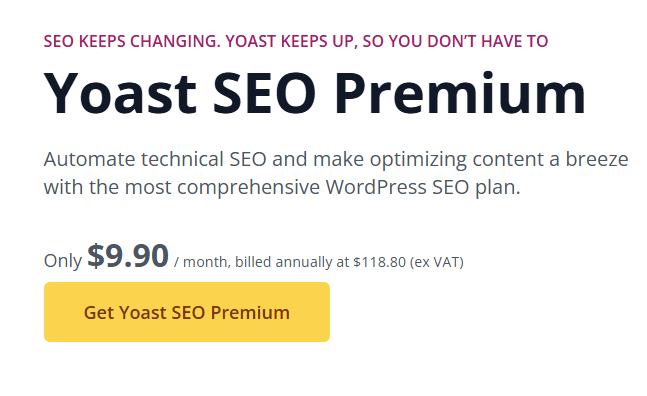
Yoast SEO Premium costs $9.90 per month when billed annually at $118.80 per year, excluding VAT.
The paid version adds more optimization support, redirects, internal linking suggestions, social previews, and additional workflow features compared with the free plugin. It can be a useful upgrade for agencies managing smaller WordPress sites that do not need a full content optimization platform.
Yoast works best for agencies that want straightforward on-page checks inside WordPress. It is particularly useful for beginners, small teams, and clients who need a simple interface rather than detailed SERP analysis.
The main limitation is depth. Yoast does not provide the same level of competitor analysis, semantic recommendations, content briefs, or team workspaces as dedicated tools such as Surfer SEO, Clearscope, or Frase.
Its per-site pricing can also become expensive when an agency manages a large number of client websites.
Overall, Yoast SEO is a reliable publishing-layer tool for basic WordPress optimization, but it should not be treated as a complete content strategy or SERP analysis platform.
15. AIOSEO — Best for WordPress Agencies Managing Multiple Sites
AIOSEO is a broader WordPress SEO plugin that combines on-page optimization with schema, redirects, internal linking, search performance data, and site-management features.
For agencies, its strongest advantage is scale. The Pro plan supports up to 10 websites, while Elite supports up to 100. That makes it more suitable for multi-site client work than plugins designed around a single installation.
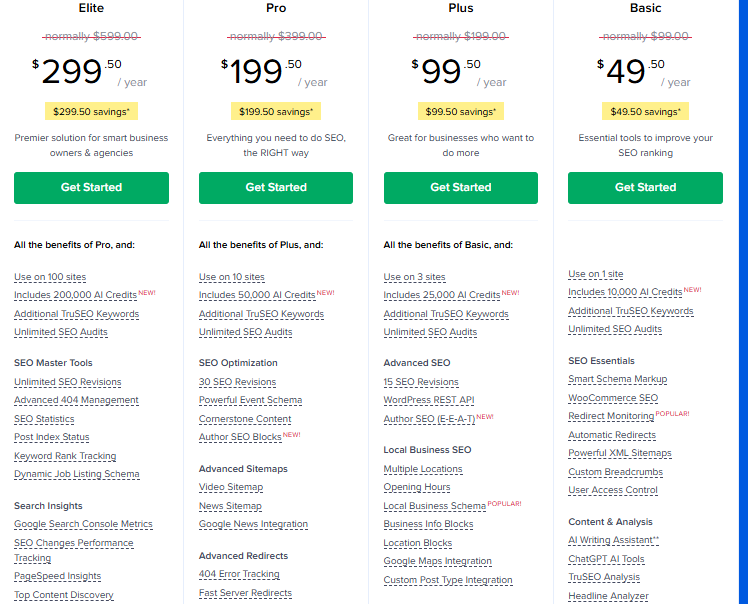
The Basic plan costs $49.50 per year and can be used on one site. It includes 10,000 AI credits, unlimited SEO audits, schema tools, redirect monitoring, XML sitemaps, WooCommerce SEO, content analysis, and integrations with platforms such as Google Search Console and Semrush.
Plus costs $99.50 per year and supports three sites. It includes 25,000 AI credits and adds local SEO, image SEO, multiple-location support, author SEO, and more advanced site controls.
Pro costs $199.50 per year and supports 10 sites. It includes 50,000 AI credits, advanced sitemaps, internal linking automation, orphaned-post reports, affiliate-link reports, redirect tools, and priority support.
Elite costs $299.50 per year and supports 100 sites. It includes 200,000 AI credits, client management, multisite support, network-wide SEO tools, advanced 404 management, keyword tracking, search insights, and performance reporting.
AIOSEO is best for WordPress agencies that want more than basic content checks and need broader control across several client sites.
The main limitation is that it is still a WordPress plugin, not a dedicated content optimization platform. It does not offer the same level of SERP analysis, content briefs, semantic recommendations, or editorial workflows as Rankability, Surfer SEO, or Clearscope.
Overall, AIOSEO is a strong publishing and site-management layer for WordPress agencies, especially when Pro or Elite replaces several smaller plugins across multiple client websites.
How to Choose the Right SEO Content Optimization Tool for Your Agency
The best tool is not always the platform with the longest feature list. It is the one that fits your agency’s actual workflow, client load, team size, and monthly production volume.
Start by identifying the main problem you want the software to solve. If writers need clear SERP-based guidance while drafting, Surfer SEO, Rankability, Clearscope, or NeuronWriter may be the strongest fit. If the bigger challenge is building briefs and moving content through research, writing, and publishing, Frase or Dashword may be more practical.
If you’re still deciding between the two biggest SEO platforms, read our detailed Semrush vs Ahrefs comparison before choosing a tool.
Agencies managing large existing content libraries should place more weight on planning and prioritization. MarketMuse is better suited to deciding what should be updated, consolidated, or created next. AirOps is more useful when the agency already has a defined process and wants to automate it at scale.
Team limits matter as much as features. A low starting price can become expensive once additional writers, editors, clients, and websites are added. Check whether the plan limits users, workspaces, projects, reports, articles, credits, or domains before subscribing.
Integrations should also match the way your team already works. Google Docs access may matter more than an advanced dashboard if most writers never leave Docs. WordPress agencies may benefit from combining a dedicated optimization platform with Rank Math, Yoast SEO, or AIOSEO as the final publishing layer.
Finally, calculate the cost using your real monthly workload rather than the advertised entry price. Estimate how many briefs, articles, audits, client sites, and team members the agency needs. The right plan should still make financial sense after those limits are applied.
A Practical Content Optimization Workflow for Agencies
A content optimization tool works best when it supports a clear process instead of becoming another dashboard the team rarely uses.
Agencies that need hands-on help with SEO strategy, content systems, or implementation can explore our SEO services
Start with keyword and intent research. The strategist should confirm what the searcher wants, review the main competing pages, and decide whether the content should inform, compare, recommend, or sell. The optimization tool can support this research, but it should not replace the decision.
Agencies that need a dedicated platform for keyword research, backlink analysis, and competitor discovery can also read our full Ahrefs review 2026
Next, turn the research into a focused brief. The brief should include the primary topic, important subtopics, likely questions, internal-link opportunities, examples, and the action the reader should take. Avoid giving writers a long list of terms without explaining why they matter.
The writer should then produce the first draft for the reader, not for the content score. Optimization recommendations are more useful during editing, when the team can compare coverage, identify missing sections, improve headings, and remove unnecessary repetition.
After editing, send the page through a final quality check. Review factual accuracy, readability, search intent, links, calls to action, metadata, and formatting. A high optimization score does not fix weak examples, unsupported claims, or a confusing structure.
The final publishing step should happen inside the agency’s normal CMS workflow. WordPress teams can use Rank Math, Yoast SEO, or AIOSEO for titles, descriptions, schema, redirects, and basic on-page checks before publication.
Once the page is live, monitor impressions, rankings, clicks, and conversions. Revisit the content when search intent changes, competitors improve their pages, or the article gains impressions without earning enough clicks. This turns content optimization into an ongoing process rather than a one-time score.
How to Measure Content Optimization Success
Publishing optimized content is only the first step. To measure success, monitor impressions, clicks, average position, and click-through rate in Google Search Console while tracking keyword rankings with your preferred SEO platform. Compare updated pages against their previous performance, identify which topics gain visibility, and continue improving articles that receive impressions but low clicks. Content optimization is an ongoing process, and regularly reviewing performance data helps businesses refine their strategy, strengthen topical authority, and achieve sustainable organic growth over time.
Free vs. Paid SEO Content Optimization Tools
Free tools can help with basic checks, but they are usually not enough for an agency managing several clients and writers.
The main issue is limits. Free plans often restrict the number of articles, reports, keywords, projects, or users. They can be useful for testing the interface or handling a small website, but they become difficult to rely on once the team needs a repeatable workflow.
A paid platform is usually worth considering when the agency regularly creates briefs, optimizes several pages each month, collaborates with multiple writers, or manages content across different client websites. The time saved through better research, clearer briefs, and faster editing can matter more than the subscription price.
That does not mean every agency needs an expensive enterprise tool. Smaller teams may get enough value from NeuronWriter, GrowthBar, or a lower Frase plan. WordPress-focused agencies may also combine a plugin such as Rank Math, Yoast SEO, or AIOSEO with a separate research and optimization tool.
Free plans are most useful for testing. MarketMuse offers a limited free option, while several other platforms provide trials or reduced access. Use that period to test the workflow with a real article, not just the dashboard.
The right decision depends on volume. If the agency only publishes a few pages each month, a low-cost plan may be enough. If it manages multiple writers, clients, and content calendars, paying for better collaboration and higher limits is usually the more practical choice.
Common Content Optimization Mistakes to Avoid
Many websites fail to achieve better rankings because they focus on optimization scores instead of user value. Common mistakes include overusing keywords, copying competitor headings without adding unique insights, relying entirely on AI-generated content, ignoring search intent, publishing without updating older articles, and failing to strengthen internal links. SEO content optimization tools should guide editorial decisions rather than replace human expertise. The best-performing content combines accurate information, practical experience, and continuous improvement based on real performance data.
Frequently Asked Questions
What is the best SEO content optimization tool for agencies?
Rankability is the best overall choice in this comparison because it combines content optimization, client management, AI visibility tracking, and unlimited users. Surfer SEO is a stronger fit for agencies that mainly want a polished content editor, while Clearscope is better for larger editorial teams.
Which content optimization tool is best for small agencies?
NeuronWriter is one of the strongest low-cost options for small agencies. Its Gold plan includes unlimited team members, semantic recommendations, AI credits, and multiple projects at a lower price than many premium platforms.
Frase is also a good choice when the agency needs briefs, audits, drafting, and publishing support in one workflow.
Is Surfer SEO better than Clearscope?
Surfer SEO is generally better for scalable production, integrations, and teams that want clear optimization guidance inside a structured editor.
Clearscope is better for editorial teams that prioritize consistency, unlimited users, and a more quality-focused workflow. The better option depends on whether the agency values production speed or editorial standardization more.
Can AI writing tools replace content optimization tools?
Not completely. AI writing tools can speed up drafting, but they do not always provide reliable SERP analysis, topic coverage, content scoring, client organization, or editorial controls.
The strongest workflow uses AI to support research and drafting while human strategists and editors make decisions about intent, accuracy, structure, and usefulness.
Are WordPress SEO plugins enough for content optimization?
Rank Math, Yoast SEO, and AIOSEO are useful for final on-page checks, metadata, schema, redirects, and technical publishing tasks.
They are not full replacements for dedicated platforms such as Rankability, Surfer SEO, Clearscope, or Frase, which provide deeper SERP analysis, content briefs, semantic guidance, and team workflows.
How much should an agency spend on a content optimization tool?
The right budget depends on monthly content volume, team size, client count, and required integrations.
A small agency may spend between $20 and $100 per month. A growing team may need a plan between $100 and $300 per month. Larger agencies can spend significantly more once they add users, client workspaces, reports, AI credits, and higher production limits.
What features matter most for agencies?
The most important features are reliable SERP guidance, content briefs, writer access, client organization, integrations, exports, clear usage limits, and pricing that remains affordable as the team grows.
Unlimited users can be valuable, but only when article, credit, project, or report limits also match the agency’s real workload.
Best Practices for Using SEO Content Optimization Tools
The most successful SEO teams treat content optimization as an ongoing process rather than a one-time task. Begin with clear keyword research, understand the search intent behind every topic, create comprehensive content briefs, optimize naturally without overusing keywords, and review performance regularly. Refresh outdated content, strengthen internal linking, improve topical coverage, and update articles using performance data from Google Search Console instead of relying only on optimization scores. Following these best practices helps build long-term topical authority and sustainable organic growth.
How to Choose the Best SEO Content Optimization Tool
There is no single SEO content optimization tool that fits every business or agency. The right choice depends on your content volume, budget, workflow, team size, and optimization goals. Smaller teams may prefer affordable tools with strong semantic optimization, while larger agencies often benefit from platforms that support collaboration, content briefs, workflow automation, and scalable client management. Before subscribing, test the software using real content, compare its recommendations with your existing workflow, and evaluate whether it improves content quality, team productivity, and long-term SEO performance.
Final Verdict
Rankability is the best overall choice for agencies that want content optimization, client workflows, AI visibility tracking, and unlimited users in one platform.
Surfer SEO is the better option for teams that mainly need a polished content editor and reliable SERP-based guidance. Clearscope is stronger for larger editorial teams that care about consistency and collaboration, while Frase is a practical all-round choice for briefs, drafting, audits, and publishing.
Smaller agencies should look closely at NeuronWriter or GrowthBar. Both cost less than the premium platforms, although they do not offer the same depth or polish. Agencies managing large content libraries may get more value from MarketMuse, while AirOps is the strongest fit for custom, high-volume automation.
WordPress plugins such as Rank Math, Yoast SEO, and AIOSEO still have an important role, but mainly at the publishing stage. They are useful for metadata, schema, redirects, and on-page checks, not as full replacements for dedicated content optimization software.
The right choice depends on how your agency actually works. Compare team access, article limits, credits, client sites, integrations, and upgrade costs before subscribing. A tool that fits the workflow will save time and improve consistency. A tool chosen only because it has the highest content score will usually become another unused subscription. Explore more practical SEO software guidance at SaaSLogicLab.