Semrush vs Ahrefs: Which SEO Tool Is Worth Your Money in 2026?
Two of the best-known SEO platforms, one budget. Here’s how we actually chose between them while building SaaSLogicLab from scratch.
Jump to: Quick Verdict · How We Tested · What Top-Ranking Guides Miss · Semrush · Ahrefs · Keyword Research · Backlinks · Competitor Research · Site Audit · Rank Tracking · AI Visibility · Free Tools · Ahrefs Toolbar · Pricing · If You’re Just Starting Out · Who Should Buy What · Mistakes to Avoid · Myths · Decision Tree · What Reddit Says · Scorecard · FAQ · Bottom Line
If you’ve got Semrush and Ahrefs on your shortlist, you’re not making a bad decision either way — that’s actually the problem. Both are good enough that “which one has more features” stops being useful as a question about page fifteen of some feature-comparison spreadsheet.
Most articles comparing these two tools read like a checklist: Semrush has this, Ahrefs has that, tally the boxes, declare a winner. We’re not going to do that here, because that’s not how anyone actually picks software. A freelancer running three client sites doesn’t shop the same way a fifty-client agency does. Someone running a SaaS content engine cares about different things than someone optimizing four thousand eCommerce category pages.
So instead of “which tool wins,” the real question is: which one fits how you already work?
We built our answer on four things, roughly in this order — what we found using both tools ourselves on SaaSLogicLab, what the official docs say, what shows up again and again in Reddit and Quora threads, and our own judgment about what actually moves the needle in a working SEO business. Throughout this guide, we use real screenshots captured during SaaSLogicLab testing instead of stock promotional images.
If you’re also weighing individual tools, our Best Keyword Research Tools 2026 and Best SEO Tools for Agencies pieces cover more ground on that front.
Who this is for (and who it isn’t)
This is written for people who’ve already decided a paid SEO platform is worth the money and just need to pick the right one. That covers agencies juggling client work, freelancers who need enterprise power without enterprise complexity, bloggers chasing topical authority, affiliate marketers hunting commercial keywords, SaaS teams that need more than rankings, eCommerce operations managing huge catalogs, local businesses that just want straightforward reporting, and in-house marketing teams that answer to stakeholders.
It’s probably not for you if you want something free forever, you’re brand new to SEO and haven’t learned the vocabulary yet, you check one keyword a month, or you’re still deciding whether SEO is worth doing at all. Different questions, different articles.
Quick Verdict
There’s no universal winner here, and anyone who tells you otherwise is probably an affiliate for one of them.
Semrush makes sense if you want one platform for everything — SEO, technical audits, reporting, AI visibility — and you’re managing more than one site or client.
Ahrefs makes sense if backlinks and organic research are where you actually spend your time, and you’d rather have a tighter, research-focused tool than a sprawling one.
Still torn? Stop comparing feature lists and start comparing your actual Tuesday. Whichever tool removes more friction from the work you do every week wins — not the one with more line items on its pricing page.
How we tested this
We ran both tools against real SaaSLogicLab work — keyword research, competitor digging, backlink checks, technical audits, rank tracking, and a first look at AI visibility reporting. Where a feature claim needed checking, we went to the official documentation rather than trusting a random blog’s summary of it. We also read a fair amount of Reddit and Quora, not as proof of anything, but because recurring complaints and praise tell you something real about long-term use that a demo never will.
Official pricing was checked directly against Semrush’s pricing page and Ahrefs’ pricing page.
What the current top-ranking guides get wrong (and what we did differently)
Before writing this, we actually pulled up what’s currently ranking for “semrush vs ahrefs” — not to copy the structure, but to see what someone searching this exact term gets handed today, and where it falls short.
A few things stood out fast. A real chunk of the current top results are either published by one of the two vendors directly, or earn a commission on whichever tool they end up crowning — without saying so upfront. That doesn’t automatically make them wrong, but it does mean the winner in several of these pieces was arguably decided before any testing happened. We’d rather say plainly where our own bias risk sits: we run SaaSLogicLab on Semrush day to day, which is exactly why the editorial disclosure sits above our scorecard instead of us pretending the testing was perfectly even-handed.
Pricing was the second surprise, and an easy one to check. Pull three or four of the top-ranking articles up side by side and the numbers actively disagree with each other — one lists the Semrush entry plan at $129.95, another at $139.95; one lists Ahrefs Lite at $99, another at $129. Some of that is just stale content that never got revisited after a price change went live. We pulled our tables straight from the current official pricing pages rather than trusting whatever was already ranking, and we’ve flagged that prices move and should be reverified before you buy — not treating the numbers as permanent.
Third: almost none of the ranking pages we looked at showed testing tied to an actual, named, currently-running website. Plenty claim months of hands-on use, but the evidence stops at a general feature walkthrough. That’s the gap we tried to close by testing directly against SaaSLogicLab — a real domain, real screenshots, a real WordPress fix-and-reverify loop on the technical audit side rather than a description of what a Site Audit report generally looks like.
A couple of other things were thin or missing across the field: a clear answer to who shouldn’t buy either tool yet, a workflow-based way to decide instead of a flat feature list, and any honest note about where the writer’s own testing was uneven rather than presenting it as a perfectly symmetrical comparison. AI visibility coverage was also inconsistent — a couple of currently-ranking pages still claim one platform “doesn’t track AI citations,” which was accurate roughly a year ago and isn’t anymore. We checked that claim directly against both companies’ current help documentation before writing the AI Visibility section here, rather than repeating what kept getting recycled across the search results.
None of that makes the existing guides bad — several are genuinely well put together. But the missing bias disclosure, the stale pricing, and the lack of testing evidence tied to a real, working site were the three gaps we set out to close with this one.
At a glance
| Priority | Go with | Why |
| One tool that does everything | Semrush | Research, audits, reporting, and AI visibility all live in one place. |
| Backlinks | Ahrefs | Still the deepest backlink database and workflow around. |
| Keyword research | Either, honestly | Semrush organizes better; Ahrefs digs into competitors better. |
| Technical SEO | Semrush | Issues get sorted by priority, not just dumped in a list. |
| Competitor research | Both are strong, differently | Depends how deep you need to go. |
| Agencies | Semrush | Project structure and reporting hold up across many clients. |
| Bloggers | Depends | Content planning vs. backlink chasing — pick your poison. |
| SaaS companies | Semrush | Technical + content + AI visibility together. |
| Link builders | Ahrefs | This is the one thing it does better than almost anyone. |
Semrush: what it’s actually like to use
Semrush stopped being “just a keyword tool” a while ago. It’s now closer to a full marketing operating system — SEO, PPC, content, competitor intel, technical audits, local, reporting, and AI visibility, all under one login.
That doesn’t automatically make it the right choice for you. But it explains why agencies and growing teams keep landing on it — because most days, you don’t need to leave the platform to go from “here’s an idea” to “here’s a published, tracked, audited page.”

A few things stand out after actually using it:
It connects the dots. Keyword discovery feeds into content clusters, which feed into Site Audit priorities, which feed into rank tracking, which shows up in reports. None of that requires exporting a CSV and re-importing it somewhere else.
Keyword research feels like planning, not scrolling. The Keyword Magic Tool, Keyword Gap, and Search Intent filters push you toward grouping ideas by topic and intent, rather than handing you a 400-row spreadsheet and wishing you luck.
Technical audits don’t drown you. Issues get bucketed — errors, warnings, crawlability, HTTPS, internal linking, markup, Core Web Vitals — so you’re fixing things instead of hunting for them.
Projects actually mean something. Site Audit, tracking, backlinks, and AI visibility all attach to the same project, which matters a lot more once you’re running this across several sites.
AI visibility is genuinely being built out, not bolted on as an afterthought — worth watching if that’s part of your strategy going forward.
None of this comes free, though. New users can feel buried under the sheer number of reports, and if your SEO needs are genuinely small, you’ll end up paying for tools you never open. Data is also just data — Semrush will surface a hundred opportunities, and figuring out which ten matter is still on you.
Where it earns its keep: agencies with multiple clients, SaaS teams publishing constantly, in-house departments juggling SEO with other channels, and anyone running technical work alongside content at the same time. If your week bounces between research, audits, tracking, and reporting, having it all in one place saves more time than any single feature does.
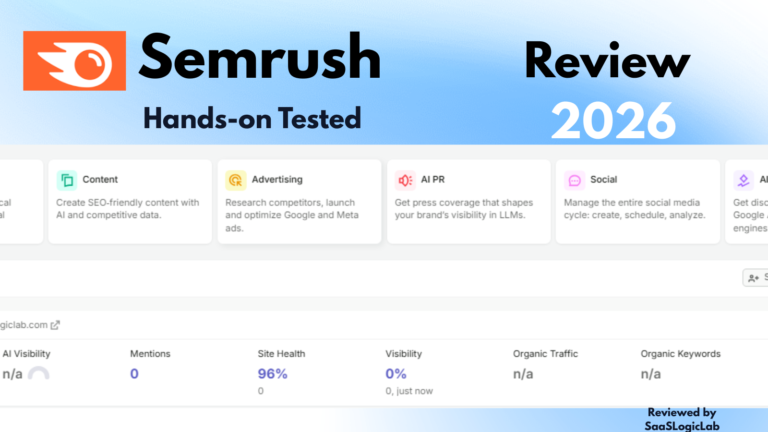
Full breakdown here: Semrush Review
Ahrefs: what it’s actually like to use
Ahrefs has one job it’s obsessed over for years: figuring out how sites earn visibility, mostly through links. Everything else got added around that core.
Ask any SEO who’s been doing this for a decade which tool they open first when they need answers, and a lot of them will say Ahrefs — not because it does the most, but because when the question is “how did this page get so many links,” it answers faster than anything else.
Referring domains, anchor text, new and lost links, broken backlinks, top linked pages — Site Explorer makes all of that fast to dig through. The Keywords Explorer side is just as strong for understanding why something ranks, not just that it does: top pages, ranking keywords, traffic estimates, historical performance, organic competitors.
What people notice most after switching from a broader tool is how clean it feels. There’s a lot of data in there, but it doesn’t feel like fifteen products stapled together. Site Explorer, Keywords Explorer, Content Explorer, Rank Tracker, Site Audit — five things, and you generally know which one you need before you open it.
The tradeoff is real, though: if your job also involves managing PPC research, a chunky reporting stack, or AI visibility tracking baked into the same dashboard as everything else, you’ll likely be reaching for another tool alongside it. Ahrefs doesn’t pretend to be your whole marketing department — it’s a research engine, and a very good one.
It’s the natural home for link builders, affiliate marketers, publishers chasing topical authority, SEO consultants, and agencies whose whole pitch is competitor teardown.
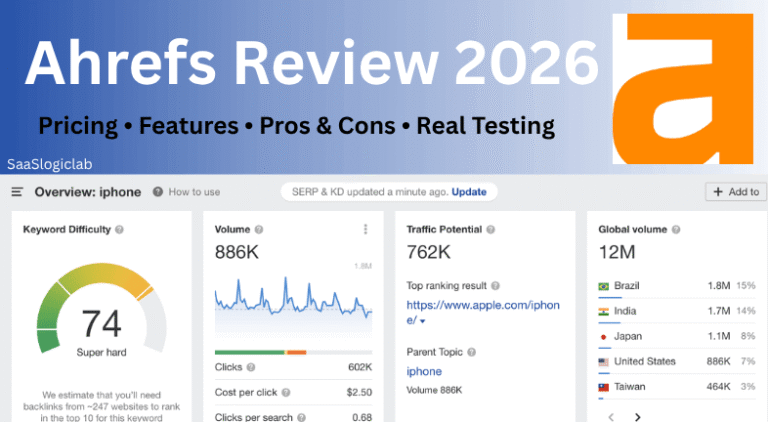
Full breakdown here: Ahrefs Review
Keyword Research
Everyone compares keyword tools by asking “who has more keywords.” Wrong question — both databases are enormous. The question that actually matters is what happens after you find the keyword.
Open Semrush’s Keyword Magic Tool with a seed term and you get keyword groups, not a flat list — filter by intent, compare difficulty, and you’re building a content cluster before you’ve left the tool. Ahrefs, by contrast, nudges you toward the SERP itself: search a term, look at who’s ranking, check their traffic, and let that shape what you write next.
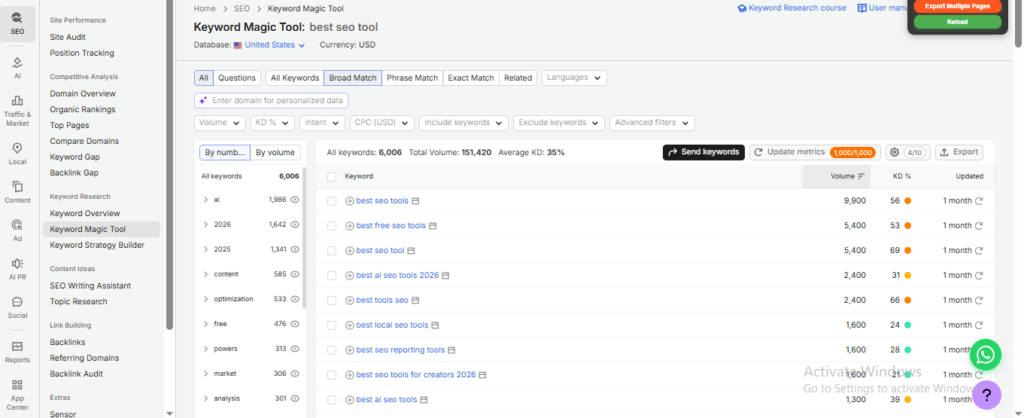
We used the Semrush route while planning several SaaSLogicLab pieces, including our Best Keyword Research Tools 2026 article narrowing a long keyword list down by intent and commercial relevance before writing a single word turned out to matter more than chasing the highest search-volume terms.
The Ahrefs route works better when you’re updating existing content and want to know exactly which competitor pages are eating your lunch.
A word of caution either way: keyword difficulty is a comparative estimate, not a promise. High volume doesn’t mean the term fits your audience or your product, and building one article per keyword instead of a proper cluster is still one of the most common ways people waste a good keyword list.
It tends to come down to how your content operation actually runs. If you’re building calendars, publishing on a schedule, and managing an editorial team that needs organized clusters more than raw discovery, Semrush’s structure pays off.
Teams that also need help improving content briefs, on-page relevance, and optimization workflows can explore our Best SEO Content Optimization Tools comparison.
If your process starts by reverse-engineering what’s already ranking — competitor-first, then working backward into the content — Ahrefs fits that instinct more naturally. Neither is universally right; it depends on where your content strategy actually begins.
Bottom line: Semrush wins if your process starts with topic planning. Ahrefs wins if it starts with “what’s already ranking, and why.” A lot of experienced teams end up doing both, even if only one tool gets the subscription.
Backlinks
This is the category where the gap between the two tools is easiest to see, and it’s not close.
Both will show you referring domains, anchor text, new and lost links, and competitor link profiles. The mistake is judging either one by the raw number on the dashboard — that number tells you almost nothing about whether the links are relevant, replicable, or worth chasing.

Inside Ahrefs, the useful move is picking three to five real competitors, pulling their most-linked pages, and sorting the links into buckets — editorial mentions, resource pages, guest posts, directories, free tools, original research. Once you know why a link exists, you know whether you can realistically earn something similar. That classification step is where Ahrefs quietly does its best work; it’s built for exactly this kind of digging.
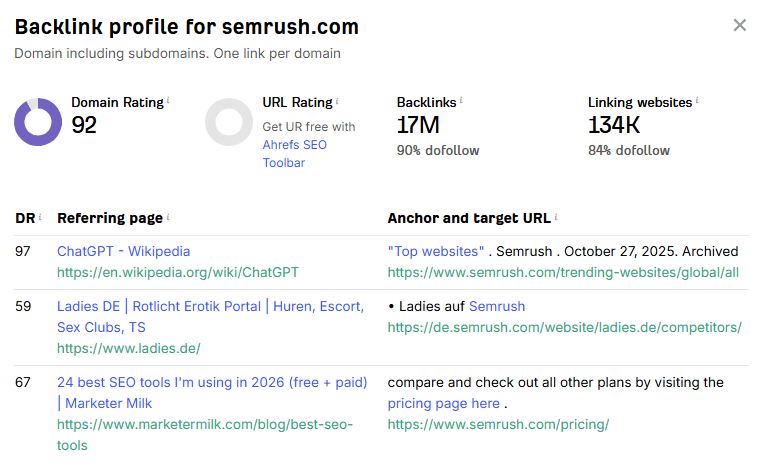
Semrush is better suited to the wider view — stacking several competitors side by side to see where a growing domain sits relative to established players. We used it that way to place SaaSLogicLab next to more mature SEO publications, not to expect matching numbers, but to understand the shape of the gap.
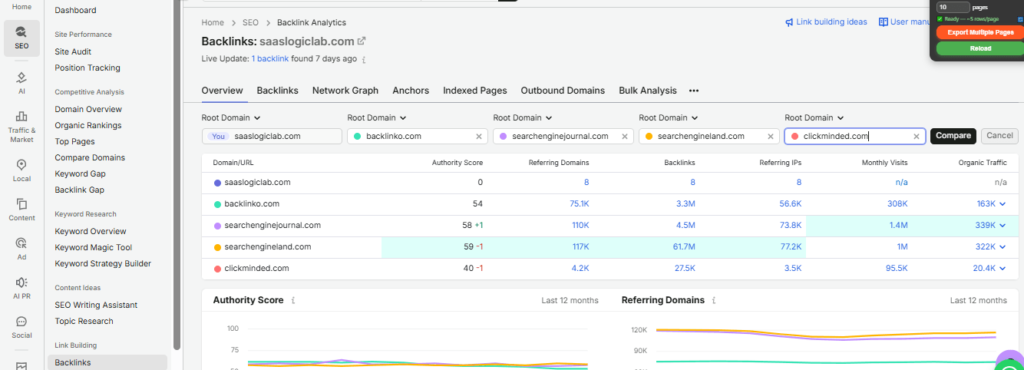
One honest caveat: Ahrefs and Semrush will almost never report the same backlink count for the same domain. Different crawlers, different indexes, different classification rules. That’s normal — don’t treat either number as gospel, and don’t panic when they disagree.
If link building is a running campaign for you — regular outreach, digital PR, content-led acquisition — backlink analysis isn’t an occasional task, it’s the core of the job, and that’s exactly where Ahrefs earns its subscription. If backlinks are just one input alongside audits, keyword tracking, and reporting, Semrush keeping it all in one project view saves more time than a deeper specialist tool would. And honestly — a very small site with no active link-building strategy probably doesn’t need a premium backlink platform every month at all. Free webmaster tools and the occasional paid check-in cover that case fine; the subscription earns itself once backlink data starts actually changing what you create or pursue.
Bottom line: if backlink work is a real, ongoing part of what you do, Ahrefs is the stronger specialist tool. If backlinks are one piece of a bigger, connected workflow, Semrush keeps it in the same place as everything else.
Competitor Research
Bad competitor research looks like exporting a rival’s top keywords and calling it a content strategy. Good competitor research starts narrower — which pages actually bring them traffic, which keywords support those pages, who’s linking to them, and whether any of that is realistic for you to replicate.
It helps to separate competitors into categories before you start pulling data: search competitors who rank for your terms but don’t sell what you sell, business competitors who compete for the same customer, content competitors who own the informational search results before someone even reaches a buying decision, and backlink competitors who earn links from sites you’d like to reach too. These overlap constantly, but keeping them separate stops you from copying a strategy built for a completely different business.
Semrush’s Domain Overview, Organic Research, and Keyword Gap reports are where we go to get a fast read on the whole landscape.
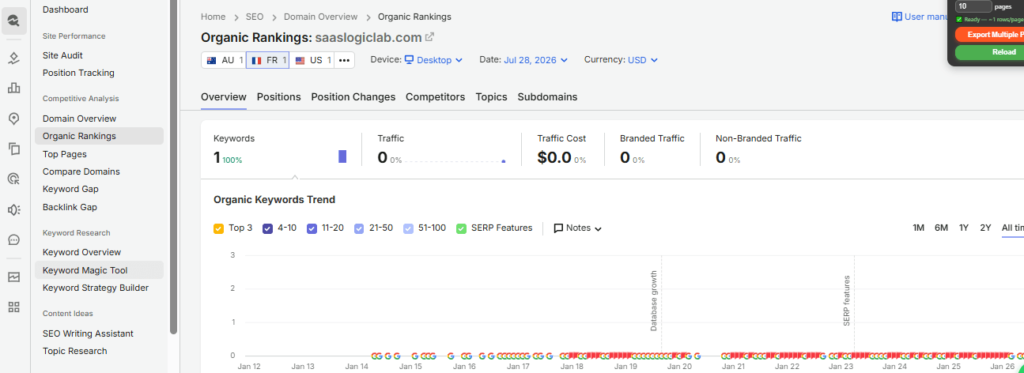
Ahrefs is where we go once that landscape has narrowed to one or two competitors we actually want to reverse-engineer, page by page. Teams managing several sites or clients tend to lean on Semrush for exactly this reason — it’s built for scanning multiple domains quickly. Teams that live in page-level detail, reverse-engineering backlink acquisition and content performance one competitor at a time, get more out of Ahrefs.
Neither tool tells you whether a competitor’s traffic converts, what their margins look like, or why they’re actually winning — that’s still your job to figure out. And if you don’t have a clear audience or offer yet, no amount of competitor data will hand you one; these tools show what already exists in the market, not what should differentiate you from it.
Site Audit
A technical audit is only as good as its prioritization. Nobody needs a tool that finds two hundred issues and treats all of them as equally urgent.
Semrush splits things into errors, warnings, and notices, and that hierarchy genuinely changes how you work through a crawl — errors first, then warnings, notices when there’s time. We ran this against SaaSLogicLab directly: flag an issue in Semrush, fix it in WordPress, clear the cache, rerun the crawl, confirm it’s gone.
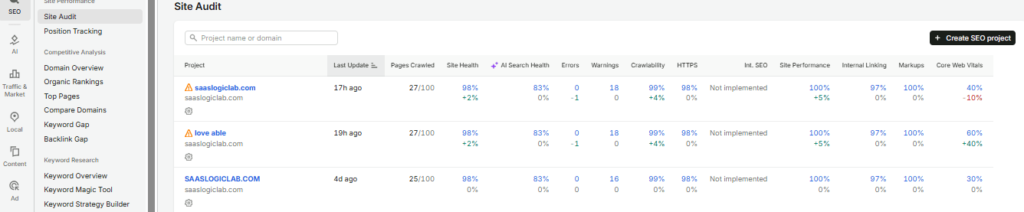
Being upfront: we tested Site Audit hands-on in Semrush for this piece. We didn’t run the same crawl side-by-side in Ahrefs, so the score below reflects how deep our own testing went, not a controlled head-to-head. If you already live in Ahrefs, its Site Audit may cover everything you need without adding a second tool.
Scores will jump around between crawls for reasons that have nothing to do with your site getting worse — cache state, crawl timing, a plugin that briefly misbehaved. Verify before you panic and change ten things at once; changing everything simultaneously is the fastest way to lose track of what actually fixed the problem.
Worth saying plainly: this isn’t a tool every site needs running constantly. A small static website, someone who checks in occasionally rather than weekly, or a technical team that already has a proper crawler and custom monitoring in place — none of those really need a recurring paid audit tool on top of what they’ve already got. The value shows up with repeated use on a growing site, not from a single one-off crawl.
Rank Tracking
Tracking a hundred keywords nobody cares about produces a chart that looks busy and tells you nothing. Start smaller — core commercial terms, product or service keywords, branded searches, and whatever informational topics actually matter to the business.
We set up Semrush Position Tracking early for SaaSLogicLab across keywords targeted in our Best SEO Tools guide, Best SEO Content Optimization Tools comparison, and Best Keyword Research Tools 2026 article. The point of doing it early wasn’t to prove anything yet — it was to have a real baseline to compare against once there’s actually history to look at.
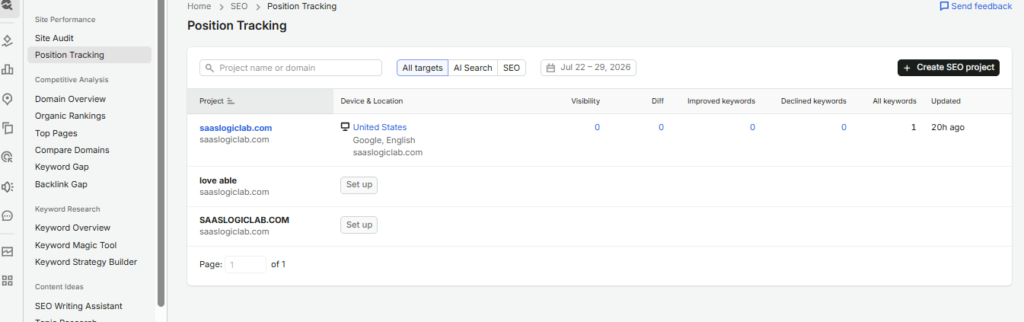
Worth remembering: tracking shows you that something moved, not why. Content changes, a competitor’s update, an algorithm shift, a technical hiccup — the chart won’t tell you which one it was. You still have to go find out.
It’s genuinely useful for agencies reporting movement to clients, local businesses watching defined service areas, and anyone running content clusters or product-category terms that need ongoing visibility checks. It’s a lot less useful when the keyword set has no strategic purpose behind it, when the reports get generated but nobody actually acts on them, or when the tracked locations don’t match where the actual audience is. Rankings on their own aren’t the goal — they only matter once they connect to clicks, leads, or something the business can point to.
AI Visibility
This is the newest, messiest category in the whole comparison, and neither company has fully figured it out yet — worth keeping that in mind before treating any AI visibility score as gospel.
Semrush’s current SEO and AI Search plans include custom prompt tracking, brand-performance monitoring, sentiment data, and AI-oriented audit features, scaled by plan tier. (Semrush) Ahrefs has gone in a similar direction with tracked prompts at different plan levels, plus Brand Radar and optional custom-prompt add-ons. (Ahrefs Help Center)
So the real question isn’t whether either tool “does AI visibility” — both do, now. It’s whether that reporting sits naturally next to the rest of your SEO work or feels bolted on.
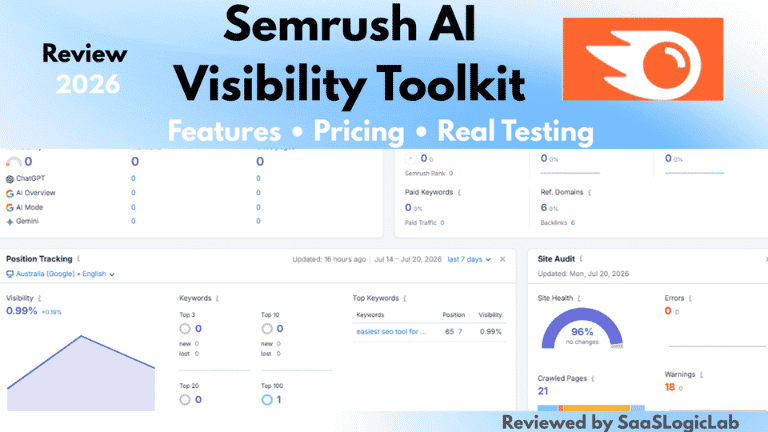
For a deeper look at Semrush’s AI-focused features, monitoring workflow, and limitations, read our Semrush AI Visibility Toolkit Review.
We started with a small set of prompts that actually matter commercially — best tools in the category, alternatives to a competitor, buying questions a real prospect would ask — rather than tracking generic queries just to fill a dashboard. Even then, treat the results as directional. A brand showing up in one AI answer and not a near-identical prompt a day later isn’t a bug; that’s just how these systems currently behave.
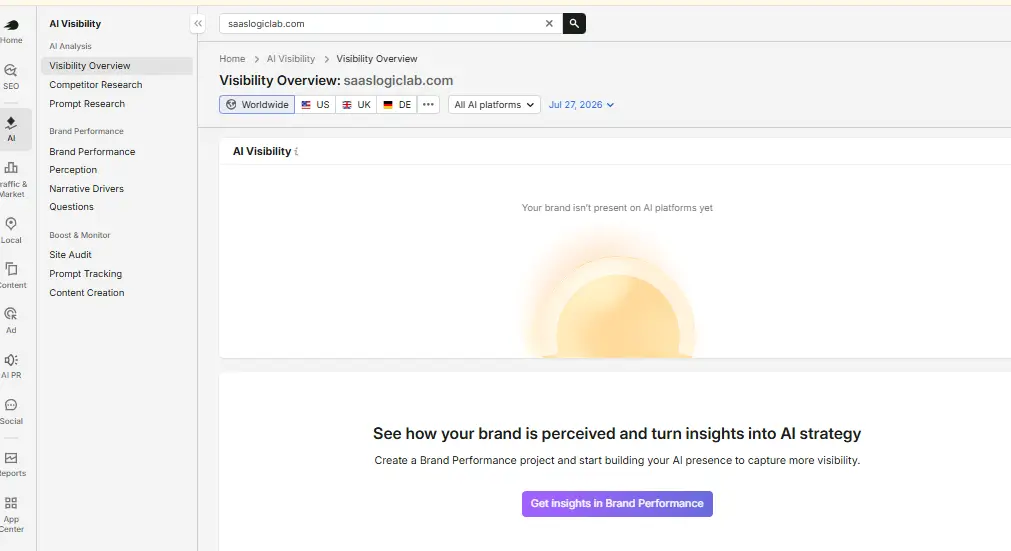
If you’re a small business with thin content and no real AI-search angle yet, honestly, spend that money improving the actual site first — better product pages, clearer entity information, stronger supporting content. AI monitoring earns its keep once there’s enough of a content and brand footprint that the findings translate into something actionable, whether that’s content work, digital PR, or product positioning. Watching a dashboard with nothing to act on is just watching a dashboard.
The free stuff
Before spending anything, both companies give you a way to poke around.
| Semrush | Ahrefs | |
| Free account | Yes, with daily limits on most reports | Ahrefs Webmaster Tools, free for verified site owners |
| Free trial | No standing trial; occasional 14-day promos through partners | None on paid plans |
| Cheapest paid entry | $139/month ($117.33 billed annually) | $29/month (Starter) |
| Browser extension | No real equivalent | SEO Toolbar — see below |
If you want to poke at the full premium experience before paying, watch for a Semrush trial through an official partner. If you just want a free habit-forming tool for daily use, the Ahrefs Toolbar plus Webmaster Tools covers a surprising amount of ground for zero dollars.
The Ahrefs Toolbar
Outside the main dashboard, Ahrefs gives away a free browser extension called the SEO Toolbar, and it’s more useful day-to-day than it sounds. It shows Domain Rating, URL Rating, backlink counts, referring domains, and basic on-page info right in the browser, on whatever page you’re currently looking at.
That’s genuinely handy when you’re qualifying outreach targets, doing a quick SERP scan, or just deciding whether a site is worth a deeper look before you open the full dashboard. Bloggers, outreach specialists, and anyone doing rapid competitor scans lean on this constantly.
A couple of things it isn’t, though: the DR/UR scores are Ahrefs’ own metric, not a Google ranking signal, and they don’t translate directly to Semrush’s Authority Score if you’re used to that instead. It’s also a snapshot tool — good for a fast check, not for tracking anything over time, and the data can lag slightly behind what’s in the live dashboard. For real backlink analysis, keyword research, or historical data, you’re still opening the full platform.
Pricing
Figures below are current as of our last check against each vendor’s live pricing page. Prices move, and regional pricing can differ — always confirm on the official checkout page before you subscribe.
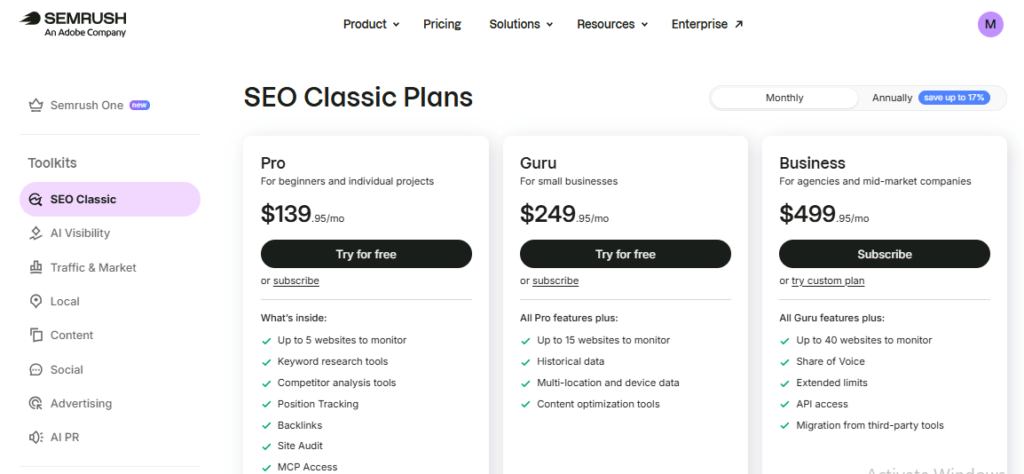
The monthly number on a pricing page tells you what shows up on your card statement. It doesn’t tell you whether the plan actually covers your workflow, how many sites you can run, or which everyday actions quietly eat into your usage limits. The real question is: what’s the cheapest plan that covers everything you’ll actually do this month, without forcing an upgrade three weeks in?
Semrush doesn’t offer a standing free trial, but its free account lets you poke around with daily caps, and partners occasionally run 14-day promotional trials. Ahrefs skips the trial entirely — you get its free tools (Webmaster Tools, the Toolbar) and jump straight into a paid plan when you’re ready for more.
Semrush plans
| Plan | Monthly (USD) | Annual (USD/mo) | Rough limits |
| SEO | $139 | $117.33 | 5 sites, 500 daily tracked keywords |
| Semrush One Starter | $199 | $165.17 | 5 sites, 500 keywords, 50 daily AI prompts |
| Semrush One Pro+ | $299 | $248.17 | 15 sites, 1,500 keywords, 100 daily AI prompts |
| Semrush One Advanced | $549 | $455.67 | 40 sites, 5,000 keywords, 200 daily AI prompts |
Source: Semrush’s official pricing page. Semrush Local starts separately at $30/month per location, and Advertising, Social, and Traffic & Market are their own subscriptions on top.
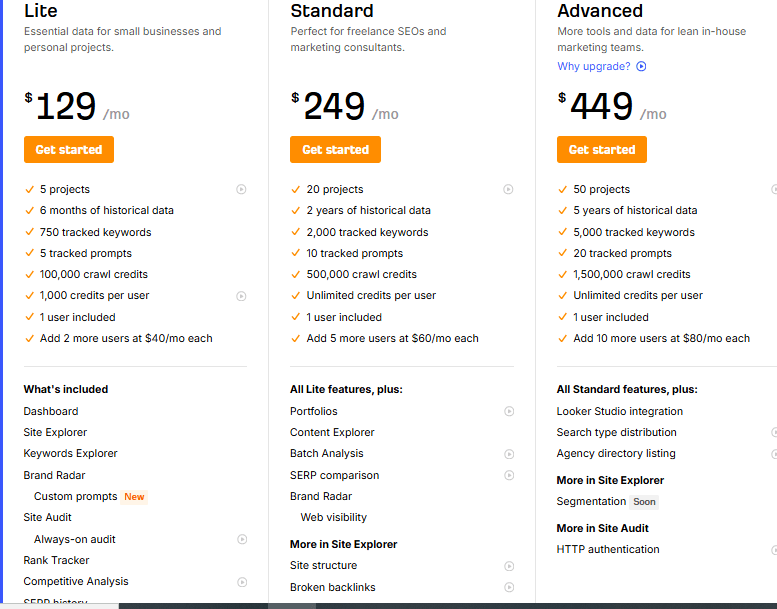
Ahrefs plans
| Plan | Monthly (USD) | Usage model | Tracked keywords |
| Starter | $29 | 200 credits/month | 25–50 |
| Lite | $129 | Credit-based | ~750 |
| Standard | $249 | Unlimited fair use | ~2,000 |
| Advanced | $449 | Unlimited fair use | ~5,000 |
| Enterprise | $1,499+ | Unlimited fair use | 10,000+ |
Source: Ahrefs’ official pricing page and the Ahrefs Help Center. Annual billing saves roughly 17% (“2 months free”). Starter is monthly-only. Starter and Lite run on credits — opening reports and applying filters can eat into that number, so a heavy researcher will burn through Lite faster than the price tag suggests. Standard and above drop the credit ceiling entirely.
The actual cost math goes beyond the sticker price, too. Add up the base subscription, seats (Ahrefs requires one per person logging in separately, at its own added cost per plan), usage limits you might actually hit, add-ons like AI visibility or local packages, what it would cost in time to switch platforms later if this one doesn’t work out, and — the one people skip — how much of what you’re paying for the team will genuinely touch each week. A cheaper plan that blocks a task you need weekly isn’t actually cheap. A bigger plan full of unused capability isn’t good value either.
None of this means you need the biggest plan available. If research is occasional, you’re running one site, you don’t need big exports, and you’re still figuring out whether the platform even fits — start at the bottom of either pricing table. Semrush’s higher tiers and Ahrefs’ Standard-and-above make more sense once usage is already intensive enough to hit the lower limits regularly, not before.
Bottom line: Semrush pays for itself faster when several of its connected tools are genuinely in weekly use. Ahrefs pays for itself faster when backlink and organic research is the job, not a side task.
If you’re just starting out
A few things worth doing before you commit to either:
Write down what you’ll actually do every week — not what you might do someday. Then match that list against the limits in the tables above, not just the plan names. Test with something real during any trial window: one actual keyword cluster, one real competitor teardown, one backlink check — not a click-through demo. Decide before you commit to annual billing; the discount only pays off if the tool already fits. Most freelancers and small teams genuinely don’t need both platforms on day one — add a second tool later if a specific, recurring gap shows up. And if the budget’s genuinely tight, start with the free layer: Ahrefs Webmaster Tools, the Ahrefs Toolbar, and Semrush’s free account will tell you a surprising amount before you spend a dollar.
What we actually learned using both
Semrush felt like a connected workspace — research feeding audits feeding tracking feeding reports, all without leaving the tab. The upside was real; the downside is that without a defined process, it’s easy to open six reports, collect a pile of data, and still not know what to do next.
Ahrefs felt like a research tool with a very specific personality — it kept pulling us deeper into referring domains and competitor pages in a way that felt natural rather than forced. It’s just not trying to be your whole marketing stack, and it doesn’t pretend to be.
Neither tool proved that using it produces higher rankings, more traffic, or better leads. That’s not what they’re for. They organize information and surface opportunities — what you do with that is still entirely on you.
Who should buy what
Industry labels only get you so far — two agencies can run completely differently, and two SaaS companies can weigh technical SEO versus content very differently too. Still, some patterns hold up often enough to be worth stating plainly.
Agencies: most full-service agencies land on Semrush, because juggling multiple sites, technical audits, ranking reports, competitor work, and client-facing reporting inside one project-based system beats stitching several tools together. The exception is agencies that specialize hard in link building, digital PR, or organic competitor research — for them, Ahrefs’ depth matters more than Semrush’s breadth.
Freelancers: this really comes down to what you’re selling. If your service is audits, keyword research, and rank tracking across recurring client projects, one Semrush subscription covering multiple deliverables is easier to justify. If research, content strategy, or link building is the actual service, Ahrefs’ focused interface fits the work better — and costs less to start with.
Bloggers and publishers: if you’re building structured content calendars and grouping topics into clusters while also needing some technical monitoring, Semrush’s planning tools do more of that work for you. If your growth comes from studying competing publishers, seeing which pages attract links, and adjusting content based on what’s already winning, Ahrefs is the better daily driver.
Affiliate marketers: Ahrefs tends to win here — understanding which pages generate traffic, which commercial terms competitors rank for, and where content gaps sit is exactly the page-level reverse-engineering Ahrefs is built for. Switch to Semrush instead if you also need heavier project organization, technical monitoring, and structured keyword clustering layered on top.
SaaS companies: SaaS SEO rarely lives in one lane — commercial keyword research, competitor monitoring, technical audits, content strategy, and increasingly AI visibility all matter at once, which is why Semrush tends to fit the broader operating model better. If you’ve already got separate technical and reporting systems and just need deep organic and backlink intelligence layered in, Ahrefs covers that gap without the overlap.
eCommerce: large catalogs mean managing product and category keywords, technical issues across huge site structures, and competitor tracking across many markets at once — the integrated audit-plus-keyword-plus-tracking workflow in Semrush handles that scale well. Ahrefs makes more sense if the real objective is narrower: studying competitor category pages and how they’re earning links specifically.
Local businesses: most local businesses want something simpler — service keyword tracking, defined-location monitoring, site health checks, and local competitor comparisons, without every enterprise feature in the box. Semrush’s broader workflow fits that combination naturally. If you’ve already got a capable SEO person on staff and just need the research layer, Ahrefs works fine without the extra local tooling.
In-house teams: teams working across developers, writers, marketing managers, and executives need information that can move cleanly from discovery to implementation to reporting — Semrush’s project structure tends to make that handoff easier. Highly specialized in-house SEO teams that already run separate platforms for auditing, analytics, and reporting may not need that connective layer and can lean on Ahrefs for the research piece alone.
Mistakes people make
Buying for one flashy feature demoed in a video that never becomes part of the actual weekly workflow. Skipping the workflow-definition step and comparing tools before knowing what you’ll use them for. Assuming the platform will decide your strategy for you — it won’t; it surfaces data, you still make the call. Buying the biggest plan for growth that hasn’t happened yet, and paying for unused projects, seats, and exports for months while you wait for that growth to show up. Treating third-party traffic and authority estimates as if they were Google Search Console or GA data — they’re not, and they shouldn’t replace your own first-party numbers. Ignoring plan limits buried under a feature that “technically” exists. Comparing raw database numbers across tools as if they should match, when each one runs its own crawler and methodology. Paying annually before confirming the tool actually fits — the discount means nothing if the platform doesn’t stick. Rolling out a powerful platform and letting only one person on the team actually learn it, so the investment never scales past that one person. Confusing more rows and credits with better decisions — capacity isn’t the same thing as insight. And assuming one platform has to handle everything — sometimes two focused tools beat one bloated one, and sometimes it’s the other way around.
Myths worth killing
Ahrefs is not “just a backlink tool” — it does keyword research, competitor analysis, content research, and auditing too, on top of the backlink work it’s known for.
Semrush isn’t “too complicated for everyone” — it’s genuinely more complex to learn, but that complexity buys real breadth for teams juggling more than one workflow.
More data isn’t automatically better — past a point it’s just noise, and the tool that helps you filter beats the tool that just gives you more.
Keyword difficulty is an estimate, not a prophecy — it says nothing about your content quality, your existing authority, or search intent fit.
A high authority score doesn’t mean a good link — it’s a proprietary comparative number, not something Google actually calculates.
And paying for either tool doesn’t produce rankings by itself. The subscription buys information. Results still come from execution.
Still can’t decide?
Work through this in order:
- What do you do most weeks — research/audits/tracking, or backlink and competitor digging? First → Semrush. Second → Ahrefs. Both roughly equally → keep going.
- Do you need one platform for everything, marketing-wise? Yes → Semrush.
- Is backlink intelligence central to how you grow? Yes → Ahrefs.
- Managing multiple clients or sites? Yes → Semrush usually wins here on project structure.
- Need AI visibility inside the same workflow as everything else? Yes → Semrush, based on our testing.
- Broad capability or tight, focused research? Broad → Semrush. Focused → Ahrefs.
- Budget the deciding factor? Don’t anchor on the cheapest entry price — check credits, projects, exports, and seats first.
- Still stuck? Run a real seven-day test in both: one keyword cluster, three competitors, one backlink review, one technical audit, one tracking setup, one exported report. Whichever one got you through that list with less friction is your answer.
What Reddit and Quora actually say
Community threads aren’t proof of anything — they’re personal opinions from people with their own biases and blind spots. But patterns that show up repeatedly are worth noting, if only because they tell you what long-term use actually feels like, which no demo will.
Semrush shows up described as broad, powerful, agency-friendly, and genuinely useful for connected workflows — with the recurring complaint being complexity and add-on costs stacking up fast.
Ahrefs shows up described as strong on backlinks, clean for competitor research, and efficient once you know your way around — with the recurring gripe being how restrictive the credit-based lower tiers feel in daily use.
That lines up almost exactly with what we found hands-on: Semrush for broader operations, Ahrefs for focused research. Useful as a sanity check. Not a substitute for testing it yourself.
A note on the scorecard below
Some categories — Site Audit, Position Tracking, and AI Visibility especially — got tested more deeply in Semrush than in Ahrefs, mostly because Semrush is what we’ve been running SaaSLogicLab’s ongoing technical monitoring on. The scores below reflect how far our own testing went, not a claim that Ahrefs is objectively worse in those categories. Anyone whose day-to-day life already runs through Ahrefs might land somewhere different after testing the same things there directly.
The scorecard
| Category | Semrush | Ahrefs | Why |
| Keyword research | 9.3 | 9.0 | Semrush organizes better for planning; Ahrefs digs deeper into competitors. |
| Backlink analysis | 9.1 | 9.7 | Ahrefs is still the deep-dive specialist here. |
| Competitor research | 9.4 | 9.5 | Semrush is broader; Ahrefs is stronger page-by-page. |
| Site auditing | 9.4 | 8.8 | Reflects our testing depth — see note above. |
| Rank tracking | 9.3 | 8.9 | Fits naturally into Semrush’s project structure. |
| AI visibility | 9.3 | 8.8 | Same testing-depth caveat applies. |
| Focused SEO research | 8.8 | 9.5 | Ahrefs keeps this tighter and more streamlined. |
| All-in-one capability | 9.7 | 8.5 | Not close — this is Semrush’s home turf. |
| Agency workflow | 9.6 | 9.0 | Multi-project reporting is a Semrush strength. |
| Link building | 9.0 | 9.7 | Ahrefs, clearly. |
| Beginner friendliness | 8.6 | 8.8 | Ahrefs feels more focused out of the gate. |
| Overall value | Depends | Depends | Comes down to what you actually use. |
Quick answers by priority
| If you want | Go with |
| Everything in one place | Semrush |
| Backlink depth | Ahrefs |
| Structured keyword planning | Semrush |
| Competitor-led keyword research | Ahrefs |
| Technical SEO monitoring | Semrush |
| Link building | Ahrefs |
| Agency reporting at scale | Semrush |
| Page-level competitor teardowns | Ahrefs |
| Rank tracking built into the workflow | Semrush |
| AI visibility, integrated | Semrush |
| Tight, focused organic research | Ahrefs |
| Small, occasional lookups | Free tools first, decide later |
Choosing the right software is only the first step. Explore our SaaS SEO services if you need help turning keyword, technical, competitor, and content data into an actionable growth strategy.
Bottom line
Neither tool deserves to be crowned universal winner — they’re solving overlapping problems from two different angles.
Go with Semrush if you want keyword research, competitor analysis, auditing, tracking, backlinks, reporting, and AI visibility living in one connected system. It earns its price for agencies, SaaS teams, in-house departments, and eCommerce operations juggling several SEO tasks at once.
Go with Ahrefs if your work is really about backlinks, competitor investigation, and page-level organic performance. It’s the better home for link builders, affiliate marketers, publishers, and consultants who’d rather have a focused tool than a sprawling one.
Skip the popularity contest. Ask which reports you’ll actually open every week, which one fits your team, and which one turns data into action without extra steps in between. That’s the tool worth paying for.
Still unsure which platform fits your business? Contact SaaSLogicLab for practical guidance based on your website, team, budget, and recurring SEO workflow.
FAQ
Is Semrush better than Ahrefs? Depends what “better” means to you. All-in-one marketing workflow → Semrush. Backlinks, organic competitors, page-level research → Ahrefs.
Is Ahrefs better for backlinks? Generally, yes — its workflow for digging into referring domains, individual links, and competitor acquisition patterns is a step ahead. Semrush is still capable, especially when backlink data needs to connect to a broader project.
Which is better for keyword research? Semrush for structured planning and content clustering. Ahrefs for competitor-led discovery.
Which is better for beginners? Ahrefs feels more focused at first glance. Semrush has more to learn but more connected capability once you do.
Which is better for agencies? Semrush, for most full-service agencies. Specialist link-building shops may still prefer Ahrefs.
Which is better for bloggers? Semrush for structured calendars and clusters. Ahrefs for studying competitors and chasing links.
Which is better for SaaS companies? Semrush, generally — technical SEO, content, and AI visibility together matter more here than pure research depth.
Which is better for affiliate marketing? Ahrefs, usually —the page-level competitor research workflow suits affiliate content well.
Does Semrush have good backlink data? Yes — analytics, referring domains, anchor analysis, gap reports. Ahrefs is still the deeper specialist tool.
Does Ahrefs have a site audit? Yes. We found Semrush’s stronger in the workflow we tested, particularly for prioritization, but Ahrefs’ audit is a real, usable tool too.
Can these replace Google Search Console? No. GSC is first-party data straight from Google. Semrush and Ahrefs are estimates and competitive research — useful alongside GSC, not instead of it.
Can either tool guarantee rankings? No legitimate SEO tool can, and you should be skeptical of anyone who claims otherwise.
Are the traffic estimates accurate? Good for comparison, not for exact numbers. Use your own analytics to measure your own site.
Why do the two tools show different numbers for the same domain? Different crawlers, different databases, different methods. Expect some mismatch — it doesn’t mean either one is wrong.
Should I subscribe to both? Some agencies do. Most smaller businesses don’t need to — pick one primary tool and lean on free first-party data for the rest.
Which offers better value? Semrush when several connected features are genuinely in weekly use. Ahrefs when deep backlink and organic research is the actual job.
Should I just get the cheapest plan? Get the cheapest plan that covers your real workflow — check credits, projects, tracked keywords, crawl limits, exports, and seats before deciding, not just the price tag.