
Search Intent in SEO: How to Identify & Optimize It
A keyword can look like a strong SEO opportunity and still lead to the wrong content decision.
It may have relevant search volume, reasonable competition, and a clear connection to your business. But those numbers do not tell you what someone expects to find after typing that query into Google. If your page answers a different need, targeting the right keyword will not fix the mismatch.
That is where search intent matters.
Search intent is the goal behind a query: what the searcher wants to learn, compare, find, evaluate, or accomplish. That goal influences whether the best response should be a guide, comparison, product page, landing page, tool, or another type of result.
For SaaS and other content-driven websites, this distinction becomes increasingly important as the site grows. An informational query may need an educational guide. A commercial query may be better served by a comparison or review. A searcher closer to taking action may expect a feature, pricing, or product page instead. Treating every relevant keyword as another blog-post opportunity can leave the site with plenty of content but weak alignment between queries and pages.
Intent is not always obvious from the keyword itself, either. Two similar queries can produce very different results. One query can support several interpretations. And the dominant intent can shift as search behavior and the SERP change.
So search intent should be validated rather than assumed.
This guide explains how to identify intent from a query and the live SERP, map keywords to the right content and page type, use intent across a broader content strategy, measure whether existing pages are satisfying the right searchers, and recognize when changing search results signal that a page needs to be updated.
What Is Search Intent in SEO?
Search intent is the purpose behind a search query, but in practice, understanding intent requires more than assigning a keyword to a category.
Classifying a keyword as informational or commercial is only the starting point. The real test is whether the page would satisfy the person behind the search.
Consider four queries around SEO:
- “what is keyword cannibalization”
- “how to fix keyword cannibalization”
- “keyword cannibalization checker”
- “Semrush vs Ahrefs”
All four belong to the broader SEO space, but they represent different expectations.
Someone searching “what is keyword cannibalization” primarily needs an explanation. The person searching “how to fix keyword cannibalization” already understands enough of the problem to want a solution. A search for a “keyword cannibalization checker” suggests that the user wants to perform a task, not read several thousand words before reaching a useful tool. And “Semrush vs Ahrefs” indicates an evaluation decision: the searcher wants enough evidence to compare two options.
Each query therefore calls for a different content response.
A definition may satisfy the first query. A diagnostic workflow is more appropriate for the second. The third may be better served by a tool or a page built around using one. The fourth calls for a comparison that helps the reader make a decision.
This is why search intent should influence more than the words used on a page. It affects the content type, page format, depth, angle, and next action you present to the searcher.
It also explains why two pages targeting closely related keywords can require completely different structures. Keyword similarity does not automatically mean intent similarity.
For SEO, intent classification is only useful when it leads to a page that supports the outcome behind the search.
Why Search Intent Matters for SEO
A page does not compete in search results simply because it mentions the right keyword. It competes by offering the kind of result that makes sense for that search.
The mismatch becomes clear when the SERP consistently favors a different page type. If most top results for a query are comparison pages, publishing a basic informational guide creates a structural disadvantage. If users are looking for a tool, expanding a blog post from 2,000 to 4,000 words may add depth without making the page more useful.
The same problem appears when intent is only partially matched. A page may answer the topic correctly but emphasize the wrong stage of the searcher’s decision.
For example, someone searching for best SEO tools for agencies is unlikely to need a long explanation of what SEO software is. They are evaluating options. They need meaningful differences, use cases, limitations, pricing context, and enough evidence to narrow a shortlist. A page that spends most of its space teaching SEO basics may be relevant to the keyword while still being poorly aligned with the search.
Intent therefore affects several SEO decisions at once:S
- Which page should target the query: an existing page may already satisfy the intent, making another article unnecessary.
- What type of content should be created: a guide, comparison, review, category page, product page, tool, or landing page can serve very different goals.
- What information deserves priority: the searcher’s immediate need should determine what appears early and what can wait.
- How multiple keywords should be grouped: related terms belong on the same page only when their underlying expectations are compatible.
- What action should follow the content: the appropriate next step for someone learning about a problem is different from the next step for someone comparing solutions.
This is particularly important on growing SaaS websites because one subject can support several legitimate pages. A broad guide might explain a problem, a comparison page can evaluate competing solutions, a feature page can show how a product addresses it, and a template or tool can help the visitor act on it.
Those pages are not automatically competing with one another. Problems begin when their purpose becomes difficult to distinguish.
That makes search intent useful beyond individual keyword optimization. It helps define the role of each page within the site, reduces unnecessary overlap, and creates a clearer path from early research to evaluation and action.
The Main Types of Search Intent
Search intent is commonly grouped into four core categories: informational, navigational, commercial, and transactional. These labels are useful, but they should be treated as a starting point rather than a rigid classification system.
The same topic can appear across several intent types depending on what the searcher is trying to accomplish. In SaaS SEO, that distinction matters because each intent can require a different page, level of detail, and next step.
Informational Search Intent
Informational intent appears when the primary goal is to understand something, solve a problem, or learn how a process works.
Queries such as:
- “what is search intent”
- “how to perform an SEO audit”
- “how to find keyword cannibalization”
indicate that the searcher needs information before making another decision.
A strong informational page should answer the immediate question early, then provide enough context for the reader to understand or apply the answer. The required depth depends on the problem. A definition may need only a concise explanation, while a technical process may justify a detailed guide, screenshots, examples, or a checklist.
The mistake is assuming that informational intent automatically means “write a long blog post.” The appropriate format is determined by what the searcher needs to learn or accomplish, not by the intent label alone.
Navigational Search Intent
Navigational intent occurs when the searcher already knows the website, brand, product, or destination they want to reach.
Examples include:
- “Google Search Console”
- “Semrush login”
- “Ahrefs pricing”
Here, discovery is usually not the primary problem. The searcher is trying to reach something specific.
For SaaS companies, navigational queries can point to important branded destinations such as login areas, documentation, pricing, feature pages, integrations, or support resources. The page should make that destination easy to recognize and reach rather than forcing the visitor through unnecessary educational content.
Navigational intent also shows why keyword volume should not be interpreted without context. A branded query can attract substantial demand while offering little opportunity to a website that does not own or directly represent that destination.
Commercial Search Intent
Commercial intent sits closer to a decision. The searcher is researching available solutions but has not necessarily chosen one.
Typical queries include:
- “best SEO tools for agencies”
- “Semrush review”
- “Ahrefs alternatives”
- “Semrush vs Ahrefs”
These searches require more than product descriptions. The reader needs information that reduces uncertainty: meaningful comparisons, strengths and limitations, pricing context, suitability for different use cases, and evidence that helps distinguish one option from another.
For SaaS content strategies, commercial intent is particularly valuable because it connects organic discovery with product evaluation. Reviews, alternatives pages, “best” lists, and comparison content can all serve this stage, provided the page genuinely helps the reader make a decision rather than disguising promotional copy as analysis.
Transactional Search Intent
Transactional intent signals that the searcher is prepared to take a specific action or is much closer to doing so.
That action does not always mean purchasing something. Depending on the business, it could involve starting a free trial, requesting a demo, downloading a template, creating an account, subscribing, or buying a plan.
Queries might include:
- “start Semrush free trial”
- “buy Ahrefs subscription”
- “download SEO audit template”
At this stage, forcing the visitor through a broad educational article can create unnecessary friction. The page should make the intended action clear, provide the information required to complete it confidently, and remove distractions that do not support the decision.
This is why transactional intent is often better matched by pricing pages, signup pages, product or service pages, template pages, and focused landing pages than by conventional blog content.
What About Local and Mixed Search Intent?
Not every query fits neatly into one of the four categories.
Local search intent appears when location is part of what makes a result useful. A query such as “SEO agency near me” requires more than information about SEO agencies; the searcher expects geographically relevant businesses or services.
Mixed or hybrid intent occurs when the SERP suggests that searchers may have more than one reasonable goal. Google might rank guides alongside tools, product pages alongside comparisons, or other combinations of result types for the same query.
Mixed result types are a signal to examine which interpretations dominate the current SERP and whether one page can satisfy the overlap without becoming unfocused.
The categories help describe intent. The live search results help validate what that intent means for the page you actually need to create.
How to Identify Search Intent Before Creating Content
Search intent should not be assigned from the wording of a keyword alone. Modifiers such as “how,” “best,” “review,” “pricing,” or “buy” provide useful clues, but the strongest evidence usually comes from the results Google is already showing for the query.
That makes intent analysis a two-part process: interpret the query, then validate that interpretation against the live SERP.
Start With the Query, but Do Not Stop There
The wording of a search often reveals the searcher’s immediate goal.
A query beginning with “how to” usually suggests that someone wants instructions. “Best,” “vs,” “alternatives,” and “review” often appear during evaluation. Brand names can indicate navigational intent, while terms such as “pricing,” “trial,” or “demo” may signal that the searcher is moving closer to action.
These modifiers are useful for forming an initial hypothesis, not making the final decision.
Consider the keyword “SEO audit.”
It could refer to someone who wants to understand what an SEO audit is, learn how to perform one, find an audit tool, download a checklist, or hire someone to conduct the audit. The two-word query does not provide enough information to determine which of those needs dominates.
The SERP can.
Analyze the Content Types Ranking on Page One
Search the target keyword and classify the pages that consistently appear near the top.
Look for patterns such as:
- educational guides and tutorials
- comparison or “best” lists
- product and feature pages
- category pages
- tools and calculators
- templates or downloadable resources
- videos
- local results
You are not trying to copy the highest-ranking page. You are trying to understand the type of experience Google repeatedly considers relevant to the query.
If eight of the leading results are detailed guides, publishing a thin product page would require strong evidence that another intent is underserved. If tools dominate, another long-form explanation may not address the primary reason people are searching.
The pattern matters more than any single result.
Check the Content Format and Angle
Content type tells you what kind of page is ranking. Format and angle tell you how those pages are satisfying the search.
Suppose guides dominate the SERP. That still leaves several possibilities. Searchers might prefer:
- a beginner explanation
- a step-by-step process
- a checklist
- a template
- a data-backed analysis
- a collection of examples
- an advanced workflow
This distinction prevents a common mistake: correctly identifying informational intent but creating the wrong informational experience.
For example, a SERP dominated by practical checklists is not necessarily asking for another broad “ultimate guide.” Both are informational, but they solve the search differently.
Read SERP Features as Intent Evidence
Organic listings are only part of the search results.
People Also Ask, featured snippets, video results, image results, local packs, shopping results, discussion forums, and other SERP features can reveal additional expectations around a query.
A large People Also Ask section may expose follow-up questions that searchers need answered. A video-heavy SERP can indicate that demonstration matters. Local results introduce geographic intent. Forums may appear when searchers value first-hand experiences or discussion rather than another polished publisher article.
AI-generated search experiences add another layer. When an AI Overview appears, examine what Google chooses to summarize, which subtopics it emphasizes, and what types of sources are surfaced around it. That information can help identify questions and relationships that deserve coverage.
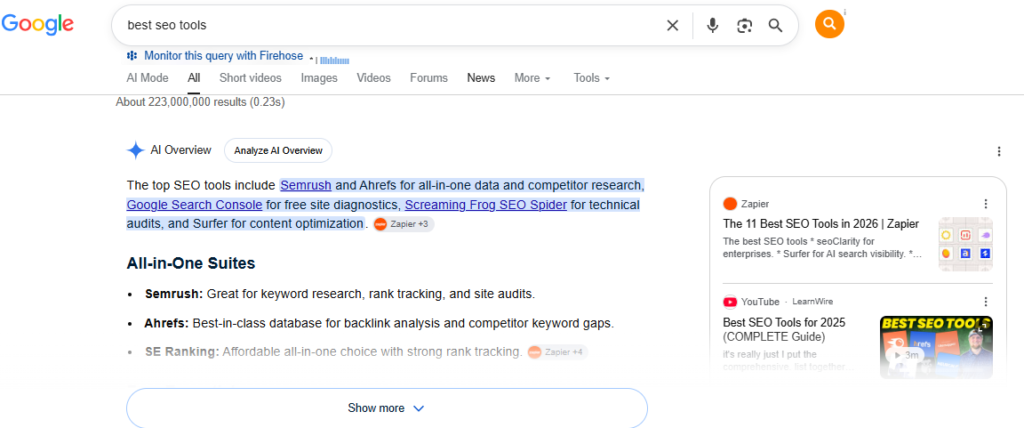
But SERP features should be treated as evidence, not instructions. Their presence does not mean every page needs to reproduce every format appearing in the results.
Compare the Top Results for a Dominant Pattern
After reviewing individual results, step back and look for agreement across the SERP.
Ask:
What are most of these pages helping the searcher do?
Then examine three practical dimensions:
Content type: Is Google primarily ranking guides, product pages, comparisons, tools, or something else?
Content format: Are the results tutorials, lists, checklists, reviews, templates, or another recognizable format?
Content angle: Are they emphasizing beginners, affordability, speed, comprehensiveness, recent information, a particular audience, or a specific use case?
If these signals consistently point in the same direction, the dominant intent is relatively clear.
If they do not, you may be looking at mixed search intent rather than a keyword that can be reduced to one simple label.
Validate Intent Against the Audience You Actually Serve
The SERP tells you what currently performs for the query, but it should not erase business context.
A SaaS company still needs to ask whether the people behind that query overlap with its ideal audience and whether satisfying the query creates a sensible relationship with the product, service, or broader content strategy.
A keyword can have clear intent and still be a poor target.
For example, a high-volume informational query may attract thousands of people who have no realistic connection to the problems your product solves. Another query with less demand may reach exactly the users your product team, sales team, or content strategy is built to serve.
Intent analysis therefore needs two validations:
Does this page match what the searcher expects?
and
Is this a searcher we have a useful reason to serve?
When both answers are yes, the keyword becomes much more than a traffic opportunity. It becomes a defensible content decision.
How to Map Search Intent to the Right Content Type
Identifying intent is only useful if it changes what you create.
Once a query has been analyzed, the next decision is not simply whether to target it. You need to decide which page should own that intent and what kind of content gives that page the best chance of satisfying it.
At this point, keyword research starts informing content strategy.
Match the Searcher’s Goal to the Page’s Job
Every page should have a primary job.
A guide may teach. A comparison can help someone evaluate alternatives. A review can examine one product in depth. A feature page explains a specific capability. A pricing page supports a purchase decision. A template or tool helps the visitor complete a task.
Problems appear when one page tries to perform too many of those jobs at once.
Consider these queries:
| Query | Likely searcher goal | Better content direction |
| what is technical SEO | Understand a concept | Educational guide |
| technical SEO checklist | Complete or follow a process | Practical checklist |
| best SEO audit tools | Evaluate options | Best-tools comparison |
| Semrush review | Evaluate one product | Product review |
| Semrush vs Ahrefs | Compare two solutions | Head-to-head comparison |
| Semrush pricing | Understand plans/cost | Pricing-focused page |
| SEO audit template | Use a resource | Template/resource page |
These keywords can all exist within the same broader SEO topic without belonging on the same page.
The deciding factor is not topical similarity. It is whether the searcher expects the same outcome from each query.
Map Keywords With the Same Intent to One Primary Page
Creating a separate URL for every keyword variation is rarely a useful content strategy.
Queries such as “search intent examples,” “examples of search intent,” and “search intent SEO examples” may use different wording while expressing essentially the same need. If the live SERPs confirm that they share the same dominant intent, one strong page can usually address them together.
The opposite is also true.
Two keywords can look semantically close while requiring different pages because their searchers are at different stages or expect different formats.
This gives keyword mapping a more useful rule:
Group keywords by shared intent and expected outcome, not simply by shared words.
Grouping keywords by shared intent can support broader, stronger pages without forcing unrelated search needs into the same content.
Decide Whether to Create, Update, or Reuse a Page
Finding a target keyword does not automatically justify publishing something new.
Before creating a URL, check whether the site already has a page capable of owning that intent.
There are three practical outcomes:
Create: No existing page serves the intent well, and the query deserves a distinct destination.
Update: A relevant page exists, but its format, depth, angle, or coverage no longer matches what searchers need.
Reuse: An existing page already targets the same underlying intent. Strengthening that page is more sensible than creating another URL around a keyword variation.
This decision becomes increasingly important as a content library grows. Without it, keyword research can quietly turn into URL production rather than useful coverage.
Keep One Clear Primary Intent Per Page
A page can satisfy related secondary needs, but it should still have a recognizable primary purpose.
For example, a Semrush review can include pricing, strengths, weaknesses, and alternatives because those details help someone evaluate the product. That does not mean the review should also try to replace a dedicated Semrush-vs-Ahrefs comparison, a general best-SEO-tools roundup, and every Semrush feature guide.
Those pages support different decisions.
Trying to make one URL rank for every related intent often creates a page that is comprehensive in length but unclear in purpose.
A better approach is to let each page own its primary intent while using relevant internal links to move readers toward the next question or decision.
Map Intent Across the SaaS Buyer Journey
Search intent has practical value when it changes what you decide to publish.
A SaaS prospect might move through searches such as:
Problem awareness:
“why is my website losing rankings”
↓
Learning:
“how to perform an SEO audit”
↓
Solution research:
“best SEO audit tools”
↓
Product evaluation:
“Semrush review”
↓
Comparison:
“Semrush vs Ahrefs”
↓
Action:
“Semrush pricing” or “Semrush free trial”
The same person will not necessarily make every search, and real journeys are rarely this linear. But the sequence exposes an important content gap: ranking for educational queries alone does not mean a website supports the later decisions that follow them.
For a SaaS content strategy, intent mapping can therefore reveal both what to publish and what is missing between existing pages.
A strong content journey does not require a page for every possible stage. It requires enough relevant coverage to move searchers from understanding a problem to evaluating an appropriate solution without unnecessary gaps or duplicate pages.
How to Build a Content Strategy Around Search Intent
Mapping intent at the keyword level solves only part of the problem. A content strategy also needs to account for how those intents connect across the site.
If every keyword is planned independently, a website can end up with dozens of individually relevant pages that do not form a useful system. Some topics receive several pages serving almost the same need, while important decision stages remain uncovered.
An intent-based content strategy starts with the audience’s problems and decisions, then assigns a clear role to each page.
Organize Topics Around Problems, Not Just Keyword Lists
Keyword research can reveal demand, but a spreadsheet of keywords is not yet a content strategy.
Start by identifying the broader problem or subject the audience is trying to understand. Then separate the searches around that problem according to what people need at different points.
For example, a SaaS SEO topic could contain searches around:
- understanding an SEO problem
- diagnosing its cause
- learning how to fix it
- finding tools that can help
- comparing available solutions
- evaluating a specific product
- taking an action
The resulting model is more useful than sorting keywords by search volume or difficulty alone.
Volume can help estimate demand. Difficulty can help assess competition. Intent determines what role the keyword can realistically play in the content strategy.
Segment Keywords by Search Intent Before Assigning URLs
Once related keywords have been collected, segment them according to the need behind the search.
A simple working model might look like this:
| Intent segment | Searcher need | Typical content role |
| Learn | Understand a topic or problem | Guide, explainer |
| Diagnose | Find the cause of a problem | Audit, troubleshooting guide |
| Solve | Complete a process | Tutorial, checklist |
| Evaluate | Research possible solutions | Best-tools page, alternatives |
| Compare | Choose between options | Comparison |
| Validate | Investigate one solution | Review, use case |
| Act | Complete the next step | Product, pricing, signup, template |
This segmentation is more detailed than placing every keyword into four broad labels. The traditional intent types still matter, but content planning often needs to distinguish between searches that technically share a category while serving different jobs.
“SEO audit” and “technical SEO checklist,” for example, can both carry informational intent while requiring different experiences.
Use Intent to Build Topic Clusters Without Creating Overlap
Topic clusters become useful when their pages expand coverage without repeatedly answering the same question.
A strong cluster might contain a broad resource supported by narrower pages for audits, checklists, tools, comparisons, reviews, and specific problems. Each page contributes something the others do not.
The cluster becomes weak when new URLs are created simply because another keyword variation exists.
Before assigning a keyword to a new page, ask:
Does this search require a different outcome from the pages we already have?
If the answer is no, the keyword may belong within an existing page.
If the answer is yes, determine what distinct job the new page will perform and how it connects to the rest of the cluster.
Giving each page a distinct job helps prevent topic clusters from turning into collections of near-duplicate articles.
Connect Informational Content to the Next Relevant Decision
Informational traffic has limited strategic value if every article becomes a dead end.
That does not mean every educational page needs an aggressive product CTA. It means the next step should make sense in relation to the problem the reader is already solving.
Someone learning how to identify keyword cannibalization may logically need a practical audit process next. A reader comparing SEO platforms may want an individual product review. Someone completing an audit may need a checklist, tool, or deeper guide for a problem the audit uncovered.
Internal links can support these transitions when they are based on intent progression rather than anchor-text opportunities alone.
The question changes from:
“Where can we insert another internal link?”
to:
“What is the most useful next question this reader is likely to have?”
That produces links that serve both site architecture and the reader’s journey.
Find Intent Gaps Across Existing Content
Intent mapping can also reveal what a website has not covered.
Imagine a SaaS site has ten educational articles explaining a problem but no comparison, review, use-case, or solution-focused content around it. The site may attract early-stage searches while providing little support for people who move closer to evaluating a solution.
The reverse can happen as well. A site may have product and pricing pages but lack the educational content that introduces the problems those products solve.
An intent gap therefore is not necessarily a missing keyword.
It can be a missing decision stage.
Reviewing a content library this way helps prioritize pages that connect existing coverage rather than continually expanding the site with unrelated topics.
Prioritize Content by Intent, Business Relevance, and Opportunity
Search volume alone is a weak publishing priority.
A lower-volume query can deserve attention when its intent closely matches the audience, connects naturally to the product or service, and fills an important gap in the existing content journey.
A higher-volume query may deserve less attention when the audience is too broad or the expected result has little relationship to the business.
A practical content decision therefore considers at least three factors together:
Search opportunity: Is there meaningful demand and a realistic search opportunity?
Intent fit: Can the website create the type of result the searcher actually wants?
Business relevance: Does serving this searcher support a problem, audience, or decision that matters to the business?
The strongest opportunities sit where those three factors overlap.
That is the difference between using search intent as another keyword label and using it to make content strategy decisions.
How to Optimize Content for Search Intent
A page can target the right topic and still underperform because its structure, depth, format, or emphasis does not match what searchers expect. This often happens when optimization is treated as keyword placement rather than as a content decision.
Intent-based search optimization works differently. The goal is to make the page the right response for the query before worrying about how often a phrase appears.
Match the Dominant Content Type
Start with the type of page Google consistently rewards for the target query.
If the SERP is dominated by educational guides, publishing a thin product page creates an obvious mismatch. If comparison pages dominate, a general informational article may explain the subject well without helping the searcher make the decision behind the query.
Common content types include:
- guides and tutorials
- list posts
- comparison pages
- reviews
- category pages
- product or feature pages
- landing pages
- tools and calculators
- templates or downloadable resources
Instead of copying the pages that rank, identify why their content type satisfies the query.
Once that is clear, you can compete within the expected format while making the page more useful.
Match the Content Format and Angle
Content type and content format are related, but they are not identical.
Two pages may both be informational guides while serving the searcher differently. One might be a beginner walkthrough, another a checklist, and another a technical framework for experienced practitioners.
The angle matters as well.
Consider a query around an SEO audit. Searchers might prefer:
a beginner-friendly walkthrough,
a complete technical process,
a downloadable checklist, or
a SaaS-specific audit framework.
The SERP helps reveal which interpretation currently dominates.
This is why matching intent should not produce ten nearly identical articles. The expected format provides the boundaries; your expertise, audience, examples, and depth provide the differentiation.
Answer the Primary Need Before Expanding the Topic
A common content mistake is delaying the answer while trying to establish context.
If someone searches for a definition, give them a clear definition early. If they want a process, make the process easy to find. If they are comparing two products, show the meaningful differences before burying them beneath several hundred words of background information.
Depth still matters, but depth should follow relevance.
A useful structure is:
Primary answer → necessary explanation → evidence or examples → deeper considerations → next action
This gives the reader an immediate reason to continue while leaving room for comprehensive coverage.
It also makes the page easier for search engines and AI-powered search experiences to interpret because the central answer is not hidden inside unnecessary setup.
Cover the Questions That Belong to the Same Intent
Comprehensive content does not mean answering every question related to a keyword.
It means covering the questions necessary to satisfy the searcher’s current goal.
Suppose someone searches for how to perform an SEO audit. Questions about crawlability, indexing, on-page issues, internal linking, and prioritizing fixes can belong naturally within that journey.
A detailed comparison of every SEO platform on the market probably does not.
Related searches, People Also Ask results, competitor headings, community discussions, and query data can all reveal useful subtopics. But each potential addition should pass one test:
Does answering this help the same searcher complete the same job?
If it serves a substantially different intent, it may deserve another page rather than another heading.
Optimize Titles and Descriptions for the Same Promise the Page Delivers
Intent alignment begins before someone clicks.
A title can attract the wrong searcher when it promises something the page does not actually provide. That can happen when a guide is presented like a comparison, a basic explainer is described as an advanced framework, or a page uses words such as “best,” “free,” or “template” without delivering what those modifiers imply.
The title, search snippet, introduction, and main content should therefore make the same promise.
For example:
“SEO Audit Checklist” suggests something actionable and scannable.
“What Is an SEO Audit?” suggests explanation and education.
“Best SEO Audit Tools” suggests evaluation and comparison.
They may share topical vocabulary, but they serve different expectations.
Matching those expectations is more important than forcing the same target phrase into every visible element.
Differentiate Without Breaking Intent
There is a difference between differentiation and changing the purpose of the page.
If Google consistently ranks step-by-step guides for a query, replacing the guide with an opinion essay simply to be different is unlikely to improve the result.
A better approach is to preserve the required job while improving how well you perform it.
For a SaaS-focused page, differentiation could come from:
- real SaaS scenarios
- clearer decision frameworks
- original screenshots or workflows
- stronger examples
- practical templates
- first-hand observations where genuinely available
- clearer explanations of trade-offs
- connections between SEO actions and business outcomes
The page remains aligned with the dominant intent, but it gives the reader a reason to prefer it.
Optimize for Mixed Intent When the SERP Supports It
Not every SERP has one clean purpose.
Some queries return guides, product pages, videos, forums, tools, and comparison content together. That usually indicates that Google is testing or satisfying more than one interpretation of the query.
Do not respond by trying to turn one page into every possible content type.
Identify the dominant need first, then decide whether a secondary need can be satisfied without weakening the page.
For example, an informational guide about search intent can explain the concept thoroughly while including practical examples and a framework for applying it. It does not need to become a software comparison simply because a commercial result appears somewhere on the SERP.
Mixed intent requires prioritization, not content sprawl.
Treat AI Overviews as Another Intent Signal
AI Overviews add another layer to intent analysis because they can reveal what Google considers answer-worthy for a query.
Look at what the overview tries to resolve immediately.
Does it define the topic? Present steps? Compare options? Summarize several interpretations? Surface examples?
Then compare that with the organic results underneath it.
If both emphasize the same need, the dominant intent is relatively clear. If the AI Overview answers one part of the query while organic results support several deeper tasks, the opportunity may lie beyond the basic answer.
For example, repeating a definition already summarized directly on the SERP provides limited additional value. A stronger page can give the searcher what the summary cannot easily provide: context, examples, decision criteria, workflows, evidence, or a complete process.
AI Overviews should be treated as evidence of what Google is already answering on the results page and what still requires a useful destination.
How to Measure Whether Your Content Actually Matches Search Intent
Publishing a page that appears to match search intent does not prove that the match is correct.
The SERP gives you evidence about what searchers are likely to want before publication. Performance data gives you another layer of evidence after the page begins appearing in search.
Until real search data arrives, your intent analysis is still a hypothesis.
A page may receive impressions but attract very few clicks. Another may earn clicks but fail to move users toward the next useful step. Rankings can also improve for queries you did not originally target, revealing an intent or audience that was not obvious during keyword research.
No single metric can confirm an intent match. Query data, rankings, clicks, engagement, and conversions need to be read together to see whether the page is attracting the right searchers and serving the purpose it was created for.
Start With the Queries the Page Is Actually Appearing For
The target keyword tells you what you intended the page to rank for.
Google Search Console shows you what Google is actually associating with the page.
Once a page has enough data, review its search queries and group them by the underlying need rather than looking only at individual keyword positions.
Imagine a SaaS article written as an educational guide begins receiving impressions for queries containing:
best, vs, pricing, alternative, or review.
That does not automatically mean the article should be converted into a commercial page. But it does show that Google is testing the URL against searchers who may have a different goal from the audience the page was originally designed to serve.
The opposite can happen as well. A commercially focused page may begin appearing heavily for “how,” “what,” or other educational searches.
Those patterns are useful because they expose the difference between intended intent and observed intent.
Planning content around search intent helps build stronger topical coverage while creating a clearer site structure.
CTR is useful, but interpreting it alone can be misleading.
A low click-through rate can result from an unattractive title, a weak position, strong SERP features, brand competition, or an intent mismatch. Similarly, a high number of impressions does not necessarily mean the page is successfully satisfying the query.
Look at the relationship between:
query → position → impressions → clicks → CTR
Suppose a page consistently ranks high enough to be visible for a group of queries but receives disproportionately few clicks.
That is worth investigating.
Open those queries in the current SERP and compare your result with what surrounds it. If users are being shown comparison pages while yours is a broad educational guide, the problem may be deeper than rewriting the title tag.
The page itself may be the wrong response.
This is also why CTR optimization should come after diagnosing the SERP. Improving the wording of a search snippet cannot fully repair a page-type mismatch.
Use Engagement as Supporting Evidence, Not a Standalone Verdict
What happens after the click can provide another signal.
Useful questions include:
- Do visitors continue into relevant pages?
- Do they interact with the part of the page that answers the query?
- Do they leave before reaching the core information?
- Do they take the next action the page was designed to support?
Analytics can help answer those questions, but engagement metrics need context.
A visitor who reads a concise definition and leaves may have received exactly what they needed. A visitor who spends several minutes on a comparison page but never reaches the comparison itself may represent a very different problem.
So a short session does not automatically mean poor content, just as a long session does not automatically mean strong intent alignment.
Interpret behavior against the job of the page.
Connect Intent to the Conversion That Makes Sense for That Stage
Not every search should produce the same conversion.
Someone asking an informational question may not be ready to start a trial. Someone comparing two SaaS products is much closer to a product decision. A branded pricing search may be closer still.
Measurement should reflect those differences.
For an informational page, useful outcomes might include moving to a related guide, exploring a relevant tool or feature, subscribing to a resource, or continuing deeper into the topic.
For commercial content, the next meaningful action might be viewing pricing, reading a product review, visiting a comparison page, or starting an evaluation.
For transactional searches, signup, demo, download, purchase, or another direct action may become the primary objective.
This prevents a common measurement mistake: declaring top-of-funnel content ineffective simply because it does not convert like a bottom-of-funnel page.
Intent determines not only what content should exist, but also what success should look like.
Look for Query Groups, Not Isolated Keyword Movements
One keyword moving from position 14 to position 9 tells you something about ranking.
It tells you much less about whether the page is satisfying the broader intent.
Instead, look for patterns across related queries.
If an article gradually gains visibility across a group of informational searches that share the same problem, Google may be developing a clearer understanding of the page.
If visibility starts spreading into a different intent category, investigate why.
That may reveal:
- a secondary intent worth supporting on the existing page
- a missing section
- a separate content opportunity
- an unclear page focus
- overlap with another URL
This makes query clustering useful after publication, not just during keyword research.
Watch for Intent Overlap Between Multiple Pages
Performance analysis can also reveal when two URLs are being tested for similar searches.
For example, a SaaS site might have an educational guide, a feature page, and a comparison article that occasionally appear for overlapping keyword groups.
Some overlap is normal.
The problem begins when Google repeatedly switches between URLs for queries that should have one clear destination, or when several pages compete without a meaningful difference in purpose.
Before merging, redirecting, or rewriting anything, compare the intent each page is supposed to serve.
The issue may be keyword cannibalization.
But it may also be poor intent mapping.
Two pages can discuss the same subject legitimately when one answers “how does this work?” and another answers “which option should I choose?”
The goal is not one page per topic. It is one clear purpose per page.
Build an Intent Measurement Loop
Search intent analysis should not end when the page is published.
A practical measurement loop looks like this:
Target intent → publish → collect query data → inspect SERP → evaluate clicks and behavior → compare intended vs. observed intent → improve only where evidence supports a change
This creates a feedback system between keyword research, content strategy, Search Console, analytics, and the live SERP.
It also reduces unnecessary updates.
If a page is attracting the expected query groups, maintaining visibility, and helping users take an appropriate next step, there may be no reason to restructure it simply because an SEO tool recommends additional keywords.
When the evidence shows a mismatch, however, the next question becomes more important:
Has the page always misunderstood the intent, or has the intent itself changed?
That is where content refresh and intent-shift analysis begin.
How to Update Existing Content When Search Intent Changes
A page can match search intent when it is published and become less aligned months later without anything being technically wrong with it.
The keyword may remain the same. The page may still be indexed. Its backlinks, internal links, and core topic may not have changed.
What changes is the search environment around it.
Google may begin favoring a different content format. Searchers may become more familiar with the topic and expect deeper answers. A query that once returned mostly educational guides may start showing tools, comparisons, product pages, forums, videos, or AI-generated summaries.
When that happens, adding another paragraph or updating the publication date is not a meaningful content refresh.
The first question should be:
Does this page still solve the same job that the current SERP suggests searchers want completed?
Recognize the Signals of a Possible Intent Shift
A ranking decline alone does not prove that search intent changed.
Rankings move for many reasons, including stronger competitors, technical problems, content quality, authority differences, algorithm changes, and normal SERP volatility.
Look for several signals appearing together.
A possible intent shift becomes more credible when:
- the dominant page type on the SERP has changed
- new SERP features begin occupying prominent positions
- different modifiers appear in the queries generating impressions
- Google starts testing your page for a different group of searches
- competitors with a different format consistently replace older results
- rankings decline despite the page remaining technically healthy and topically relevant
The important point is diagnosis.
Do not label every traffic decline an intent problem simply because “search intent” sounds like a plausible explanation.
Compare the Current SERP With the SERP Your Page Was Built For
When reviewing an older page, do not evaluate it only against its existing copy.
Run the target query again and inspect the current results as if you were researching the keyword for the first time.
Ask:
What types of pages dominate now?
What format do those pages use?
What angle appears repeatedly?
Which questions are being answered directly on the SERP?
Have videos, forums, tools, comparisons, or AI Overviews become more prominent?
Then compare those findings with the assumptions behind the existing page.
Suppose you originally published a long educational guide because most top results were tutorials. Six months later, the same query is dominated by templates and interactive tools.
The issue is no longer simply whether your guide needs another 500 words.
The SERP may be telling you that the preferred way of solving the problem has changed.
Separate Content Decay From Intent Mismatch
Content decay and intent mismatch can look similar in performance reports, but they require different fixes.
Content decay occurs when the page still serves the correct purpose but becomes less useful or competitive. Its examples may be old, screenshots outdated, statistics stale, explanations incomplete, or competitors simply better.
Intent mismatch occurs when the page is solving a different problem from the one the current searcher appears to have.
Each problem requires a different refresh strategy.
If the intent remains stable, improve the existing answer.
If the intent has shifted, reconsider the page type, format, angle, or role before expanding the copy.
Otherwise, you can spend hours making an outdated interpretation of the query more comprehensive.
Use Search Console to Compare Old and New Query Patterns
SERP analysis tells you what Google is currently displaying.
Your own query history can show whether the audience reaching the page has changed.
In Google Search Console, compare meaningful periods rather than looking only at the latest seven days. Review which query groups gained or lost impressions, whether new modifiers appeared, and whether visibility moved toward a different stage of the search journey.
For example, an article that historically received queries such as:
what is X
how does X work
X examples
might gradually begin receiving:
best X tools
X software
X pricing
X alternatives
That pattern does not prove a full intent shift by itself.
But combined with a SERP increasingly dominated by commercial pages, it becomes much stronger evidence that the search landscape is changing.
This is where historical first-party data can reveal something a one-time keyword report cannot.
Decide How Much of the Page Actually Needs to Change
Not every intent change requires rebuilding the URL from scratch.
The size of the update should match the size of the mismatch.
If the core intent remains intact but searchers now expect a clearer process, restructuring the guide may be enough.
If the expected format has shifted from a general guide toward a checklist, adding a usable checklist and reorganizing the page around it may solve the problem.
If the SERP has moved decisively from informational content to product or category pages, however, forcing an educational article to behave like a transactional page can create a worse experience.
At that point, the better decision may be to preserve the informational article and create or strengthen a separate page for the new intent.
A content refresh should therefore begin with page purpose, not word count.
Preserve What Is Already Working
Refreshing content does not mean rewriting everything.
Existing sections may already rank for useful long-tail queries, earn links, answer important questions, or move readers into relevant parts of the site.
Removing those sections simply because they look old can destroy value without improving intent alignment.
Before making major changes, identify:
- queries already generating useful visibility
- sections supporting those queries
- internal links pointing into and out of the page
- examples or assets still serving the reader
- parts of the page that already match the current SERP
Keep what continues to perform the intended job.
Change what no longer does.
A controlled update is usually more defensible than treating every refresh as a complete rewrite.
Recheck the Entire Search Promise After the Update
Intent alignment can break in small places even after the main content is improved.
Once the update is complete, review the page from the search result onward:
Title → meta description → H1 → introduction → primary answer → supporting sections → CTA
They should all serve the same dominant need.
For example, changing an article from a basic definition into a practical implementation guide while leaving a “What Is…” title can undersell what the page now provides.
The opposite is also possible: an aggressive commercial title can attract visitors expecting a buying decision when the page remains primarily educational.
A successful refresh aligns the entire promise, not just the body copy.
Measure the Updated Page Against the New Intent
After publishing the changes, do not judge the refresh immediately.
Allow enough data to accumulate, then repeat the measurement process:
query mix → impressions → rankings → CTR → relevant engagement → appropriate next actions
The comparison should answer two questions.
First:
Is Google associating the page more strongly with the intended query group?
Second:
Are the searchers arriving from those queries receiving a page designed for their actual goal?
If both improve, the update has stronger evidence behind it than a simple ranking increase.
If they do not, return to the diagnosis rather than automatically adding more content.
Content refresh should be iterative, but it should not become endless rewriting.
Search Intent Examples: Turning Queries Into the Right Content Decisions
Search intent becomes more useful when it changes an actual publishing decision.
Knowing that a keyword is “informational” or “commercial” is only the first layer. Two informational searches can require completely different pages, and two commercial searches can represent users at very different stages of evaluation.
Identifying the intent type is only the first step. The stronger question is: what is this person trying to accomplish, and what page would help them do it with the least friction?
The following examples show how these differences shape content strategy for SaaS and SEO websites.
Informational Intent: “What Is Keyword Cannibalization?”
Someone searching “what is keyword cannibalization” is primarily trying to understand a concept.
They may need to know what cannibalization means, why it happens, how to recognize it, and whether it is actually damaging their rankings.
A suitable page would usually be an educational guide rather than a product page.
But stopping at the definition would underserve many searchers.
A stronger page can move naturally from:
definition → symptoms → examples → diagnosis → fixes → prevention
That progression stays informational while helping the reader move from understanding the problem to doing something about it.
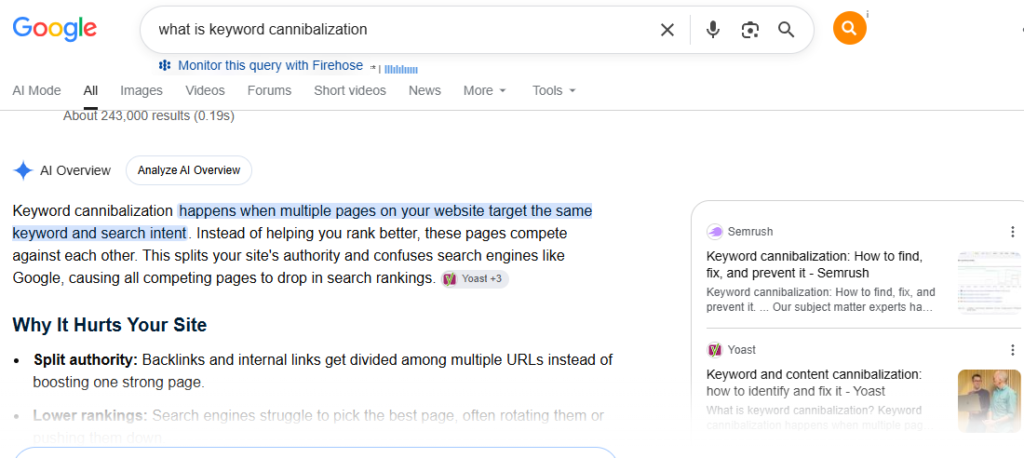
The CTA should respect that stage as well. Sending the reader immediately to a sales demo may be less useful than directing them toward an audit process, Search Console workflow, or another relevant educational resource.
Informational Action Intent: “How to Perform an SEO Audit”
This query is informational too, but the job is different.
The searcher does not primarily need a definition of an SEO audit. They want to perform one.
That changes the preferred format.
A practical response may need:
- a logical audit sequence
- clear checks
- instructions
- examples
- tools where necessary
- a prioritization method
- a checklist or repeatable workflow
An article that spends most of its opening explaining the history or importance of SEO audits can technically be relevant while still frustrating the searcher.
The intent label has not changed.
The expected actionability has.
This is why broad categories such as “informational” should guide analysis rather than replace it.
Commercial Intent: “Best Keyword Research Tools”
Now consider someone searching best keyword research tools.
They already understand that keyword research tools exist. Their immediate problem is choosing among them.
A definition-heavy guide would therefore miss the central job.
The page should help evaluate options through criteria such as:
use case, capabilities, limitations, pricing, workflow fit, and who each tool is best suited for.
The useful content format may include a shortlist, comparison table, individual evaluations, pros and cons, and clear recommendations for different users.
The searcher may still need educational information, but education supports the decision rather than becoming the purpose of the page.
That decision-focused structure is what turns a generic software list into useful commercial-intent content.
Comparison Intent: “Semrush vs Ahrefs”
A comparison query is even more specific.
The searcher has already narrowed the decision to two products. They do not need a broad roundup of every SEO platform available.
They need meaningful differences between those two options.
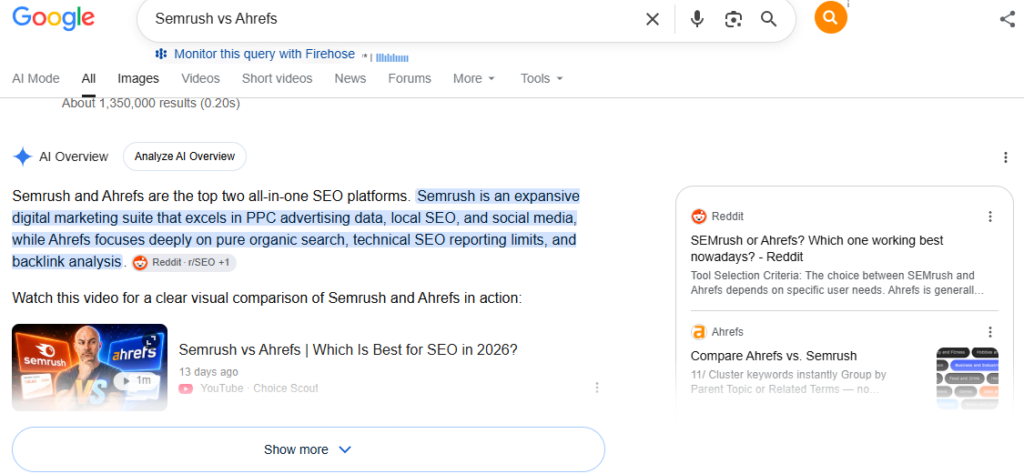
A useful comparison can organize the decision around:
keyword research → backlink analysis → technical SEO → rank tracking → usability → pricing → limitations → best fit
The important part is not declaring a universal winner.
A freelancer, an in-house SaaS SEO team, and an agency can value different capabilities. The page should make those trade-offs visible enough for each reader to reach an informed decision.
The intent therefore affects not only the page format but the editorial standard.
The content should reduce decision uncertainty.
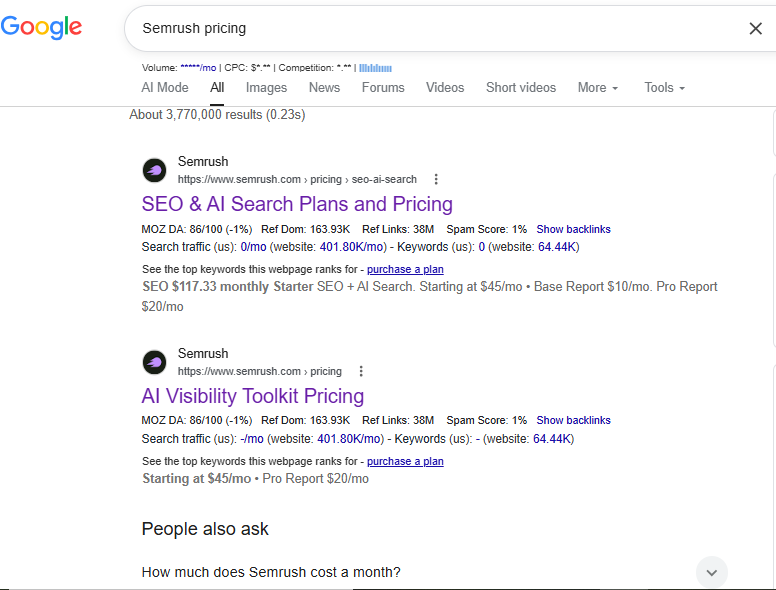
Transactional Intent: “Semrush Pricing”
A searcher using a query such as “Semrush pricing” is much closer to action.
They may want to know what plans cost, what each plan includes, whether limits apply, and which option fits their needs.
A 4,000-word general introduction to SEO software would create unnecessary friction.
The expected destination is more likely to provide pricing information quickly, followed by the details needed to make a purchase or signup decision.
This illustrates an important content-strategy boundary:
Not every keyword should become a blog article.
If the intent belongs more naturally to a product, feature, pricing, category, signup, or other commercial page, creating another informational article can produce unnecessary overlap inside the site.
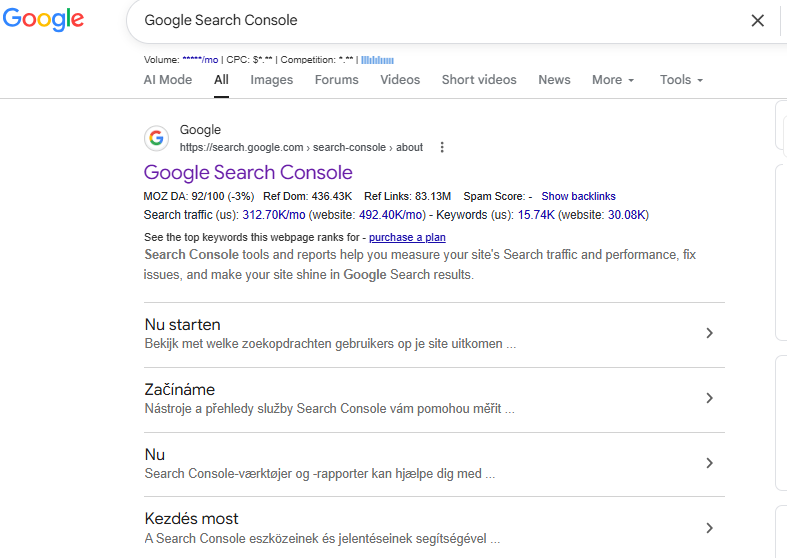
Navigational Intent: “Google Search Console”
Navigational intent can be more complicated than it first appears.
Someone searching for a brand or product name may simply want the official destination. In that situation, another website is unlikely to replace the navigational result.
But branded queries can also contain a secondary informational need.
Compare:
Google Search Console
Google Search Console indexing report
how to use Google Search Console
Google Search Console alternatives
The first can be strongly navigational.
The others progressively introduce informational or commercial jobs.
For keyword research, this changes how branded search volume should be interpreted. A high-volume branded query may still offer little realistic traffic opportunity for an independent content site.
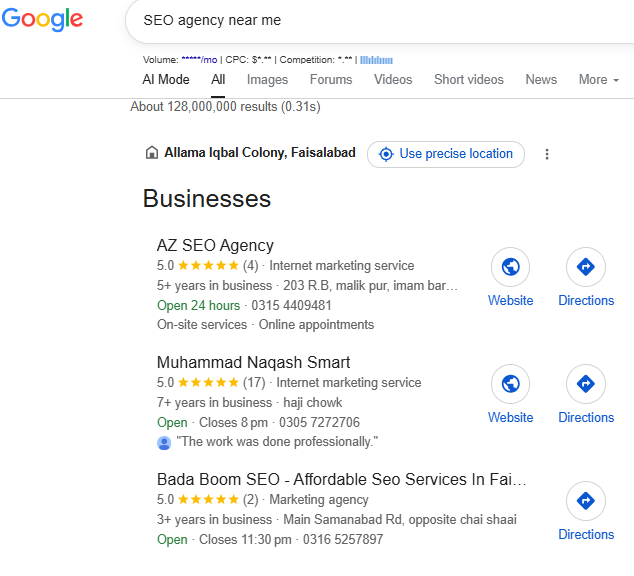
Local Intent: “SEO Agency Near Me”
Local search adds another dimension because location becomes part of the expected solution.
Someone searching “SEO agency near me” is not asking for a general explanation of what an SEO agency does.
They are looking for a provider within a relevant geographic area.
The SERP may therefore prioritize local results, business profiles, maps, service pages, directories, reviews, and location-specific pages rather than general educational articles.
Intent analysis should account for where the searcher expects the solution to exist, not only the information they want.
A national informational article cannot simply be optimized harder until it becomes the right local result.
Mixed Intent: “SEO Tools”
Broad queries often create the hardest decisions.
Someone searching “SEO tools” could want:
- a list of recommended tools
- a definition
- free tools
- a specific platform
- a comparison
- an actual tool they can use immediately
That ambiguity can produce a mixed SERP.
Instead of choosing an intent label from the keyword alone, inspect which interpretation Google currently gives the most visibility.
Then build for the dominant job while supporting secondary needs only where they fit naturally.
Trying to satisfy every possible interpretation can leave the page unfocused.
The Same Topic Can Support Multiple Pages Without Creating a Conflict
These examples reveal an important principle for larger content strategies.
A single topic can legitimately support several URLs when each URL serves a distinct search job.
For example:
SEO audit → complete educational process
SEO audit checklist → actionable checklist
Best SEO audit tools → commercial evaluation
SEO audit service → service/transactional page
The subject overlaps.
The intent does not.
Intent-based content planning helps strengthen both topical coverage and site architecture.
Instead of asking whether the site has already “written about SEO audits,” you ask whether each meaningful search need has an appropriate destination.
That approach also creates a clearer boundary between healthy topical depth and keyword cannibalization.
How Search Intent Connects Content Across the Buyer Journey
At the strategy level, search intent should shape how pages work together across the site.
At the page level, intent helps determine whether a query needs a guide, comparison, tool, feature page, or another format. At the strategy level, it helps answer a broader question:
Does the website have useful content for the different problems people search as they move from learning about an issue to evaluating and choosing a solution?
Segmenting by search intent makes content planning more deliberate.
Instead of building a calendar around keyword volume alone, you can group opportunities by the job the searcher is trying to complete and the stage at which that job occurs. The result is not a rigid funnel where every visitor follows the same path. It is a clearer way to identify which search needs the site already serves and which ones still have no appropriate destination.
Start With the Searcher’s Problem, Not the Funnel Label
It is tempting to begin by assigning every keyword to top, middle, or bottom of funnel.
That can make a spreadsheet look organized without necessarily improving the content strategy.
Start with the actual search need instead.
For an SEO SaaS company, those needs might include:
understanding a problem
“why did my organic traffic drop?”
learning a process
“how to track keyword rankings”
finding possible solutions
“SEO rank tracking tools”
evaluating options
“best rank tracker for agencies”
comparing finalists
“Semrush vs Ahrefs rank tracking”
evaluating a specific product
“Semrush Position Tracking review”
taking action
“Semrush pricing”
Only after identifying the job should you connect it to a broader journey stage.
This prevents the funnel model from overriding what the query itself is telling you.
Map Informational Searches to Problems and Processes
Informational content often creates the widest part of a site’s organic footprint.
But informational traffic is not automatically valuable.
An informational content strategy should focus on problems and processes that matter to the audience the business wants to reach.
For a SaaS SEO site, topics such as keyword research, technical SEO, internal linking, search intent, and SEO audits can make sense because the people learning those subjects may later need tools, comparisons, templates, or specialist help related to the same work.
The connection should be genuine.
Publishing high-volume educational content about unrelated subjects simply to increase traffic may improve pageview totals without strengthening topical relevance or bringing the site closer to its business goals.
Informational content works best when it creates a logical path into the rest of the site.
Use Commercial Intent to Support Evaluation
As the searcher becomes more solution-aware, their questions change.
They may move from:
“how to research keywords”
to:
“best keyword research tools”
and eventually:
“Semrush vs Ahrefs.”
These searches should not be treated as interchangeable keyword variations.
The first needs instruction.
The second needs option discovery and evaluation.
The third needs direct comparison.
Commercial content should therefore help users reduce uncertainty rather than simply repeat product descriptions.
Useful elements may include:
- selection criteria
- meaningful feature differences
- limitations
- pricing context
- use-case fit
- pros and cons
- decision tables
- alternatives
- clear recommendations for different user profiles
This is where reviews, comparisons, “best” lists, alternatives, and similar formats become part of the content architecture rather than isolated affiliate-style articles.
Give Transactional Intent an Appropriate Destination
The closer a query moves toward action, the less useful a general educational article may become.
Queries around:
pricing, demo, trial, buy, download, signup, or a specific service
often need a destination built for action.
For a SaaS company, that could be a pricing, product, feature, integration, demo, or signup page.
For a service business, it may be a service or consultation page.
SEO content planning needs a clear boundary: not every keyword belongs in a blog post.
Sometimes the correct SEO recommendation is to optimize an existing commercial page or create a missing landing page instead.
Intent mapping should decide the destination before the writing begins.
Connect Intent Stages With Internal Links
Once different search needs have their own pages, internal linking can connect them without forcing every page to perform every job.
Consider a simplified path:
SEO audit guide → SEO audit tools → tool comparison → individual review → product/pricing destination
Each page can remain focused on its primary intent while giving users a relevant next step when they are ready for it.
The same principle works in reverse.
A commercial comparison can link to an educational guide when a reader needs deeper context before making a decision.
Internal links therefore do more than distribute authority.
Used deliberately, they help connect related search jobs across the site.
The anchor and destination should make sense in the reader’s current context rather than being inserted only because two pages share a keyword.
Build Topic Clusters Around Search Jobs, Not Just Keyword Similarity
Traditional keyword clustering often groups phrases because they contain similar words.
Search intent adds another layer.
Consider these queries:
SEO audit
SEO audit checklist
SEO audit tools
SEO audit service
They clearly belong to the same broader topic, but that does not mean they belong on the same URL.
A strong cluster can contain several pages serving different jobs while still reinforcing one subject area.
For example:
Educational hub: how to perform an SEO audit
Action resource: SEO audit checklist
Commercial evaluation: best SEO audit tools
Transactional destination: SEO audit service
The cluster is connected semantically.
The pages are separated intentionally.
This is a more useful approach than merging keywords solely because a keyword tool places them in the same topical group.
Use an Intent Matrix to Find Content Gaps
Once existing and planned URLs are mapped, an intent matrix can expose gaps that a normal keyword list may hide.
A simple version could look like this:
| Topic | Learn | Do | Compare/Evaluate | Act |
| SEO audit | Guide | Checklist | Tools comparison | Service |
| Keyword research | Guide | Workflow | Best tools | Tool/product |
| Rank tracking | Explainer | Setup guide | Best trackers | Product/trial |
| Internal linking | Guide | Audit process | Tool evaluation | Service/tool |
The purpose is not to fill every cell.
Some topics genuinely do not need content at every stage.
The matrix is useful because it forces a better question:
Is there a meaningful search need here that our current site cannot satisfy?
If the answer is no, leave the cell empty.
That restraint matters. Search-intent planning should reduce unnecessary content, not manufacture reasons to publish more of it.
Prioritize Gaps by Business Relevance and Ranking Opportunity
Finding an intent gap does not automatically make it worth targeting.
A useful prioritization process can consider:
Audience relevance: Is this actually a problem our intended reader has?
Intent fit: Can we provide the type of page the SERP expects?
Business relevance: Is there a logical connection to our product, service, or expertise?
Organic opportunity: Is ranking realistically achievable?
Existing coverage: Do we already have a URL that should own this search need?
Journey value: Does this page create a useful entry point or next step within the broader site?
This prevents a common content-strategy mistake: prioritizing a keyword simply because its volume is attractive and difficulty score looks manageable.
A lower-volume query that reaches the right audience at an important decision point can be strategically more useful than a larger keyword with little connection to what the site actually offers.
Do Not Force Every Searcher Through the Same Funnel
Search journeys are rarely linear.
Someone can discover a brand through a comparison page, visit a technical guide next, return through a branded search, and only later investigate pricing.
Another person may already understand the problem and begin directly with a product comparison.
Search intent should shape a network of connected destinations rather than force every searcher through the same sequence.
The objective is to make the appropriate page available when a searcher needs it and provide sensible paths to adjacent information or actions.
A useful intent-based content strategy therefore resembles a network more than a straight funnel:
different entry points → clear page purposes → relevant connections → appropriate next actions
That structure is better suited to how people actually research complex SaaS and business-software decisions.
How to Measure Whether Your Content Actually Matches Search Intent
Publishing a page that appears to match search intent is only the first test.
The stronger test begins after the page starts appearing in search.
A SERP analysis can tell you what Google currently prefers. Keyword research can suggest the likely intent. Competitor pages can reveal common formats and angles. But none of those signals can tell you exactly how your own page will perform once real searchers begin seeing and using it.
That requires performance data.
The goal is not to find one metric that proves an intent match. There is no reliable “search intent score” that can reduce user satisfaction to a single number. Instead, look for patterns across impressions, rankings, clicks, query coverage, engagement, and conversions.
Together, those signals can show whether the page is attracting the searchers it was designed for — and whether it is helping them complete the job behind the query.
Start With Google Search Console Query Data
Google Search Console is one of the most useful places to validate intent because it shows the actual queries for which Google is displaying your page.
Open the page in the Performance report and review its query data rather than looking only at total clicks and impressions.
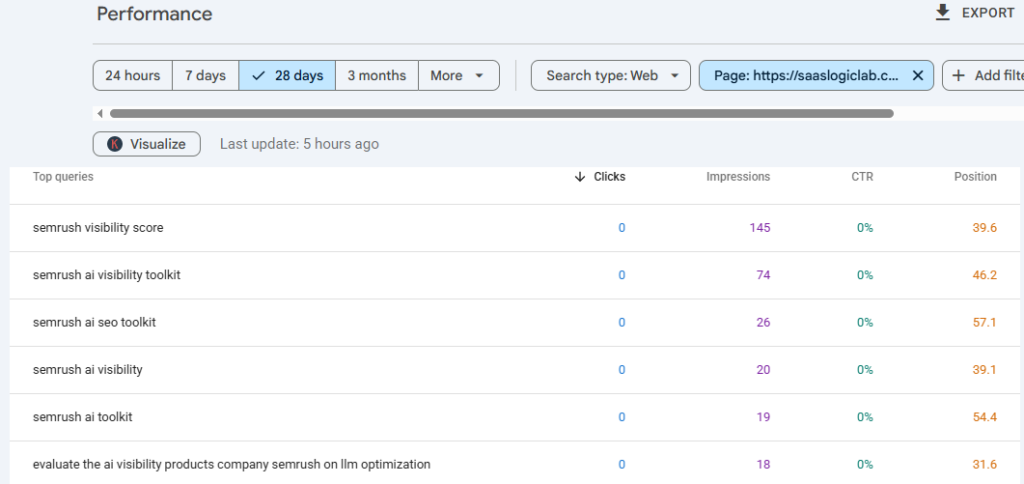
Ask:
- Which queries are generating the most impressions?
- Are those queries consistent with the page’s intended purpose?
- Is Google testing the page for searches you did not originally target?
- Are different intent patterns beginning to appear?
- Which queries receive impressions but very few clicks?
- Which queries are moving closer to page one?
Suppose you publish an educational guide about conducting an SEO audit.
You expect informational searches such as:
how to do an SEO audit
SEO audit checklist
how to audit a website for SEO
But the page begins receiving substantial impressions for:
best SEO audit tools
SEO audit software
SEO audit service
That does not automatically mean the page is badly optimized.
It tells you something more useful: Google may be associating the page with several adjacent search needs.
Your next decision should not be to insert those phrases repeatedly into the article.
Instead, compare their SERPs.
If the commercial queries consistently return software lists, product pages, or tool comparisons while the informational queries return guides, you may be looking at separate intents that deserve separate destinations.
Search Console therefore becomes more than a reporting tool. It can expose intent overlap and help refine the site’s keyword-to-page mapping after publication.
Read Impressions and Rankings Together
Impressions without context can be misleading.
A growing impression count may mean that Google is expanding the number of queries for which it tests the page. That can be encouraging, particularly for a newer URL.
But more impressions do not necessarily mean the page is satisfying intent.
Consider two situations.
Page A receives increasing impressions while its relevant queries gradually move from positions 40–50 toward positions 15–20.
Page B receives increasing impressions across many loosely related queries but remains buried for the searches the page was actually created to answer.
Both pages gained visibility.
Only one shows a clear pattern of improving relevance for its intended search need.
Historical first-party data can reveal changes that a one-time keyword report cannot.
Use CTR as a Clue, Not a Verdict
Click-through rate can help reveal whether the search result looks relevant to the searcher, but CTR should not be interpreted in isolation.
A low CTR can result from:
- a weak title
- an unclear meta description
- low ranking position
- strong competing brands
- ads
- featured snippets
- AI-generated answers
- other SERP features
- or a genuine mismatch between the query and the page
That distinction matters.
If a page ranks in a weak position, low CTR is hardly surprising.
If it ranks prominently, receives substantial impressions, and still earns very few clicks compared with what the SERP environment would reasonably allow, inspect the result more closely.
Does the title communicate the same job the searcher is trying to complete?
Does the description reinforce that expectation?
Does the page type match the surrounding results?
CTR is therefore a diagnostic signal.
It can tell you where to investigate, but not automatically what is wrong.
Check What Happens After the Click
Search Console shows what happens before and around the click.
Your analytics data helps examine what happens afterward.
The important question is not simply whether someone stayed on the page for a long time.
Different intentions create different behaviors.
A visitor looking for one specific definition may get the answer quickly and leave. Another person comparing software may spend considerably longer reviewing tables, features, pricing, and alternatives.
So a short visit is not automatically a failure, and a long visit is not automatically a success.
Instead, evaluate behavior in the context of the page’s intended job.
Depending on the page, useful signals may include:
- engagement with important sections
- navigation to related pages
- tool or template usage
- comparison interaction
- pricing-page visits
- trial or demo actions
- form submissions
- downloads
- other relevant conversions
The measurement should follow the intent.
If an informational guide successfully answers the question and moves a portion of relevant readers into a deeper resource, it may be doing its job even if it does not generate immediate conversions.
Measure Different Intent Types Differently
Applying the same KPI to every page can distort content decisions.
An informational article, commercial comparison, and transactional landing page exist for different reasons.
A simple measurement framework can look like this:
| Intent | Primary question | Useful signals |
| Informational | Did we answer the searcher’s problem? | Relevant query growth, rankings, clicks, engagement, next-page movement |
| Commercial | Did we help the searcher evaluate options? | Commercial query visibility, comparison engagement, product/review visits, assisted conversions |
| Transactional | Did we help the searcher act? | Qualified organic visits, signup/demo/purchase actions, conversion rate |
| Navigational | Did users reach the expected destination? | Branded visibility, correct landing page, successful navigation |
| Mixed/Hybrid | Are we satisfying the dominant need while supporting secondary needs? | Query segments, section engagement, next actions, changing SERP composition |
The table is not a universal scoring model.
Its purpose is to prevent a common mistake: judging every organic page by traffic alone.
Traffic measures reach.
Intent-aware measurement asks whether the right searchers reached the right page and could do what they came there to do.
Segment Queries Before Drawing Conclusions
Page-level averages can hide useful information.
Suppose one URL ranks for 80 queries.
Twenty are informational. Thirty are commercial. The remaining queries are loosely related variations.
Looking only at the page’s average position, CTR, or engagement combines several different search behaviors into one number.
Segmenting by search intent gives you a clearer view.
You can group queries into categories such as:
Informational
Commercial
Transactional
Navigational
Mixed or uncertain
Then compare how each group performs.
This can reveal that a page performs well for its intended informational queries but poorly for commercial searches.
That is a very different diagnosis from:
“This page has a low CTR.”
The first diagnosis can lead to a useful content or architecture decision.
The second is merely an observation.
Look for Intent Mismatch Patterns, Not One Bad Metric
A search intent mismatch becomes more convincing when several signals point in the same direction.
For example:
Signal The page receives impressions for a valuable query but rankings stop improving.
Signal The dominant SERP contains a different page type.
Signal The title and content angle solve a different problem from the top results.
Signal Relevant visitors rarely use the page in the way its intended journey suggests.
One signal alone may have several explanations.
Several aligned signals create a stronger case for investigation.
Before rewriting the page, return to the live SERP and ask whether the search need itself has changed or whether the original intent classification was wrong.
That prevents unnecessary updates based on noisy data.
Build an Intent Dashboard for Important Pages
You do not need an elaborate reporting system for every URL.
For strategically important pages, however, a small intent dashboard can make changes easier to spot.
Track:
Primary target query
Dominant intent
Expected page type
Top query groups
Impressions
Clicks and CTR
Ranking direction
Relevant conversion or next action
Current SERP composition
Last intent review date
This turns intent analysis into an ongoing SEO process rather than a one-time label added during keyword research.
The dashboard can be maintained in a spreadsheet, reporting platform, or whichever system your team already uses.
The tool matters less than maintaining a consistent record of what the page is supposed to satisfy and whether the evidence still supports that assumption.
Separate an Intent Problem From a Content-Quality Problem
This distinction can prevent unnecessary rewrites.
A page may match the correct intent and still perform poorly.
Perhaps competitors provide stronger evidence, clearer examples, better organization, more current information, or substantially more useful answers.
In that case, changing the page type would solve the wrong problem.
The reverse can also happen.
You may have an exceptionally detailed 5,000-word guide, but if the dominant SERP expects a free tool, comparison page, or product category, adding another 1,000 words is unlikely to repair the fundamental mismatch.
Before updating underperforming content, diagnose the problem in this order:
1. Is the target query still relevant to the page?
2. Does the page match the dominant intent?
3. Does it use an appropriate content type, format, and angle?
4. Is the content itself competitive and useful?
5. Are technical or authority limitations affecting performance?
Only then decide what needs to change.
That order separates intent optimization from the habit of treating every ranking problem as a writing problem.
How to Ensure Updated Content Still Matches Search Intent
Updating old content is often treated as a maintenance task: replace outdated statistics, add a few sections, refresh screenshots, change the year in the title, and republish.
That can improve freshness.
It does not necessarily improve relevance.
Before updating a page, the more important question is whether the searchers arriving for its target query still want the same thing they wanted when the page was originally created.
Search intent can change.
Google may begin favoring a different content type. A query that once returned mostly educational guides may start showing tools or product pages. A commercial SERP may shift toward comparisons. New SERP features can change how much information users expect before clicking. In some cases, the intent does not completely change but becomes broader, narrower, or more mixed.
A content refresh should begin by revalidating search intent before any rewriting starts.
Recheck the Live SERP Before Updating the Page
Do not assume that the SERP you researched six or twelve months ago still represents the current search need.
Search the primary keyword again and compare the current results with the type of page you already have.
Look at:
- the page types ranking near the top
- recurring content formats
- dominant angles
- SERP features
- People Also Ask questions
- videos, tools, forums, or comparison results
- how much commercial content appears
- whether AI Overviews are present
- whether different interpretations of the query coexist
Rechecking the SERP is not about copying the pages that currently rank. It is about seeing whether the query now calls for a different kind of answer.
Suppose your page is a detailed informational guide, but the current SERP is increasingly dominated by interactive tools.
Adding another 1,500 words may make the guide more comprehensive without making it more appropriate.
The problem would not be freshness.
It would be format.
Compare Current Queries With the Queries the Page Used to Attract
The SERP shows what currently ranks.
Your own search data can show whether the audience reaching the page has changed.
In Google Search Console, compare meaningful periods rather than looking only at the latest totals.
Review:
Queries gained — searches that now trigger the page but previously did not.
Queries lost — searches for which visibility has declined or disappeared.
Queries growing — searches receiving substantially more impressions.
Queries declining — previously important searches losing visibility.
Query mix — whether informational, commercial, transactional, or other intent patterns are becoming more prominent.
A page may still receive similar total impressions while the composition underneath those impressions changes considerably.
For example, imagine an article originally attracted mostly:
how to choose an SEO tool
what SEO tools do I need
Over time, its visibility shifts toward:
best SEO tools
Semrush vs Ahrefs
SEO tools pricing
Total visibility alone might hide the change.
The new query mix suggests stronger commercial evaluation intent.
That evidence should influence the update.
Determine Whether the Intent Changed or the SERP Simply Improved
A different-looking SERP does not automatically mean search intent has changed.
Sometimes competitors simply create better pages.
The right fix depends on which problem the SERP reveals.
If the intent remains informational but newer results provide clearer explanations, stronger examples, updated evidence, better visuals, or more useful workflows, you probably have a content-quality gap.
If the SERP has shifted from guides toward comparison pages, free tools, category pages, videos, or another fundamentally different result type, you may have an intent or format gap.
Ask:
Has the user’s goal changed?
Are other pages simply satisfying the same goal better?
Do not rebuild the page until you can answer that question.
Revalidate Content Type, Format, and Angle
A useful refresh audit can return to three practical dimensions:
Content type:
Is Google favoring a blog post, product page, category page, landing page, comparison, tool, or something else?
Content format:
Does the query favor a tutorial, checklist, list, template, review, definition, calculator, comparison table, or step-by-step workflow?
Content angle:
What specific perspective appears to matter now — beginner-friendly, free, enterprise, 2026, SaaS-specific, fast, comprehensive, or another qualifier?
These signals should guide the update, but they should not turn the page into a clone of the current top results.
Matching intent means satisfying the same underlying need.
Differentiation determines why your page deserves to be chosen among the other results satisfying it.
Preserve What Already Works
Content refreshes can damage useful sections when everything is rewritten simply because the page is old.
Before changing the page, identify what already performs.
That may include:
- queries holding strong positions
- sections earning impressions for valuable long-tail searches
- passages that answer recurring questions clearly
- internal links supporting other important pages
- original examples
- useful tables or workflows
- sections that contribute to conversions or deeper site visits
Keep those elements unless the evidence gives you a reason to change them.
A content update should not mean:
old page → rewrite everything
A safer model is:
preserve → remove → improve → add → restructure
This makes the refresh more deliberate and reduces the risk of replacing useful content with newer but less effective wording.
Update Missing Needs, Not Just Missing Keywords
Competitor research during a refresh often produces a long list of terms your page does not contain.
That list can be useful.
But missing words are not necessarily missing value.
Instead of asking:
“Which keywords haven’t we used?”
ask:
“Which relevant searcher needs does the current page fail to satisfy?”
If several current results explain how to validate intent using live SERPs, and your article only defines the four intent types, the gap is not the phrase live SERP analysis.
The gap is the process itself.
Add the process.
The related language will usually follow naturally.
This is a better basis for updating content than inserting terms merely because an optimization tool marks them as absent.
Account for AI Overviews and Changing SERP Features
Traditional organic listings are no longer the only elements shaping how users experience many search results.
Depending on the query, searchers may encounter:
- AI Overviews
- featured snippets
- People Also Ask
- video results
- forums
- local results
- product results
- comparison modules
- other interactive SERP features
These features can change what users learn before they ever reach an organic page.
That does not mean every page needs to be rewritten specifically for an AI Overview.
It means the SERP itself provides more context about what Google believes users may need.
If a query repeatedly surfaces concise definitions, comparison tables, step sequences, or follow-up questions, your page should make the relevant information easy to understand and retrieve — while still offering enough original value to justify the click.
For a content refresh, therefore, SERP-feature analysis belongs alongside traditional competitor analysis rather than being treated as a separate SEO tactic.
Handle Mixed Intent Without Turning One Page Into Everything
Some updated SERPs reveal several legitimate needs at once.
You might see educational articles, commercial comparisons, videos, tools, and product pages competing around the same broad topic.
The wrong response is to combine every possible intent into one enormous page.
Instead, identify:
Primary intent — the main job your page should perform.
Secondary intent — an adjacent need that can reasonably be supported without changing the page’s purpose.
Separate intent — a sufficiently different need that deserves another URL.
For example, an informational article about keyword research can briefly explain what users should look for in a keyword research tool.
It does not necessarily need to become a full “best keyword research tools” roundup.
If that commercial need is substantial enough, a dedicated comparison article can satisfy it more effectively and link naturally from the informational guide.
That creates clearer content architecture instead of forcing several jobs onto one URL.
Know When Not to Update
A ranking decline is not automatically a signal to rewrite content.
Before making a major update, rule out other explanations:
- indexing problems
- crawling issues
- internal-link changes
- technical problems
- stronger competitors
- lost links or authority
- seasonality
- SERP volatility
- declining demand
- cannibalization
- changes elsewhere on the site
If intent is stable and the content still satisfies it well, rewriting the page may introduce unnecessary risk.
Sometimes the correct content decision is:
leave the page alone.
That is still an optimization decision when it is based on evidence rather than neglect.
Use a Repeatable Search Intent Refresh Workflow
For important organic pages, the process can be kept simple:
1. Review the page’s original target query and intended audience.
2. Search the target keyword and inspect the current SERP.
3. Identify the dominant content type, format, angle, and SERP features.
4. Compare current Search Console queries with an earlier period.
5. Check whether the page is attracting the same intent or a different query mix.
6. Separate intent changes from content-quality, technical, and authority problems.
7. Preserve sections that are already performing well.
8. Update genuine information and user-need gaps.
9. Recheck internal links and page relationships if the site’s content architecture has changed.
10. Measure the page again after enough new search data accumulates.
This turns content refreshing into a diagnostic process rather than a scheduled rewrite.
The objective is not to make every page look newer.
It is to make sure the page still deserves to exist in its current form for the search need it is supposed to satisfy.
A Practical Search Intent Framework for Building Better SEO Content
Search intent becomes practical when it guides what you publish, which page targets a query, and how that page should serve the searcher.
Knowing that a keyword is informational, commercial, transactional, navigational, local, or mixed is helpful, but the label itself does not tell you what to publish, which URL should target the query, or whether an existing page still deserves to rank for it.
The practical value comes from connecting intent to the rest of the SEO process.
A useful workflow looks like this:
Query → Search intent → Live SERP → Content type → Page mapping → Content creation → Performance data → Intent revalidation
Each stage answers a different question.
Skip one, and it becomes easier to make the wrong content decision even when the keyword itself looks promising.
1. Start With the Searcher, Not the Keyword Volume
Keyword metrics help determine whether an opportunity deserves investigation.
They should not determine the page by themselves.
Before deciding what to create, ask what someone using the query is actually trying to accomplish.
Do they need to:
- understand something?
- solve a problem?
- compare alternatives?
- evaluate a product?
- reach a specific website or page?
- complete an action?
- find something locally?
This gives you an initial intent hypothesis.
It is deliberately only a hypothesis.
The keyword wording can provide clues, but the live search results should validate what Google currently interprets as the dominant need.
2. Validate the Intent Against the Live SERP
Search the keyword before deciding on the content format.
Look beyond the titles of the top results.
Examine:
Content type — guides, product pages, comparisons, category pages, tools, videos, or other results.
Content format — tutorials, lists, definitions, templates, reviews, checklists, calculators, or step-by-step processes.
Content angle — beginner, enterprise, free, SaaS, local, current-year, quick, comprehensive, or another recurring perspective.
SERP features — AI Overviews, People Also Ask, featured snippets, videos, forums, local results, and other features that reveal additional search needs.
Then ask a simple question:
Would the page I am planning look naturally useful on this SERP?
If the answer is no, do not rely on keyword optimization to repair the mismatch later.
Change the content decision first.
Map the Query to the Right Page Before Writing
Once the intent is clear, decide where the query belongs.
That may mean creating a new page.
It may also mean assigning the keyword to an existing page that already satisfies the same need.
This step matters because keyword research without page mapping can produce several URLs aimed at slightly different phrases but essentially the same searcher.
For a SaaS website, the mapping might look like this:
| Search need | Likely page |
| Learn how a problem works | Educational guide |
| Learn how to complete a task | Tutorial or workflow |
| Compare several solutions | Best-tools or alternatives page |
| Compare two specific products | Product-vs-product comparison |
| Evaluate one product | Review |
| Understand a capability | Feature or solution page |
| Evaluate cost | Pricing page |
| Start using the product | Signup, demo, or product page |
These are starting points, not fixed rules.
The SERP remains the stronger evidence.
A query that sounds informational may produce commercial results, while an apparently commercial phrase may still have a strong educational component.
4. Decide Whether One Page Can Satisfy the Intent
Not every keyword needs its own URL.
If several keywords represent the same underlying goal and the SERPs substantially overlap, one strong page may satisfy them together.
If the search needs differ, separating them usually creates a clearer experience.
Intent analysis also helps prevent keyword cannibalization by showing when multiple pages are competing for the same search need.
Creating multiple articles merely because the wording of the keywords differs can leave several pages competing for the same job.
The opposite mistake is equally damaging: forcing unrelated intents into one oversized page because the keywords belong to the same broad topic.
The decision should be based on searcher need and SERP overlap, not keyword similarity alone.
5. Build the Content Around the Job the Searcher Needs Done
After the page has been mapped, content creation becomes more focused.
An informational page should make the explanation or solution easy to reach.
A comparison should make meaningful differences easy to evaluate.
A review should help someone decide whether the product fits their situation.
A transactional page should remove unnecessary friction between the search and the intended action.
Search intent becomes part of content strategy when it shapes more than keyword classification.
The heading structure, examples, tables, screenshots, calls to action, internal links, and level of detail should all support the job of that particular page.
Do not add a section simply because competitors have it.
Ask whether the section helps this searcher make progress.
6. Support Primary Intent Without Ignoring the Next Question
A page can satisfy one dominant intent while still anticipating what the user may need next.
Someone learning how keyword cannibalization works may eventually need instructions for finding competing URLs.
Someone conducting an SEO audit may need a more focused internal linking audit. Someone researching SEO software may move from a broad tools roundup to a direct Semrush vs Ahrefs comparison.
Those transitions are useful for both users and site architecture.
They also give internal links a clearer purpose.
Instead of inserting links because two articles share a keyword, connect pages when one resource represents a logical next step in the searcher’s journey.
The result is a connected content system rather than a collection of isolated posts.
7. Publish, Then Validate the Original Assumption
Intent analysis does not finish when the article goes live.
Once the page starts receiving impressions, compare the original strategy with actual search data.
Look at:
- which queries trigger the page
- which query groups are growing
- where rankings are improving
- whether the expected audience is reaching the page
- whether users continue to relevant next steps
- whether commercial or transactional actions occur where appropriate
Use real performance data to test whether the page still supports the intent you originally assigned to it, rather than reacting to every new query Google discovers.
If it does, strengthen what works.
If it does not, investigate why before rewriting anything.
8. Revalidate Intent When the SERP Changes
Search intent should not become a permanent label in a keyword spreadsheet.
Recheck important queries when:
- rankings decline unexpectedly
- the query mix changes
- CTR changes materially
- competitors with different page types begin replacing older results
- new SERP features appear
- the page is scheduled for a substantial refresh
Then determine whether you are seeing:
the same intent with stronger competition,
a change in preferred format or angle,
or
a genuine shift in what searchers appear to need.
Those situations should not receive the same response.
Sometimes the page needs better content.
Sometimes it needs restructuring.
Sometimes another URL should handle the emerging intent.
And sometimes nothing should be changed.
Search Intent Content Strategy Example: From Keyword to Page Decision
Consider a SaaS SEO site researching these queries:
SEO audit
SEO audit checklist
Best SEO audit tools
Technical SEO checklist
Internal linking audit
They belong to the same broad SEO-audit topic, but that does not make them one search intent.
A practical mapping could be:
| Query | Likely need | Content decision |
| SEO audit | Learn or perform a broad audit | Comprehensive SEO audit guide |
| SEO audit checklist | Follow a repeatable process | Checklist/workflow |
| Best SEO audit tools | Evaluate software options | Commercial tools comparison |
| Technical SEO checklist | Audit technical issues specifically | Dedicated technical SEO guide |
| Internal linking audit | Diagnose site-linking structure | Dedicated internal linking audit |
Now the site can cover the broader topic without asking every URL to compete for the same purpose.
The pages can also support one another.
The broad SEO audit guide can direct readers toward the technical checklist when they reach technical diagnostics, and toward the internal linking audit when they need to examine site structure in greater depth.
That is search intent content strategy in practice:
not simply identifying what a query means, but deciding which page should satisfy it, what that page should contain, and where the user should be able to go next.
Conclusion
Search intent is not another field to fill in after keyword research.
It is the connection between a query and the page you choose to create for it.
Start with the searcher’s goal. Validate that assumption against the live SERP. Identify the content type, format, and angle users currently expect. Map the query to the most appropriate page instead of automatically creating another article. Then build the content around that page’s specific job.
After publication, use real query and performance data to test whether the decision was correct.
And when rankings or search results change, do not immediately rewrite the content. Recheck the intent first.
That creates a more disciplined SEO process:
Research the query → understand the need → validate the SERP → choose the page → satisfy the intent → measure the result → revalidate when the evidence changes.
The objective is not to create the most content around a keyword.
It is to create the right page for the reason the search happened.