
SEO Content Strategy: How to Plan Content That Ranks in 2026
Publishing more content does not automatically create a stronger search presence.
A website can publish every week, build large keyword lists, and still end up with dozens of pages competing for similar searches, attracting the wrong audience, or generating traffic that has little connection to business goals. The problem is usually not the lack of content. It is the lack of clear decisions behind that content.
An SEO content strategy is a system for deciding what search-focused content should exist, who it should serve, which search need each page should own, how related pages should connect, and how performance should be measured and improved over time.
That makes SEO content strategy different from keyword research or SEO writing.
Keyword research can show that demand exists. It cannot decide whether a keyword deserves a new page, belongs on an existing URL, should be grouped with related queries, or is worth targeting at all.
Writing can turn an approved idea into a useful page. It cannot decide whether that page should have been created in the first place.
A complete strategy has to make those decisions before content production begins.
This guide covers that process from end to end: defining business goals and audience needs, auditing existing content, finding search opportunities, validating intent, mapping keywords to the right URLs, building topic clusters without unnecessary cannibalization, prioritizing content, creating briefs, publishing and distributing pages, and using real search data to decide what should be updated, consolidated, or left alone.
The goal is not to publish the most content.
It is to build the right content system for the searches and users that matter.
What Is an SEO Content Strategy?
An SEO content strategy is the decision-making framework behind the content you create for organic search.
It connects audience problems, search demand, search intent, business value, page ownership, content creation, internal linking, and performance data so that every important page has a defined purpose.
That distinction matters because finding a keyword and writing an optimized article is not, by itself, a strategy.
For example, imagine keyword research uncovers five phrases:
- SEO content strategy
- content strategy for SEO
- SEO and content strategy
- content SEO strategy
- SEO content strategies
Creating five articles simply because five keywords exist would be a keyword-led publishing process. A strategy first asks a different question:
Do these searches represent five different needs, or are they different ways of expressing the same need?
If the intent substantially overlaps, one strong page may be the better decision. If one query represents a genuinely different problem or stage of the search journey, it may deserve its own page.
This is where strategy begins: not with how many keywords you can target, but with deciding what content should exist and what job each page should perform.
SEO Content Strategy vs. SEO Writing
SEO writing operates at the page level.
Once a page has been approved, SEO writing helps turn the idea into content that is clear, useful, well structured, and aligned with the searcher’s need. That can involve the page outline, headings, terminology, internal links, supporting evidence, examples, title tag, and other on-page elements.
SEO content strategy operates one level above that.
Before asking how should we write this page?, it asks:
Should this page exist at all?
It determines the opportunity, intended audience, search intent, page purpose, relationship with existing content, business relevance, and how the page fits into the wider site.
A well-written page can still be a poor strategic decision if another URL already satisfies the same search need.
That is why SEO writing should execute the strategy rather than replace it.
SEO Content Strategy vs. Content Marketing Strategy
SEO and content strategy overlap, but they are not interchangeable.
A broader content marketing strategy can include newsletters, social posts, webinars, videos, reports, podcasts, sales enablement material, thought leadership, and other content that may have little or no organic-search objective.
An SEO content strategy focuses specifically on opportunities connected to search discovery and the pages needed to serve them.
The two should still support each other.
A useful research report, for example, might originate from a broader content marketing initiative but later earn links, support several search-focused pages, provide original evidence, and strengthen the site’s wider topical coverage.
So the distinction is not SEO versus content marketing. The important question is what role a particular piece of content is expected to play.
| Area | SEO Content Strategy | SEO Writing | Content Marketing Strategy |
| Primary decision | What search-focused content should exist? | How should an approved page be written? | What content should the business create and distribute? |
| Starting point | Audience need + search opportunity + business value | Approved topic/page brief | Audience + marketing/business objectives |
| Scope | Site, topic, cluster, and URL level | Individual page | Multiple channels and formats |
| Search intent | Core decision input | Used to shape the page | Relevant when search is a channel |
| Page ownership | Critical | Usually already decided | Not always required |
| Keyword research | Opportunity and demand evidence | Supports page coverage | One possible research source |
| Main output | Content map and prioritized decisions | Search-focused page | Broader content program |
| Success | Search visibility plus meaningful business outcomes | Page fulfills its intended search need | Channel-specific marketing outcomes |
What a Real SEO Content Strategy Should Decide
A usable strategy should produce decisions, not simply a spreadsheet full of keywords.
For every meaningful opportunity, you should eventually be able to answer:
Who is searching?
What problem, question, comparison, or task brought that person to search?
What are they actually trying to accomplish?
The wording of the query matters, but the underlying intent matters more.
Does the opportunity deserve a page?
Some keywords justify new content. Others belong inside an existing page, overlap with another URL, or are not valuable enough to pursue.
Which URL should own the search need?
Without clear ownership, teams can unintentionally create several pages trying to satisfy essentially the same intent.
Where does the page fit in the wider topic?
A page should not exist in isolation when users naturally need related information before or after it.
Why does the opportunity matter to the business?
Traffic potential alone does not tell you whether a topic can attract the right audience, support a product or service, generate demand, or contribute to another meaningful objective.
How will you know whether the decision worked?
The strategy needs a feedback loop using search visibility, queries, engagement where useful, conversions, and other metrics appropriate to the page’s job.
This changes the workflow from:
Keyword → Article → Publish
into:
Audience problem → Search demand → Intent → Existing-page check → Page decision → Priority → Content → Distribution → Measurement → Improvement
That second workflow is the foundation we will use throughout this guide.
A Common Practitioner Problem: Strategy Becomes a Publishing Calendar
One recurring problem in SEO practitioner discussions is that a “content strategy” eventually becomes a list of keywords attached to publication dates.
The calendar says what will be published on Monday and Thursday, but it does not explain why those pages deserve to exist, whether another URL already covers the need, how the pages relate to one another, or what result would make each page successful.
A publishing calendar is useful for execution.
It is not the strategy itself.
The strategy should determine the decisions first. The calendar should organize their execution afterward.
Step 1 — Define Business Goals, Audience, and Success
Keyword research can tell you that people are searching for a topic. It cannot tell you whether winning that search would matter to your business.
That decision has to come first.
Before building a keyword list or content calendar, define three things: what the business needs from organic search, which audience matters, and what outcome would make the content successful.
Without those decisions, a content team can make perfectly reasonable SEO choices and still spend months building traffic that has little commercial value.
Start With Business Outcomes, Not Search Volume
Search volume is useful for estimating demand. It is a poor substitute for deciding what deserves priority.
Consider a B2B SaaS company selling technical SEO software. It finds two potential topics:
| Opportunity | Monthly Search Volume | Business Relevance |
| What is SEO? | 100,000+ | Low |
| Technical SEO audit software | 500 | High |
The larger keyword can bring substantially more traffic. But many of those searchers may be students, beginners, job seekers, or people looking for a basic definition.
The smaller topic has less traffic potential, but the person searching for it is much closer to a problem the product can solve.
That does not automatically make the 500-volume keyword the winner either.
You still need to check search intent, ranking feasibility, existing site coverage, and what currently ranks. The point is that volume alone cannot make the decision.
Before approving a topic, define the business outcome it could support:
- Build awareness among a relevant audience
- Establish authority around a commercially important problem
- Introduce potential customers to a product category
- Capture comparison or solution research
- Generate qualified leads, trials, demos, or sales
- Support existing customers with useful search content
A topic that does none of these may still be worth publishing, but there should be a clear reason for doing it.
This prevents a common planning mistake: treating every high-volume keyword as an opportunity.
Define the Audience and the Problems They Search For
A useful audience definition needs more detail than:
“Our audience is marketers.”
That description gives a writer almost nothing to work with.
A content strategist needs to know who has the problem, what situation creates the search, what the person already understands, and what decision they need to make next.
For example:
Audience: SEO manager at a growing SaaS company
Situation: The company has published dozens of articles, but organic growth has stalled
Problem: Existing pages overlap, topic coverage is inconsistent, and the team does not know what to publish next
Search behavior: Content audit, keyword cannibalization, content gap analysis, SEO content strategy, topic clusters
Desired outcome: Decide what to keep, update, consolidate, and create
That gives you something actionable.
It also changes keyword research.
Instead of starting with thousands of phrases and trying to invent reasons to publish them, you can start with real audience problems and use keyword data to determine how those problems appear in search.
This is also where non-keyword sources become useful.
Search Console queries can reveal the language people already use to find your pages. Sales conversations can expose objections and recurring questions. Customer-support tickets can show where users get stuck. Reddit, Quora, LinkedIn, YouTube comments, and specialist communities can expose questions that keyword databases flatten into numbers or miss entirely.
These sources do not replace keyword research. They add context to it.
A recurring question in a community is not automatically evidence that it deserves a dedicated SEO page. It is a clue worth investigating against search demand, intent, existing content, and business relevance.
That distinction keeps community research useful without turning anecdotes into SEO rules.
Choose KPIs That Match the Page’s Job
Not every SEO page should be judged by the same metric.
A top-of-funnel educational guide and a bottom-of-funnel comparison page perform different jobs. Expecting both to generate demos at the same rate would distort the analysis.
Define the page’s job first. Then choose the measurements.
| Page Job | Useful Primary Measures | Supporting Measures |
| Build search visibility | Relevant impressions and ranking/query coverage | Organic clicks |
| Answer an informational problem | Qualified organic visits | Engagement and onward journeys |
| Build topical coverage | Visibility across the target topic | Internal discovery and supporting query growth |
| Support consideration | Visits from relevant commercial searches | Product/service page progression |
| Capture demand | Qualified conversions | Conversion rate and assisted conversions |
| Refresh an existing page | Recovery/growth in relevant queries and clicks | Change in conversions or downstream actions |
The word relevant matters.
Ten thousand impressions across unrelated queries can look impressive in a report while contributing almost nothing to the page’s intended purpose.
The same problem appears with rankings. A page may rank for hundreds of related queries even when many of those queries were never explicitly targeted. That does not mean the content strategy is working.
A better measurement question is:
Is this page becoming more visible for the search needs we intentionally built it to serve, and is that visibility producing the outcome we expected?
That question gives the team something useful to evaluate after publication.
It also creates a baseline for later decisions. When Search Console data starts coming in, you can compare the queries Google associates with the page against the search need the page was supposed to own.
If those two things diverge, the data becomes diagnostic rather than just another dashboard number.
Step 2 — Audit Existing Content Before Creating More
Before adding another page to a site, check what is already there.
This sounds basic, but it changes the quality of almost every decision that follows. A keyword may look like a new opportunity in a research tool while an existing page already covers most of the same search need. Creating another URL at that point can split the topic across multiple pages instead of strengthening the page you already have.
The audit is not simply a list of published URLs. Its purpose is to answer a more useful question:
What does the site already own, and what should happen to each existing page before we create anything else?
Inventory Existing Pages by Topic and Intent
Start with a content inventory, but do not stop at URL, title, and traffic.
For each indexable content page, record enough information to understand its current role:
| Field | What to Record | Why It Matters |
| URL | Current canonical URL | Identifies the page being evaluated |
| Page title / H1 | Current topic | Shows how the page positions itself |
| Primary topic | Main subject covered | Helps group related content |
| Search intent | Informational, commercial, transactional, etc. | Reveals pages serving similar needs |
| Intended audience | Who the page is for | Separates superficially similar topics |
| Page job | Educate, compare, convert, support, etc. | Connects content to business purpose |
| Target search need | The problem the URL should own | Exposes ownership conflicts |
| Current queries | Relevant GSC queries | Shows how Google currently associates the page |
| Performance | Impressions, clicks, conversions where applicable | Gives context for later decisions |
| Internal links | Important incoming/outgoing contextual links | Shows how the page fits into the site |
| Initial action | Keep, investigate, update, consolidate, or remove from plan | Creates an audit queue |
Do not make final decisions from this spreadsheet alone.
A page with low traffic is not automatically bad. It may target a small but commercially important query. A page with high traffic is not automatically successful either; it may be attracting searches that have little relationship with the business.
The inventory gives you the map. The next step is finding where that map conflicts with itself.
Identify Content Gaps, Overlap, and Cannibalization
These are three different problems and should not be treated as one.
A content gap exists when an important audience need or search opportunity is not adequately served by the site’s current content.
Overlap occurs when multiple pages cover some of the same subject matter. That can be perfectly reasonable. A broad technical SEO guide and a dedicated crawlability guide will naturally share concepts.
Cannibalization needs a closer diagnosis. Two URLs mentioning the same keyword does not automatically mean there is a problem.
The useful question is whether multiple pages are competing to perform essentially the same search job.
Suppose a site has:
- /seo-content-strategy/
- /seo-content-planning/
- /seo-content-marketing-strategy/
Their titles look different.
But if all three explain the same process, target substantially the same intent, answer the same questions, and appear for overlapping query groups, the distinction may exist mainly in the wording—not in what the pages actually do.
Now consider:
- /seo-content-strategy/
- /seo-content-brief-template/
Both belong to the same topic. They may even share keywords. But the first can teach the complete planning system while the second serves someone who specifically needs a working brief template.
That is topical overlap with different page jobs.
This distinction prevents two opposite mistakes: consolidating pages merely because they share terminology, and creating separate pages merely because keyword tools list different phrases.
When reviewing potential overlap, compare at least four things:
- Search intent: Are searchers trying to accomplish the same task?
- SERP overlap: Do substantially the same types of pages appear for both query sets?
- Page purpose: Would the two URLs give the reader meaningfully different outcomes?
- Existing query data: Are multiple site URLs already receiving impressions for the same relevant query group?
None of these signals should be used mechanically. Together, they tell you whether the site has a coverage gap, legitimate supporting pages, or an ownership problem that deserves investigation.
Decide What Should Stay Before Deciding What to Add
After the audit, resist the urge to turn every finding into a new article.
For each opportunity, first compare it with the site’s existing content.
An existing URL may already have relevant history, internal links, backlinks, query impressions, or useful material. If it can satisfy the intended search need with a focused update, creating a second page may add work without adding useful coverage.
At this stage, use a preliminary decision set:
Keep — The page has a clear job and still serves it well.
Update — The page owns the right search need, but its information, structure, evidence, or coverage needs improvement.
Investigate overlap — Another URL may be serving substantially the same intent. Compare both before changing either.
Consolidate candidate — Two or more pages appear to perform the same job and may be stronger as one resource. Do not merge them until their queries, traffic, links, conversions, and intent have been reviewed.
Gap / possible new page — The audience has a useful search need that existing pages do not adequately satisfy.
Ignore for now — Search demand exists, but the opportunity does not justify resources yet.
Notice that “create” is not the default answer.
It is one possible outcome of the audit.
The final Create / Update / Reuse / Consolidate / Ignore framework comes after opportunity research and search-intent validation. At this point, the audit’s job is narrower: understand the site’s existing coverage well enough that new keyword research does not happen in isolation.
That creates a cleaner starting point for the next step.
Instead of asking:
“What else can we publish?”
you can ask:
“What important search need is still unresolved by what we already have?”
Step 3 — Find SEO Content Opportunities
Once you know what the site already covers, you can look for new opportunities without treating every keyword as a publishing assignment.
The starting point is not a keyword database. It is the set of problems your audience needs to solve.
Keyword tools come next. They help you measure whether those problems appear in search, how people describe them, how demand branches into related searches, and what competing pages already serve.
This order matters. Starting with a massive export and filtering it only by volume and difficulty can produce a clean spreadsheet while losing the connection between the search and the person behind it.
A better research process moves through four layers:
Audience problem → Search demand → Real questions → Competitive coverage
Each layer answers a different question.
Start With Audience Problems and Topics
Begin with the problems that are close enough to your business that solving them would make sense for your site.
For a SaaS SEO business, that could include problems such as:
- Choosing the right SEO software
- Finding keywords worth targeting
- Diagnosing declining organic performance
- Auditing technical SEO issues
- Planning content around search demand
- Preventing keyword cannibalization
- Improving internal linking
- Measuring search performance
These are problem areas, not final article titles.
That distinction gives you room to investigate before deciding what should become a page.
Take keyword cannibalization as an example. Someone researching that problem may need to:
- understand what cannibalization actually is;
- determine whether their site has it;
- find competing URLs;
- distinguish harmful competition from normal keyword overlap;
- choose between updating, merging, redirecting, or leaving pages alone.
Those needs can generate several keyword variations, but they should not automatically generate several URLs.
At this stage, create a simple problem map:
| Audience Problem | What the Searcher May Need | Possible Search Territory |
| Content is not growing | Diagnose why | content audit, content performance, content decay |
| Pages target similar topics | Diagnose overlap | keyword cannibalization, competing pages |
| Team does not know what to publish | Build a plan | SEO content strategy, content planning |
| Important pages feel isolated | Improve relationships | internal linking, topic clusters |
| Rankings exist but results are weak | Measure performance | GSC analysis, SEO KPIs |
The right-hand column is a research territory, not a confirmed content plan.
That comes later.
Use Keyword Research to Measure Search Demand
Now take those problem areas into a keyword research tool.
This is where metrics such as search volume, keyword difficulty, intent, trend, CPC, and related queries become useful. They add evidence to an opportunity, but none of them should make the publishing decision alone.
Consider this keyword set as an example:
| Keyword | Volume | KD | Intent |
| seo content strategy | 4,400 | 43 | Informational |
| seo content marketing strategy | 2,400 | 55 | Informational |
| content marketing strategy for seo | 1,300 | 52 | Informational |
| content strategy seo | 1,000 | 40 | Informational |
| content marketing seo strategy | 1,000 | 46 | Informational |
| seo and content strategy | 880 | 27 | Informational |
| content strategy and seo | 880 | 33 | Informational |
| seo content strategies | 720 | 26 | Informational |
| content seo strategy | 590 | 27 | Informational |
| content strategy for seo | 590 | 32 | Informational |
| b2b seo content strategy | 170 | 34 | Informational |
| seo content strategy template | 170 | 37 | Informational |
| what is seo content strategy | 140 | 24 | Informational |
There are thousands of searches across these terms, but the list does not justify thirteen articles.
Several phrases are simply different ways of expressing closely related needs.
The useful work is therefore not collecting more keywords indefinitely. It is understanding their relationships.
For each promising term, record:
Demand: Is there meaningful search activity?
Intent: What does the searcher appear to expect?
Relevance: Does solving this problem make sense for the business and audience?
Specificity: Is this a distinct need or a variation of a broader one?
Existing coverage: Does the site already have a page capable of serving it?
SERP evidence: What kind of page is Google currently returning for the query?
The keyword tool helps discover the opportunity.
It does not own the final decision.
Research Questions Beyond SEO Tools
Keyword databases are useful because they turn search behavior into measurable data. They are less useful at explaining the context behind every search.
That is why the research process should extend beyond them.
Google Search Console
For an existing site, Search Console can expose opportunities that generic keyword research cannot.
Look for:
- relevant queries generating impressions but few clicks;
- unexpected queries attached to existing pages;
- groups of related queries growing around a topic;
- pages appearing for searches they were not deliberately designed to serve;
- queries sitting close enough to stronger visibility that an existing page deserves investigation.
The value here is that these are not theoretical keywords. They are searches for which Google is already displaying your pages in search results.
Do not automatically rewrite a page because one unusual query appears in the report. Look for meaningful patterns.
Reddit and Quora
Community discussions are useful for discovering frustration, confusion, objections, edge cases, and the language practitioners actually use.
For SEO content strategy, recurring concerns include questions such as:
- How do I know which keywords deserve separate pages?
- Should similar keywords be grouped into one article?
- How much content should a site publish?
- Should I update an existing article or create a new one?
- How do I build topical authority without creating overlapping pages?
- Why is content getting impressions but not meaningful traffic or leads?
Those questions are valuable because they expose the decisions people struggle with after basic keyword research is finished.
But community popularity is not search-volume evidence.
A Reddit thread with hundreds of comments may reveal a useful pain point without justifying a dedicated organic-search page. Take the language and problem back into keyword research and the SERP before making that decision.
YouTube
YouTube is particularly useful when the topic involves a workflow.
A written competitor may tell you what to do, while a video often reveals the actual sequence: which tool is opened first, which filters are applied, what gets exported, where judgment is required, and what the practitioner ignores.
For content-strategy research, that can expose missing practical steps for:
keyword discovery → clustering → SERP review → briefing → writing → publishing → measurement.
Use those observations to make the article more executable, not to copy another creator’s workflow.
LinkedIn and Medium
LinkedIn can expose how practitioners and teams frame current problems. Medium and other long-form practitioner platforms can provide deeper explanations of workflows, failures, experiments, and strategic trade-offs.
Their strongest contribution is often not a new SEO “fact.”
It is perspective.
For example, practitioner discussions repeatedly distinguish traffic from qualified traffic. That can tell you that an article focused only on increasing sessions would leave an important user concern unanswered.
Treat that as a research clue. Any factual claim that follows still needs appropriate evidence.
Analyze Competitors for Missing Needs, Not Missing Words
Competitor analysis becomes weak when it is reduced to:
Competitor A used this heading, so we should use it too.
The objective is not to assemble every heading already ranking on Google.
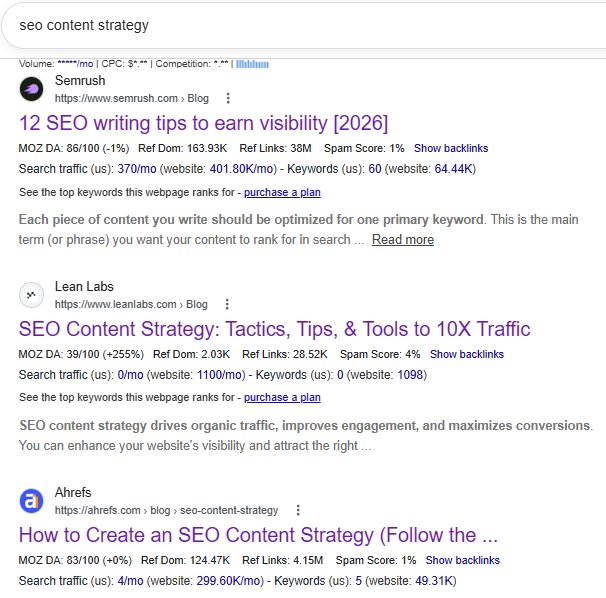
It is to understand what the current SERP satisfies well, what it handles superficially, and what useful decision remains difficult after reading it.
Most SEO content strategy guides already cover much of the expected foundation:
- definitions of SEO content strategy;
- audience and search intent;
- keyword and topic research;
- topic clusters and pillar pages;
- content calendars;
- on-page optimization;
- content creation;
- measurement;
- updates;
- tools;
- AI and changing search behavior.
Those subjects cannot simply be removed. They form part of the searcher’s expected coverage.
The opportunity is to improve what happens between them.
A reader can understand keyword research and still not know whether three similar terms require one page or three.
They can understand content audits and still not know whether an existing URL should be kept, rewritten, consolidated, or replaced.
They can understand topic clusters and still create several supporting pages with nearly identical jobs.
They can track traffic and rankings without knowing whether the queries appearing after publication match the search need originally assigned to the page.
Those are decision gaps.
They are more valuable than finding another synonym competitors forgot to mention.
Use a competitor-gap sheet like this:
| Competitor Covers | Depth | User Question Still Unresolved | Opportunity to Add Value |
| Keyword research | Strong | Which terms actually deserve pages? | Add page-decision framework |
| Topic clusters | Strong | How do we prevent cluster overlap? | Map each URL to a distinct search need |
| Content audit | Moderate | Update, consolidate, or create? | Add explicit decision criteria |
| Content calendar | Strong | What earns a place on the calendar? | Make strategy precede scheduling |
| Measurement | Strong | Are we ranking for the intended need? | Add post-publish query-group review |
| AI | Increasing | Which decisions should remain human? | Separate operational assistance from strategic judgment |
This is how competitor research should shape content decisions.
Match the intent where competitors are already correct. Add depth where the user’s decision is still unresolved.
That produces a qualified pool of opportunities.
The next step is to validate what those searches actually mean before deciding how many pages they require.
Step 4 — Validate Search Intent Before Choosing a Page
Finding a keyword is not the same as understanding what the searcher expects.
Two phrases can look similar in a keyword tool and still require different pages. The opposite is also true: several different phrases can represent the same underlying need and belong on one URL.
That is why search intent has to be validated before page creation.
The practical question is not:
“What does this keyword mean?”
It is:
“What kind of result would naturally satisfy the person using this query, and does that result belong on an existing page or a new one?”
Analyze the SERP’s Content Type, Format, and Angle
Start with the live results.
Look at three things separately.
Content type tells you what kind of page is ranking:
- guide
- tutorial
- comparison
- review
- category page
- product page
- landing page
- tool
- template
- video
Content format tells you how that page delivers the answer:
- step-by-step process
- checklist
- list
- definition
- framework
- case study
- calculator
- downloadable resource
Content angle tells you how the topic is positioned:
- beginner
- advanced
- B2B
- SaaS
- enterprise
- free
- current-year
- practical
- fast
- comprehensive
These distinctions matter because intent is not fully captured by a label such as “Informational.”
A keyword can be informational and still require a very specific result format.
For example:
“what is seo content strategy” likely needs a concise explanation first.
“seo content strategy template” may still have informational intent, but the expected outcome is much more practical. A user searching for a template is probably not satisfied by a long definition-only article.
That is why intent analysis should influence the page itself, not simply a column in a spreadsheet.
The important distinction is this: the keyword label does not tell you what to publish, which URL should own it, or whether an existing page already fits the need.
Use SERP Features as Intent Evidence
The standard organic results are only part of the SERP.
Look at the additional features around them.
These can include:
- AI Overviews
- People Also Ask
- videos
- forums
- featured snippets
- image results
- shopping or product results
- local results
- other SERP modules
The purpose is not to copy every feature.
Use them to identify secondary needs and preferred ways of consuming the answer.
If videos repeatedly appear prominently in the SERP, demonstration may be an important part of satisfying the query.
If People Also Ask contains several implementation questions, the searcher may need more than a definition.
If forums are visible, users may be looking for practical opinions or edge cases that polished editorial pages are not answering well.
If templates or tools dominate, publishing another long explanatory article may be the wrong page type entirely.
A useful test is:
Would the page we are planning look naturally useful on this SERP?
If the answer is no, changing keyword placement later will not solve the underlying mismatch.
Change the content decision first.
Validate content type, format, angle, and SERP features before mapping the query to a page.
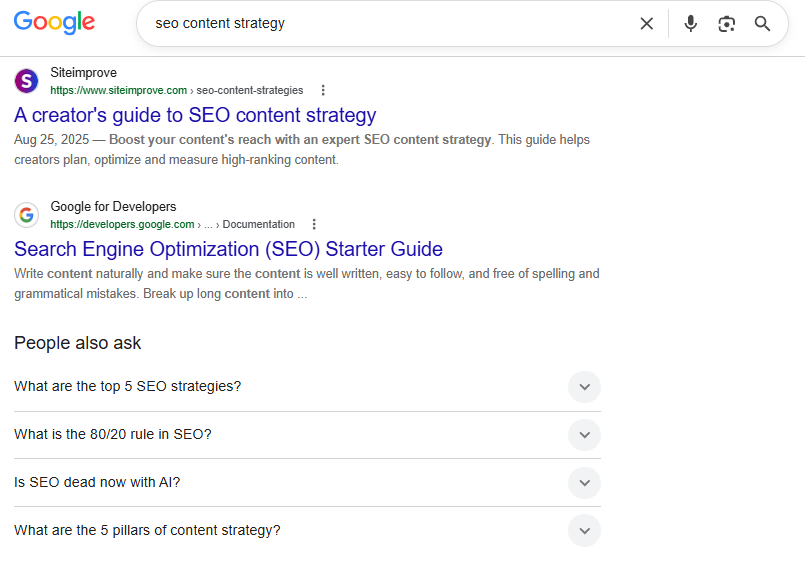
Group Keywords by Shared Intent and Expected Outcome
This is where keyword clustering becomes strategic.
Do not group phrases only because the words overlap.
Group them when the searcher appears to want the same result.
Take these researched terms:
- seo content strategy
- seo and content strategy
- content seo strategy
- content strategy for seo
- seo content strategies
They use different wording, but if the live SERPs show substantially the same result type, format, and purpose, one strong page can usually address them together.
Creating a separate URL for every variation would add pages without adding a new user outcome.
Now compare that with:
- seo content strategy
- seo content strategy template
- b2b seo content strategy
These are related, but the expected outcome may differ.
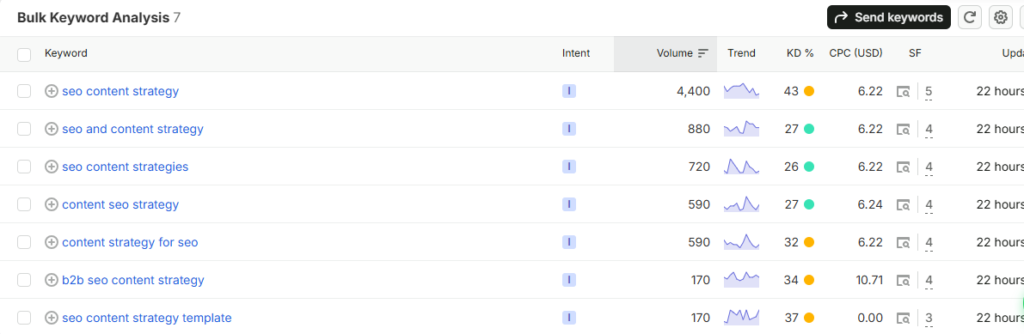
A template query can justify a reusable asset or dedicated template section.
A B2B variation may require buyer-journey, qualified-demand, and commercial-context coverage.
Whether those deserve separate URLs or sections should depend on SERP overlap and searcher outcome, not wording alone.
The practical rule is:
group keywords by shared intent and expected outcome, not simply by shared words.
Stop One-Keyword-One-Page SEO
One-keyword-one-page thinking creates two common problems.
The first is unnecessary duplication.
A site finds several variations of the same search need and publishes a page for each one. The pages end up competing for similar queries, repeating the same explanations, and making internal linking harder to organize.
The second is the opposite problem.
A site sees several keywords inside one broad topic and forces them all into one oversized page, even though the searches represent different jobs.
For example:
| Query | Likely Job | Better Content Direction |
| what is technical SEO | Understand the concept | Educational guide |
| technical SEO checklist | Follow a process | Checklist |
| best SEO audit tools | Compare options | Commercial comparison |
| Semrush review | Evaluate one product | Product review |
| Semrush vs Ahrefs | Compare two products | Head-to-head comparison |
| SEO audit template | Use a resource | Template/resource page |
All of these can sit inside the broader SEO topic.
They do not all belong on one URL.
The same principle applies here: related keywords can legitimately belong to different pages when the expected outcome changes, while wording variations can belong together when the underlying need stays the same.
Use SERP Overlap as Supporting Evidence, Not a Mechanical Rule
SERP overlap can help confirm whether two queries belong together.
If the same types of pages—and often the same URLs—appear repeatedly for two keywords, that is evidence that the two SERPs currently overlap substantially.
But do not turn overlap into a rigid percentage rule.
You still need to inspect:
- page type
- searcher outcome
- content angle
- business relevance
- existing site coverage
Two keywords can share some results while still representing different stages of a journey.
The goal is not to calculate an arbitrary threshold.
The goal is to understand whether one page can genuinely satisfy both searches without becoming unfocused.
Build an Intent Group Before You Build the Page
Before a keyword moves into a brief, create a simple intent group:
| Field | Decision |
| Core search need | What is the user trying to accomplish? |
| Dominant intent | Informational / commercial / transactional / mixed |
| Content type | Guide / comparison / review / tool / template / etc. |
| Format | Checklist / tutorial / framework / list / definition |
| Angle | Beginner / SaaS / B2B / advanced / current-year |
| Supporting queries | Variations with the same expected outcome |
| Separate queries | Related terms that require a different job |
| Existing URL candidate | Page already capable of owning the need |
| New page required? | Not decided until ownership review |
Notice the last row.
Even after intent has been validated, we still have not automatically created a new page.
Now we know what the searcher expects.
The next step is deciding which URL should own that expectation.
Step 5 — Decide Which Page Should Target Each Opportunity
Once search intent is clear, the next decision is not what to write.
It is where that search opportunity belongs on the site.
This is where many content plans become unnecessarily large. A keyword is discovered, assigned a title, added to the calendar, and eventually turned into a new URL. Nobody checks whether an existing page already serves the same search need.
That creates a simple but expensive problem: more pages, without more useful coverage.
Before creating anything new, compare the opportunity against the pages you already have.
For each opportunity, there are five practical decisions:
Create. Update. Reuse. Consolidate. Ignore.
The correct choice depends on the searcher’s need, existing page coverage, SERP expectations, business value, and whether another URL already has a legitimate claim to the topic.
The Page Ownership Framework
Page ownership means giving one URL a clear primary job within the site’s search architecture.
It does not mean a page can rank for only one keyword.
A strong page may rank for dozens or hundreds of related queries. What matters is whether those queries represent compatible needs that the same page can satisfy well.
Consider a simple example.
Suppose a site already has:
/seo-audit/
Then keyword research finds:
- SEO audit
- how to do an SEO audit
- website SEO audit
- SEO audit process
Those phrases should not automatically produce four URLs.
If the same comprehensive SEO audit guide can satisfy the underlying need, the sensible decision may be to strengthen the existing page.
But now suppose the research also finds:
- SEO audit checklist
- SEO audit template
- best SEO audit tools
These terms still belong to the same broad topic, but their expected outcomes may be different.
A person looking for a template wants something usable.
A person looking for the best tools wants evaluation and comparison.
A person searching for a general SEO audit may want to understand and perform the complete process.
The topic is related.
The page job is not necessarily the same.
That distinction is page ownership.
Decision 1: Create a New Page
Create a new URL when the opportunity represents a distinct search need that your existing content cannot satisfy cleanly.
A new page becomes easier to justify when:
- the SERP shows a meaningfully different content type or format;
- the user expects a different outcome;
- existing pages only touch the topic indirectly;
- adding the subject to an existing page would weaken that page’s focus;
- the opportunity has enough audience or business value to justify maintaining another URL.
For example, suppose you already have a general article about SEO tools.
You discover demand for:
The existing tools article may mention both products, but somebody searching for a direct comparison expects something more specific: side-by-side features, strengths, limitations, pricing context, use cases, and a decision between the two.
That is a different page job.
A dedicated comparison can therefore make sense.
The reason for creating it is not simply that the keyword exists.
The reason is that the user needs a result the existing page was not designed to provide.
Decision 2: Update an Existing Page
Sometimes the best new content is not a new page.
It is a better version of a page you already have.
Update an existing URL when:
- it already owns, or is the strongest candidate to own, the search need;
- its core intent still matches the query;
- important subtopics or questions are missing;
- impressions show that the page is already appearing for relevant searches;
- the page is useful but outdated, incomplete, or poorly aligned with the current SERP.
Suppose an existing guide starts receiving impressions for several relevant queries in Google Search Console.
Creating another article to chase those terms can split your effort.
First ask whether the existing page can satisfy them better.
That might require:
- expanding a missing section;
- answering a newly visible question;
- improving examples;
- clarifying the opening answer;
- adding a useful table or template;
- improving internal links;
- updating outdated information.
This is an important distinction:
A content gap does not always mean a URL gap.
You can be missing information without needing another page.
Decision 3: Reuse an Existing Page
Reuse is different from updating.
Sometimes a page already satisfies the search need well enough. No substantial rewrite is required.
The opportunity simply needs to be mapped to that URL.
For example, keyword research may uncover:
- SEO content strategy
- content strategy for SEO
- content SEO strategy
- SEO and content strategy
If SERP analysis shows these phrases largely represent the same underlying task, there is little value in producing a separate article for each variation.
One comprehensive guide can own the broader topic.
Those phrases become part of its broader query universe rather than four separate content assignments.
This decision prevents a keyword database from turning into an unnecessarily large publishing calendar.
Different keyword wording does not automatically mean different content.
Decision 4: Consolidate Overlapping Pages
Consolidation becomes relevant when the problem already exists.
You may find two or more URLs covering substantially the same search need.
For example:
/seo-content-strategy/
/content-strategy-for-seo/
/seo-content-strategies/
If all three were built around essentially the same intent, keeping them separate may provide little additional user value.
But consolidation should not be automatic just because topics look similar.
Check each page first:
- What queries does it receive impressions for?
- Does it have clicks or useful backlinks?
- Does it satisfy a distinct intent?
- Is one URL clearly stronger?
- Are the pages actually duplicates, or only topically related?
- Would merging them make the surviving page more useful?
If two pages serve genuinely different needs, keep them separate.
If they perform the same job, consolidation may create a clearer site structure.
The important part is that the decision is based on page purpose and evidence, not URL similarity.
Decision 5: Ignore the Opportunity
Not every keyword deserves your time.
This is one of the most useful decisions in content strategy because keyword tools make it easy to build enormous lists of possible topics.
A keyword can have search volume and still be a poor target.
Ignore or deprioritize an opportunity when:
- it falls outside the audience you want to attract;
- the intent has little relationship with your business;
- your site has no credible reason to cover the subject;
- another topic offers substantially better strategic value;
- the searcher needs something you cannot realistically provide;
- the term is only superficially related to your core topic.
This matters especially when working with low-difficulty keywords.
Low KD is useful as one input.
It is not a reason to publish.
A low-competition keyword that attracts the wrong visitor can be less valuable than a harder keyword connected directly to the problems your target audience needs solved.
Opportunity is not search volume minus difficulty.
It also includes relevance and value.
Page Ownership Decision Tree
Every researched opportunity should pass through this sequence before entering production:
NEW SEARCH OPPORTUNITY
│
▼
Does an existing relevant URL exist?
│ │
NO YES
│ │
▼ ▼
Is the opportunity Does that URL serve
relevant and valuable? the same search need?
│ │ │ │
NO YES NO YES
│ │ │ │
▼ ▼ ▼ ▼
IGNORE CREATE Could another Does the page
existing URL already satisfy
own it? the need well?
│ │ │ │
NO YES YES NO
│ │ │ │
▼ ▼ ▼ ▼
CREATE REUSE REUSE UPDATE
Are multiple existing URLs
serving substantially the same need?
│
YES │
▼
CONSOLIDATE
The tree is deliberately conservative about creating new URLs.
A new page should be the result of a decision, not the default response to discovering another keyword.
Page Ownership Decision Matrix
| Situation | Decision | What You Do | Why |
| No suitable page exists and the search need is valuable and distinct | Create | Build a new URL around that specific need | Adds genuinely missing coverage |
| Correct page exists but coverage is incomplete or outdated | Update | Improve the existing URL | Preserves ownership while closing the content gap |
| Existing page already satisfies the same need | Reuse | Map the opportunity to that URL | Avoids unnecessary duplication |
| Multiple URLs perform essentially the same job | Consolidate | Evaluate them and merge where justified | Creates clearer ownership |
| Opportunity has weak relevance or business value | Ignore | Do not put it into production | Protects resources and topical focus |
This matrix should sit between keyword research and the editorial calendar.
Without it, keyword research asks:
“What can we write?”
With it, strategy asks:
“What should happen to this opportunity?”
Those are very different questions.
Avoid One-Keyword-One-Page SEO
The traditional spreadsheet model often looks like this:
| Keyword | Volume | Proposed Article |
| seo content strategy | 4,400 | Article A |
| seo and content strategy | 880 | Article B |
| content seo strategy | 590 | Article C |
| content strategy for seo | 590 | Article D |
| seo content strategies | 720 | Article E |
That would turn five researched keyword variations into five articles before proving that five different pages are needed.
For this topic, that is exactly what we should not do.
Consider these keyword variations:
- seo content strategy — 4,400
- seo and content strategy — 880
- seo content strategies — 720
- content seo strategy — 590
- content strategy for seo — 590
These terms collectively represent substantial demand, but their wording alone does not establish five different intents.
A better mapping begins with the user outcome:
| Keyword | Volume | Strategic Treatment |
| seo content strategy | 4,400 | Primary page topic |
| seo and content strategy | 880 | Same-page supporting variation if intent overlaps |
| seo content strategies | 720 | Same-page supporting variation if intent overlaps |
| content seo strategy | 590 | Same-page supporting variation if intent overlaps |
| content strategy for seo | 590 | Same-page supporting variation if intent overlaps |
| seo content strategy template | 170 | Template section/asset first; separate URL only if SERP evidence justifies it |
| b2b seo content strategy | 170 | Dedicated B2B section first; separate page only if distinct intent/opportunity is validated |
This is the difference between keyword targeting and content architecture.
The first asks how many terms are available.
The second decides how many useful pages the site actually needs.
Use Existing Performance Data Before Creating a Competing URL
Page ownership should not be decided from keyword tools alone.
When an existing site is involved, Google Search Console gives you evidence that keyword research cannot.
Before creating a new page, inspect the existing candidate URL.
Look at:
Query groups:
Are several related variations already accumulating around the same URL?
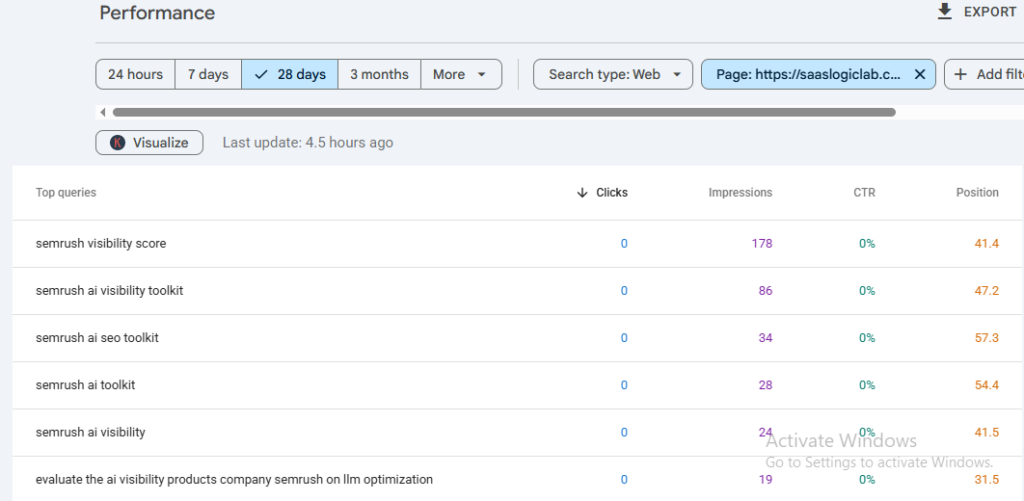
Suppose an existing page receives impressions for:
- SEO content software
- content optimization tool
- best SEO content tool
- SEO tools for agencies
That does not automatically mean all four terms belong on the page.
But it is evidence worth investigating before creating four new URLs.
The correct workflow is:
GSC evidence → SERP validation → existing-page review → ownership decision.
Not:
New impression → new article.
Page Ownership Is Not Permanent
Assigning a URL today does not mean the decision can never change.
Search behavior changes.
SERPs change.
Your site grows.
A supporting topic can become large enough to justify its own page. Two separate pages can begin overlapping. An old URL can lose relevance. Google Search Console can reveal queries you did not originally expect a page to attract.
Page ownership should therefore be treated as a maintained content map.
The initial decision answers:
“Which page should own this need now?”
Performance data later asks:
“Is that still the right decision?”
That feedback loop becomes important after publication, when we measure query groups and page performance rather than assuming the original content map was perfect.
Step 6 — Build Topic Clusters Without Creating Cannibalization
A topic cluster should make a site easier to understand, not give it more pages competing for the same search need.
The basic idea is simple: choose an important topic, create strong coverage around the different problems people search within that topic, and connect those pages where the relationship is useful.
The difficult part is deciding where one page ends and another should begin.
That is why topic clustering comes after search-intent validation and page ownership. If those decisions have not been made first, a cluster can become nothing more than a collection of closely related articles.
A useful cluster has three things:
one clear central topic, distinct jobs for its supporting pages, and deliberate connections between those pages.
Identify Pillar Topics and Supporting Subtopics
A pillar should represent a subject broad enough to support several meaningful search needs.
It should not simply be the keyword with the highest search volume.
For example, consider SEO content strategy as the central topic.
Someone learning how to build an SEO content strategy may also need to understand:
- search intent;
- keyword research;
- content audits;
- keyword cannibalization;
- internal linking;
- on-page SEO;
- content optimization;
- performance measurement.
These subjects are related, but they are not interchangeable.
A user searching “keyword cannibalization” has a more specific problem than someone searching “SEO content strategy.”
A user searching “internal linking audit” expects a process for evaluating links, not another general explanation of content strategy.
That gives each supporting page a reason to exist.
A practical cluster could look like this:
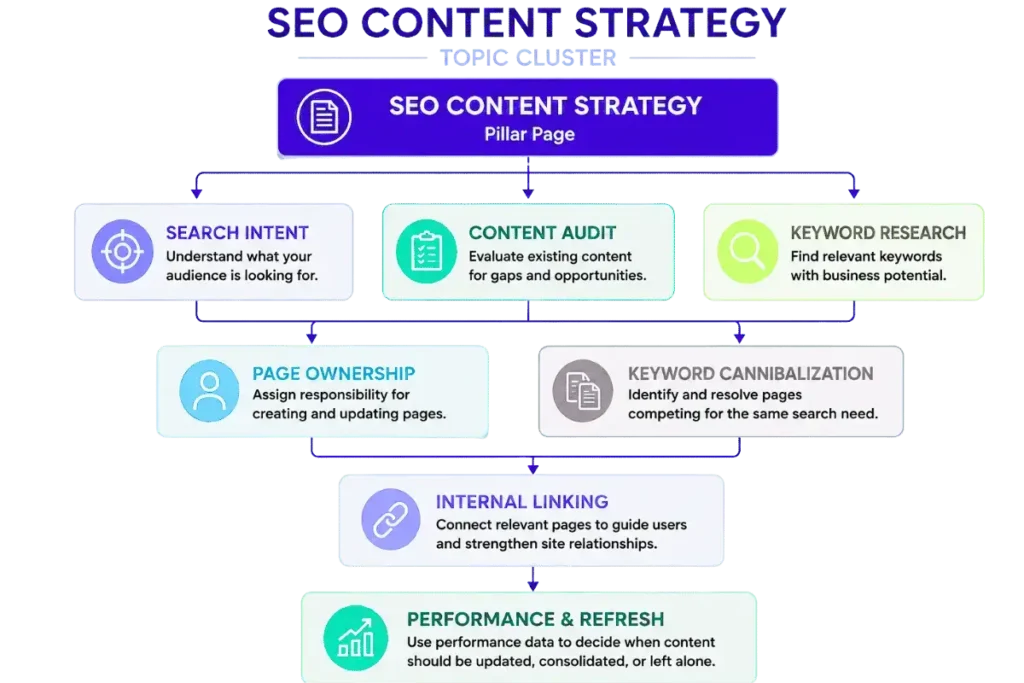
The point of the structure is not that every cluster must look like a tree.
It is that every page should have a recognizable job within the subject.
Map Cluster Pages Around Distinct Search Needs
Before approving a supporting page, write down its job in one sentence.
For example:
| Page | Primary Search Need | Page Job |
| SEO Content Strategy | Build an overall search-focused content system | Pillar/framework |
| Search Intent in SEO | Understand and validate what searchers expect | Intent guide |
| Keyword Cannibalization | Diagnose overlapping keyword/page targeting | Problem-solving guide |
| Internal Linking Audit | Evaluate and improve existing internal links | Audit/process guide |
| On-Page SEO Checklist | Check page-level optimization | Actionable checklist |
| SEO Audit | Evaluate broader SEO problems | Audit framework |
If two proposed pages cannot be given meaningfully different jobs, stop.
That is a warning that you may be splitting one search need into multiple URLs.
For example:
SEO content strategy
and
content strategy for SEO
look like two possible article titles in a keyword spreadsheet.
They should first be tested as variations of the same search need—not assumed to be two separate cluster pages.
Compare that with:
SEO content strategy
and
keyword cannibalization
The second query represents a distinct problem. It can support the broader strategy topic while owning its own search need.
That is a legitimate cluster relationship.
Do Not Build Clusters From Keyword Similarity Alone
Keyword tools make clustering look easier than it is.
Terms sharing the same modifier can be grouped automatically, but semantic similarity is only a starting point.
Consider:
- SEO content strategy
- SEO content strategy template
- B2B SEO content strategy
- SEO content strategy course
- AI SEO content strategy
All five contain nearly the same core phrase.
That does not tell us whether they need five URLs.
For each one, ask:
- Does the searcher want a different outcome?
- Does the SERP favor a different page type or format?
- Can the pillar satisfy this need without becoming unfocused?
- Is the subtopic substantial enough to maintain independently?
- Does the business have a reason to own that search need?
If the answer points toward the same outcome, keep the query with the existing page.
If it reveals a distinct job, evaluate it as a supporting page.
This keeps topic coverage from becoming URL inflation.
Cannibalization Is an Ownership Problem, Not a Keyword-Repetition Problem
Keyword cannibalization is often oversimplified as:
“Two pages contain the same keyword.”
That is not a useful diagnostic rule.
Related pages naturally use overlapping terminology.
A pillar about SEO content strategy may mention search intent. A dedicated search-intent guide will obviously mention search intent much more deeply. That does not automatically make the two pages competitors.
The real question is:
Are multiple URLs trying to satisfy substantially the same search need?
Suppose a site contains:
- /seo-content-strategy/
- /how-to-create-an-seo-content-strategy/
- /best-seo-content-strategies/
If all three provide essentially the same general guide, the architecture may be unclear.
Compare that with:
- /seo-content-strategy/
- /search-intent-in-seo/
- /keyword-cannibalization/
These pages can share terminology while performing clearly different jobs.
So do not audit cannibalization by searching for repeated keywords alone.
Audit overlapping intent and page ownership.
Give Every Cluster Page a Primary Job
A simple content map can prevent many problems before writing begins.
For every approved URL, record:
| Field | What to Define |
| Page | Planned or existing URL |
| Primary job | The main problem the page solves |
| Core intent | What the searcher wants to accomplish |
| Primary topic | Main subject owned by the page |
| Supporting queries | Related queries the same page can satisfy |
| Parent/pillar | Broader topic it supports |
| Related pages | Other useful pages in the journey |
| Overlap risk | Existing URLs that may compete for the same need |
| Business role | Why attracting this audience matters |
| Next step | What the reader logically needs afterward |
The overlap risk field is especially important.
Do not wait until rankings become confusing to discover that two briefs were designed around the same intent.
Flag the conflict while the content is still a row in a spreadsheet.
Fixing architecture before publication is cheaper than fixing duplicated content afterward.
Use Internal Linking to Connect the Search Journey
Internal links should reflect useful relationships between pages.
The simplest cluster model is often described as:
supporting pages → pillar page
That is useful, but incomplete.
Users do not always move from a narrow article back to a broad guide.
Their journey can move in several directions.
Someone reading an SEO content strategy guide may next need a detailed search intent process.
Someone diagnosing keyword cannibalization may need an internal linking audit.
Someone completing an SEO audit may need an on-page SEO checklist.
The useful link is therefore not determined only by hierarchy.
It is determined by what the reader reasonably needs next.
A stronger internal-linking model looks like:
PILLAR
↕
SUPPORTING PAGE ←→ RELATED SUPPORTING PAGE
↓
NEXT LOGICAL TASK / DEEPER GUIDE
This still gives the cluster structure, but it does not force every page into a rigid hub-and-spoke pattern.
Use Descriptive Anchor Text
Anchor text should help the reader understand what is behind the link.
For example:
Instead of:
“Read more here.”
Use:
“run an internal linking audit”
or:
“identify keyword cannibalization”
when those phrases accurately describe the destination.
The goal is not to force an exact-match keyword into every internal link.
The goal is to provide useful context.
Different natural anchors can point to the same page when they accurately describe it.
Do Not Link Every Cluster Page to Every Other Page
More internal links do not automatically produce a better cluster.
If a cluster contains 20 pages and every article links mechanically to the other 19, the structure stops communicating meaningful relationships.
Link when the destination:
- explains something the current page cannot cover deeply;
- provides the next logical step;
- helps complete a task;
- supports a claim or concept;
- resolves a related problem.
This makes internal linking part of the content experience rather than a post-publication SEO checkbox.
Practical SaaSLogicLab Cluster Example
Here is how the principle works in a real content cluster.
The site already has pages covering subjects such as:
SEO Content Strategy
→ broad strategic framework.
Search Intent in SEO
→ determines what the searcher expects and how queries should be grouped.
Keyword Cannibalization
→ deals specifically with overlapping page/query ownership.
Internal Linking Audit
→ evaluates whether existing pages are connected appropriately.
On-Page SEO Checklist
→ handles page-level optimization checks.
SEO Audit
→ evaluates wider SEO health and problems.
These should not become six articles repeating the same SEO fundamentals.
Their value comes from specialization.
For example, the SEO Content Strategy guide can explain why page ownership matters.
The keyword cannibalization guide can go much deeper into how to detect and resolve ownership conflicts.
The SEO Content Strategy guide can explain why internal links matter to a content cluster.
The internal linking audit can handle the actual audit process.
The pillar provides context.
The supporting page provides depth.
That is a cleaner division of responsibility than trying to make every article comprehensive about everything.
Topic Cluster Quality Check
Before calling a group of pages a topic cluster, test it with five questions:
| Question | If the Answer Is “No” |
| Does every page solve a distinct search need? | Recheck overlap |
| Can you explain each page’s job in one sentence? | Clarify ownership |
| Does each supporting page add depth the pillar should not carry? | Consider keeping it within the pillar |
| Are internal links useful to the reader’s next step? | Redesign linking |
| Does the cluster support an audience or business objective? | Reconsider whether the cluster deserves investment |
A large cluster is not automatically an authoritative cluster.
Twenty weakly differentiated pages can create less clarity than six pages with distinct jobs.
The goal is not to cover every keyword variation.
It is to build enough useful, connected coverage that a user can move through the subject without encountering repeated pages answering the same question.
Step 7 — Build a B2B SEO Content Strategy Around the Buyer Journey
For B2B SEO, traffic becomes more strategically valuable when it reaches the right audience and supports a meaningful business or customer outcome.
That matters even more in B2B SEO.
A SaaS or B2B company can rank for hundreds of informational queries and still generate very few qualified leads. The content may be performing exactly as planned from a rankings perspective while attracting people who have little reason to evaluate the product or service.
A B2B SEO content strategy therefore needs another layer beyond search volume and ranking potential:
Where does this search fit in the buyer’s decision process, and what business opportunity exists if we rank for it?
This does not mean every article needs to sell something.
It means every important topic should have a reason for being part of the content system.
Mapping Search Intent to Buyer Journey Stages
The traditional buyer journey is often divided into awareness, consideration, and decision.
That is useful as a starting point, but search behavior rarely follows a perfectly straight path.
A buyer might:
- discover a problem;
- research possible solutions;
- compare several approaches;
- investigate a specific product;
- return to an educational guide;
- search for pricing or alternatives;
- ask colleagues for recommendations;
- return to Google with a much more specific question.
For content planning, it is more useful to map search needs than to assume every visitor moves neatly from top to bottom.
A practical B2B search journey can be divided like this:
| Search Stage | What the Searcher Is Trying to Do | Typical Query Pattern | Content Job |
| Problem discovery | Understand a problem | “why is organic traffic dropping” | Diagnose and educate |
| Learning | Understand a concept/process | “what is keyword cannibalization” | Explain clearly |
| Solution exploration | Find ways to solve the problem | “how to fix keyword cannibalization” | Show practical options |
| Category evaluation | Understand available solutions | “best SEO tools for agencies” | Compare suitable options |
| Product evaluation | Investigate a specific solution | “Semrush review” | Help evaluate the product |
| Direct comparison | Choose between alternatives | “Semrush vs Ahrefs” | Explain meaningful differences |
| Decision/action | Evaluate cost, fit, or next action | pricing, service, demo, implementation queries | Reduce decision uncertainty |
These stages can overlap.
The table is not a rigid funnel. Its job is to prevent every informational keyword from being treated as equally valuable.
Search Intent and Buyer Stage Are Not the Same Thing
This distinction matters.
Search intent describes what someone expects from the current search.
Buyer stage describes where that search may sit in a broader decision process.
For example:
may have commercial investigation intent.
It can also sit relatively close to solution evaluation because the searcher is comparing available products.
Meanwhile:
what is seo content strategy
is primarily informational. The searcher may be much earlier in the journey.
Both can be valuable.
They simply perform different jobs.
Do not change an informational article into a sales page because the company ultimately wants customers.
If somebody searches for a definition, answer the definition.
Business alignment happens through topic selection, useful next steps, internal links, and the wider content journey—not by forcing a pitch into every article.
Prioritize Qualified Demand Over Vanity Traffic
Search volume estimates how often a term is searched within the tool’s selected market and time frame.
It does not answer:
How useful would the right visitor be to this business?
Imagine two opportunities.
Topic A
- 10,000 monthly searches
- broad audience
- weak relationship with the product
- mostly early-stage curiosity
Topic B
- 500 monthly searches
- clearly defined B2B audience
- problem directly related to the company’s solution
- strong evaluation or purchase relevance
Topic A may produce more traffic.
Topic B may create more business value.
That does not mean Topic A should automatically be ignored. It might build topical coverage, earn links, introduce new users to the brand, or support other pages.
But the decision should be deliberate.
A useful content roadmap needs both search opportunity and business relevance.
Add Business Value Before Prioritization
Ahrefs’ framework includes an important step between finding topics and producing content: check their business value.
That principle can be taken further.
Instead of asking only:
“Can our product be mentioned here?”
ask:
“What useful relationship does this search have with the business?”
A simple business-value scale can help:
| Score | Business Relationship | Example |
| 0 | Almost no meaningful relationship | Broad traffic topic outside the target market |
| 1 | Relevant audience, weak connection to an offering | General industry education |
| 2 | Problem is relevant to the target customer | Educational problem-solving topic |
| 3 | Product/service category can naturally help | Solution exploration |
| 4 | Searcher is actively evaluating relevant solutions | Tool/category/comparison query |
| 5 | Search is directly connected to becoming a customer | Service, pricing, demo, high-fit decision query |
This score should not become an automatic publishing formula.
A score of 5 does not automatically beat a score of 2.
Search opportunity, competition, authority requirements, strategic importance, and content dependencies still matter.
The score simply forces the team to document why the keyword matters commercially.
Do Not Turn Every Informational Article Into a Sales Page
This is where B2B content often goes wrong.
A company correctly identifies an informational search but then writes the page as if the visitor had already decided to buy.
The result might look like:
User: “What is an SEO content strategy?”
Page: “Book our SEO strategy consultation.”
The page technically targets the keyword but does not respect the user’s current job.
A better sequence is:
SEARCH QUESTION
↓
SOLVE THE IMMEDIATE NEED
↓
HELP WITH THE NEXT LOGICAL PROBLEM
↓
INTRODUCE A COMMERCIAL NEXT STEP
ONLY WHEN IT BECOMES RELEVANT
For an SEO content strategy guide, the reader first needs a usable system for planning SEO content.
The article should deliver that.
If the reader later needs implementation help, a relevant service page can be introduced contextually.
The commercial opportunity should follow usefulness rather than interrupt it.
Build Content Across the Journey, Not Only at the Top
Another common problem is an informational-heavy content library.
The site publishes:
- what is X;
- why X matters;
- benefits of X;
- beginner guide to X;
- X statistics;
- X trends.
These can generate impressions and traffic, but the content library may become disconnected from how buyers actually evaluate solutions.
A stronger B2B content system usually needs several types of demand.
Educational Demand
Helps the audience understand problems, concepts, and processes.
Examples:
- What is SEO content strategy?
- What is keyword cannibalization?
- How does search intent work?
Problem-Solving Demand
Helps users fix something.
Examples:
- How to perform an SEO audit
- How to fix keyword cannibalization
- How to improve internal linking
Category Demand
Appears when the searcher begins investigating types of solutions.
Examples:
- best SEO tools;
- best SEO tools for agencies;
- content optimization tools.
Product Demand
Appears when a specific product enters consideration.
Examples:
- Semrush review;
- Ahrefs review;
- Semrush pricing;
- product-specific feature queries.
Comparison Demand
Helps someone choose between alternatives.
Examples:
- Semrush vs Ahrefs;
- Tool A vs Tool B;
- alternative queries.
These content types should not be treated as isolated SEO campaigns.
They can support the same buying journey.
A B2B Topic Map Should Show Commercial Distance
A normal topic map shows how subjects relate.
A B2B topic map should also show how close each search need is to a meaningful commercial decision.
For example:
BROAD EDUCATION
│
▼
SEO CONTENT STRATEGY
│
┌─────────────┴─────────────┐
▼ ▼
SEARCH INTENT SEO CONTENT AUDIT
│ │
▼ ▼
KEYWORD CANNIBALIZATION CONTENT OPTIMIZATION
│ │
└─────────────┬─────────────┘
▼
SOLUTION EXPLORATION
│
▼
BEST SEO TOOLS / SOFTWARE
│
┌────────┴────────┐
▼ ▼
SEMRUSH REVIEW AHREFS REVIEW
│ │
└────────┬────────┘
▼
SEMRUSH VS AHREFS
│
▼
PRODUCT / SERVICE
DECISION
A real buyer may not follow those arrows exactly.
The map exists for the strategist.
It exposes whether the site has content only at one end of the journey.
If a site has 100 educational posts but nothing for category evaluation, comparison, or product evaluation, traffic growth can hide a commercial content gap.
Connect Informational Demand to the Next Logical Search Need
Internal linking now has a second job.
In Step 6, we used links to connect related pages inside a topic cluster.
For B2B content, links can also help users progress from one problem to the next.
For example:
SEO content strategy
→ deeper guide to search intent
Search intent
→ keyword mapping/page ownership
Keyword cannibalization
→ internal linking audit
Best SEO tools
→ individual Semrush and Ahrefs reviews
Product reviews
→ relevant comparison pages
This is not about forcing everyone down a funnel.
Some readers will stop after one article because their question has been answered.
That is fine.
The site’s job is to make the next useful resource available when the reader needs it.
Match the CTA to the Page’s Job
The same call to action should not appear blindly across every page.
A reader at the beginning of a topic may need:
- another guide;
- a checklist;
- a template;
- an audit process;
- a related example.
A reader comparing products may need:
- a detailed review;
- feature comparison;
- pricing information;
- alternatives;
- a trial or product page.
A reader evaluating a service may be ready for:
- case evidence;
- process details;
- consultation;
- contact.
This produces a better rule than:
“Every article needs a sales CTA.”
Use:
“Every important page needs an appropriate next step.”
Sometimes that next step is commercial.
Sometimes it is another piece of content.
Separate Traffic KPIs From Business KPIs
A B2B SEO content strategy should not be judged from clicks alone.
Search metrics tell us whether content is gaining visibility:
- impressions;
- rankings;
- clicks;
- CTR;
- query coverage.
Business metrics tell us whether that visibility is useful:
- qualified leads;
- demo requests;
- trial starts;
- contact submissions;
- assisted conversions;
- product-page visits;
- commercially relevant journeys.
The exact business metric depends on the site’s model.
The important part is not to collapse these into one number.
A page can be a strong SEO performer and a weak commercial performer.
Another page can receive far less traffic while influencing substantially more valuable actions.
Both facts matter.
Practical B2B Content Opportunity Matrix
Before approving a B2B topic, classify it on two dimensions:
search opportunity and business value.
| Low Business Value | High Business Value | |
| High Search Opportunity | Publish selectively; require a strategic reason | Strong candidate |
| Low Search Opportunity | Usually low priority | Consider despite lower volume |
| No Clear Search Demand | Usually avoid for SEO purposes | May still belong in broader content marketing/sales enablement |
This prevents two opposite mistakes.
Mistake 1: Chasing traffic.
The roadmap fills with high-volume topics that attract the wrong audience.
Mistake 2: Chasing only bottom-of-funnel keywords.
The site ignores the educational and problem-solving searches through which future buyers first discover the subject.
A sustainable strategy needs the right balance for the business.
The Practical Test: Would the Right Customer Care?
Before adding a B2B keyword to the roadmap, ask:
If we ranked #1 for this query, would the people we want as customers have a meaningful reason to visit?
Then ask:
What useful job would this page perform for them?
And finally:
Where could they logically go next?
If those questions have clear answers, the topic has strategic context.
If the only answer is:
“It has good volume and low KD,”
The research is not finished.
Search opportunity gets a keyword onto the table.
Audience fit and business value help decide whether it deserves investment.
Step 8 — Prioritize What to Create First
A content roadmap usually contains more opportunities than a team can realistically execute.
After keyword research, competitor analysis, content auditing, and intent validation, you might have 20, 50, or several hundred possible pages. At that point, the problem changes.
You are no longer asking:
“What could we create?”
You need to decide:
“What deserves resources first?”
This is where many SEO content plans lose focus.
Teams often sort a keyword sheet by search volume, keyword difficulty, or some combination of the two. A high-volume, low-difficulty keyword moves to the top. A smaller keyword moves down.
That looks objective, but it ignores two important questions:
Does the search match something the business should be visible for?
And:
Can the site realistically create a page that deserves to compete for it?
A better prioritization system considers the opportunity from several angles before assigning production resources.
Search Volume Is Evidence of Demand, Not a Priority Score
Search volume is useful because it gives us an estimate of demand.
But volume alone cannot tell us whether a topic deserves to be published next.
Suppose your research produces these two opportunities:
| Opportunity | Monthly Volume | KD | Business Relevance |
| Broad SEO topic | 8,000 | 18 | Low |
| Specific B2B problem | 450 | 24 | High |
Sorting by volume puts the first topic comfortably ahead.
Sorting by KD may still favor it.
But neither metric tells you whether those 8,000 searches come from people the business wants to reach.
The second keyword might attract fewer searches while being much closer to the problems your target customers actually need solved.
This is why low KD is not automatically a green light, just as high search volume is not automatically a reason to publish.
Both are inputs.
Neither should make the final decision.
Evaluate Search Opportunity
The first factor is the actual search opportunity.
Search volume belongs here, but it is only one part of the assessment.
Look at:
- estimated search demand;
- relevant secondary queries;
- long-tail variations;
- SERP features;
- current rankings;
- existing impressions in Google Search Console;
- whether several related queries can be satisfied by the same page;
- the likely click opportunity after SERP features are considered.
This gives a more useful picture than reading one volume number from a keyword tool.
For example, a keyword showing only 200 searches may belong to a query group containing several closely related searches.
The page opportunity can therefore be larger than the primary keyword suggests.
The reverse can also happen.
A keyword may show substantial volume while the SERP contains features that answer much of the query without requiring a traditional organic click.
So the question is not simply:
“How much volume does this keyword have?”
It is:
“How much realistic and relevant search opportunity exists around this search need?”
Measure Intent Fit
Next, ask how closely the proposed page can satisfy the searcher’s actual need.
This should already have been investigated during Step 4, but prioritization needs the result of that analysis.
A simple intent-fit scale can work:
| Score | Intent Fit |
| 1 | Weak match; the site would have to stretch its expertise or offering to justify the page |
| 2 | Related, but not central to the audience’s problem |
| 3 | Relevant topic with a clear reason for the site to cover it |
| 4 | Strong fit with the target audience and existing content |
| 5 | Direct match with a core audience problem the site is well positioned to solve |
This prevents a common research mistake.
A keyword can look attractive because it has:
high volume + low KD
while having weak relevance to the audience.
Without an intent-fit check, that keyword can consume resources that should have gone to a smaller but much better opportunity.
Add Business Value
Step 7 established why traffic and business value need to be evaluated separately.
Now we use that information operationally.
For each opportunity, assign the business-value score based on its relationship with the company’s actual goals.
The question is not:
“Can we somehow mention our service in this article?”
It is:
“If the right person finds this page, is there a meaningful relationship between their problem and what this business does?”
That difference matters.
An educational topic can still have strong business value when it addresses a problem experienced by the exact audience the company serves.
A high-volume industry-news topic might have much weaker value even if it generates considerably more traffic.
Use a Priority Score as a Decision Aid
Once search opportunity, intent fit, and business value have been evaluated, they can be combined into a simple working model:
Priority Score = Search Opportunity × Intent Fit × Business Value
The formula is intentionally simple.
Its purpose is not to pretend SEO decisions can be reduced to perfect mathematics.
Its purpose is to stop one attractive metric—usually volume or KD—from controlling the entire roadmap.
For example:
| Topic | Search Opportunity | Intent Fit | Business Value | Priority Score |
| Topic A | 5 | 2 | 1 | 10 |
| Topic B | 3 | 5 | 5 | 75 |
| Topic C | 4 | 4 | 3 | 48 |
| Topic D | 2 | 5 | 5 | 50 |
Topic A has the strongest raw search opportunity.
But once relevance and business value are included, it becomes the weakest candidate of the four.
Topic D demonstrates the opposite situation.
Its search opportunity is relatively small, but the search need strongly matches both the audience and the business.
That may justify creating it before a much larger keyword.
Do Not Treat the Formula as an Algorithm
There is an important limitation here.
A spreadsheet score cannot understand your business.
Two topics with identical scores can require completely different decisions.
For example, one may:
- complete an important topic cluster;
- support a high-value product page;
- already receive impressions;
- have an existing URL that can be improved quickly;
- require original data the team does not currently possess;
- depend on another page being published first;
- face a SERP dominated by sites the domain cannot realistically challenge yet.
The formula therefore creates a shortlist, not an automatic publishing order.
Human review still decides what moves into production.
Add Ranking Feasibility Before Final Approval
Keyword difficulty can be useful here, but it should not be treated as a verdict.
A KD score is a tool-specific estimate.
Before approving a page, inspect the actual SERP.
Look at the pages currently winning.
Ask:
What type of pages rank?
If Google consistently ranks product pages and you plan to publish a general educational article, the issue is not KD. The proposed format may simply be wrong.
How strong are the competing pages?
Do not look only at domain-level authority. Inspect the individual pages, their relevance, links, depth, freshness where relevant, and how directly they satisfy the search.
Are weaker or newer sites competing?
Their presence can suggest that established brands do not exclusively dominate the SERP, but it does not by itself prove that the query will be easy to rank for.
Can we contribute something materially useful?
If the planned article merely rewrites what already ranks, a low KD score does not create a competitive advantage.
Do we have the necessary evidence or experience?
Some queries require credible firsthand knowledge, testing, data, screenshots, or specialist expertise.
If you cannot produce what the query deserves, postpone it even when the metrics look attractive.
Existing Search Data Can Change the Priority
For an established site, keyword tools should not be the only source used for prioritization.
Google Search Console can expose opportunities already developing on your own pages.
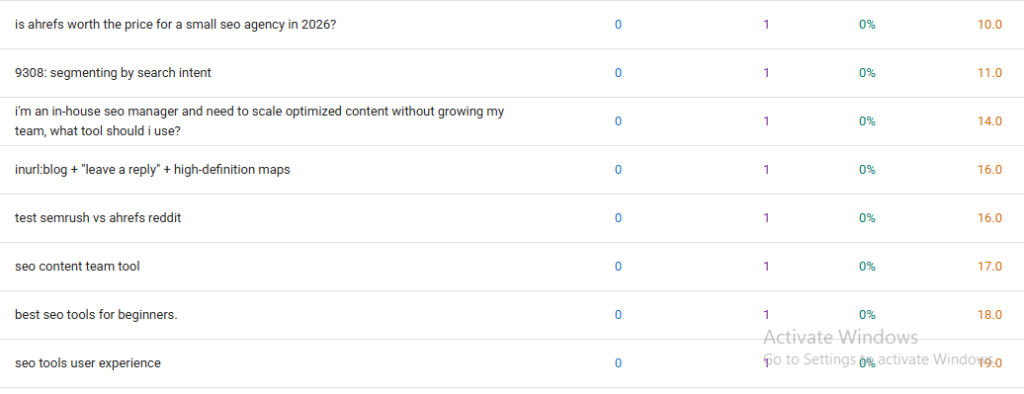
Suppose an existing article is receiving impressions for a relevant query but is ranking just outside the strongest organic positions.
That situation is different from creating a completely new page for a keyword where the site has no existing visibility.
Before adding another URL, investigate:
- which page is receiving the impressions;
- what queries are triggering it;
- whether those queries share the page’s existing intent;
- whether the content actually covers that need;
- whether another page is also receiving impressions for the same query group.
Sometimes the fastest useful move is not:
Create another article.
It is:
Topic B — Existing page ranks 11–20 and matches the intended search need — Evaluate and improve existing page
This is another reason the page-ownership decision from Step 5 comes before prioritization.
Existing Pages and New Pages Should Compete for the Same Resources
A content roadmap should not contain only new URLs.
Every opportunity should be allowed to result in:
Create
Update
Expand
Consolidate
Reposition
Leave alone
Consider this example:
| Opportunity | Current Situation | Recommended Action |
| Topic A | No relevant page exists | Create |
| Topic B | Existing page ranks 11–20 | Improve existing page |
| Topic C | Two URLs overlap heavily | Consolidate |
| Topic D | Existing page performs well | Leave alone |
| Topic E | Relevant but low strategic value | Defer |
This changes the meaning of a content roadmap.
It stops being a publishing queue and becomes an SEO decision queue.
That is a much more useful operational document.
Balance Quick Wins and Authority Builders
Not every priority should be selected for the same reason.
A healthy roadmap usually contains different types of opportunities.
Quick Wins
These are opportunities where the site already has some advantage.
Examples include:
- an existing page ranking within reach of stronger visibility;
- queries already generating impressions;
- a page that needs a clearer intent match;
- missing supporting coverage around an established topic;
- internal-link improvements that can strengthen an important page.
Quick wins matter because they can produce results without requiring an entirely new content asset.
But a strategy built only around quick wins eventually runs out of obvious improvements.
Authority Builders
These are pages that may take longer to perform but are important to the site’s long-term topical coverage.
They can include:
- major pillar resources;
- foundational concepts;
- original research;
- comprehensive workflows;
- supporting content needed to complete an important cluster.
An authority-building page may not have the easiest KD or the fastest ranking opportunity.
It can still deserve investment because other strategically important content depends on it.
Commercial Opportunities
These sit close to product, service, comparison, or evaluation demand.
They may have lower volume but strong business value.
Ignoring them because their traffic potential looks small can leave a major gap between educational traffic and commercial outcomes.
A strong roadmap therefore does not choose between:
quick wins OR authority
or:
traffic OR commercial content.
It determines the right mixture.
Use Content Dependencies to Set Publishing Order
Some pages should be published before others even when their numerical priority score is lower.
Suppose you plan:
SEO CONTENT STRATEGY
│
├── Search Intent
├── Keyword Cannibalization
├── Internal Linking Audit
└── Content Optimization
If the central resource does not exist, publishing supporting pages randomly may make the architecture harder to organize later.
Likewise, a comparison article might depend on detailed individual product reviews if those reviews provide the evidence and internal-link destinations needed for the comparison.
This creates another prioritization question:
Does another important page depend on this asset existing first?
If yes, the page may need to move higher in the roadmap even if another keyword has better isolated metrics.
Build a Practical Prioritization Sheet
The working sheet does not need dozens of columns.
Use enough information to make the decision visible.
| Topic / Search Need | Search Opportunity | Intent Fit | Business Value | Existing URL? | SERP Feasibility | Page Decision | Dependency | Priority |
| Topic A | 5 | 5 | 4 | No | Strong | Create | Pillar | High |
| Topic B | 3 | 5 | 5 | Yes | Strong | Update | None | High |
| Topic C | 5 | 2 | 1 | No | Medium | Ignore/Defer | None | Low |
| Topic D | 2 | 5 | 5 | No | Medium | Create | Supports commercial page | High |
| Topic E | 4 | 4 | 3 | Two pages | Strong | Consolidate | Cluster cleanup | High |
The important column is not the score.
It is Page Decision.
If prioritization ends with a number but nobody can say what should actually happen to the site, the system has failed.
A Low-KD Keyword Still Needs to Pass the Strategic Test
Low-difficulty keywords can be valuable, particularly for a newer site that cannot compete efficiently across every high-authority SERP.
But “low KD” should narrow the opportunity set, not replace strategy.
Before approving one, check:
- Does our target audience search for this?
- Does the SERP match the page we can realistically create?
- Does the keyword represent a distinct search need?
- Do we already have a URL that should own it?
- Can we produce something genuinely useful for that SERP?
- Does ranking for it contribute to a larger topic or business objective?
If the answer to several of those questions is no, the keyword is not a quick win.
It is simply an easy-looking metric.
Final Prioritization Gate
Before a topic enters the content calendar, it should pass one final review:
SEARCH DEMAND EXISTS?
│
▼
RIGHT AUDIENCE?
│
▼
CLEAR SEARCH INTENT?
│
▼
EXISTING PAGE CHECKED?
│
▼
CREATE / UPDATE / CONSOLIDATE / IGNORE?
│
▼
BUSINESS VALUE?
│
▼
REALISTIC SERP OPPORTUNITY?
│
▼
DEPENDENCIES CHECKED?
│
▼
PRIORITY ASSIGNED
│
▼
READY FOR CONTENT BRIEF
That last line is important.
A keyword should not move directly from research into writing.
By the time an opportunity reaches the content brief, you should already know:
why it matters, who it serves, what intent it owns, which URL should target it, how valuable it is, and why it deserves production now rather than later.
Only then is it ready to become a writing assignment.
Step 9 — Turn the Strategy Into a Content Brief and Calendar
By this point, the major SEO decisions should already be made.
You know which audience problem you are targeting, what people are searching for, what the SERP suggests about intent, whether the opportunity needs a new or existing URL, where the page belongs in the topic cluster, and why it deserves priority.
Now that strategy has to survive the handoff to production.
This is where a surprising amount of good SEO research gets lost.
A strategist may spend hours analyzing queries, competing pages, search intent, content gaps, and page ownership. The writer then receives something like this:
Primary keyword: SEO content strategy
Word count: 3,000 words
Competitors: three URLs
Deadline: Friday
That is not a content brief.
It is a writing assignment with a keyword attached.
The writer still has to guess what the page is supposed to accomplish, which searches belong together, what should be excluded, what competitors failed to explain, which internal pages matter, and what evidence would make the page genuinely useful.
A proper SEO content brief removes those decisions from guesswork.
What an SEO Content Brief Should Actually Do
A useful brief should preserve the reasoning that led to the page being approved.
It should tell the writer:
- who the page is for;
- what problem brought that person to search;
- what the primary search intent is;
- what the page should help the reader accomplish;
- which keyword or query group represents that need;
- what belongs on the page;
- what does not belong on the page;
- which competing pages reveal useful SERP expectations;
- what gaps the page should address;
- what original evidence or experience is available;
- which internal pages should connect to it;
- what action should logically follow;
- how success will eventually be evaluated.
This matters because writers should make writing decisions.
They should not have to reconstruct the entire SEO strategy every time they receive an assignment.
Build the Brief Around a Search Need, Not a Keyword List
A common briefing mistake is giving the writer a large list of keywords and expecting every term to appear in the article.
That reverses the correct briefing process.
The strategy has already grouped queries according to intent and decided what the URL should own. The brief should communicate that search need first.
For example:
Page purpose:
Help someone build an SEO content strategy from research through measurement.
Primary query:
seo content strategy
Closely related query variations:
seo and content strategy
content strategy for seo
content seo strategy
seo content strategies
Those variations help describe the topic.
They are not five writing requirements.
If several phrases mean essentially the same thing, forcing every variation repeatedly into the copy makes the writing worse without improving the strategic decision behind the page.
The writer needs to understand the concept the page owns, not chase a keyword checklist.
Separate Required Coverage From Optional Supporting Material
Not everything found during research deserves equal space.
The brief should distinguish between three levels of information.
Required Coverage
These are concepts necessary to satisfy the search need.
If they are missing, the page is incomplete.
For an SEO content strategy guide, that might include:
- audience and business goals;
- existing-content audit;
- opportunity research;
- search intent;
- page ownership;
- topic mapping;
- prioritization;
- content briefs;
- publishing;
- measurement;
- updating and consolidation.
Differentiating Coverage
These are areas where competitor or practitioner research reveals a meaningful gap.
They may not be required merely to define the topic, but they can make the page substantially more useful.
Examples include:
- deciding whether a keyword deserves a new page;
- separating query wording from actual intent;
- Create / Update / Reuse / Consolidate / Ignore decisions;
- preventing cannibalization during planning rather than fixing it later;
- using post-publish GSC queries as a feedback loop.
Optional Supporting Coverage
These are useful details that can strengthen an explanation but should not expand the article unnecessarily.
They might include additional examples, tools, short definitions, supporting statistics, or implementation notes.
This distinction gives the writer room to work without allowing the article to become a collection of everything discovered during research.
Give Every Section a Job
An outline becomes much more useful when each heading has a defined purpose.
Compare these two instructions:
H2: Keyword Research
versus:
H2: Find SEO Content Opportunities
Section job: Show the reader how to move from audience problems to measurable search opportunities without assuming that every keyword deserves a page.
The second version tells the writer what the section needs to accomplish.
The same rule applies to H3s.
A heading is the visible structure.
The section job is the editorial instruction underneath it.
For complex guides, the brief should include both.
Give the Writer Evidence, Not Just Competitor URLs
Competitor URLs alone create another problem.
The writer opens three ranking pages and starts combining their structures.
The result may be comprehensive, but it can also become a polished version of what already exists.
Competitor research should instead be translated into useful instructions.
For example:
| Research Finding | Brief Instruction |
| Several ranking pages explain keyword research | Cover keyword research, but do not treat it as the entire strategy |
| Competitors discuss topic clusters | Explain page-level intent separation before building clusters |
| Competitors cover KPIs | Connect metrics to each page’s intended job |
| Community discussions show frustration with random publishing | Address the difference between a strategy and a publishing calendar |
| SERP repeatedly emphasizes audience and intent | Treat both as required coverage |
| Existing guides rarely provide page-ownership decisions | Make Create / Update / Consolidate decisions a major practical framework |
The writer now understands why something belongs in the article.
That is much more useful than “review these five competitors.”
Plan Original Evidence Before Writing
E-E-A-T should not be something an editor tries to sprinkle into a finished draft.
If the page needs original experience, it should be identified in the brief.
Possible evidence includes:
- firsthand workflow;
- screenshots;
- tool output;
- internal data;
- original calculations;
- tested examples;
- before-and-after results;
- expert commentary;
- product experience;
- mistakes encountered during implementation.
The type of evidence depends on the topic.
And if you do not have firsthand evidence, do not manufacture it.
A writer should never turn secondhand research into sentences such as:
“In our ten years of experience…”
unless that experience genuinely exists and belongs to the author or organization publishing the page.
Credibility comes from evidence you can stand behind, not from making the article sound experienced.
Use Community Research Without Turning It Into Proof
Reddit, Quora, YouTube comments, LinkedIn discussions, forums, and similar sources can improve a brief considerably.
They reveal:
- questions people repeatedly ask;
- confusing terminology;
- frustrations with existing advice;
- real-world implementation problems;
- language practitioners use to describe those problems.
But community discussion is not automatically factual evidence.
The brief should therefore record it separately.
For example:
Practitioner concern:
Teams create large keyword lists but struggle to decide which terms deserve separate URLs.
Editorial use:
Address this concern in the page-ownership section.
Evidence status:
Pain-point/input source — not evidence of a Google ranking rule.
This protects both usefulness and accuracy.
Copy-Pasteable SEO Content Brief Template
The following template can be used for a new page or an existing page being substantially updated.
SEO CONTENT BRIEF
Source:
Claim / Section Supported:
Source Type:
[Official Documentation / Original Research / Primary Data / etc.]
Source:
Claim / Section Supported:
Source Type:
13. ON-PAGE REQUIREMENTS
Title Tag:
Meta Description:
H1:
URL Slug:
Featured-Snippet Opportunity:
[Yes / No]
Snippet Format:
[Definition / Steps / Table / List]
Schema Candidate:
[Article / FAQ / HowTo / Other — only when appropriate]
Image Requirements:
Accessibility Notes:
14. CONVERSION / NEXT STEP
Primary CTA:
Secondary CTA:
Relevant Product / Service:
Reader’s Logical Next Step:
15. SUCCESS MEASUREMENT
Primary KPI:
Secondary KPIs:
Target Query Group:
GSC Review:
[Queries / Impressions / Clicks / CTR / Position]
Business Measurement:
[Lead / Signup / Trial / Demo / Revenue / Assisted Conversion / Other]
Initial Review Date:
Second Review Date:
Decision After Review:
[Keep / Improve / Expand / Consolidate / Reposition]
That is intentionally more detailed than a typical writer brief.
You do not need every field for every 800-word article.
But for strategically important pages, documenting these decisions prevents expensive ambiguity later.
The Brief Is Not a Prison for the Writer
A detailed brief should make writing easier, not reduce the writer to filling boxes.
Research can reveal what the page needs to accomplish.
It cannot predict every useful explanation the writer will discover while working.
If the writer finds:
- a better example;
- a missing user question;
- new primary evidence;
- a clearer section order;
- an important factual correction;
the brief should be updated.
What should not change casually are strategic decisions such as page ownership, primary intent, or scope.
If new evidence challenges those decisions, return the issue to the strategist instead of silently turning the draft into a different page.
Build the Editorial Calendar Only After Page Decisions Are Made
Once approved opportunities have proper briefs, they can enter the editorial calendar.
This order matters.
A calendar built directly from a keyword export creates deadlines before strategy.
A strategic calendar organizes already-approved decisions.
At minimum, track:
| Field | Why It Matters |
| Page / Topic | Identifies the asset |
| Page Decision | Create, update, consolidate, etc. |
| Cluster | Shows its relationship to wider coverage |
| Intent | Protects the page’s search purpose |
| Priority | Explains why it is being worked on now |
| Dependency | Prevents publishing pages in the wrong sequence |
| Owner | Makes responsibility clear |
| Status | Shows production progress |
| Publish / Update Date | Controls execution |
| Internal Links | Ensures cluster connections are implemented |
| Review Date | Creates the post-publish feedback loop |
Notice what is missing:
A calendar does not need to become a database containing every SEO metric collected during research.
The detailed evidence belongs in the brief or research sheet.
The calendar’s job is execution.
Use Production Statuses That Reflect the Real Workflow
“Not started / In progress / Published” is usually too vague for a serious content operation.
A more useful workflow is:
Opportunity approved → Brief ready → Writing → Editorial review → SEO review → Assets ready → Published → Indexed/validated → Performance review
This exposes bottlenecks.
If ten articles remain at “SEO review,” you know the problem is not writing capacity.
If pages are published but never reach performance review, the process is producing content without learning from it.
Set a Publishing Cadence Based on Capacity, Not SEO Folklore
There is no useful reason to promise three articles per week if the team can properly research, write, edit, verify, design, and publish only one.
Consistency matters operationally because it helps a team plan resources.
But publishing frequency should follow production capacity and opportunity quality.
A smaller operation might produce:
Week 1: one major new page
Week 2: one existing-page update
Week 3: one supporting cluster page
Week 4: refresh and performance work
Another team may legitimately publish several pages every week.
The number itself is not the strategy.
The better question is:
How much high-quality work can the team complete without weakening research, evidence, editing, or existing-content maintenance?
Do Not Fill the Calendar Just Because There Are Empty Dates
An empty publishing slot is not an SEO problem.
Publishing a weak or redundant page to fill it can become one.
If no opportunity has passed the strategic gates established in the previous steps, do not manufacture an article simply to maintain a calendar streak.
Use the capacity elsewhere:
- improve an existing page;
- consolidate overlap;
- strengthen internal links;
- collect original evidence;
- analyze GSC query data;
- improve an upcoming brief;
- refresh a declining resource.
This is the practical difference between content production and content management.
The goal is not to keep writers busy.
The goal is to improve the site’s useful search coverage.
Connect the Calendar to the Content Cluster
The calendar should also preserve dependencies identified during prioritization.
Instead of:
Monday: Article A
Thursday: Article B
Monday: Article C
think:
CORE TOPIC
│
├── Supporting Need A
├── Supporting Need B
├── Commercial Need C
└── Supporting Need D
Then decide the order based on what the cluster needs.
For example, if a supporting page needs to link users toward a central guide that does not yet exist, publishing the central resource first may make implementation cleaner.
Likewise, if an existing pillar already performs well, strengthening missing supporting pages may be more useful than rewriting the pillar simply because its scheduled refresh date arrived.
The calendar follows the architecture.
The architecture should not be invented by the calendar.
Add the Performance Review Before You Publish
Every calendar entry should eventually have a review point.
Not because every page must be changed after 30 days, but because someone needs to examine what happened.
The review can ask:
- Has the URL been indexed?
- Which queries are generating impressions?
- Are those the queries we expected?
- Is Google associating the page with the intended topic?
- Are multiple URLs appearing for the same query group?
- Has visibility started to develop?
- Are users reaching the intended next step?
- Is there enough evidence yet to justify changing anything?
The final question prevents premature optimization.
A review date is a point for evaluation, not an automatic instruction to rewrite the article.
That distinction should also guide the measurement and refresh process.
The Output of Step 9
At the end of this step, an approved SEO opportunity should no longer exist as a row containing only:
keyword + volume + KD.
It should exist as a production-ready package:
Strategic decision → Page ownership → Search intent → Query group → Content brief → Evidence requirements → Internal links → Assets → Production owner → Publication order → Measurement date
That package creates continuity between SEO research and the page that eventually reaches the search results.
The next stage is where those decisions become the content itself.
Step 10 — Create Content That Deserves to Rank
Once the strategy is approved, the page still has to earn its place.
A strong brief prevents the wrong page from being created. It does not guarantee the content itself will be useful.
The writing stage has three jobs:
answer the searcher’s need quickly, add evidence or experience competitors do not have, and cover the topic fully without turning the page into a bloated summary of everything found during research.
That sounds straightforward. In practice, this is where many otherwise solid SEO plans become generic.
A page can have the right keyword, the right intent, the right headings, and the right internal links—and still feel interchangeable with ten other results.
The difference usually comes from what the page actually helps the reader understand, decide, or do.
Satisfy the Searcher’s Need Early
Do not make the reader work through a long introduction before reaching the answer.
If the query is:
“What is an SEO content strategy?”
give the definition early.
If the query is:
“How do I build an SEO content strategy?”
show the process early.
If the query is:
“SEO content strategy template”
the template should not be buried after 4,000 words of explanation.
The opening should confirm three things quickly:
- the reader is on the right page;
- the article understands the problem;
- the answer or process is available without unnecessary delay.
That does not mean every article needs a two-sentence answer and nothing else.
It means the page should respect the urgency behind the search.
A useful rule is:
Answer first. Explain second. Expand where the complexity justifies it.
This is especially important for informational queries.
A long article can still be efficient if the reader can reach the main answer quickly and then choose how deeply to continue.
Match the Depth to the Searcher’s Job
Comprehensive content is not the same as long content.
A searcher evaluating two products may need:
- side-by-side differences;
- pricing context;
- limitations;
- use cases;
- a clear recommendation framework.
A searcher learning a definition may need:
- a concise explanation;
- a few examples;
- context about when the concept matters.
The amount of detail should follow the task.
This prevents a common SEO-writing mistake: using competitor word count as the content target.
If the top pages average 4,000 words, that tells you something about the depth of the SERP.
It does not prove that 4,500 words will rank better than 3,500.
The correct question remains:
What information does the user need to complete the job behind the query?
Use Headings to Move the Reader Forward
A good heading should do more than contain a keyword.
It should tell the reader what problem the next section solves.
Compare:
Keyword Research
with:
Use Keyword Research to Measure Search Demand
The second heading communicates a role.
The same applies to:
Search Intent
versus:
Validate Search Intent Before Choosing a Page
The second heading explains why the section exists.
That makes the page easier to scan and reduces the chance that headings become a list of disconnected SEO terms.
Add Original Experience and Evidence
This is where a page can become meaningfully different from the current SERP.
Original value does not require a massive proprietary study.
It can come from:
- a real workflow;
- screenshots from actual tools;
- your own GSC data;
- a real content map;
- a tested process;
- a before-and-after example;
- a mistake discovered during implementation;
- a decision that required judgment;
- a real limitation the tool or process created;
- a practical example using your own site.
A real first-party evidence layer can include:
- actual published content;
- real keyword research;
- real GSC query data;
- real internal-linking decisions;
- the actual content cluster;
- the real Create / Update / Reuse / Consolidate logic used during planning.
That is much stronger than writing:
“Based on our years of experience…”
without showing what that experience actually produced.
Experience should appear as evidence, not decoration.
Suppose a strategist decides not to create a new page.
That decision becomes useful when the article explains why.
For example:
Research found:
seo content strategy
seo and content strategy
content seo strategy
A generic article might simply state that these keywords belong together.
A stronger article shows the reasoning:
- the phrases appear to represent the same broad informational need;
- the SERP type and format overlap;
- one comprehensive page can satisfy them together;
- separate URLs would add wording variation without adding a new search outcome.
Now the reader can reuse the method.
That is the difference between a conclusion and transferable expertise.
Use Real Examples Where the Concept Is Easy to Misapply
Not every paragraph needs an example.
Use one when the reader could reasonably interpret the rule the wrong way.
For example:
Rule: Related keywords do not always need separate URLs.
Potential misunderstanding:
“Then I should put every keyword in one giant article.”
A short counterexample fixes that:
seo content strategy
and
Semrush vs Ahrefs
Both belong to SEO, but they serve completely different jobs.
One is a strategic educational guide. The other is a product comparison.
The example protects the rule from being overgeneralized.
Firsthand Experience Is Not the Same as Personal Opinion
A useful first-party observation should have something behind it.
Good:
During a content audit, we found that two pages were receiving impressions for nearly the same query group. We compared intent and page purpose before deciding whether to consolidate them.
Weak:
In my experience, Google prefers one strong page.
The first describes a real process.
The second makes a broad claim without evidence.
If the observation is based on your own site, say that clearly.
If it is based on official documentation or third-party research, cite that instead.
Do not blur the two.
Support Factual Claims With the Right Source
Different claims need different types of evidence.
Use:
Google documentation for:
- crawling;
- indexing;
- Search Console behavior;
- supported structured data;
- official search guidance.
Use:
first-party tool documentation for:
- how Semrush calculates a metric;
- how Ahrefs reports a feature;
- how a platform’s own workflow works.
Use:
original studies or first-party data for:
- market statistics;
- conversion data;
- industry benchmarks.
Use:
community discussions for:
- pain points;
- practitioner concerns;
- terminology;
- implementation questions.
Do not use Reddit or Quora to prove a ranking factor.
Do not use a competitor blog to make an official Google claim when the primary source is available.
That source discipline protects the article from sounding authoritative while being poorly supported.
Build E-E-A-T Into the Draft, Not Into the Bio
E-E-A-T is often treated as something solved by adding an author box.
The author information matters, but it cannot compensate for weak content.
Experience and credibility should be visible in the page itself.
Look for opportunities to include:
| Evidence Type | What It Adds |
| Real screenshots | Shows the process actually exists |
| First-party data | Gives evidence competitors may not have |
| Real examples | Makes abstract strategy usable |
| Clear limitations | Demonstrates judgment rather than promotion |
| Primary sources | Improves factual reliability |
| Tested workflow | Shows how the process works in practice |
| Decision rationale | Demonstrates strategic expertise |
A page that makes strong claims without showing evidence does not become more credible simply because the author bio says “SEO expert.”
E-E-A-T Evidence Checklist
Before the article is considered complete, check:
E-E-A-T / ORIGINAL VALUE CHECK
[ ] Does the article contain at least one real workflow?
[ ] Are firsthand claims clearly identified as firsthand?
[ ] Are screenshots based on actual tools/data?
[ ] Are factual claims supported by appropriate sources?
[ ] Are limitations or trade-offs explained where relevant?
[ ] Does the article show why key decisions were made?
[ ] Are examples specific enough to teach the method?
[ ] Have fake years-of-experience claims been avoided?
[ ] Are community opinions framed as practitioner insight only?
[ ] Does the article add something beyond competitor summaries?
If most of those boxes remain empty, the page may be optimized but still lack original value.
Cover the Topic Completely Without Creating Content Bloat
Research creates a dangerous temptation.
You collect:
- hundreds of keywords;
- competitor headings;
- PAA questions;
- Reddit threads;
- Quora answers;
- videos;
- Medium posts;
- LinkedIn discussions.
Then every item gets added to the article.
The result is “comprehensive” only in the sense that nothing was excluded.
That is not the goal.
A section belongs on the page when it helps complete the searcher’s job.
Ask:
Does this answer the primary search need?
Does it remove a likely obstacle?
Does it help the reader make the next decision?
Does it provide necessary evidence or context?
If not, the information may belong somewhere else.
This is especially important for large pillar guides.
A pillar should be broad enough to orient the reader but not so broad that every supporting page becomes unnecessary.
Use Supporting Pages for Depth
A pillar page does not need to teach every technical detail of:
- keyword cannibalization;
- internal linking audits;
- on-page SEO;
- technical SEO;
- Google Search Console;
- keyword research tools.
Those already deserve deeper treatment elsewhere.
The main guide should explain:
where those concepts fit into the strategy and when the reader needs them.
Then the supporting page handles the detailed implementation.
That creates a cleaner article and a stronger site architecture at the same time.
Do Not Add a Section Only Because Competitors Have It
Competitor consensus matters because repeated topics can signal expected coverage.
But a competitor heading should still pass the usefulness test.
Suppose eight ranking pages include:
“Best SEO Content Strategy Tools.”
Before adding the section, ask:
- Is a tools section necessary to complete this searcher’s job?
- Does the article already explain which tools belong at each stage?
- Would a short contextual reference be enough?
- Does the site already have a dedicated SEO tools article?
If the answer points toward another page, use the internal link.
Do not create a redundant section simply to match the outline count.
Remove Repetition Between Sections
Long strategic guides can repeat themselves without noticing.
For example:
Step 4 may explain search intent.
Step 5 may mention intent again during page ownership.
Step 6 may mention it again during topic clustering.
That repetition is necessary only when each section adds a new decision.
Good progression:
Step 4: What does the searcher expect?
Step 5: Which URL should own that expectation?
Step 6: How should that URL connect with related pages?
Bad progression:
Every section redefines search intent from scratch.
Is this concept being repeated, or is it being advanced?
If it is only repeated, cut it.
Optimize On-Page Elements After the Content Decision Is Correct
On-page SEO still matters.
But it comes after the page has the right job.
Check:
- title tag;
- H1;
- heading hierarchy;
- URL;
- opening answer;
- natural terminology;
- internal links;
- useful external sources;
- image alt text;
- relevant structured data where appropriate;
- readable tables and lists;
- mobile readability.
Do not treat these as a substitute for a weak content decision.
A perfectly optimized page targeting the wrong intent remains the wrong page.
Use the Primary Keyword Where It Helps Clarity
The primary keyword should appear naturally in important locations such as:
- title/H1;
- early in the introduction;
- relevant headings where it fits;
- body copy;
- conclusion where natural.
But there is no reason to force it into every section.
The same applies to secondary variations.
If seo and content strategy fits a sentence naturally, use it.
If it does not, do not rewrite a clear sentence merely to insert the exact phrase.
The content should sound like an expert explaining the subject, not a keyword list being converted into prose.
Technical SEO and Content Quality Still Have to Meet
A strong article cannot earn organic search visibility if search engines cannot access and index the page appropriately.
Before publication, confirm the basics:
- page is crawlable;
- page is indexable;
- canonical is correct;
- important content is rendered;
- internal links point to the page;
- images do not create unnecessary performance problems;
- mobile presentation is usable.
These checks belong to the publishing workflow.
Their role here is simple:
good content needs a technically usable page.
Write for Extraction Without Writing Like a Database
Search results increasingly surface answers in multiple formats, including snippets, AI-generated summaries, videos, forums, and other SERP features.
The correct response is not to make every paragraph sound like a definition card.
Instead:
- give direct answers where the query needs them;
- use descriptive headings;
- make lists and tables genuinely useful;
- keep relationships between concepts explicit;
- explain terms before adding nuance;
- avoid vague references such as “this” when the subject could be named clearly.
That improves readability for humans first.
It also makes important information easier to understand and reuse across search interfaces without turning the article into robotic Q&A copy.
Final Content Quality Gate
Before a section is approved, ask:
CONTENT QUALITY GATE
1. Does the section solve a real part of the searcher’s problem?
2. Is the answer reachable without unnecessary delay?
3. Is anything included only because a competitor mentioned it?
4. Is the same point already explained elsewhere?
5. Does the section contain evidence, example, or useful reasoning where needed?
6. Are factual claims supportable?
7. Is any experience claim fabricated or exaggerated?
8. Are keywords natural rather than forced?
9. Does the section lead logically to the next decision?
10. Would removing this section make the page meaningfully less useful?
If the answer to question 10 is no, the section probably does not belong.
That is a stronger editing standard than trying to hit an arbitrary word count.
The objective is not to create the longest result.
It is to create a page where every meaningful section earns its place.
Step 11 — Where AI Fits in an SEO Content Strategy in 2026
AI belongs inside the content workflow, but it should not own the strategy.
That distinction matters because AI tools are now useful across research, clustering, briefing, drafting, summarization, reporting, and content maintenance. At the same time, the most consequential decisions still depend on business context, editorial judgment, first-party evidence, and an understanding of what the page should actually do.
For Google specifically, the current guidance is clear: foundational SEO practices still apply to AI Overviews and AI Mode, and Google does not describe a separate set of special optimization requirements for appearing in those features. Pages still need to be indexed, eligible to appear in Search with a snippet, and useful enough to be selected by Google’s systems.
So the practical question is not:
“How do we replace SEO with AI SEO?”
It is:
“Which parts of the content operation can AI make faster, and which decisions still need human judgment?”
Use AI to Accelerate Research and Operations
AI is useful when the task involves organizing, comparing, classifying, or transforming information that has already been collected.
That includes work such as:
- grouping related keywords;
- summarizing competitor structures;
- classifying query intent;
- organizing Reddit, Quora, LinkedIn, Medium, and YouTube findings;
- identifying repeated questions;
- converting research into an initial brief;
- spotting possible content overlap;
- summarizing Search Console exports;
- creating first-pass content inventories;
- generating alternative ways to structure a table or checklist;
- identifying sections that repeat the same idea.
Google’s own guidance says generative AI can be useful for researching a topic and adding structure to original content, while warning against scaled production that adds little or no value.
That is a useful boundary.
AI can reduce the time spent processing information.
It should not be treated as evidence that the information is correct.
Keep Human Judgment in the Decisions That Matter
Some decisions should not be delegated blindly because they require context the model may not have.
Human judgment should remain responsible for:
Page ownership
Should this query create a new URL, update an existing one, or be ignored?
Business relevance
Is this traffic actually useful to the company?
Search-intent interpretation
Does the SERP indicate one dominant need or a mixed result?
Original angle
What can this page add that current results do not?
Evidence selection
Which claims need Google documentation, first-party data, screenshots, testing, or another primary source?
Editorial trade-offs
What belongs on the page, and what should be removed even if competitors cover it?
Final accuracy
Are the facts, examples, terminology, and conclusions supportable?
First-party experience
What can the author or company genuinely claim to have tested or observed?
These decisions shape the page’s value.
A model can suggest possibilities.
It should not silently turn those possibilities into editorial facts.
AI Assists; Humans Decide
A practical workflow can be divided like this:
| AI Can Assist With | Human Should Decide |
| Keyword clustering | Whether the cluster actually shares one intent |
| Competitor summarization | Which competitor gaps matter |
| Question extraction | Which questions belong on this page |
| Draft brief creation | Page ownership and scope |
| Outline suggestions | Final structure and section jobs |
| Data organization | Business relevance |
| First-pass content audit | Keep/update/consolidate decisions |
| Drafting support | Original argument and evidence |
| Repetition checks | What should actually be cut |
| Reporting summaries | What action the data justifies |
The distinction is not based on the idea that AI is inherently bad at writing.
It is based on accountability.
If a decision changes the site’s architecture, creates another URL, alters a factual claim, or influences a commercial strategy, someone needs to own the reasoning behind it.
Do Not Use AI to Manufacture Experience
AI can produce a sentence that sounds experienced very easily.
For example:
“In our decade of managing SaaS SEO campaigns, we have consistently found…”
If that experience does not exist, the sentence is not expertise.
It is fabrication.
The same applies to:
- invented client stories;
- imaginary experiments;
- fake conversion improvements;
- fabricated ranking lifts;
- fake screenshots;
- false “we tested this” language.
If the article needs experience, use real evidence.
Useful first-party evidence can come from:
- SaaSLogicLab’s actual content inventory;
- real keyword research;
- real GSC queries;
- the actual internal-link structure;
- screenshots from tools genuinely used;
- documented content-planning decisions.
AI can help organize that evidence.
It cannot create the underlying experience.
Use AI for Drafting Without Letting the Draft Become Generic
AI-assisted drafting becomes weak when the model is given only:
“Write 2,000 words about SEO content strategy.”
The result has little reason to differ from thousands of other pages.
A better input contains the strategy already developed:
- target audience;
- search intent;
- page ownership;
- required sections;
- competitor gaps;
- community questions;
- first-party evidence;
- excluded topics;
- internal links;
- source requirements;
- editorial tone;
- section-specific jobs.
The model is then helping execute an existing editorial decision.
It is not inventing the decision from scratch.
That is a much stronger use of AI in a professional content workflow.
AI Search Does Not Remove the Need for SEO Fundamentals
Google’s current documentation states that the same core SEO best practices continue to matter for its generative Search features. Google also says there are no additional technical requirements specifically for AI Overviews or AI Mode beyond the underlying Search eligibility requirements.
That means the same SEO fundamentals still matter:
- crawlable and indexable pages;
- clear page purpose;
- useful content;
- relevant internal links;
- strong search-intent fit;
- technical eligibility;
- original value;
- accurate information;
- coherent site structure.
There is no reason to abandon those fundamentals simply because the interface generating the answer has changed.
Avoid Chasing GEO, AEO, and AI SEO as Separate Checklists
Terms such as GEO, AEO, and AI SEO can describe useful ideas.
The problem begins when they are treated as completely separate disciplines requiring a second version of every page.
For Google Search, the company’s own 2026 guidance explicitly emphasizes that standard SEO remains foundational for generative AI features and also addresses misconceptions around separate “AEO/GEO” optimization.
A more practical approach is to ask:
Is the page technically accessible?
Does it answer the search need clearly?
Does it contain something original or useful?
Are facts and entities easy to understand?
Can users verify important claims?
Does the page connect logically to related content?
Those questions improve both traditional search usefulness and the chances that the content can be understood in newer search experiences.
Structure for Clarity, Not for “LLM Tricks”
There is a temptation to turn AI-search optimization into formatting tricks:
- ultra-short paragraphs everywhere;
- dozens of mini FAQs;
- forced definitions under every heading;
- excessive entity repetition;
- artificial “answer blocks” written only for machines.
That is the wrong direction.
Use structure when it improves comprehension.
Good structure includes:
- descriptive headings;
- direct answers where appropriate;
- tables for comparisons;
- lists for steps;
- clear definitions;
- explicit relationships between concepts;
- source links for important factual claims;
- distinct examples;
- concise summaries where the reader benefits from them.
Google’s guidance continues to emphasize helpful, reliable, people-first content and unique value rather than a separate formatting formula for AI features.
Make Important Claims Easy to Verify
AI-assisted search raises the value of source discipline rather than reducing it.
When a section relies on a factual claim, make the evidence clear.
For example:
Claim about Google Search behavior
→ cite Google Search Central or Search Console documentation.
Claim about Semrush functionality
→ cite Semrush’s own documentation where possible.
Claim about your own site
→ use first-party GSC, GA4, screenshots, or workflow evidence.
Claim about practitioner frustration
→ community discussion can provide context, but should be framed as practitioner perspective.
This helps users verify important information and makes the article less dependent on assertion.
Search Discovery Is Broader Than a Traditional Blue-Link SERP
Modern search journeys can include classic results, AI Overviews, AI Mode, videos, forums, images, and other features.
Google now provides dedicated documentation for how AI Overviews and AI Mode interact with site content, and Search Console has begun rolling out a dedicated generative-AI performance report to a subset of properties. That report currently covers impressions from AI Overviews and AI Mode for supported sites.
This creates a useful strategic shift.
A page should still have one clear primary job, but the content may be discovered through more than one presentation layer.
That strengthens the case for:
- clear answers;
- strong evidence;
- useful visuals;
- concise tables;
- first-party examples;
- well-structured supporting pages.
It does not justify creating separate “AI versions” of content without a distinct user need.
Measure AI Visibility Separately Where the Data Exists
Traditional measurement remains relevant:
- impressions;
- clicks;
- CTR;
- rankings;
- query coverage;
- conversions.
Where Search Console’s generative-AI reporting is available, teams can also inspect generative-AI impressions by page, country, device, and date. Google notes that the dedicated report is still being rolled out to a subset of properties, so its absence does not necessarily indicate that a site has no AI visibility.
Do not mix these metrics blindly.
A page may have:
- strong traditional organic clicks;
- growing AI-feature impressions;
- weak commercial outcomes.
Another page may have:
- modest visibility;
- fewer clicks;
- much stronger qualified conversions.
The measurement still needs to return to the page’s original job.
AI Should Reduce Mechanical Work, Not Strategic Thinking
The strongest use of AI in this workflow is not “write more pages.”
It is reducing the amount of time spent on mechanical tasks so more attention can go into decisions that actually affect quality.
A mature workflow might look like:
RAW RESEARCH
│
▼
AI-ASSISTED ORGANIZATION
│
▼
HUMAN INTENT / PAGE DECISION
│
▼
AI-ASSISTED BRIEF / DRAFT SUPPORT
│
▼
HUMAN EVIDENCE + EDITORIAL JUDGMENT
│
▼
TECHNICAL / FACTUAL REVIEW
│
▼
PUBLISH
│
▼
REAL PERFORMANCE DATA
│
▼
HUMAN DECISION ON WHAT CHANGES NEXT
The model participates in the process.
It does not become the process.
That is the role AI should play in an SEO content strategy.
Step 12 — Publish, Index, and Distribute the Content
Finishing the draft does not finish the job.
A page can be well researched, useful, and correctly mapped to search intent, but none of that matters if search engines cannot reliably access it, the page sits disconnected from the rest of the site, or the people most likely to benefit from it never discover it.
This stage has three jobs:
make the page technically available, give it context inside the site, and put it in front of relevant audiences outside search.
The important distinction is that publishing is not another content-creation step. The page has already earned its place in the strategy. Now the goal is to make sure that decision is properly executed.
Check Technical Indexability Before Promotion
Do not assume that pressing Publish means a page is available to Google.
Before promoting a new page, verify the basic conditions that allow it to participate in Search.
At minimum, check:
- the indexable page returns an HTTP 200 status;
- the page is not blocked by robots.txt;
- there is no unintended noindex directive;
- the canonical points to the intended URL;
- the page is accessible without login or authentication;
- important content is available to Googlebot;
- the URL is included in the appropriate XML sitemap;
- internal links point to the final URL rather than a staging or redirected version.
Google explains that a page must be accessible to Googlebot, return an HTTP 200 status, and contain indexable content to be eligible for indexing. Meeting those requirements makes indexing possible; it does not guarantee that Google will index the page.
That final distinction matters.
Crawlable does not mean indexed. Indexed does not mean ranked. Ranked does not mean the page is succeeding.
Treat those as separate stages.
Use Search Console to Verify the Published URL
Once the page is live, inspect the actual production URL in Google Search Console.
The URL Inspection tool can help determine whether Google knows about the URL, whether it is indexed, what canonical Google selected, and whether there are indexing or enhancement issues associated with the page.
For a newly published strategic page, the workflow should be:
Publish → verify live URL → inspect indexability → confirm internal discovery → monitor indexing
Submitting a URL for recrawling can be useful after publishing or making important changes, but it should not become a ritual performed instead of fixing discovery or quality problems.
If a site publishes hundreds of pages but Google repeatedly chooses not to index many of them, clicking Request Indexing harder is not a content strategy.
Investigate the underlying pattern.
Add Contextual Internal Links Before Waiting for Rankings
A new page should not enter the site as an orphan.
Before or immediately after publication, identify existing pages where a link to the new resource would genuinely help the reader.
For example, if you publish a detailed SEO content strategy guide, relevant links might come from pages discussing:
- keyword research;
- search intent;
- on-page SEO;
- keyword cannibalization;
- internal linking;
- SEO audits;
- content optimization.
The purpose is not to manufacture a certain number of internal links.
It is to establish relationships between useful pages.
Google recommends crawlable <a> links and descriptive anchor text that helps both users and Google understand the destination page.
So instead of:
Read more here
a contextual anchor such as:
how to audit internal links
provides more information about what the reader will find after clicking.
But descriptive does not mean repetitive.
You do not need every internal link pointing to a page to use the exact same keyword.
Use the wording that makes sense in the surrounding sentence.
Internal Linking Should Reflect the Search Journey
Internal links become more useful when they are planned around what someone may need next, not merely around which pages share keywords.
Imagine someone learning how to audit existing content.
Their next need may be:
How do I actually perform the audit?
That is a natural place to link to a detailed SEO audit resource. Later, the reader reaches page ownership and overlapping intent.
Their next problem may be:
How do I identify pages competing for the same queries?
That creates a natural path toward a keyword cannibalization guide.
The relationship looks like this:
SEO CONTENT STRATEGY
│
├── Search Intent
│
├── SEO Audit
│
├── Keyword Cannibalization
│
├── Internal Linking Audit
│
└── On-Page SEO
This is stronger than inserting links simply because an SEO checklist says a page should contain a certain number.
Each link should answer:
Why would a reader reasonably need this page at this point?
Link Back to the New Page From Existing Content
Internal linking works in both directions.
The new article can point toward supporting resources, but established pages should also be reviewed for opportunities to point back to the new page. This is often missed.
Teams publish a new article, add several outgoing internal links from it, and wait for the rest of the site to somehow discover that the new resource now exists.
Instead, perform a quick internal-link insertion pass after publication.
Search the existing site for passages discussing the new page’s topic.
Then ask:
- Is the new page genuinely useful from this passage?
- Does another page already receive the most appropriate link?
- Can the link be added without rewriting the sentence unnaturally?
If yes, add it.
This also creates a repeatable post-publishing task instead of treating internal linking as something that only happens while writing new articles.
Do Not Confuse XML Sitemaps With Internal Linking
An XML sitemap is useful for communicating URLs you want search engines to know about.
It is not a substitute for site architecture.
Google explicitly describes sitemaps as a hint rather than a guarantee that submitted URLs will be crawled or indexed.
That means:
Sitemap inclusion + no internal links is not a strong publishing system.
Important pages should be discoverable through meaningful site relationships as well.
The sitemap supports discovery.
The site structure explains context.
Distribution Starts After the Page Is Worth Distributing
Distribution cannot rescue a weak page.
But a useful page should not be expected to generate all of its initial discovery through Google.
After publication, identify where the underlying problem is already being discussed.
Depending on the audience, that might include:
- LinkedIn;
- Reddit;
- Quora;
- relevant communities;
- email;
- YouTube;
- Medium;
- industry groups;
- existing customers or subscribers.
The mistake is turning distribution into:
“New blog post! Read here.”
That gives the audience almost no reason to care.
Instead, extract something useful from the article itself.
Turn One Article Into Several Useful Entry Points
Suppose a guide contains a Page Ownership Framework.
The LinkedIn post does not need to summarize all 6,000 words.
It could focus on one problem:
Keyword research gave you 40 terms.
That doesn’t mean you need 40 pages.
Then explain the create/update/consolidate decision briefly and point readers toward the full framework if they need it.
The same article might produce:
LinkedIn:
A practical observation about why keyword lists become duplicate pages.
Reddit:
A useful answer inside an existing discussion about content cannibalization, linking the guide only where appropriate and permitted.
Quora:
A direct response to a specific question such as how to create an SEO content strategy.
YouTube:
A walkthrough of the page-ownership decision tree or 30-day implementation plan.
Medium:
A narrower standalone argument derived from the larger framework rather than a mechanical copy of the entire article.
Email:
A short explanation of one strategic mistake followed by the relevant resource.
One source page can therefore support several distribution formats without copying the same promotional message everywhere.
Match the Format to the Platform
Distribution becomes weak when the exact same paragraph is pasted across every platform.
People use different platforms differently.
Someone searching Google for SEO content strategy may want an end-to-end guide.
Someone opening LinkedIn may respond better to one sharp professional observation.
Someone asking a question on Quora wants the answer to that question.
Someone participating in a Reddit discussion is unlikely to appreciate a reply whose only purpose is to drop a link.
The underlying expertise can remain the same.
The presentation should change.
A useful rule is:
Reuse the insight. Do not blindly duplicate the delivery.
Community Distribution Should Contribute Before It Promotes
Reddit and Quora were useful during the research phase because they revealed how people describe their actual problems.
Those platforms can also support distribution, but only when the contribution stands on its own.
If someone asks:
“Should every keyword have its own article?”
a useful response should answer the question first.
Explain that keyword wording alone does not determine page ownership. Compare intent, SERP overlap, existing URLs, and the actual task behind the searches.
Only then, where relevant and allowed, can a deeper resource be referenced.
If the answer becomes useless when the link is removed, it was probably promotion rather than participation.
That distinction matters for reputation even before SEO enters the discussion.
Distribution Is Also a Research Feedback Loop
Distribution has another value that is easy to overlook.
It can reveal what the article still fails to explain.
Suppose you share the page-ownership framework and several people ask:
“How much SERP overlap is enough to combine two keywords?”
That repeated question is useful information.
It might justify:
- clarifying the existing section;
- adding an example;
- expanding a table;
- creating a separate supporting article if the question represents a distinct search need.
This means distribution can feed information back into the strategy:
PUBLISH
↓
DISTRIBUTE
↓
QUESTIONS / REACTIONS
↓
NEW INFORMATION
↓
CONTENT IMPROVEMENT
↓
FUTURE CONTENT OPPORTUNITIES
Distribution is therefore not only traffic acquisition.
It can become another source of audience research.
Do Not Measure Distribution by Link Drops
A team can post an article in twenty places and still accomplish very little.
Instead of counting how many channels received the URL, evaluate what happened afterward.
Depending on the channel and business model, useful signals might include:
- qualified referral visits;
- discussion;
- saves;
- replies;
- newsletter clicks;
- branded searches;
- leads;
- citations;
- natural links;
- sales conversations;
- new questions worth answering.
The metric should reflect the reason the channel was used.
A Reddit discussion and an email newsletter do not need the same success metric.
Build a Repeatable Post-Publish Checklist
The publishing process should be boring enough to repeat.
That is a good thing.
A practical checklist might look like this:
| Check | Question | Action |
| HTTP status | Does the final URL load normally? | Fix response/redirect issues |
| Indexability | Is noindex absent where indexing is intended? | Correct directives |
| Canonical | Does the intended canonical resolve correctly? | Fix canonical conflicts |
| Sitemap | Is the final URL included where appropriate? | Update sitemap |
| Internal links in | Do relevant existing pages link to it? | Add contextual links |
| Internal links out | Does the page connect to useful supporting resources? | Add reader-first links |
| Search Console | Can Google access the live URL? | Inspect and troubleshoot |
| Page presentation | Do title, headings, tables and images render correctly? | QA the production page |
| Distribution | Which audiences already care about this problem? | Adapt the insight by channel |
| Tracking | Can performance be evaluated later? | Confirm measurement setup |
The point of this checklist is not to create more administrative work.
It prevents a finished article from failing because the final ten minutes of execution were skipped.
Publishing Is the Beginning of the Evidence Stage
Before publication, most strategic decisions are hypotheses.
You believe a group of keywords shares an intent.
You believe one URL should own that need.
You believe the page format fits the SERP.
You believe the topic is valuable to the business.
Publishing gives those decisions a chance to encounter real users and real search behavior.
The next stage is therefore not:
“Publish another article.”
It is:
“See what the first article teaches you.”
That is where measurement becomes part of the content strategy rather than a reporting exercise.
Step 13 — Measure SEO Content Strategy Performance
Publishing gives you data.
The mistake is looking at that data and asking only:
“Did traffic go up?”
Traffic matters, but it cannot tell you whether the original content decision was correct.
A page can attract thousands of visits from people who will never become customers. Another page may receive a fraction of that traffic but consistently bring qualified prospects into the site.
The purpose of measurement is therefore not to prove that content is “working.”
It is to answer more useful questions:
- Is Google associating the page with the search need we intended it to own?
- Are the right queries gaining visibility?
- Is the page attracting the audience it was created for?
- Is it helping users move toward another useful page, product, service, signup, or conversion?
- Are multiple URLs beginning to compete for the same search need?
- Does the performance data support the original strategy, or tell us to change it?
This is where an SEO content strategy becomes a feedback system rather than a publishing plan.
Measure the Page Against the Job It Was Created to Do
Not every page should be judged by the same KPI.
An informational guide near the beginning of the search journey may primarily exist to capture relevant demand, introduce the brand, and move readers toward more specific resources.
A comparison page may sit much closer to a buying decision.
A product or service page has a different job again.
Consider these examples:
| Page Type | Primary Job | Useful SEO Signals | Useful Business Signals |
| Educational guide | Capture relevant informational demand | Queries, impressions, clicks, visibility | Assisted journeys, relevant next-page visits |
| Pillar page | Own a broad topic and connect related needs | Topic-level query coverage, rankings | Movement into cluster/product pages |
| Supporting cluster | Satisfy a narrower search need | Query relevance, clicks, ranking growth | Progress toward related pages |
| Comparison page | Help evaluate alternatives | Commercial query visibility | Qualified leads, trials, product visits |
| Service page | Capture service demand | Relevant commercial rankings | Enquiries and qualified leads |
| Product page | Support product discovery/action | Product-intent visibility | Signups, demos, purchases or trials |
This prevents one of the most common reporting mistakes:
judging every URL by raw organic traffic.
A page should be measured according to the reason it exists.
Track Search Visibility Before Judging Traffic
For a new page, clicks are often one of the later signals to become meaningful.
Before a page earns substantial traffic, Google Search Console can show whether it is beginning to appear for relevant searches.
That makes impressions and query data useful early diagnostic signals.
Suppose you publish a page targeting SEO content strategy.
After several weeks, it starts receiving impressions for:
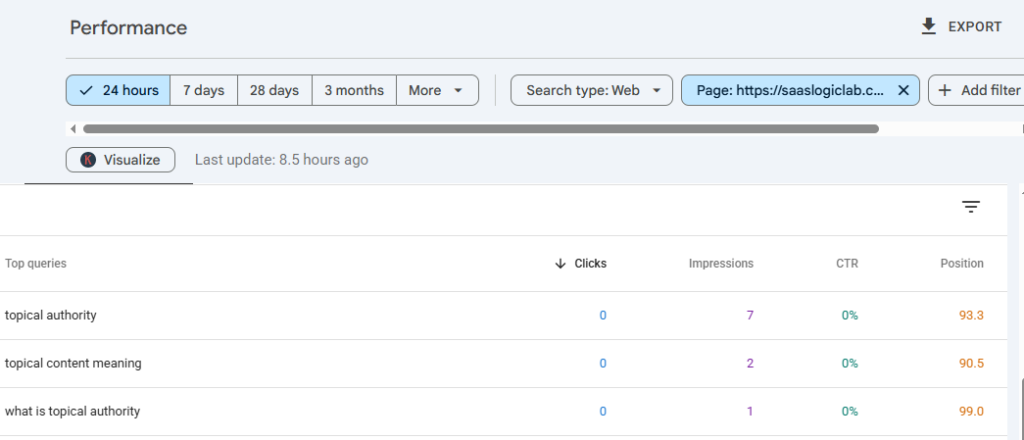
- seo content strategy
- content strategy for seo
- seo and content strategy
- how to create seo content strategy
- seo content strategy template
Even if clicks remain limited, that query set tells you something important:
The URL is beginning to appear across the intended topic and closely related search needs.
Now imagine the same page receives impressions mostly for unrelated content-marketing terms.
That does not automatically mean the page has failed.
But it does justify investigation.
The question becomes:
Why is the page being surfaced for those queries instead of the search need we intended it to own?
That is a much more useful question than simply recording total impressions.
Use GSC Query Groups, Not Just Individual Keywords
One of the strongest post-publish improvements you can make is to stop treating every query as an isolated keyword.
A single page may appear for dozens or hundreds of query variations.
Looking at them one by one can hide the larger pattern.
Instead, group related queries by the need they represent.
For example:
| Query Group | Example Queries | What It May Tell You |
| Core strategy | seo content strategy, content strategy for seo | Main intent alignment |
| Definition | what is seo content strategy, seo content strategy meaning | Definition section is gaining visibility |
| Process | how to create seo content strategy | Step-by-step intent exists |
| Template | seo content strategy template | Users want an execution asset |
| B2B | b2b seo content strategy | Business-specific demand exists |
| Content marketing overlap | seo content marketing strategy | Broader adjacent intent is being associated with the page |
Now you can evaluate intent coverage, not merely keyword positions.
This is especially useful because the search terms people actually use after publication may be broader, narrower, or phrased differently from the keyword set used during research.
Let Real Query Data Challenge the Original Keyword Map
Keyword research happens before publication.
Search Console data happens after Google begins testing the page against real searches.
The two should not be treated as equal forms of evidence.
Research tools help estimate opportunities.
Post-publish first-party query data shows how the page is actually participating in Search.
That creates an important feedback loop:
INITIAL KEYWORD RESEARCH
↓
SEARCH INTENT HYPOTHESIS
↓
PAGE OWNERSHIP DECISION
↓
CONTENT + PUBLISHING
↓
REAL GSC QUERY DATA
↓
COMPARE EXPECTED vs ACTUAL SEARCHES
↓
KEEP / IMPROVE / EXPAND / REMAP
Suppose your original research did not treat SEO content strategy template as a major part of the page.
But after publication, template-related queries repeatedly generate impressions.
That is evidence worth investigating.
You might discover that users want something more actionable than the existing explanation.
The correct response is not automatically:
“Create another article targeting the template keyword.”
Return to the page-ownership framework from Step 5.
Ask whether the template is:
- part of the same search need;
- a useful asset inside the existing guide;
- or sufficiently distinct to deserve its own URL.
Performance data should inform page decisions, not restart one-keyword-one-page SEO.
Compare Expected Intent With Actual Intent
Before publication, record what the page is expected to rank for.
This does not need to be a list of 100 keywords.
A simple expectation sheet is enough:
Primary search need:
Build an SEO content strategy.
Expected query groups:
Definition, process, planning, template, B2B application.
Expected audience:
SEO practitioners, marketers, SaaS teams, business owners managing organic content.
Expected next actions:
Move into deeper resources such as keyword research, search intent, content audits, internal linking, or relevant services.
After sufficient data accumulates, compare those expectations with what actually happened.
This gives the team a meaningful post-publish review instead of a generic traffic report.
Diagnose Position, Impressions, CTR, and Clicks Together
Search metrics become more useful when interpreted together.
Consider four simplified situations.
High Impressions + Low Position
The page is appearing for relevant queries, but its current positions are not yet producing strong visibility.
Investigate:
- whether the content actually satisfies the dominant intent;
- whether competing pages provide something materially better;
- whether your site has enough topical support around the subject;
- whether important internal links are missing;
- whether the page is still relatively new;
- whether the query is simply much more competitive than expected.
Do not immediately rewrite the entire article.
First determine what the data actually indicates.
Good Position + Low CTR
Now SERP presentation becomes more relevant.
Check:
- title link;
- snippet;
- whether the page’s angle matches the query;
- what competing results communicate;
- SERP features that may reduce clicks;
- whether the query itself has strong click potential.
A low CTR is not automatically evidence of a bad title.
The SERP context matters.
Rising Impressions + Rising Relevant Queries
This is generally a more encouraging pattern.
The page is expanding its visibility across searches related to the intended topic.
Instead of making unnecessary changes, continue monitoring and look for specific opportunities supported by the query data.
Traffic + No Meaningful Business Movement
This is where SEO reporting often becomes uncomfortable.
The page may rank.
It may attract visitors.
It may even look successful in a monthly traffic report.
But if the topic has little connection to the audience or business, the original opportunity may have been overvalued.
That is why Step 1 started with business outcomes rather than search volume.
CTR Needs Query-Level Context
Sitewide CTR averages can be misleading.
Even page-level averages can hide useful information.
Imagine a page receives:
- 10,000 impressions;
- 100 clicks;
- 1% overall CTR.
It is tempting to conclude:
“CTR is poor.”
But the average might combine:
- queries where the page ranks near the top;
- queries where it appears near the bottom of page one;
- queries where it ranks far lower;
- branded and non-branded searches;
- SERPs containing different features.
The actionable analysis is therefore closer to:
Query group → position → impressions → CTR → search intent
rather than:
Page → average CTR → good/bad
This reduces unnecessary title changes based on an aggregate number.
Measure Topic Performance, Not Only URL Performance
Earlier in the strategy, we built topic clusters around distinct search needs.
Measurement should eventually return to that same structure.
Suppose a cluster contains:
SEO CONTENT STRATEGY
│
├── Search Intent
├── Keyword Cannibalization
├── Internal Linking Audit
├── On-Page SEO
└── SEO Audit
Looking at each URL separately is useful.
But the strategic question is larger:
Is the site’s visibility across this topic improving?
Track:
- how many relevant query groups the cluster appears for;
- which pages are gaining or losing visibility;
- whether important search needs remain uncovered;
- whether multiple pages are unexpectedly appearing for the same query groups;
- which pages introduce users to deeper parts of the site.
This turns reporting from a collection of URLs into an evaluation of the content architecture itself.
Watch for Unexpected URL Competition
GSC data can also expose page-ownership problems that were not obvious during planning.
Suppose two URLs repeatedly receive impressions for the same group of searches.
That alone does not prove harmful keyword cannibalization.
Different URLs can appear for similar queries for legitimate reasons.
But it gives you a reason to investigate.
Compare:
- the intent each URL was designed to satisfy;
- the queries triggering both pages;
- their ranking patterns;
- content overlap;
- internal anchor context;
- which URL better satisfies the search need.
Then decide whether both pages deserve to remain separate.
This brings measurement directly back to the page-ownership decision made earlier.
Connect Search Performance to Business Outcomes
Search Console tells you how pages perform in Google Search.
It cannot answer every business question.
That is where analytics and business data become necessary.
Depending on the site, useful outcomes may include:
- demo requests;
- contact-form submissions;
- product signups;
- free trials;
- purchases;
- newsletter subscriptions;
- visits to commercial pages;
- assisted conversions;
- qualified leads.
For B2B content in particular, expecting every informational article to produce an immediate lead can create bad decisions.
A user may discover the company through an informational query, return later through another channel, visit a comparison page, and convert afterward.
The strategic question is therefore not only:
“Did this article generate a form submission?”
It can also be:
“Did this article attract the right audience and help move that audience toward a commercially meaningful part of the site?”
Separate Leading and Lagging Indicators
This distinction makes early measurement more useful.
Leading indicators can appear before meaningful business outcomes:
- relevant impressions;
- intended query coverage;
- improving positions;
- clicks;
- discovery of additional relevant queries;
- movement into connected pages.
Lagging indicators may take longer:
- leads;
- trials;
- pipeline;
- revenue;
- customer acquisition.
For a new site or new topic cluster, demanding revenue before looking at earlier evidence can lead to premature conclusions.
The reverse is equally dangerous.
Strong impressions should not be celebrated indefinitely if the strategy never creates meaningful business value.
Both levels matter.
Do Not Make Major Decisions From Tiny Samples
A handful of impressions can be interesting.
It is rarely enough to justify rebuilding a page.
New content needs enough opportunity to be crawled, indexed, tested across searches, and accumulate meaningful data.
There is no universal number of days that makes every SEO decision statistically valid.
Competition, crawl frequency, site authority, search demand, seasonality, query type, and the scale of the site can all affect how quickly useful patterns emerge.
So avoid rules such as:
“Update every article after 30 days.”
A 30-day review can be operationally useful.
It is not proof that every page needs modification after 30 days.
Use a 30–60–90 Day Review as a Framework, Not a Ranking Promise
A practical review cadence can look like this:
| Review Point | Main Question | What to Inspect |
| ~30 days | Is the page being discovered for the intended topic? | Indexing, impressions, initial queries, obvious technical problems |
| ~60 days | Are meaningful query patterns developing? | Query groups, positions, CTR context, competing URLs |
| ~90 days | What does accumulated evidence suggest? | Visibility trend, intent alignment, traffic quality, business contribution |
The dates are checkpoints.
They are not deadlines by which Google must rank the page.
If there is insufficient data, record that instead of manufacturing a conclusion.
Build a Content Performance Scorecard
A useful reporting sheet can stay surprisingly simple.
For every strategic page, record:
| Dimension | Question |
| Intended search need | What was this URL created to own? |
| Actual query groups | What needs is Google showing it for? |
| Visibility trend | Is relevant visibility increasing, stable, or declining? |
| URL ownership | Is another page appearing for the same need? |
| Traffic quality | Are visitors moving into relevant areas of the site? |
| Business contribution | Is the page supporting a meaningful outcome? |
| Decision | Keep, monitor, improve, expand, consolidate, or investigate |
Notice what is missing:
a meaningless universal SEO score out of 100.
Different pages have different jobs.
The scorecard exists to support decisions, not manufacture a number for a dashboard.
The Most Important Output of Measurement Is a Decision
Reports are not the final product of analytics.
Decisions are.
After reviewing a page, you should be able to choose one of a small number of actions:
KEEP
The page is doing its intended job. Avoid unnecessary edits.
MONITOR
The evidence is promising or incomplete. Gather more data.
IMPROVE
The intended search need is correct, but specific weaknesses are visible.
EXPAND
Real query data exposes an important need that belongs within the page.
CONSOLIDATE
Two or more pages are serving substantially overlapping needs and would be stronger together.
INVESTIGATE
Something is wrong, but the available evidence does not yet explain why.
That last option is important.
SEO teams sometimes feel pressure to make a change simply because performance is disappointing.
“We don’t know yet” is a better decision than changing a page without understanding the problem.
Measurement Closes the Strategy Loop
These decisions connect into one continuous strategy loop.
BUSINESS GOAL
↓
AUDIENCE PROBLEM
↓
SEARCH OPPORTUNITY
↓
SEARCH INTENT
↓
PAGE OWNERSHIP
↓
PRIORITIZATION
↓
CONTENT
↓
PUBLISH + DISTRIBUTE
↓
REAL SEARCH + BUSINESS DATA
↓
DECISION
↺
That final arrow matters.
SEO content strategy is not a straight line from keyword research to publication.
It is a loop.
Research creates the first hypothesis.
Publishing creates evidence.
Measurement tells you whether the hypothesis survived contact with real search behavior.
And that evidence determines what happens next.
Step 14 — Refresh, Consolidate, or Prune Content
Content maintenance should begin with diagnosis.
A traffic decline, ranking drop, or loss of impressions does not automatically mean a page needs more words, a new title, or a complete rewrite.
Before changing anything, determine what changed.
The page may have:
- outdated information;
- weaker evidence than newer competitors;
- lost alignment with the current SERP;
- become too broad;
- started overlapping with another URL;
- lost internal-link support;
- attracted the wrong query group;
- or simply entered a temporary period of lower demand.
Different problems require different responses.
That is why maintenance should not be reduced to:
“Update old content every six months.”
The better question is:
What evidence shows that this page needs to change, and what kind of change is justified?
Separate Content Decay From Search Intent Change
Content decay and intent change can look similar in analytics, but they are not the same problem.
Content decay means the page still targets the right need, but its ability to satisfy that need has weakened.
That can happen because:
- facts are outdated;
- screenshots no longer match the product;
- examples are stale;
- important subtopics are missing;
- competing pages now provide stronger evidence;
- the page has not kept up with how the subject is discussed.
Search intent change is different.
The searcher may now expect a different type of result.
For example, a query that once returned long educational articles might begin favoring:
- tools;
- templates;
- comparison pages;
- videos;
- product pages;
- more specialized guides.
If that happens, adding another 1,000 words to the old format may not solve the problem.
The issue is not freshness.
The page may simply be answering the wrong version of the query.
Use a Diagnostic Sequence Before Editing
When performance falls, work through the problem in order.
Start with the page itself:
1. Is the page still indexed?
Check whether the URL is available in Search and whether any technical issue has appeared.
2. Did visibility decline across the whole page or only one query group?
A single losing keyword is different from broad topic-level decline.
3. Did the SERP change?
Compare the current result type, format, angle, and competing pages with what existed when the page was created.
4. Did another site URL begin appearing for the same search need?
This may indicate an ownership conflict rather than content decay.
5. Is the content factually or practically outdated?
Check data, screenshots, tools, links, examples, pricing, product features, regulations, and other time-sensitive details.
6. Did the business or audience change?
A page can still rank while becoming strategically less useful.
Only after answering those questions should editing begin.
Content Decay vs. Intent Shift Diagnostic Flow
PERFORMANCE DECLINE
│
▼
IS THE URL INDEXED AND TECHNICALLY HEALTHY?
│
NO ──┴── YES
│ │
▼ ▼
FIX DID THE RELEVANT QUERY GROUP DECLINE?
TECH │
├── NO → Check seasonality / demand / data quality
│
▼
HAS SERP INTENT OR PAGE TYPE CHANGED?
│
YES ─┴─ NO
│ │
▼ ▼
REASSESS IS CONTENT OUTDATED / WEAKER?
PAGE TYPE │
├── YES → UPDATE
│
▼
IS ANOTHER URL COMPETING?
│
YES ─┴─ NO
│ │
▼ ▼
CONSOLIDATE MONITOR / INVESTIGATE
OR REMAP
This prevents the common mistake of assuming every decline is a writing problem.
Update When the Page Still Owns the Right Search Need
An update is appropriate when the underlying page decision remains correct.
The URL still serves the right audience and intent, but the execution needs improvement.
That may mean:
- refreshing outdated facts;
- replacing old screenshots;
- adding a missing example;
- improving a weak explanation;
- answering a recurring new question;
- strengthening internal links;
- correcting factual errors;
- adding evidence;
- reorganizing a section that has become difficult to use.
Do not treat an update as permission to rewrite everything.
If a section already performs well and still satisfies the search need, preserve it.
The goal is to strengthen the weak parts without destroying what already works.
Preserve What Already Works
Content refresh projects often become unnecessary rewrites.
A page is several years old, so the team assumes every paragraph needs to be rewritten.
That can remove useful material, change wording around queries the page already ranks for, and introduce new errors without solving a real problem.
Before changing a strong page, inspect:
- the queries already bringing relevant impressions;
- sections attracting useful long-tail visibility;
- links pointing to the page;
- internal links using the page as a destination;
- conversion paths;
- information that remains accurate.
Then separate:
what is outdated
from
what is merely old.
Age alone is not a diagnosis.
Expand When New Demand Belongs on the Same Page
Sometimes Search Console or community research exposes an important question that the page does not currently answer.
Expansion makes sense when the new need:
- belongs to the same core intent;
- supports the same page job;
- can be added without making the page unfocused;
- would help the existing audience complete the task.
For example, if an SEO content strategy guide begins receiving meaningful template-related queries, adding a usable template section may be the correct move.
That is different from creating a separate URL automatically.
The page-ownership framework still applies.
Consolidate When Multiple URLs Perform the Same Job
Consolidation is appropriate when several URLs have become difficult to distinguish.
Possible warning signs include:
- overlapping query groups;
- very similar titles and headings;
- repeated explanations;
- both pages trying to rank for the same dominant intent;
- internal links split between multiple versions;
- the two pages repeatedly alternating visibility for substantially the same query group.
Before consolidating, compare:
- search queries;
- clicks;
- impressions;
- backlinks;
- internal links;
- conversions;
- content sections worth preserving.
Then choose the strongest destination based on page purpose, not simply traffic.
Useful content from the weaker URL can be incorporated where it improves the surviving page.
Any redirect or removal decision should also be handled technically correctly.
Do Not Consolidate Pages Just Because the Topics Are Related
A pillar and a supporting page may share many terms while serving different jobs.
For example:
SEO content strategy
and
keyword cannibalization
are closely related.
That does not make them duplicates.
The first provides the broader planning system.
The second solves a narrower diagnostic problem.
Consolidation should be driven by overlapping search need, not topical similarity alone.
Prune Content Only When Keeping It Adds Little Value
Pruning can mean several different actions:
- deleting a page;
- redirecting it;
- merging its useful content into another page;
- keeping the page available to users while intentionally excluding it from search indexing when there is a valid non-search purpose;
- leaving the URL live but removing it from active content strategy.
Those decisions should not be based on:
“This page has no traffic.”
A low-traffic page may still:
- support customers;
- earn links;
- answer a niche commercial query;
- support another strategic page;
- have seasonal demand;
- serve a non-SEO purpose.
A stronger pruning test asks:
- Does the page serve a useful audience need?
- Does that need belong on this site?
- Is another page already serving it better?
- Does the page have valuable links, traffic, conversions, or historical value?
- Can the content be improved efficiently?
- Would removing it create a gap?
Prune only after those questions have been answered.
Content Pruning Without Panic
Large sites often accumulate pages that no longer have a clear role.
The answer is not a mass deletion campaign.
Start by classifying weak pages.
| Page Condition | Likely Action |
| Useful intent, weak execution | Update |
| Useful intent, wrong URL owner | Consolidate/remap |
| Outdated but recoverable | Refresh |
| Duplicate or near-duplicate need | Consolidate |
| No meaningful audience/business role | Consider pruning |
| Valuable for users but not SEO | Keep for non-search purpose |
| Insufficient data | Monitor |
This creates a controlled maintenance process instead of a cleanup driven by traffic alone.
Know When Not to Update
One of the hardest SEO decisions is doing nothing.
If a page:
- still matches the search intent;
- is gaining or maintaining relevant visibility;
- answers the searcher’s need;
- contains accurate information;
- has no ownership conflict;
- supports the business appropriately;
then an update may add risk without adding value.
Do not change a page merely because:
- a calendar says it is “due”;
- a competitor published something newer;
- the title contains an older date but the content remains accurate;
- one keyword moved a few positions;
- an SEO tool produced a lower score.
Sometimes the best maintenance decision is:
Leave it alone and keep monitoring.
That restraint is part of strategy.
Use 30–60–90 Reviews as Diagnostic Checkpoints
The review framework from Step 13 becomes useful here.
At roughly 30 days, ask:
Is the page being discovered and associated with the intended topic?
At around 60 days:
Are meaningful query patterns becoming visible?
At around 90 days:
Is there enough evidence to justify a specific action?
These are not ranking deadlines.
A low-volume B2B page may need much longer to accumulate useful data than a high-volume informational page.
The decision should follow evidence, not the calendar.
Refresh Based on the Type of Change
A “content update” can mean very different things.
Factual Refresh
Use when:
- statistics changed;
- tools changed;
- pricing changed;
- regulations changed;
- product features changed;
- screenshots became outdated.
Editorial Improvement
Use when:
- the explanation is unclear;
- the answer is buried;
- examples are weak;
- unnecessary sections create friction.
Intent Realignment
Use when:
- the SERP now expects a different format;
- the page angle is no longer competitive;
- the user’s task changed.
Structural Consolidation
Use when:
- multiple pages now share the same job;
- ownership has become unclear.
Evidence Upgrade
Use when:
- the page is accurate but generic;
- stronger original data, screenshots, experience, or primary sources are now available.
This is more precise than calling every change a “refresh.”
Audit Internal Links During Major Updates
When a page changes substantially, the internal-link network may need to change too.
Check:
- whether incoming anchors still describe the page accurately;
- whether the updated page should link to newly published supporting resources;
- whether consolidated pages require internal links to be updated;
- whether links still point through unnecessary redirects;
- whether the page’s role in the cluster has changed.
Content architecture should remain aligned with the new page decision.
Update the Brief and Content Map After Major Changes
Maintenance decisions should not live only inside the edited article.
If a page changes from:
general guide
to
specialized template resource
the strategy documents should reflect that.
Update:
- page purpose;
- intent;
- query group;
- cluster relationship;
- internal-link expectations;
- business role;
- review date.
Otherwise, the editorial calendar and content map will continue operating on an outdated understanding of the site.
Use Change Logs for Important Strategic Pages
For major pages, a simple change log can prevent repeated guesswork.
Record:
| Date | Observation | Action | Reason | Outcome to Watch |
| Aug 2026 | Template queries increasing | Added usable template | Same intent expanding | Template query visibility |
| Oct 2026 | Two URLs competing | Consolidated | Same search job | Query ownership |
| Jan 2027 | Product screenshots outdated | Updated screenshots | Accuracy | Engagement / usability |
This gives future editors context.
They can see why a change was made instead of treating every version as a blank slate.
The Maintenance Decision Framework
At every major review, choose the action that matches the diagnosis:
KEEP
The page still does its job.
MONITOR
Evidence is incomplete.
UPDATE
Right page, weaker execution.
EXPAND
New demand belongs on the same URL.
REALIGN
The search need or SERP expectation changed.
CONSOLIDATE
Multiple URLs serve the same job.
PRUNE
The page no longer provides enough value to justify keeping it.
INVESTIGATE
Performance changed, but the reason is not clear yet.
The framework matters because “refresh” is not one action.
Different problems need different responses.
Maintenance Completes the Content Lifecycle
The full lifecycle now looks like this:
RESEARCH
↓
INTENT
↓
PAGE OWNERSHIP
↓
PRIORITY
↓
BRIEF
↓
CREATE
↓
PUBLISH
↓
MEASURE
↓
DIAGNOSE
↓
KEEP / UPDATE / EXPAND / CONSOLIDATE / PRUNE
↺
The last loop is what prevents an SEO content strategy from becoming an endless production machine.
A mature content program does not ask only:
“What should we publish next?”
It also asks:
“What should we stop, strengthen, merge, preserve, or leave alone?”
That is how the content library becomes more useful as it grows rather than simply becoming larger.
SEO Content Strategy Example: From Keywords to a Content Map
A framework becomes useful when you can see how the decisions connect.
This example uses SaaSLogicLab’s actual content system: keyword research, search intent, page ownership, existing articles, topic relationships, internal linking, and post-publish measurement. The example focuses on the planning logic behind the content map rather than claiming unverified ranking results.
Start With a Broad Topic
The broad strategic topic is:
SEO content strategy
From there, the first mistake would be to turn every related phrase into a separate article.
Consider these related keyword variations:
| Keyword | Volume | KD | Initial Role |
| seo content strategy | 4,400 | 43 | Primary topic |
| seo content marketing strategy | 2,400 | 55 | Broader related variation |
| content marketing strategy for seo | 1,300 | 52 | Related variation |
| content strategy seo | 1,000 | 40 | Variation |
| content marketing seo strategy | 1,000 | 46 | Related variation |
| seo and content strategy | 880 | 27 | Strong secondary |
| content strategy and seo | 880 | 33 | Secondary |
| seo content strategies | 720 | 26 | Strong secondary |
| content seo strategy | 590 | 27 | Strong secondary |
| content strategy for seo | 590 | 32 | Strong secondary |
| b2b seo content strategy | 170 | 34 | B2B-specific variation |
| seo content strategy template | 170 | 37 | Template/use-case variation |
| what is seo content strategy | 140 | 24 | Definition intent |
If this table were treated as a publishing calendar, the site could end up with thirteen overlapping URLs.
That would create unnecessary overlap.
The next step is to group the terms by search need.
Separate Similar Keywords by Search Need
Start with the phrases that appear to represent the same core informational task:
- seo content strategy
- seo and content strategy
- seo content strategies
- content seo strategy
- content strategy for seo
- content strategy seo
These phrases use different wording, but they do not automatically represent six different jobs.
The strategic decision is:
One main page can own the broad SEO content strategy need if SERP intent remains sufficiently aligned.
These variations can be served by one comprehensive page when their search intent is sufficiently aligned.
Consider another query:
what is seo content strategy
That is a narrower definition-oriented query.
It does not necessarily need its own URL.
A concise definition near the beginning can satisfy this narrower informational need before the page moves into the full framework.
Compare that with:
seo content strategy template
This is still related to the main topic, but the expected outcome is more actionable.
The user may want something they can copy, adapt, or implement.
Instead of creating a separate page immediately, the query can be served with a dedicated asset inside the main guide:
the copy-paste SEO Content Brief Template in Step 9.
That satisfies a meaningful part of the template intent without creating another URL before the need has been validated independently.
The same reasoning applies to:
b2b seo content strategy
Instead of creating a separate B2B article automatically, this guide contains a dedicated B2B buyer-journey section.
If post-publish data later shows that B2B-specific queries represent a larger or materially different search need, a separate page can be reconsidered.
The practical rule is:
consolidate wording variations; separate only when the expected outcome changes enough to justify it.
Map Existing SaaSLogicLab Pages Around Distinct Jobs
An SEO content strategy should connect naturally with related resources across the site.
They should not compete with one another.
Each page needs a distinct role.
| Existing / Planned Page | Main Search Need | Page Job | Relationship to This Guide |
| SEO Content Strategy | Build the overall content system | Strategic pillar | Main page |
| Search Intent in SEO | Understand what searchers expect | Intent guide | Supports Step 4 |
| Keyword Cannibalization | Diagnose overlapping page/query targeting | Problem-solving guide | Supports Steps 2, 5, 6, 14 |
| Internal Linking Audit | Evaluate internal-link structure | Audit/process guide | Supports Steps 2, 6, 12 |
| On-Page SEO Checklist | Optimize individual pages | Execution checklist | Supports Step 10 |
| SEO Audit | Diagnose broader site issues | Audit framework | Supports Steps 2 and 12 |
| Technical SEO Checklist | Validate crawlability/indexability | Technical checklist | Supports Step 12 |
| Google Search Console Guide | Measure real search performance | Measurement guide | Supports Steps 13 and 14 |
| Topical Authority | Build broader subject depth | Strategic supporting guide | Supports Step 6 |
| Best Keyword Research Tools | Evaluate research tools | Commercial/research guide | Supports Step 3 |
| Semrush Review | Evaluate Semrush | Product review | Lower-funnel support |
| Ahrefs Review | Evaluate Ahrefs | Product review | Lower-funnel support |
| Semrush vs Ahrefs | Compare two SEO platforms | Comparison page | Commercial decision support |
The pages share a broader SEO theme, but the intended search outcomes are different.
That is what allows them to coexist.
Example: Mapping an SEO Audit Content Cluster
A smaller content map makes the decision logic easier to see.
Take SEO audit as a simple example:
SEO audit
Several distinct search needs can sit around that broader topic:
- SEO audit
- technical SEO checklist
- on-page SEO checklist
- internal linking audit
- keyword cannibalization
- Google Search Console analysis
A weak approach would be to decide that these all belong in one giant SEO audit article because they are related.
An equally weak approach would be to create a separate page for every tiny keyword variation around “SEO audit.”
Instead, map each search need to a job.
| Search Need | User Outcome | Existing URL / Content Type | Decision |
| SEO audit | Understand and perform a complete audit | /seo-audit/ | Reuse / strengthen pillar |
| Technical SEO checklist | Check technical issues systematically | /technical-seo-checklist/ | Reuse as dedicated checklist |
| On-page SEO checklist | Check page-level optimization | /on-page-seo-checklist/ | Reuse as dedicated checklist |
| Internal linking audit | Diagnose internal-link problems | /internal-linking-audit/ | Reuse as specialist audit page |
| Keyword cannibalization | Diagnose overlapping URLs/intents | /keyword-cannibalization/ | Reuse as specialist problem guide |
| Search intent | Determine what a query/page should satisfy | /search-intent-in-seo/ | Reuse as strategic supporting guide |
Each page now serves a distinct search need.
The main SEO audit guide can explain when each problem matters.
The supporting page can explain how to solve it.
That separation prevents both thin cluster pages and oversized pillar pages.
Apply the Create / Update / Reuse / Consolidate / Ignore Framework
Now take a hypothetical new keyword opportunity:
SEO audit template
Do not create the page yet.
Run it through the framework.
Does an existing relevant URL exist?
Yes: the SEO Audit guide.
Does that page currently satisfy a template-seeking user?
Maybe not.
Could a usable audit template fit naturally inside the existing guide?
Possibly.
Does the live SERP show that users strongly expect a standalone template/resource page?
Needs validation.
Does the query have enough business/audience value to maintain a separate asset?
Needs evaluation.
So the current decision might be:
UPDATE / EXPAND the SEO Audit guide first, not CREATE a new page automatically.
Now consider:
best SEO audit tools
This expected outcome is different.
The searcher is not primarily asking how to audit a site.
They are evaluating software.
If the SERP confirms commercial comparison intent, the decision could become:
CREATE a dedicated comparison page or map the opportunity to an existing SEO-tools resource if that page can genuinely own it.
The same broad topic can therefore produce different page decisions.
Add Internal Links Based on the Reader’s Next Job
Once ownership is clear, internal linking becomes easier.
A possible path looks like this:
SEO CONTENT STRATEGY
│
├── Search Intent in SEO
│ │
│ └── Keyword Cannibalization
│
├── SEO Audit
│ ├── Technical SEO Checklist
│ ├── On-Page SEO Checklist
│ └── Internal Linking Audit
│
├── Topical Authority
│
└── Google Search Console Guide
The important part is not the diagram.
It is the reason behind each connection.
From the SEO Content Strategy guide, a reader reaches Search Intent in SEO when they need to understand how keyword groups should be interpreted.
From the SEO Audit page, they reach the Technical SEO Checklist when the audit identifies crawlability, indexing, or site-performance issues.
From the Keyword Cannibalization guide, they can reach the Internal Linking Audit when page relationships and anchor context need review.
The links follow tasks.
They are not inserted merely because all pages contain the word “SEO.”
Use Existing GSC Data to Recheck Ownership
The map is a starting hypothesis.
Google Search Console later provides evidence about which queries and pages are gaining visibility, which can help re-evaluate the original page-ownership map.
Suppose the main SEO tools article starts receiving impressions for:
- seo software for agencies
- seo tools for agencies
- best seo tools for agencies
- software for seo agency
That query group may suggest the page has a growing agency-tools association.
Do not immediately publish four new pages.
First review:
- whether those phrases share one intent;
- whether the existing page already serves agency users well;
- whether the article contains enough agency-specific evaluation;
- whether a dedicated agency-tools page would provide a genuinely different outcome.
The first-party data changes the conversation from:
“This keyword exists.”
to:
“Google is already testing our page for this need. What should we do with that evidence?”
That is a much stronger basis for content planning.
Turn the Map Into a Decision Sheet
The final content map should contain more than topic names.
A practical version looks like this:
| Search Need | Keyword / Query Group | Existing URL? | Intent | Business Role | Decision | Internal Relationship | Review Signal |
| Overall content planning | seo content strategy + close variations | Yes | Informational | Authority / relevant audience | Reuse / strengthen | Main pillar | Query-group growth |
| Definition | what is seo content strategy | Same pillar | Informational | Early-stage education | Reuse | Intro/definition | Definition queries |
| Template | seo content strategy template | Same pillar currently | Informational/actionable | Implementation value | Expand first | Step 9 asset | Template-query growth |
| B2B strategy | b2b seo content strategy | Same pillar currently | Informational | High audience relevance | Expand first | Step 7 | B2B query group |
| Search intent | search intent in SEO | Dedicated page | Informational | Supporting expertise | Reuse | Step 4 link | Intent queries |
| Cannibalization | keyword cannibalization | Dedicated page | Informational/problem-solving | Supporting expertise | Reuse | Steps 2/5/6 | Overlap queries |
| Internal linking audit | internal linking audit | Dedicated page | Informational/actionable | Supporting expertise | Reuse | Steps 6/12 | Audit queries |
This table becomes a working content architecture rather than a static keyword list.
What This Example Proves
The important result is not:
“We found 13 keywords.”
It is:
Several keywords collapse into one search need. Some become dedicated sections. Some already belong to existing supporting pages. Others should remain under observation until real SERP or GSC evidence justifies a separate URL.
That is the entire strategy in practice:
Keyword research creates options.
Intent gives those options meaning.
Page ownership decides where they belong.
Internal links connect the resulting pages.
Performance data tells us whether the original map was correct.
No part of the process requires publishing a new page simply because another keyword appears in the tool.
Common SEO Content Strategy Mistakes
A strong framework becomes easier to use when the failure patterns are clear.
Most SEO content problems do not come from one catastrophic mistake. They come from a series of smaller decisions that look reasonable in isolation:
a keyword with decent volume, a new page that seems relevant, another article added to the calendar, an update made because rankings moved, a cluster expanded because competitors have more URLs.
Over time, those decisions can produce a content library that is large but difficult to manage, hard to differentiate, and unclear about which page should own which search need.
The following mistakes are the ones this strategy is designed to prevent.
Starting With Search Volume Instead of Audience Need
Search volume estimates the level of search demand for a query.
It does not tell you whether the demand belongs to your audience or your business.
A high-volume keyword can attract a large number of visitors who have no reason to become customers, use your product, read supporting pages, or return to the site.
A better sequence is:
Audience problem → Search demand → Intent → Business relevance
not:
Highest volume → Article
This is why Step 1 defined the audience and business outcome before keyword prioritization.
Treating Every Keyword as a New Page
This is one of the fastest ways to create unnecessary overlap.
Keyword tools may return:
- seo content strategy
- seo and content strategy
- content strategy for seo
- content seo strategy
- seo content strategies
Those are useful terms for understanding demand.
They are not automatically five content assignments.
Before creating a new page, compare:
- intent;
- expected outcome;
- SERP type;
- existing URLs;
- whether one page can satisfy the whole query group.
The keyword list creates options.
The page-ownership framework decides how many URLs are actually needed.
Ignoring Existing Content Before Publishing More
New content often feels more productive than improving old content.
That can be misleading.
- established relevance and performance signals around the topic.
- indexing history;
- relevant impressions;
- internal links;
- backlinks;
- useful sections;
- authority around the topic.
Creating another URL without checking that page can split the opportunity instead of strengthening it.
Before approving a new article, ask:
Does the site already have a page that should own this search need?
If yes, update or reuse may be the stronger decision.
Confusing SEO Writing With SEO Content Strategy
A page can be well written and still be strategically unnecessary.
Strong headings, natural keywords, useful examples, and good on-page SEO do not answer:
- why the page should exist;
- which audience it serves;
- which URL should own the need;
- what it should not overlap with;
- where it belongs in the cluster;
- what outcome matters.
Writing executes the decision.
Strategy makes the decision.
When those roles are reversed, content production starts before the site architecture is clear.
Grouping Keywords by Wording Instead of Intent
Keyword clustering becomes dangerous when it is based only on lexical similarity.
Two phrases can look similar but represent different jobs.
Two very different phrases can still belong on the same page if they lead to the same outcome.
For example:
seo content strategy
and
seo content strategy template
share most of their wording, but the second term may imply a more actionable expectation.
Meanwhile:
seo content strategy
and
content strategy for seo
may use different word order while representing essentially the same broad need.
Group by:
what the searcher wants to accomplish
not by:
how similar the phrases look.
Building Forced Topic Clusters
Topic clusters are useful when they represent real relationships between distinct search needs.
They become weak when the strategist decides first that a pillar must have ten supporting pages and then searches for keywords to fill the empty slots.
That creates artificial architecture.
A supporting page should exist because it solves a distinct problem the pillar cannot cover deeply without losing focus.
If the page cannot be given a clear job in one sentence, its role in the cluster may not be strong enough.
The goal is not:
more cluster pages.
It is:
clearer topical coverage.
Measuring Traffic Without Business Context
Traffic can be a valuable outcome.
It should not be treated as the only outcome.
A B2B page generating 300 highly relevant visits may matter more than an informational article attracting 10,000 broad visits with no meaningful connection to the business.
The correct measurement depends on the page’s job.
That can include:
- relevant query visibility;
- qualified organic traffic;
- product-page progression;
- leads;
- trials;
- demos;
- conversions;
- assisted business outcomes.
A page can succeed in Search and still be a weak strategic investment.
Measurement needs to expose both facts.
Publishing Without Building Internal Relationships
A new page should not sit alone simply because it has been added to the XML sitemap.
If the page belongs to an existing topic, relevant pages should help users discover it.
Likewise, the new page should connect readers to deeper resources where appropriate.
Internal links should answer:
What does this reader reasonably need next?
not:
Where can we insert another keyword-rich anchor?
A strong content map should therefore include internal-link expectations before publication rather than treating them as cleanup work months later.
Updating Content Without Diagnosing the Problem
A ranking drop is not a diagnosis.
Neither is a traffic decline.
The problem could be:
- outdated content;
- changing search intent;
- weaker SERP fit;
- another URL competing for the same need;
- technical issues;
- declining search demand;
- stronger competitors;
- normal volatility.
Adding paragraphs or changing the title before identifying the reason can make the page worse.
Diagnosis comes first.
Then choose:
Update / Expand / Realign / Consolidate / Monitor / Leave alone.
Using AI Output as Original Experience
AI can organize research, suggest structures, classify information, and help with drafting.
It cannot legitimately create experience that did not happen.
Statements such as:
“We tested this across dozens of SaaS sites…”
need actual evidence.
The same applies to:
- fake screenshots;
- invented ranking results;
- fabricated experiments;
- false client stories;
- made-up years of experience.
If first-party evidence is unavailable, use credible primary sources and clearly framed examples instead.
Authority is not created by making the prose sound confident.
Publishing on a Fixed Cadence Without Enough Qualified Opportunities
A calendar can create its own pressure.
If the schedule says three posts need to go live every week, teams can start lowering the approval standard simply to keep the pipeline full.
That reverses the strategy.
A topic should enter production because it has passed the necessary checks:
- audience fit;
- demand;
- intent;
- page ownership;
- business relevance;
- realistic opportunity.
Not because Thursday’s publishing slot is empty.
When no strong new page is ready, use the capacity for:
- updating;
- consolidation;
- internal linking;
- performance analysis;
- evidence collection;
- better briefs.
Copying Competitor Structures Instead of Solving Competitor Gaps
Competitor research is useful.
Competitor imitation is not the same thing.
If five ranking pages all contain:
What Is SEO Content Strategy?
that is evidence that the definition is part of expected coverage.
It does not mean the sixth page should simply repeat their entire outline with different wording.
The stronger question is:
After reading those pages, what important decision is still difficult for the user?
Common gaps in SEO content strategy guides include:
- page ownership;
- Create / Update / Reuse / Consolidate / Ignore decisions;
- query-group mapping;
- avoiding one-keyword-one-page planning;
- using real post-publish data to challenge the original map.
Competitor coverage tells you what the SERP already answers.
Competitive advantage comes from what you add beyond it.
Bad Strategy vs. Better Strategic Decision
| Bad Approach | Why It Fails | Better Decision |
| Target the highest-volume keywords first | Ignores relevance and business value | Evaluate audience fit, intent, and value |
| Create one page per keyword | Produces overlapping URLs | Group by shared search need |
| Publish before checking existing content | Splits existing opportunity | Audit existing URLs first |
| Use keyword similarity to build clusters | Confuses wording with intent | Assign every page a distinct job |
| Copy competitor headings | Repeats what already exists | Find unresolved user decisions |
| Measure only traffic | Hides traffic quality and business impact | Match KPIs to the page’s job |
| Add internal links after rankings fail | Treats architecture as cleanup | Plan contextual links before publication |
| Rewrite every declining page | Changes content without diagnosis | Identify decay, intent shift, or ownership issues |
| Delete pages with low traffic | Traffic alone does not determine value | Evaluate purpose, links, conversions, and overlap |
| Use AI-generated “experience” | Creates unsupported authority | Use real evidence or no experience claim |
| Publish to maintain cadence | Quantity starts controlling quality | Let qualified opportunities control the calendar |
| Chase low KD alone | Difficulty is only one metric | Combine feasibility with relevance and value |
A Simple Pre-Publish Mistake Check
Before a page enters writing, ask:
[ ] Does this topic serve the intended audience?
[ ] Have we checked whether an existing URL already owns the need?
[ ] Are related keywords grouped by intent rather than wording?
[ ] Does the proposed page have a distinct job?
[ ] Is there a clear business or strategic reason to create it?
[ ] Does the planned format match the SERP?
[ ] Have competitor gaps been identified?
[ ] Is original evidence available where needed?
[ ] Are internal relationships already mapped?
[ ] Do we know how the page will be measured?
If several of those answers are unclear, the page is probably not ready for production.
Fixing the strategy at this stage is cheaper than fixing the content after publication.
A 30-Day SEO Content Strategy Action Plan
An SEO content strategy becomes useful only when it changes what gets researched, created, updated, and measured.
The first 30 days should not be treated as a race to publish as many pages as possible. The purpose of the month is to build enough evidence to make better content decisions.
That means the work happens in a specific order:
Understand → Audit → Research → Map → Prioritize → Produce → Measure
If you already have a content library, more of the month may go toward auditing and improving existing URLs. If the site is new, more effort may go toward opportunity research and building the first content map.
The sequence matters more than hitting an arbitrary publishing number.
Week 1 — Define the Audience, Goals, and Existing Content Baseline
Do not start the month with a keyword export.
Start by establishing what the content system is supposed to accomplish.
Days 1–2: Define the Business Goal
Write down the primary outcomes organic content should support.
Depending on the business, those could include:
- qualified organic traffic;
- product trials;
- demo requests;
- leads;
- software comparisons;
- service inquiries;
- newsletter sign-ups;
- brand discovery;
- customer education.
Avoid vague goals such as:
“Increase SEO traffic.”
Make the connection clearer:
“Attract SaaS marketers researching SEO problems and move relevant visitors toward our SEO services and software resources.”
That changes which opportunities deserve attention later.
Days 2–3: Define the Search Audience
Document:
- who you want to reach;
- what problems they are trying to solve;
- what they already understand;
- what terminology they use;
- what they might search before discovering your solution;
- what they might search when evaluating a solution;
- what they need before taking a commercial action.
Do not assume that the person with the highest search volume is automatically the most valuable audience.
Days 3–5: Build the Existing Content Inventory
Create one working sheet containing at least:
| URL | Topic | Current Purpose | Main Search Need | Current Queries | Traffic/Clicks | Business Role | Action |
| URL A | Topic | Informational | Problem A | Query group | Data | Awareness | Review |
| URL B | Topic | Checklist | Task B | Query group | Data | Support | Keep |
| URL C | Topic | Comparison | Decision C | Query group | Data | Commercial | Improve |
For an existing site, pull actual query and page data from Google Search Console rather than relying entirely on SEO-tool estimates.
The objective is not yet to decide what should be deleted or rewritten.
It is to understand what already exists.
End-of-Week Deliverable
By the end of Week 1, you should have:
Audience definition + business objectives + existing URL inventory + baseline search data
Do not move straight from the audit to deleting low-traffic pages. Those decisions need the intent and ownership work that follows.
Week 2 — Build the Search Opportunity and Page-Ownership Map
Week 2 turns research into decisions.
Days 6–7: Collect Search Opportunities
Start with audience problems and expand them through multiple evidence sources:
- keyword research tools;
- Google Search Console;
- Google SERPs;
- People Also Ask;
- competitor pages;
- customer or sales questions where available;
- Reddit and Quora discussions;
- YouTube discussions and comments;
- relevant industry communities.
These sources do different jobs.
Keyword tools help estimate demand.
SERPs help reveal intent.
GSC shows how Google is already connecting your pages with queries.
Communities expose vocabulary, frustrations, and questions that keyword databases may not explain clearly.
Keep those roles separate.
A Reddit comment can reveal a useful problem.
It should not be treated as proof of a Google ranking factor.
Days 8–9: Group Queries by Search Need
Do not group terms simply because they share words.
For every group, ask:
Would the same useful page satisfy these searches?
If yes, they may belong to one page.
If no, identify what changes:
- intent;
- content type;
- expected depth;
- audience;
- funnel stage;
- task;
- commercial expectation.
Create query groups rather than a flat keyword list.
Days 9–10: Assign Page Ownership
Run each qualified opportunity through the framework developed earlier:
Does a relevant URL already exist?
│
┌────┴────┐
YES NO
│ │
Does it Does the opportunity
own the justify a page?
intent? │
│ ├── YES → CREATE
├─ YES → REUSE │
│ └── NO → IGNORE / MONITOR
└─ NO
│
Can it be improved to own the need?
│
├─ YES → UPDATE
│
└─ NO → Check overlap
│
└── CONSOLIDATE / REASSIGN
The resulting content map should contain:
| Query Group | Intent | Existing URL | Page Decision | Target URL | Business Value | Priority |
This is one of the most important outputs of the entire 30-day process.
End-of-Week Deliverable
By the end of Week 2:
Keyword universe → intent groups → page ownership → content map
You should now know not only what people search for, but what the site should do about those searches.
Week 3 — Prioritize and Move Qualified Opportunities Into Production
Do not send the entire keyword map to the writer.
First decide what deserves resources now.
Days 11–12: Score the Opportunities
Use the prioritization framework from Step 8:
Priority Score = Search Opportunity × Intent Fit × Business Value
The formula is a decision aid, not a universal Google metric.
For example, score each factor from 1–5:
| Opportunity | Search Opportunity | Intent Fit | Business Value | Priority Score |
| Topic A | 4 | 5 | 5 | 100 |
| Topic B | 5 | 2 | 1 | 10 |
| Topic C | 3 | 4 | 4 | 48 |
A lower-volume topic can outrank a larger keyword in your production queue because it serves the right audience and has a stronger relationship with the business.
Difficulty, authority requirements, available expertise, existing rankings, and production effort can then be used as additional feasibility checks.
Days 13–15: Create the Content Brief
Every approved page should receive a complete content brief before production begins.
At minimum, lock:
- primary search need;
- primary keyword/query group;
- supporting queries;
- audience;
- intent;
- page job;
- business objective;
- existing competing/related URLs;
- SERP observations;
- required sections;
- questions to answer;
- competitor gaps;
- first-party evidence;
- external evidence required;
- internal links;
- conversion/next step;
- measurement criteria.
The writer should not have to decide the site’s architecture while writing the article.
That decision should already be made.
Days 16–17: Map Internal Links Before Writing
For each page, identify:
Links into the page:
Which existing URLs should reference it?
Links out of the page:
Which resources will naturally help the reader continue?
This prevents the common situation where a page is published and internal links are considered weeks later.
End-of-Week Deliverable
By this point, you should have:
Prioritized queue + approved briefs + internal-link map + realistic editorial calendar
Now production can begin without forcing the writer to guess the strategy.
Week 4 — Publish, Validate, and Build the Measurement Loop
The final week is not simply “publish everything.”
It establishes the process that continues after publication.
Days 18–23: Produce and Review the Highest-Priority Content
During production, check the page against the approved brief.
The editorial review should ask:
- Does it answer the primary search need early?
- Does every major section have a job?
- Is important information missing simply because competitors did not cover it?
- Is unnecessary information included simply because competitors did?
- Are examples genuine?
- Are factual claims supportable?
- Are internal links useful in context?
- Does the page overlap unnecessarily with another URL?
- Is the next action appropriate for the reader?
Do not judge quality by word count alone.
A 5,000-word page is not automatically better than a 2,000-word page.
The correct length is the amount needed to satisfy the search need with enough evidence, clarity, and useful depth.
Days 24–25: Run the Pre-Publish SEO and Technical Check
Before publication, verify:
- title tag;
- H1;
- heading hierarchy;
- URL;
- canonical;
- indexability;
- internal links;
- relevant external citations;
- images and alt text where appropriate;
- mobile usability;
- structured data where genuinely applicable;
- crawl access.
This stage is verification, not decoration.
Do not add schema simply because a plugin offers it. Use structured data only when it accurately represents content on the page and is appropriate for the page type.
Days 26–27: Publish and Distribute
Publishing is the beginning of the feedback cycle.
Depending on the audience and content, distribution may include:
- relevant existing site pages;
- email;
- LinkedIn;
- communities where participation is appropriate;
- social channels;
- sales/customer-success resources;
- outreach where the page provides genuine reference value.
Do not confuse distribution with dropping the same link everywhere.
The channel should match the audience and the content’s role.
Days 28–30: Establish the Measurement Baseline
New content may not have enough data after a few days to judge its SEO outcome.
That is fine.
Record the baseline and define what will be reviewed later.
For each important page, track:
| Signal | What It Helps Diagnose |
| Indexing | Can the page participate in search? |
| Impressions | Is Google testing/showing the page? |
| Query groups | What needs does Google associate with it? |
| Average position | How visible is it for those queries? |
| CTR | Are impressions turning into visits? |
| Organic clicks | How much search traffic is arriving? |
| Internal progression | Are users moving to relevant next pages? |
| Leads/trials/conversions | Is the page contributing to business outcomes? |
Do not rewrite a new page because three days of data look weak.
Collect enough evidence to distinguish an actual problem from an immature page.
What Happens After Day 30?
Day 30 is not the end of the strategy.
It is the point where the first full feedback loop exists.
The next cycle should use real performance data to reconsider the original decisions:
Which query groups are appearing?
Is the intended URL receiving them?
Are unexpected queries revealing another useful need?
Are two URLs appearing for the same query group?
Is a page earning visibility but attracting the wrong audience?
Are high-value pages receiving enough internal support?
Which existing pages now need updating rather than another new article?
That turns content strategy into an iterative system:
Research → Decide → Create → Measure → Learn → Adjust
rather than:
Research → Publish → Publish again → Publish again
30-Day Execution Dashboard
| Week | Main Question | Primary Work | Final Output |
| Week 1 | What do we already have and who are we serving? | Goals, audience, audit, baseline | Content inventory |
| Week 2 | What search opportunities actually deserve action? | Research, intent grouping, ownership | Content map |
| Week 3 | What should we work on first? | Prioritization, briefs, internal links | Production queue |
| Week 4 | How do we execute and learn from it? | Production, QA, publishing, measurement | Live feedback loop |
The most important outcome after 30 days is not a specific number of published articles.
It is that every future content idea has to pass through a repeatable decision system before it consumes writing, editing, design, or development resources.
Final Takeaway: Build a Content System, Not a Publishing Machine
An SEO content strategy should make content decisions easier before writing begins.
It should tell you:
- which audience and business problems deserve attention;
- which search opportunities are worth pursuing;
- whether an opportunity needs a new page at all;
- which existing URL should own a search need;
- which queries belong together;
- where separate pages are justified;
- how related pages should connect;
- what should be prioritized first;
- and what performance data should trigger the next decision.
That is why the process does not begin with:
“What should we publish next?”
A better starting question is:
“What search need matters to our audience, and what is the best way for our site to satisfy it?”
Sometimes the answer will be a new article.
Sometimes it will be updating an existing page.
Sometimes two overlapping URLs should be consolidated.
Sometimes an existing page already does the job and simply needs stronger internal support.
And sometimes the correct decision is to create nothing.
That last option matters.
A strategy that always ends in another article is not making enough decisions.
The complete process developed throughout this guide can be reduced to one operating loop:
Business goal → Audience problem → Search opportunity → Intent validation → Existing-content check → Page ownership → Prioritization → Brief → Content → Internal linking → Publication → Measurement → Improvement
Each stage protects the next one.
Better research improves page decisions.
Clearer page ownership reduces unnecessary overlap.
Better prioritization protects production resources.
Stronger briefs improve execution.
Measurement then shows whether the original assumptions were correct.
Over time, the strategy should become more informed by your own search data and less dependent on assumptions made before publication.
That is the real advantage of building a system rather than a publishing calendar.
SEO Content Strategy FAQs
What Is an SEO Content Strategy?
An SEO content strategy is a framework for deciding what search-focused content a website should create, update, reuse, consolidate, or leave alone.
It connects audience needs and business goals with keyword research, search intent, page ownership, topic relationships, content production, internal linking, and performance measurement.
The important distinction is that an SEO content strategy decides what should exist and why before SEO writing determines how an individual page should be written.
How Do You Create an SEO Content Strategy?
Start with the audience and business objective rather than a list of keywords.
Then:
- audit existing content;
- identify relevant search opportunities;
- validate search intent through the SERP;
- group queries that represent the same underlying need;
- decide which URL should own each opportunity;
- build distinct pillar and supporting pages where needed;
- prioritize opportunities by search potential, intent fit, and business value;
- create detailed content briefs;
- publish and connect pages through contextual internal links;
- measure query and business performance;
- update, consolidate, or expand the strategy using actual results.
The result should be a content map, not merely a keyword list.
What Are the Main Pillars of an SEO Content Strategy?
There is no universal set of five pillars that every website must use.
For practical planning, the framework in this guide can be organized around five core areas:
1. Audience and Business Alignment
Understand who you need to reach, what they need, and why attracting that audience matters to the business.
2. Search Demand and Intent
Research how those needs appear in search and determine what users actually expect to find.
3. Page Ownership and Content Architecture
Decide which URL should satisfy each search need and how pillar, supporting, and commercial pages should relate to one another.
4. Content Execution
Prioritize opportunities, create briefs, produce useful content, optimize the page, and establish contextual internal links.
5. Measurement and Improvement
Use indexing, queries, impressions, clicks, conversions, and other relevant performance evidence to decide what should be maintained, updated, expanded, consolidated, or reconsidered.
These are useful planning categories rather than an official Google framework.
How Often Should You Publish SEO Content?
There is no publishing frequency that works for every website.
The right cadence depends on:
- the number of qualified opportunities available;
- existing content that needs attention;
- research capacity;
- subject-matter expertise;
- writing and editing resources;
- quality-control capacity;
- business priorities.
Publishing four weak or overlapping pages every week is not inherently better than publishing one well-researched page that fills a genuine content gap.
A sustainable schedule should therefore come after opportunity validation and prioritization, not before them.
If there is no worthwhile new page to create, resources can be used to improve existing content, strengthen internal links, collect original evidence, consolidate overlap, or analyze performance.
What KPIs Should You Track for an SEO Content Strategy?
Do not use one KPI for every page.
Track metrics according to the page’s intended job.
For search performance, useful signals can include:
- indexing status;
- impressions;
- query groups;
- average position;
- organic clicks;
- click-through rate;
- relevant landing-page traffic.
For business performance, depending on the page and business model, that can include:
- product-page visits;
- trial starts;
- demo requests;
- leads;
- sign-ups;
- assisted conversions;
- revenue-related outcomes.
The key question is not simply:
“Did organic traffic increase?”
It is:
“Did this page gain visibility for the search needs we intended it to own, attract the right audience, and contribute to the outcome we created it for?”
Do You Need a Separate Page for Every SEO Keyword?
No.
Different keywords often express the same underlying search need.
Creating a separate page for every variation can result in unnecessary duplication and multiple URLs competing for substantially similar intent.
Instead, compare the queries based on:
intent + expected outcome + SERP evidence + existing page ownership.
If one page can satisfy the complete shared need, the keywords can usually be mapped together.
Create another page when the searcher requires a sufficiently different answer, task, format, comparison, audience treatment, or stage of the journey.
The decision should be driven by the search need, not the number of keyword variations in an SEO tool.
What Is an SEO Content Strategy Template?
An SEO content strategy template is a working framework that records the decisions required before content production.
At minimum, it should include:
| Field | What to Record |
| Business objective | Why the content matters |
| Target audience | Who the page should serve |
| Search problem | What the audience needs |
| Query group | Primary and supporting searches |
| Search intent | What the searcher expects |
| Existing URL | Whether relevant content already exists |
| Page decision | Create / Update / Reuse / Consolidate / Ignore |
| Page ownership | Which URL owns the search need |
| Business value | Why the opportunity deserves resources |
| Priority | When it should be addressed |
| Content brief | What the page must accomplish |
| Internal links | Relevant connections into and out of the page |
| KPI | How success will be evaluated |
| Review point | When evidence should be reassessed |
The template is valuable because it forces strategic decisions to happen before a topic reaches the writing queue.
Final Pre-Publish Strategy Check
Before approving any new SEO page, answer these questions:
Who is this page for?
What specific search need does it satisfy?
What evidence shows that demand exists?
What does the current SERP reveal about intent?
Does an existing URL already satisfy this need?
Why are these keywords being grouped together?
Why does this opportunity deserve a separate page?
What should this URL own that another URL does not?
How does the page connect with the wider topic cluster?
What business purpose does it support?
What evidence or experience can make it genuinely useful?
Which internal pages should link to it?
Where should the reader go next?
Which metrics will tell us whether the original decision was correct?
What will we do if the post-publish data contradicts our assumptions?
If those questions have clear answers, you are ready to write.
If they do not, another article is probably not the next step.
The next step is a better decision.