
Google Search Console Guide (2026): Better Rankings
Real Testing • Setup • Indexing • Rankings • CTR • Technical SEO • Step-by-Step SEO Workflows
Most websites don’t struggle because they publish bad content.
They struggle because they make SEO decisions without understanding what Google is actually seeing.
A page loses rankings, and they rewrite the content. Impressions drop, and they start building backlinks. A URL isn’t indexed, and they immediately assume something is broken. In reality, most of these decisions are based on assumptions—not data.
Google Search Console changes that.
It is the only SEO platform that comes directly from Google, giving you first-hand insight into how the world’s largest search engine discovers, crawls, indexes, and evaluates your website. Every impression, click, search query, indexing status, and crawling report represents a piece of information Google has chosen to share. The challenge isn’t accessing that data. The challenge is knowing how to interpret it and turn it into better SEO decisions.
That’s where most guides fall short.
They explain where to find reports, define a handful of metrics, and stop there. Knowing where a report lives is useful, but it doesn’t tell you why a page is losing visibility, which opportunities deserve your attention first, or what action is most likely to improve performance.
This guide takes a different approach.
Instead of treating Google Search Console as a reporting dashboard, we’ll use it as an SEO decision engine.
You’ll learn how experienced SEO professionals investigate ranking drops, uncover untapped keyword opportunities, improve click-through rates, diagnose indexing problems, validate technical SEO changes, measure content performance, and prioritize work based on real search data instead of guesswork.
Everything in this guide is built around practical application.
Rather than relying on generic examples, we’ll use real workflows, real testing, and real data from our own SaaSLogicLab project alongside official Google documentation and insights gathered from industry discussions. You’ll see how individual reports connect to one another, how experienced SEOs read the signals hidden inside the data, and how seemingly small insights often lead to meaningful gains in organic visibility.
Whether you’re running a personal blog, growing a SaaS company, managing an ecommerce store, or working with SEO clients, the underlying principle never changes: the quality of your SEO decisions depends on the quality of the data behind them.
Google Search Console provides that data.
This guide will teach you how to use it with confidence.
If you’ve ever wondered why one page ranks on Google while another never appears in search results, Google Search Console is where the investigation begins.
What Is Google Search Console?
At its core, Google Search Console is a free website management platform provided by Google that helps you understand how your website performs in Google Search. It shows how Google discovers your pages, whether they can be crawled and indexed successfully, which search queries generate impressions and clicks, and what technical issues may be affecting your visibility.
That definition, however, only explains what the platform is—not why it has become one of the most important tools in modern SEO.
Think of Google Search Console as a direct communication channel between your website and Google.
Every time Googlebot visits your site, crawls a page, indexes new content, encounters an error, or displays one of your pages in search results, Search Console records part of that activity. Instead of relying on assumptions, you gain access to Google’s own data about how your website is being processed inside its search ecosystem.
This is what makes Search Console fundamentally different from most SEO tools.
Platforms such as Semrush, Ahrefs, and many rank trackers estimate search visibility using their own databases and algorithms. Those estimates are extremely valuable for competitor research, keyword discovery, backlink analysis, and market intelligence. Search Console serves a different purpose. It reports what Google has actually observed about your website.
While Google Search Console provides first-party performance data, platforms like Semrush and Ahrefs complement it with competitor analysis, keyword research, and backlink insights. If you’re comparing these platforms, read our Semrush vs Ahrefs comparison before deciding which tool fits your workflow.
That distinction matters.
If a page receives 8,000 impressions but only 120 clicks, Search Console tells you that happened. If Google discovers a page but decides not to index it, Search Console reports that as well. If a search query suddenly begins generating impressions for one of your articles, you’ll often see that signal here before it becomes obvious anywhere else.
In other words, Search Console doesn’t guess.
It reports.
For SEO professionals, that makes it one of the most trusted sources of performance data available.
Used correctly, it answers questions that every website owner eventually asks:
✓ Why isn’t my page indexed?
✓ Which keywords are already bringing visibility?
✓ Why did my organic traffic suddenly decline?
✓ Which pages deserve updating first?
✓ Are Google’s crawlers experiencing technical problems on my website?
Every major SEO decision becomes easier when those questions are answered with evidence instead of assumptions.
As this guide progresses, you’ll learn how to move beyond simply reading reports. You’ll learn how to interpret the data, connect reports together, identify patterns, prioritize SEO tasks, and use Google Search Console as the foundation for smarter, data-driven organic growth.
Before You Set Up Google Search Console
Setting up Google Search Console takes only a few minutes.
Setting it up correctly is what saves you from weeks—or even months—of confusion later.
One of the most common mistakes beginners make is rushing through the setup process without understanding how Google identifies a website. The platform offers different property types, multiple verification methods, and several reports that won’t start collecting data immediately. If you choose the wrong setup or skip an important step, the consequences may not become obvious until you begin troubleshooting missing data, incomplete reports, or indexing issues.
Fortunately, these problems are easy to avoid.
Before adding your website, there are a few essentials you should have in place:
✓ A live website that is accessible on the public internet.
✓ A Google account with permission to manage the property.
✓ Access to your domain registrar or DNS settings if you plan to use Domain Property verification.
✓ Access to your website’s HTML files, CMS, or Google Tag Manager if you prefer an alternative verification method.
✓ A valid XML sitemap to help Google discover your important pages more efficiently.
Just as important is choosing the correct property type.
Google Search Console provides two options:
Domain Property
A Domain Property tracks your entire domain.
That means it automatically includes every protocol and subdomain associated with your website, such as:
- https://example.com
- http://example.com
- https://www.example.com
- https://blog.example.com
For most websites, this is the recommended choice because it provides a complete view of your search performance across the entire domain. Verification requires adding a DNS record through your domain provider, but you only need to complete this process once.
URL Prefix Property
A URL Prefix Property tracks only the specific URL you verify.
For example, if you verify the domain:
example.com
Only that exact URL prefix will be tracked.
Only that exact URL prefix will be tracked.
Only that exact URL prefix will be tracked.
It will NOT automatically include:
✓ http://example.com
✓ https://www.example.com
✓ https://blog.example.com
Each variation must be verified separately.
While this option is easier to verify using methods such as an HTML file, HTML tag, Google Analytics, or Google Tag Manager, it provides a more limited view of your website.
Unless you have a specific reason to monitor only one version of a site, a Domain Property is generally the better long-term choice.
While this option is easier to verify using methods such as an HTML file, HTML tag, Google Analytics, or Google Tag Manager, it provides a more limited view of your website.
Unless you have a specific reason to monitor only one version of a site, a Domain Property is generally the better long-term choice.
Taking a few extra minutes to choose the correct property at the beginning ensures that every report you rely on later—from indexing and performance to crawl diagnostics—reflects the complete picture of your website rather than only a portion of it.
How to Set Up Google Search Console
Once you’ve chosen the right property type, the actual setup process is straightforward. The entire verification process usually takes only a few minutes, although some reports may take time to populate because Google needs to collect and process data before displaying it inside Search Console.
The exact verification method depends on your property type, but the overall objective is always the same: prove to Google that you own or manage the website.
Step 1: Sign in to Google Search Console
Visit Google Search Console and sign in using the Google account you want to associate with your website. If this is your first property, Google will immediately ask you to add a new website.
Step 2: Add Your Website
You’ll be presented with two options:
✓ Domain Property
✓ URL Prefix Property
If you’re managing an entire website, choose Domain Property. It provides complete reporting across all protocols and subdomains, making it the recommended option for most websites.
Step 3: Verify Website Ownership
Google must verify website ownership before it can provide access to sensitive Search Console data.
Depending on your setup, you can verify ownership using one of these methods:
✓ DNS TXT Record
✓ HTML File Upload
✓ HTML Meta Tag
✓ Google Tag Manager
✓ Google Analytics
Among these options, DNS verification is the most reliable because it verifies ownership for the entire domain instead of a single URL variation.
Step 4: Wait for Verification
After adding the verification record, return to Google Search Console and click Verify.
Some verification methods complete almost instantly, while DNS verification may take longer if DNS changes haven’t fully propagated yet. If verification fails, don’t panic. In most cases, waiting a little longer and trying again resolves the issue.
Step 5: Submit Your XML Sitemap
Once your property has been verified, one of the first tasks should be submitting your XML sitemap.
A sitemap helps Google discover your important pages more efficiently. While Google can often find pages through internal links, a sitemap provides a clear roadmap of the content you want search engines to crawl and index.
We’ll cover XML sitemaps in detail in the next section, including where to find them, how to submit them correctly, and how to troubleshoot common sitemap errors.
What Happens Next?
Verification doesn’t mean you’ll immediately see search data.
Google first needs time to crawl your website, process its content, and begin collecting performance metrics. Depending on whether your website is new or already receiving search traffic, some reports may appear quickly, while others can take longer to populate.
At this stage, the most important thing isn’t checking rankings every few hours.
It’s making sure your website is verified correctly so Google can begin collecting accurate data from day one.
XML Sitemap: Why It Matters and How to Submit It Correctly
An XML sitemap is often described as a roadmap for search engines.
While that description is accurate, it only tells part of the story.
A sitemap doesn’t force Google to crawl your pages, nor does it guarantee that every page will be indexed. Google decides what to crawl and index based on many factors, including content quality, internal linking, website structure, and the overall value a page provides.
So why does an XML sitemap matter?
Because it makes content discovery easier.
Instead of relying solely on internal links or external references, a sitemap gives Google a structured list of URLs that you want search engines to discover. For new websites, large websites, ecommerce stores, and content-heavy blogs, this can significantly improve the efficiency of the crawling process.
Think of it like this.
Without a sitemap, Google has to find your content on its own.
With a sitemap, you’re saying:
“These are the pages that matter most. Start here.”
That doesn’t guarantee indexing.
It simply helps Google discover your content more efficiently.
What Does an XML Sitemap Contain?
An XML sitemap isn’t just a list of URLs. It also provides additional information that helps search engines understand your content.
Page URL
The exact address of the page you want Google to crawl.
Last Modified Date
Shows when the page was last updated, helping Google identify fresh or recently edited content.
Change Frequency
Suggests how often the content is expected to change. While Google doesn’t rely heavily on this value, some search engines may still consider it.
Priority
Indicates the relative importance of a page within your website. This is only a hint—not a ranking factor.
Among these elements, the page URL and the Last Modified date are generally the most valuable.
Where Can You Find Your XML Sitemap?
Most modern content management systems generate an XML sitemap automatically.
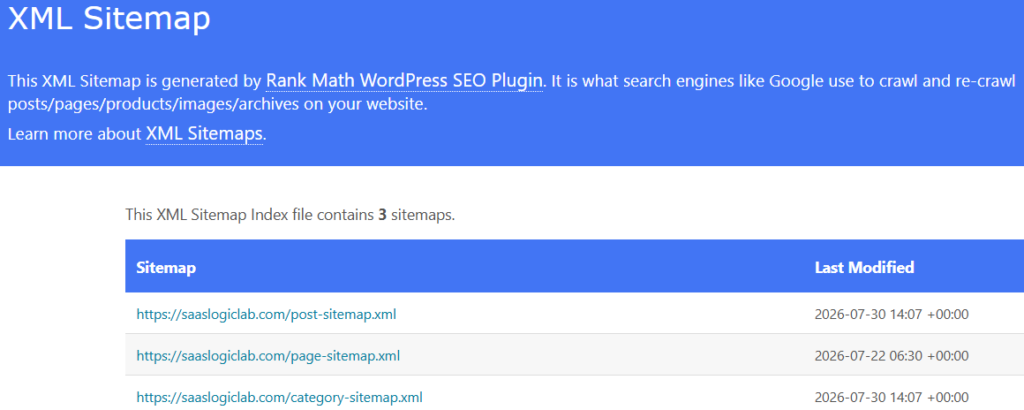
If your website uses Rank Math, you’ll usually find it here:
Other SEO plugins and CMS platforms may use slightly different URLs, but the sitemap is commonly linked from the robots.txt file or generated automatically after installation.
How to Submit Your Sitemap in Google Search Console
Submitting a sitemap takes less than a minute.
- Open Google Search Console.
- Select your verified property.
- Click Sitemaps from the left-hand navigation.
- For supported formats, submission requirements, and sitemap errors, review Google’s official Sitemaps report documentation.
- Enter your sitemap URL.
- Click Submit.
If everything is configured correctly, Google will begin processing the sitemap and display its status.
Important
Submitting a sitemap does not guarantee that every page will be indexed.
It simply tells Google where your important pages are located. Google still decides whether a page should be crawled, indexed, and shown in search results.
What Happens After You Submit a Sitemap?
Many website owners expect their pages to appear in Google immediately after submission.
That isn’t how Search works.
Once your sitemap is submitted, Google begins evaluating your URLs. It decides:
- Which pages to crawl first
- Whether a page is eligible for indexing
- How frequently it should revisit the page
- Whether the content deserves to appear in search results
In other words, sitemap submission is the starting point of Google’s evaluation process—not the finish line.
Common Sitemap Mistakes
Even a technically correct sitemap can cause problems if it isn’t maintained properly.
Some of the most common mistakes include:
- Submitting the wrong sitemap URL.
- Including pages that return 404 errors.
- Listing redirected URLs instead of their final destination.
- Adding pages blocked by robots.txt.
- Leaving deleted or outdated URLs inside the sitemap.
A sitemap should always reflect the current state of your website. The cleaner and more accurate it is, the easier it becomes for Google to crawl, understand, and prioritize your content.
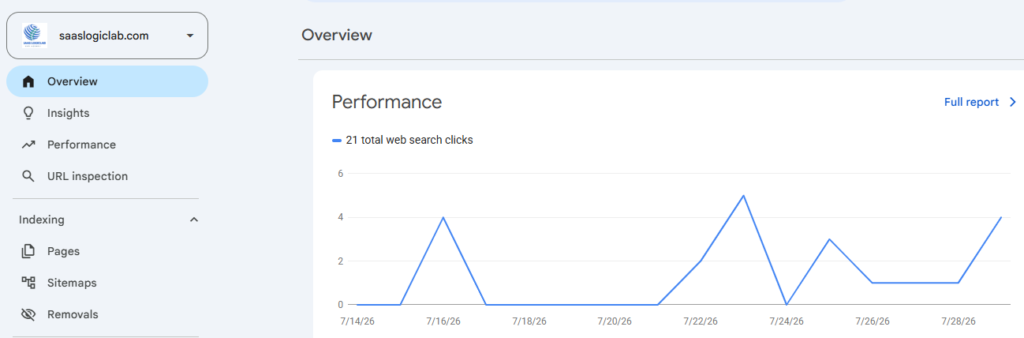
Understanding the Google Search Console Dashboard
Google Search Console isn’t a single report.
It’s a collection of specialized reports, each designed to answer a different SEO question. Looking at one report in isolation rarely tells the complete story. The real value comes from understanding how these reports connect and how experienced SEOs use them together to investigate problems, measure progress, and uncover opportunities.
That’s why treating Search Console as a simple analytics dashboard is a mistake.
Instead, think of it as your website’s SEO control center.
Every section inside the dashboard provides a different perspective on how Google interacts with your website. Some reports focus on visibility, others reveal indexing issues, while several help you diagnose technical problems before they begin affecting organic traffic.
Before diving into each report individually, it’s worth understanding what each section is designed to do.
| Report | Primary Purpose | When You’ll Use It |
| Overview | Get a high-level snapshot of your website’s health and performance. | Daily or weekly check-ins. |
| Performance | Analyze clicks, impressions, CTR, average position, and search queries. | Content optimization, keyword research, and traffic analysis. |
| URL Inspection | Check how Google sees a specific page. | Investigating indexing or ranking issues. |
| Pages (Indexing) | Monitor which pages are indexed and why others aren’t. | Fixing indexing and crawling problems. |
| Sitemaps | Submit and monitor XML sitemaps. | After publishing new content or restructuring a website. |
| Core Web Vitals | Review real-world page experience metrics. | Improving website speed and user experience. |
| HTTPS | Verify that Google recognizes your website as secure. | Technical SEO audits and migration checks. |
| Links | Analyze internal and external link data. | Internal linking strategy and backlink review. |
| Manual Actions & Security | Identify penalties, hacked content, or security issues. | During technical audits or sudden traffic drops. |
| Settings | Manage ownership, permissions, and property configuration. | Administrative tasks and verification management. |
At first glance, these reports may appear independent.
They’re not.
A sudden drop in clicks usually leads you from the Performance report to URL Inspection. If the page isn’t indexed, you’ll continue into the Pages report. If the issue is related to crawling, you’ll often check your Sitemap or review technical configurations. One report naturally leads to another.
That’s how professional SEO investigations work.
You don’t rely on a single metric.
You connect multiple reports until the data explains what happened.
Throughout the rest of this guide, we’ll examine each report individually, explain what every important metric means, highlight common mistakes, and show how to turn raw data into practical SEO decisions.
Editor’s Insight
One of the biggest differences between beginners and experienced SEO professionals isn’t the tools they use—it’s how they interpret the data.
Beginners often open Search Console looking for answers.
Experienced SEOs open Search Console looking for patterns.
That mindset shift alone can completely change how you approach SEO.
The Performance Report: Where Real SEO Decisions Begin
If there is one report inside Google Search Console that every website owner should understand, it’s the Performance report.
This is where Google’s search data turns into actionable SEO insights.
Every click, every impression, every ranking change, and every search query shown in this report represents a real interaction between your website and people searching on Google. Unlike third-party SEO platforms that estimate visibility using their own databases, the Performance report is built from Google’s own search data.
That alone makes it one of the most valuable sources of information available to any SEO professional.
Unfortunately, it’s also one of the most misunderstood.
Many website owners open the report, glance at the number of clicks, celebrate when the graph moves upward, worry when it drops, and close the tab without asking the questions that actually matter.
The numbers themselves are only the starting point.
The real value comes from understanding why those numbers changed and what action should follow.
A rise in impressions doesn’t automatically mean your SEO strategy is working.
More clicks don’t always translate into better rankings.
A decline in traffic isn’t always a sign that something is wrong.
Without context, every metric can be misleading.
That’s why experienced SEO professionals rarely look at a single number in isolation. Instead, they compare multiple metrics, analyze trends over time, identify unusual patterns, and investigate the reasons behind every significant change.
Google’s official Performance report documentation explains how clicks, impressions, CTR, queries, pages, and date comparisons are calculated and displayed.
If you want to expand your keyword opportunities beyond Google Search Console, explore our guide to the best keyword research tools used by SEO professionals.
It answers questions such as:
Can my content be discovered on Google?
Which search queries are generating visibility?
Which pages are attracting organic traffic?
Where am I losing potential clicks?
Which keywords are close to reaching the first page?
How has my search performance changed over time?
Those answers form the foundation of every successful SEO strategy.
Before learning how to optimize each metric, it’s important to understand what every number inside the Performance report actually represents.
The Four Metrics That Matter
At the top of the Performance report, Google highlights four primary metrics.
Although they’re displayed side by side, each one measures a completely different aspect of your search performance.
Understanding how they work together is far more valuable than looking at them individually.
In the following sections, we’ll break down each metric in detail, explain how experienced SEO professionals interpret the data, and show how to turn those numbers into practical SEO decisions.
Before interpreting these numbers, review how Google officially defines clicks, impressions, and average position in Search Console.
Total Clicks: Measuring Real Traffic from Google Search
Among all the metrics available in the Performance report, Total Clicks is usually the first number people notice.
It’s easy to understand why.
A click represents a real person who saw your website in Google Search results, found your listing compelling enough to select, and landed on your page. Unlike impressions, which only measure visibility, clicks represent actual visits from organic search.
At first glance, the metric seems straightforward.
More clicks should mean better SEO.
In reality, the story is far more nuanced.
A page can generate thousands of clicks while targeting irrelevant keywords that never convert into leads or customers. Another page might receive only a handful of clicks each month but consistently drive high-value conversions because it ranks for commercial or transactional search terms.
That’s why experienced SEO professionals rarely evaluate clicks in isolation.
Instead, they ask a more important question:
Are these the right clicks?
A steady increase in clicks usually indicates that your content is becoming more visible, your rankings are improving, or more users are choosing your result over competing pages. However, a sudden decline doesn’t automatically mean something is broken. Search demand changes throughout the year, competitors update their content, Google rolls out algorithm updates, and user behavior evolves over time.
The context behind the trend is what matters.
For example, imagine your clicks drop by 20% over the past month.
Before rewriting content or making technical changes, investigate the data:
- Did impressions decline as well?
- Did your average position change?
- Has your CTR remained stable?
- Did the drop affect every page or only a few URLs?
- Is the decline seasonal, or does it indicate a broader SEO issue?
These questions often reveal whether the problem is related to visibility, rankings, user behavior, or something entirely different.
Editor’s Insight
Many website owners celebrate when Total Clicks increase.
Professional SEOs celebrate only when the right pages receive more clicks.
Growing traffic is valuable.
Growing qualified traffic is what actually grows a business.
Common Misconception
A higher click count does not automatically mean your SEO strategy is succeeding.
If most of those clicks come from irrelevant search queries or pages that don’t support your business goals, the metric can create a false sense of progress.
Always evaluate clicks alongside search intent, conversions, and business outcomes—not as a standalone success metric.
What You Should Do When Clicks Change
If clicks increase:
- Review which pages contributed to the growth.
- Identify the keywords responsible for the improvement.
- Strengthen internal links pointing to those pages.
- Keep the content updated to maintain momentum.
If clicks decrease:
- Compare the affected date range with the previous period.
- Check whether impressions, CTR, or rankings also changed.
- Inspect the affected pages individually instead of assuming the entire website has a problem.
- Avoid making major SEO changes until you’ve identified the actual cause.
Real Example Placeholder
Later in this guide, we’ll analyze the SaaSLogicLab Performance report to show how click trends changed after publishing new content, what caused those changes, and which actions produced measurable improvements.
Total Impressions: The Earliest Sign That Google Is Discovering Your Content
For many website owners, impressions are one of the most confusing metrics in Google Search Console.
A page can receive thousands of impressions without generating meaningful traffic. Another page may have only a few hundred impressions but produce a healthy number of clicks.
At first glance, that seems contradictory.
It isn’t.
An impression is recorded every time one of your pages appears in Google’s search results, regardless of whether someone clicks on it. If your page is displayed for a search query, even briefly, Google counts it as an impression.
That makes impressions the earliest indicator of search visibility.
Before a page earns consistent clicks, before it reaches the first page, and often before it begins generating meaningful traffic, it usually starts collecting impressions. In many cases, impressions appear weeks before you notice measurable organic growth.
That’s why experienced SEO professionals pay close attention to this metric.
A steady increase in impressions often means Google is testing your content for more search queries, expanding its visibility, or gradually improving its confidence in your pages. While impressions alone don’t guarantee success, they frequently signal that your SEO efforts are moving in the right direction.
The opposite is also true.
A sudden drop in impressions may indicate that your content has lost visibility, competitors have overtaken your rankings, search demand has changed, or Google is no longer showing your pages as frequently for certain queries.
The key is understanding why the change occurred instead of reacting to the number itself.
Why High Impressions Aren’t Always Good News
One of the biggest misconceptions in SEO is that more impressions automatically mean better performance.
That’s not always true.
Imagine a page receives 50,000 impressions but only 150 clicks.
On paper, the visibility looks impressive.
In reality, the data raises an important question:
Why are so many people seeing the page but choosing not to click?
The answer could be:
- Your title isn’t compelling enough.
- The meta description fails to match search intent.
- Competitors have more attractive search snippets.
- Your page ranks too low on the first page or near the bottom of the second page.
- The search query doesn’t align with what your content actually offers.
High impressions without proportional clicks should be treated as an optimization opportunity—not simply a success metric.
Editor’s Insight
Clicks tell you what users did.
Impressions tell you what Google is testing.
That’s why impressions often reveal opportunities long before they become visible through traffic alone.
How Experienced SEOs Use Impression Data
Instead of treating impressions as a vanity metric, experienced SEO professionals use them to identify pages with untapped potential.
They ask questions like:
- Which pages are gaining impressions but very few clicks?
- Which queries recently started appearing for my content?
- Which URLs are consistently increasing in visibility month after month?
- Are new pages beginning to receive impressions after being indexed?
- Which topics is Google testing my website for?
These insights often lead to faster SEO wins than focusing only on rankings.
Real-World Opportunity
Imagine one of your articles receives:
- 12,000 impressions
- Average position: 11.2
- CTR: 1.1%
Many beginners see disappointing traffic.
An experienced SEO professional sees a page that’s already close to the first page and has significant growth potential.
A stronger title, a better meta description, improved internal linking, and a content refresh may be enough to push that page into the top 10 results—where both CTR and organic traffic can increase dramatically.
The impression count didn’t just measure visibility.
It revealed an opportunity.
Key Takeaway
Impressions should never be viewed as an end goal.
They’re an early signal that Google is discovering, testing, and evaluating your content.
When interpreted alongside clicks, CTR, and average position, impression data becomes one of the most valuable indicators for planning your next SEO move rather than simply measuring your last one.
Average CTR: Turning Visibility into Traffic
Getting your pages to appear in Google Search is only half the battle.
The next challenge is convincing people to click.
That’s exactly what Average Click-Through Rate (CTR) measures.
CTR shows the percentage of people who clicked your page after seeing it in Google’s search results. It’s calculated by dividing the number of clicks by the number of impressions.
For example, if your page appears in search results 10,000 times and receives 500 clicks, your CTR is 5%.
At first glance, the formula seems simple.
Interpreting the number correctly is where the real skill begins.
A 2% CTR might be disappointing for a page ranking in the top three positions, but it could be perfectly reasonable for a page that spends most of its time near the bottom of the first page. Likewise, a page ranking in position twelve may naturally have a much lower CTR because fewer users scroll that far.
Context matters more than the percentage itself.
That’s why experienced SEO professionals never ask,
“Is my CTR good?”
They ask,
“Is my CTR good for this position, this search intent, and this type of keyword?”
That small shift in thinking leads to much better optimization decisions.
Why CTR Matters More Than Most People Realize
Imagine two pages targeting similar keywords.
Both receive roughly the same number of impressions.
The first page has a CTR of 2%.
The second page has a CTR of 6%.
Without improving rankings, building backlinks, or publishing additional content, the second page already receives three times more traffic simply because more users choose to click it.
That’s why CTR optimization is often one of the quickest ways to increase organic traffic.
Sometimes the biggest opportunity isn’t ranking higher.
It’s making your existing search result more compelling.
What Influences Your CTR?
Your click-through rate is shaped by several factors, many of which are within your control.
Some of the most important include:
Search Position
Pages appearing near the top of the first page naturally receive more attention than those lower down.
Title Tag
A clear, specific, and relevant title encourages users to click. Generic or misleading titles usually perform worse.
Meta Description
Although Google doesn’t always display the exact description you write, a strong meta description can still improve click-through rates by reinforcing relevance.
Search Intent
If your page matches what the user is actually looking for, it’s much more likely to earn the click.
Competition
Even a well-written result can struggle if competing pages have stronger branding, richer snippets, or more attractive titles.
Editor’s Insight
Many SEO campaigns focus almost entirely on rankings.
Yet improving CTR from 2% to 4% can sometimes generate more additional traffic than moving from position six to position four.
The ranking hasn’t changed.
The visibility hasn’t changed.
Only the percentage of people choosing your result has changed—and that alone can produce a measurable increase in organic traffic.
Practical Ways to Improve CTR
Instead of rewriting an article from scratch, start by reviewing how it appears in search results.
Ask yourself:
- Does the title clearly explain the value of the page?
- Would you click your own result over the competitors?
- Does the title match the search intent behind the keyword?
- Is the meta description helpful rather than generic?
- Are you using dates, numbers, or meaningful qualifiers where appropriate?
Small improvements to your search snippet can often produce significant gains over time.
Common Misconception
A low CTR doesn’t always mean your title is bad.
Sometimes the issue is simply that your page ranks too low for users to notice it consistently.
Before rewriting titles and meta descriptions, compare CTR with Average Position. That comparison often reveals whether the real problem is visibility or presentation.
Key Takeaway
CTR is the bridge between visibility and traffic.
Impressions show that Google is displaying your page.
Clicks show that users are visiting it.
CTR explains how effectively your search listing turns one into the other.
Understanding that relationship helps you identify opportunities that many website owners overlook, making CTR one of the most practical metrics for improving organic performance without creating new content.
📌 Editor’s Insight
In the next section, we’ll explore Average Position, one of the most misunderstood metrics in Google Search Console. You’ll learn why obsessing over a single ranking number often leads to poor SEO decisions and how experienced professionals evaluate rankings in a much more meaningful way.
Average Position: The Metric Most People Misinterpret
Average Position is one of the most talked-about metrics in Google Search Console.
It’s also one of the most misunderstood.
Many website owners log into Search Console, notice that their average position has dropped from 12.4 to 15.8, and immediately assume their rankings have collapsed.
In many cases, nothing significant has actually happened.
The confusion begins with the word average.
Google doesn’t calculate this metric using a single keyword or a single page. Instead, it combines ranking data from all eligible search queries and calculates an average position across those impressions.
That means the number you see isn’t the ranking of one page.
It’s an average generated from many different searches.
For example, imagine one article ranks:
- Position 2 for one keyword
- Position 8 for another
- Position 19 for a third
- Position 34 for several low-volume queries
Google combines those positions to calculate the Average Position shown in your Performance report.
This is why Average Position should never be treated as an exact ranking.
It is a trend indicator, not a definitive ranking report.
Why Average Position Can Be Misleading
Imagine you publish a new article.
During its first few weeks, Google begins testing it for dozens of different search queries.
Some impressions occur in position 18.
Others appear in position 42.
A few even reach position 9.
Your Average Position may actually decrease during this period.
At first glance, that looks like poor performance.
In reality, Google is expanding your visibility across more keywords.
You’re appearing in more searches than before, which is often a positive sign.
Without understanding this context, it’s easy to draw the wrong conclusion.
Don’t Chase a Single Number
One of the biggest mistakes beginners make is treating Average Position like a scoreboard.
Professional SEO teams don’t optimize websites simply to reduce an average number.
They optimize pages that have the greatest opportunity to generate business results.
For example:
A page ranking 11th for a high-intent keyword deserves far more attention than a page ranking 4th for a keyword that generates almost no relevant traffic.
The opportunity matters more than the average.
How Experienced SEOs Use Average Position
Instead of asking,
“Why is my Average Position 18?”
they ask questions like:
- Which pages are consistently ranking between positions 8 and 15?
- Which keywords are close to reaching the first page?
- Which URLs improved after recent content updates?
- Which pages lost rankings following an algorithm update?
- Are ranking changes affecting important business pages or only low-priority content?
Those questions lead to meaningful SEO decisions.
The average number alone does not.
Common Misconception
A lower Average Position doesn’t always mean your SEO performance is getting worse.
Sometimes Google begins showing your content for hundreds of new search queries.
Many of those new impressions appear at lower positions while Google evaluates your relevance.
As a result, your Average Position may decline even though your overall visibility and future growth potential are increasing.
Always compare Average Position alongside:
- Clicks
- Impressions
- CTR
- Individual page performance
Looking at all four metrics together provides a much clearer picture than relying on one number alone.
Pro Tip
Don’t use Average Position to measure success.
Use it to identify opportunities.
Pages consistently ranking between positions 8 and 15 often require only small improvements—such as stronger internal linking, refreshed content, or better search snippets—to move onto the first page.
Those pages usually deliver faster results than starting a brand-new article from scratch.
Key Takeaway
Average Position is best viewed as a directional metric rather than an exact ranking.
It helps you understand how your visibility is changing over time, but meaningful SEO decisions come from analyzing it alongside clicks, impressions, CTR, and individual page performance.
When interpreted in context, Average Position becomes a powerful tool for prioritizing optimization efforts instead of a number that creates unnecessary concern.
How Clicks, Impressions, CTR, and Average Position Work Together
Looking at a single metric in isolation rarely tells the complete story.
A rise in clicks might look encouraging, but if impressions have doubled while CTR has dropped significantly, the situation deserves a closer look. Likewise, a decline in Average Position isn’t always bad news if impressions and clicks continue to grow.
This is why experienced SEO professionals never rely on one number.
They look for relationships between multiple metrics before making any optimization decision.
Think of the four primary metrics as pieces of the same puzzle.
Each one answers a different question.
| Metric | What It Tells You | The Question You Should Ask |
| Clicks | How many people visited your website from Google Search. | Are users actually visiting my pages? |
| Impressions | How often your pages appeared in search results. | Is Google increasing my visibility? |
| CTR | How many people clicked after seeing your result. | Is my search listing compelling enough? |
| Average Position | Where your pages generally appeared in search results. | How competitive are my rankings? |
Looking at all four together creates a much clearer picture than analyzing any single metric on its own.
Scenario 1: Impressions Increase, Clicks Stay Flat
This is one of the most common situations in Search Console.
At first glance, it looks disappointing.
However, it often indicates that Google is beginning to show your pages for more search queries. Your visibility is expanding, but your rankings may still be too low to attract consistent clicks.
Instead of assuming the content has failed, ask yourself:
- Which new keywords are generating impressions?
- Are those keywords relevant to the page?
- Is the page ranking close to the first page?
If the answer is yes, you’re looking at an optimization opportunity—not a problem.
Scenario 2: High Impressions, Low CTR
This combination usually means users are seeing your page but choosing another result.
The issue isn’t necessarily visibility.
The issue is persuasion.
Review your:
- Page title
- Meta description
- Search intent
- Rich snippets
- Competitor listings
Small improvements to your search snippet can often produce significant gains without changing the page itself.
Scenario 3: Clicks Decline While Impressions Remain Stable
When impressions stay relatively consistent but clicks fall, CTR becomes the first metric to investigate.
Several factors may be responsible:
- Competitors have written more compelling titles.
- Google’s search results now include additional SERP features.
- Search intent has changed.
- Your page is no longer attracting attention despite maintaining similar visibility.
This isn’t always a ranking issue.
Sometimes it’s simply a presentation issue.
Scenario 4: Average Position Drops, But Clicks Continue to Grow
Many beginners panic when they see Average Position decline.
Experienced SEO professionals usually investigate before reacting.
If impressions are increasing rapidly, Google may simply be testing your content for a wider range of search queries.
That additional visibility often introduces lower-ranking impressions, causing the average position to fall even though overall traffic continues to improve.
Without examining the complete dataset, it’s easy to misinterpret this trend.
Think Like an SEO Analyst
Google Search Console doesn’t make decisions for you.
It provides evidence.
Your job is to connect the evidence before deciding what to do next.
That’s the difference between reporting and analysis.
Anyone can read the numbers.
An SEO professional explains what the numbers mean, why they changed, and what action should follow.
That mindset transforms Google Search Console from a reporting platform into one of the most valuable decision-making tools in modern SEO.
Key Takeaway
Clicks, impressions, CTR, and Average Position should never be analyzed independently.
Together, they reveal how Google is evaluating your content, how users are responding to your search listings, and where your biggest opportunities for growth are hiding.
The more you learn to connect these metrics, the more confident your SEO decisions become.
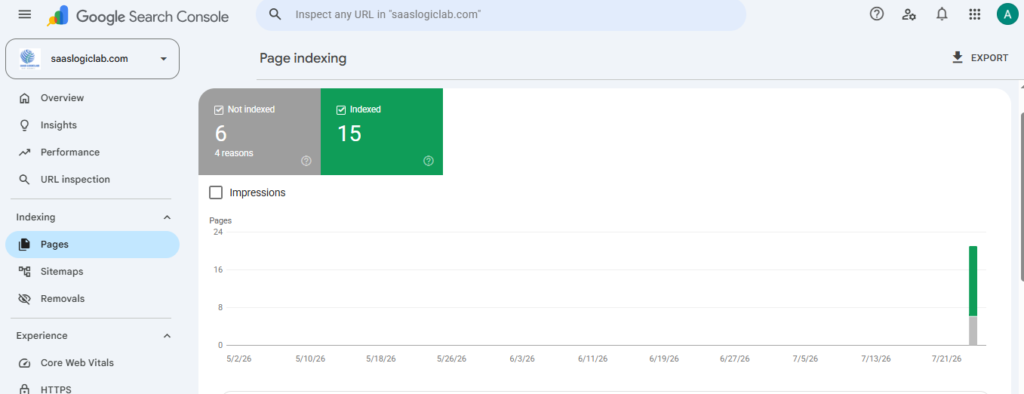
“This is exactly how we identified which pages required title optimization, which keywords were gaining visibility, and where our next content updates would have the greatest impact.”
How to Turn Performance Data into Better SEO Decisions
Collecting data is easy.
Making the right decision based on that data is where SEO becomes a skill.
Google Search Console doesn’t tell you what to do next. It provides evidence. Your responsibility is to interpret that evidence, identify meaningful patterns, and decide which action is most likely to improve your website’s performance.
This is one of the biggest differences between beginners and experienced SEO professionals.
Beginners often react to individual metrics.
Experienced professionals investigate the relationship between multiple reports before making changes.
The goal isn’t to fix every fluctuation.
The goal is to identify opportunities that can produce measurable results.
Opportunity 1: Pages Ranking Just Outside the First Page
One of the fastest SEO wins comes from identifying pages that already rank between positions 8 and 15.
These pages have already earned Google’s trust.
They don’t usually need a complete rewrite.
Instead, they often benefit from targeted improvements such as:
- Updating outdated information
- Expanding thin sections
- Strengthening internal links
- Improving the title tag
- Refining the meta description
- Adding supporting examples or visuals
Small improvements can often move these pages onto the first page, where visibility and click-through rates increase significantly.
Opportunity 2: High Impressions with Low CTR
When a page receives strong visibility but attracts very few clicks, Google is already giving you an opportunity.
Users simply aren’t choosing your result.
Before rewriting the entire article, review how your page appears in search results.
Ask yourself:
- Does the title clearly communicate the page’s value?
- Is the search intent fully matched?
- Would you personally click this result over the competing listings?
- Is the meta description helping or simply repeating the title?
In many cases, improving the search snippet produces faster results than rewriting the content itself.
You can also improve titles, headings, topical coverage, and on-page relevance with dedicated SEO content optimization tools before republishing important pages.
Opportunity 3: Sudden Traffic Decline
Not every decline is caused by an SEO problem.
Before making changes, investigate what actually happened.
Review:
- The affected pages
- The affected queries
- The date of the decline
- Changes in impressions
- Changes in CTR
- Changes in Average Position
Only after understanding the cause should you decide whether the issue relates to rankings, indexing, seasonality, search demand, or technical SEO.
Data should always guide the decision—not assumptions.
Opportunity 4: New Queries Beginning to Appear
One of the most valuable reports inside Google Search Console is the Queries report.
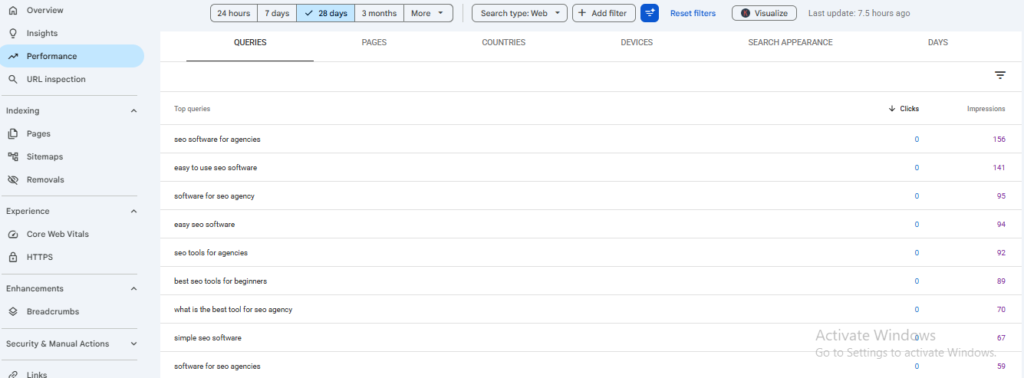
It often reveals search terms that your content wasn’t originally targeting.
When you notice relevant queries generating impressions, consider:
- Expanding the existing section
- Adding a dedicated heading
- Answering the search intent more clearly
- Including supporting examples
- Improving internal links to that page
Instead of creating a brand-new article, you may already have a page that Google is testing for those searches.
Opportunity 5: Pages That Have Stopped Growing
Sometimes a page performs well for several months before reaching a plateau.
Growth slows.
Clicks stabilize.
Impressions stop increasing.
That doesn’t always mean the content has reached its limit.
It may simply need a refresh.
Content updates, new examples, recent statistics, stronger internal links, improved visuals, and better alignment with current search intent can often restore momentum without publishing a replacement article.
Many SEO teams combine Google Search Console with comprehensive SEO tools to monitor rankings, discover new opportunities, and prioritize future optimizations.
Think in Priorities, Not Tasks
A common mistake is trying to improve every page at the same time.
Professional SEO teams work differently.
They prioritize opportunities based on potential impact.
Instead of asking,
“Which page should I update next?”
Ask,
“Which update is most likely to produce the greatest return?”
That small change in thinking leads to better use of time, better SEO decisions, and better long-term results.
Key Takeaway
Google Search Console isn’t valuable because it collects data.
It’s valuable because it helps you decide where your next SEO effort should go.
The websites that grow consistently aren’t the ones making the most changes.
They’re the ones making the right changes based on reliable evidence.
💡 Editor’s Insight
The best SEO professionals don’t spend their day chasing rankings.
They spend their day identifying opportunities.
That’s exactly what Google Search Console helps you do when you learn to interpret its data instead of simply reading its reports.
⭐ Editor Note
From this point onward, we’ll move beyond performance analysis and start exploring the reports that explain why pages succeed or fail. The next section focuses on one of the most powerful diagnostic tools in Google Search Console: URL Inspection. This is where you’ll learn how Google sees an individual page, why it may not be indexed, and how to troubleshoot indexing issues with confidence.
URL Inspection Tool: How Google Sees a Single Page
Imagine publishing a new article.
A few days later, you search Google for its title, but nothing appears.
Your first thought might be:
“Why isn’t my page showing up?”
Instead of guessing, Google Search Console gives you a direct way to investigate.
That’s exactly what Google’s URL Inspection Tool is designed for.
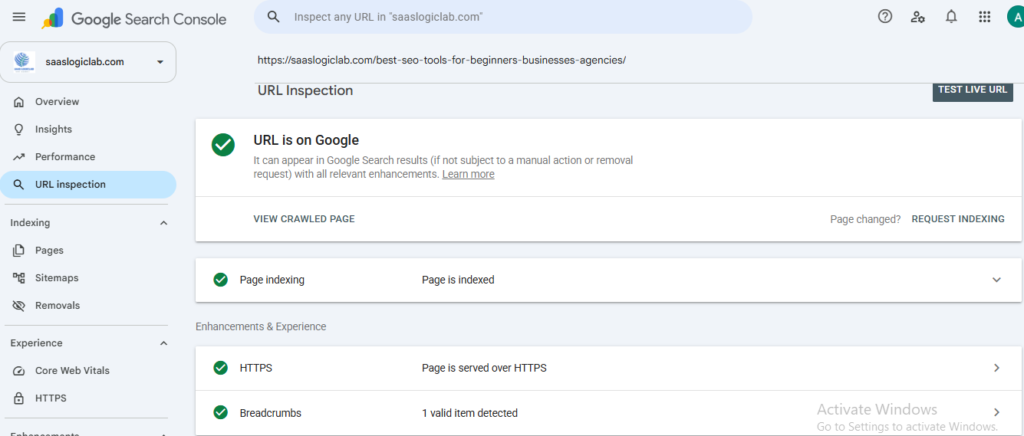
Rather than showing data for your entire website, it focuses on a single URL and explains how Google currently sees that page. It tells you whether the page has been indexed, when it was last crawled, whether Google can access it successfully, and if any issues are preventing it from appearing in search results.
For technical SEO, this is often the first report professionals check before making changes.
What Can the URL Inspection Tool Tell You?
The URL Inspection report provides far more than a simple Indexed or Not Indexed status.
It helps answer questions such as:
Is the page indexed by Google?
If not, the report usually explains why.
Can Google access the page successfully?
Crawling problems, blocked resources, or server issues are often highlighted here.
When did Google last crawl the page?
Knowing the last crawl date helps you understand whether Google has seen your latest updates.
Is the indexed version different from the live version?
Sometimes you’ve updated a page, but Google is still showing an older version in its index.
Can the page be requested for indexing?
If you’ve published new content or made significant improvements, you can ask Google to review the page again.
When Should You Use URL Inspection?
Many people use this tool only after something goes wrong.
Experienced SEO professionals use it proactively.
Some of the most common situations include:
- A newly published article isn’t appearing in Google.
- An updated page hasn’t reflected recent changes.
- A URL suddenly disappears from search results.
- Google reports an indexing issue.
- You want to verify that a technical SEO fix has been recognized.
In each of these situations, URL Inspection provides evidence instead of assumptions.
Understanding the Results
After entering a URL, Google displays a summary of its current status.
A healthy page typically shows that it:
- Exists in Google’s index.
- Was crawled successfully.
- Can be indexed.
- Doesn’t contain major crawling or indexing issues.
If the page isn’t indexed, don’t panic.
Google usually explains the reason, making it much easier to investigate the underlying problem rather than guessing what went wrong.
Common Reasons a Page Isn’t Indexed
Not every indexing issue is caused by a technical error.
Some of the most common reasons include:
| Issue | What It Usually Means |
| Discovered – currently not indexed | Google knows the page exists but hasn’t crawled it yet. |
| Crawled – currently not indexed | Google crawled the page but decided not to include it in the index. |
| Duplicate without user-selected canonical | Google found another version of the same content. |
| Excluded by ‘noindex’ tag | The page has been intentionally blocked from indexing. |
| Blocked by robots.txt | Crawlers aren’t allowed to access the page. |
| Page with redirect | The URL redirects to another location and isn’t meant to be indexed. |
The wording may seem technical, but each status is simply Google’s explanation of what happened.
Understanding the message is the first step toward resolving the issue.
Before Requesting Indexing
Many website owners click Request Indexing every time they edit a page.
That’s rarely necessary.
Request indexing only when you’ve made meaningful improvements, published new content, or fixed a genuine issue that prevented the page from being indexed correctly.
Google will still decide when to crawl the page again, but a request can help bring important updates to its attention.
Pro Tip
Don’t use the URL Inspection Tool only to solve problems.
Use it to verify success.
After updating important pages, fixing technical issues, or publishing cornerstone content, inspect the URL to confirm that Google recognizes the latest version of the page.
That simple habit gives you confidence that your SEO improvements have actually reached Google’s index.
Key Takeaway
The URL Inspection Tool is one of the most practical features in Google Search Console.
Instead of wondering why a page isn’t performing, you can see exactly how Google views it, identify potential indexing issues, and make informed decisions based on real data rather than assumptions.
Request Indexing: When You Should Use It (and When You Shouldn’t)
One of the most overused buttons in Google Search Console is Request Indexing.
Many website owners believe that clicking it after every edit will help their pages rank faster.
That’s a myth.
The Request Indexing feature isn’t a ranking booster, nor is it a shortcut to appearing on Google’s first page. Its purpose is much simpler: it tells Google that a page has been published, updated, or fixed and is ready to be reviewed again.
Whether Google recrawls the page immediately—or decides to wait—is entirely up to Google’s systems.
That’s why using this feature strategically is far more effective than using it repeatedly.
When You Should Request Indexing
There are several situations where requesting indexing makes sense.
You Published a New Page
If you’ve just published a new article, landing page, or resource, requesting indexing can help Google discover it sooner instead of waiting for the next scheduled crawl.
You Made Significant Content Updates
Refreshing an article with new information, improving search intent, adding original research, or restructuring important sections are all valid reasons to request another crawl.
Minor typo fixes or formatting changes usually don’t justify it.
You Fixed a Technical SEO Issue
If a page was previously blocked by a noindex tag, affected by an incorrect canonical tag, or inaccessible because of a technical issue, request indexing after confirming that the problem has been resolved.
A Previously Indexed Page Disappeared
If an important page unexpectedly drops out of Google’s index and you’ve identified and fixed the cause, requesting indexing can help Google reassess the page.
When You Shouldn’t Request Indexing
Using the feature too frequently provides little benefit.
Avoid requesting indexing:
- After every minor text edit.
- Simply because rankings haven’t improved.
- Multiple times for the same page within a short period.
- As a replacement for fixing real SEO issues.
If Google continues to ignore a page after repeated indexing requests, the problem usually isn’t the request itself.
The problem is the page.
Google may have concerns about content quality, duplication, technical issues, or overall value.
What Happens After You Click “Request Indexing”?
After submitting a request, Google performs a quick live test to confirm that the page is accessible.
If everything looks normal, the page is added to Google’s crawl queue.
This doesn’t mean the page will be indexed immediately.
Google still evaluates:
- Content quality.
- Search intent.
- Technical accessibility.
- Internal linking.
- Overall usefulness.
Only after that evaluation does Google decide whether the page should be indexed or updated in search results.
Common Misconception
Many beginners assume that Request Indexing forces Google to crawl a page instantly.
It doesn’t.
The feature simply notifies Google that something has changed.
The final decision always belongs to Google’s indexing systems.
Pro Tip
Before requesting indexing, ask yourself one question:
“Have I made a meaningful improvement that gives Google a reason to revisit this page?”
If the answer is yes, requesting indexing is reasonable.
If the answer is no, you’re usually better off continuing to improve the page before asking Google to crawl it again.
Key Takeaway
The Request Indexing feature is best used after meaningful changes—not routine edits.
Think of it as a way to notify Google that a page deserves another look, not as a button that guarantees faster rankings or immediate indexing.
Used wisely, it becomes a valuable part of your publishing and content update workflow.
⭐ Editor’s Recommendation
Is section ke baad hum ek “Myth vs Reality” box add karenge.
| Myth | Reality |
| Request Indexing improves rankings. | It only asks Google to review the page again. |
| Every page update needs a new request. | Only meaningful updates usually justify one. |
| Google indexes every requested page. | Google still decides whether the page should be indexed. |
| More requests mean faster crawling. | Excessive requests don’t guarantee quicker processing. |
Pages Report: Finding and Fixing Indexing Issues
Publishing great content doesn’t automatically guarantee that it will appear in Google Search.
Before a page can rank, attract visitors, or generate organic traffic, it must first be included in Google’s index.
That’s where the Pages Report becomes essential.
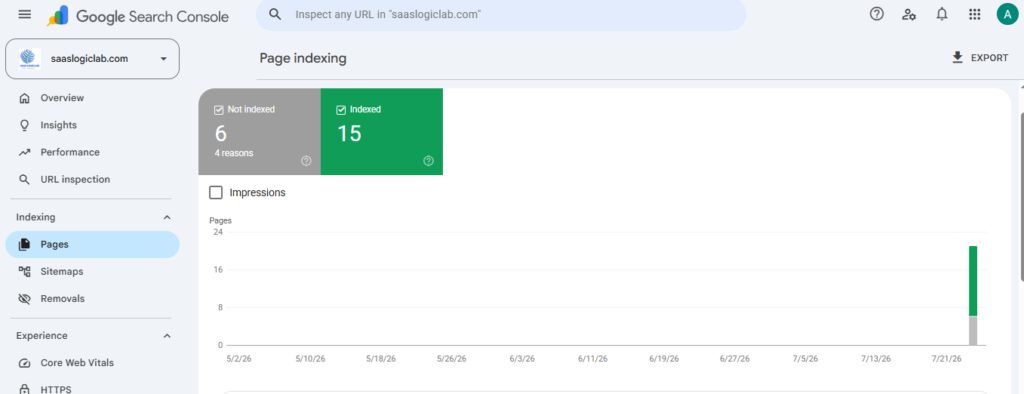
This report provides a website-wide view of your indexing status. Instead of inspecting one URL at a time, it shows which pages are indexed successfully, which ones have been excluded, and why Google made those decisions.
For larger websites, this report is often the fastest way to detect technical SEO issues before they begin affecting organic visibility.
What Is the Pages Report?
The official Page indexing report is Google’s central dashboard for reviewing indexed and non-indexed URLs.
It categorizes every discovered URL into different groups based on how Google processed it.
Some pages are successfully indexed.
Others are intentionally excluded.
Some couldn’t be crawled properly.
Others were discovered but haven’t yet been added to Google’s index.
Rather than forcing you to guess what happened, Google explains the status of each URL and, in most cases, provides a reason.
This makes troubleshooting much more efficient than relying on assumptions.
Understanding the Main Status Categories
When you open the Pages Report, you’ll notice several different indexing statuses.
Each one represents a different stage in Google’s indexing process.
Indexed
These are the pages that Google has successfully added to its search index.
If a page appears here, it is eligible to appear in Google Search.
Being indexed doesn’t guarantee high rankings, but it does mean Google recognizes the page as part of its searchable database.
Not Indexed
These pages haven’t been included in Google’s index.
That doesn’t automatically mean there’s a problem.
Some exclusions are completely normal.
For example:
- Login pages
- Thank-you pages
- Admin URLs
- Duplicate URLs
- Redirected pages
However, if an important article or service page appears here, it deserves investigation.
Common Reasons Pages Aren’t Indexed
Google provides detailed explanations for most excluded pages.
Here are some of the statuses you’ll encounter most often.
Crawled – Currently Not Indexed
Google successfully visited the page but decided not to include it in the index.
This often happens when Google believes the page doesn’t provide enough unique value at the moment.
Possible causes include:
- Thin content
- Duplicate information
- Weak internal linking
- Low perceived usefulness
- Content that doesn’t fully satisfy search intent
This status isn’t necessarily permanent.
Improving the page often leads to successful indexing later.
Discovered – Currently Not Indexed
Google knows the page exists but hasn’t crawled it yet.
This commonly occurs on:
- Newly published websites
- Large websites with many URLs
- Sites with limited crawl budget
- Pages that receive very few internal links
Patience is sometimes enough.
In other cases, improving your internal linking and XML sitemap helps Google prioritize the page.
Duplicate Without User-Selected Canonical
Google found multiple versions of similar content and selected another page as the primary version.
This doesn’t always indicate an error.
However, if Google selected the wrong canonical URL, you should review:
- Canonical tags
- Internal links
- Redirects
- Duplicate content
Consistency helps Google understand which version should appear in search results.
Excluded by “noindex”
This status means you’ve explicitly instructed Google not to index the page.
If the page is intentionally private, everything is working correctly.
If an important page appears here by mistake, check your SEO plugin, CMS settings, or page-level indexing options.
Page with Redirect
Google discovered the URL but found that it redirects to another destination.
This is expected behavior.
Redirecting pages generally aren’t indexed because Google indexes the final destination instead.
Which Indexing Issues Need Immediate Attention?
Not every warning deserves the same level of urgency.
Professional SEO teams prioritize issues based on business impact.
Focus first on:
- Important landing pages
- Service pages
- Product pages
- Cornerstone content
- High-traffic blog posts
If those pages aren’t indexed, they should become your priority.
Minor archive pages or intentionally excluded URLs usually don’t require immediate action.
Build a Habit of Reviewing the Pages Report
Indexing isn’t something you check once.
It’s something you monitor over time.
Review the Pages Report regularly, especially after:
- Publishing multiple new articles
- Migrating your website
- Changing permalink structures
- Updating robots.txt
- Installing or changing SEO plugins
- Launching new landing pages
Catching indexing issues early is far easier than discovering them after weeks of lost organic traffic.
Pro Tip
Don’t try to eliminate every “Not Indexed” page.
A healthy website almost always contains excluded URLs.
Your goal isn’t to achieve 100% indexed pages.
Your goal is to ensure that every page capable of driving business value is indexed successfully.
That’s a much more meaningful measure of SEO health.
Key Takeaway
The Pages Report isn’t simply a list of indexed URLs.
It’s an indexing health dashboard that helps you understand how Google processes your website, identify important pages that need attention, and separate normal exclusions from genuine SEO problems.
Learning to interpret this report correctly allows you to fix indexing issues before they impact your rankings and organic traffic.
Sitemaps Report: Why XML Sitemaps Still Matter in 2026
One of the biggest misconceptions in SEO is that submitting an XML sitemap guarantees your pages will be indexed.
It doesn’t.
A sitemap isn’t an indexing tool.
It’s a discovery tool.
Its purpose is to help Google understand which pages exist on your website, when they were last updated, and which URLs you consider important. Google then decides whether those pages should be crawled and indexed.
Think of a sitemap as a roadmap rather than a command.
It points Google in the right direction—but it doesn’t force Google to follow every route.
What Is an XML Sitemap?
An XML sitemap is a machine-readable file that lists the important URLs on your website.
Unlike your website’s navigation, which is designed for visitors, an XML sitemap is created specifically for search engines.
A typical sitemap may include information such as:
- The page URL
- When it was last updated
- Whether it has changed recently
- The relationship between different sitemap files
Modern SEO plugins like Rank Math automatically generate and maintain XML sitemaps, so you rarely need to edit them manually.
As you publish new content, the sitemap updates automatically.
Why Does Google Need a Sitemap?
Google can discover pages by following internal links.
So why submit a sitemap?
Because it makes discovery faster and more reliable.
A sitemap becomes especially valuable when:
- Your website is new.
- You publish content regularly.
- Your site has hundreds or thousands of pages.
- Some important pages receive very few internal links.
- You recently migrated or redesigned your website.
Without a sitemap, Google may still discover your pages.
It may simply take longer.
What You’ll See in the Sitemaps Report
The Sitemaps report inside Google Search Console is intentionally simple.
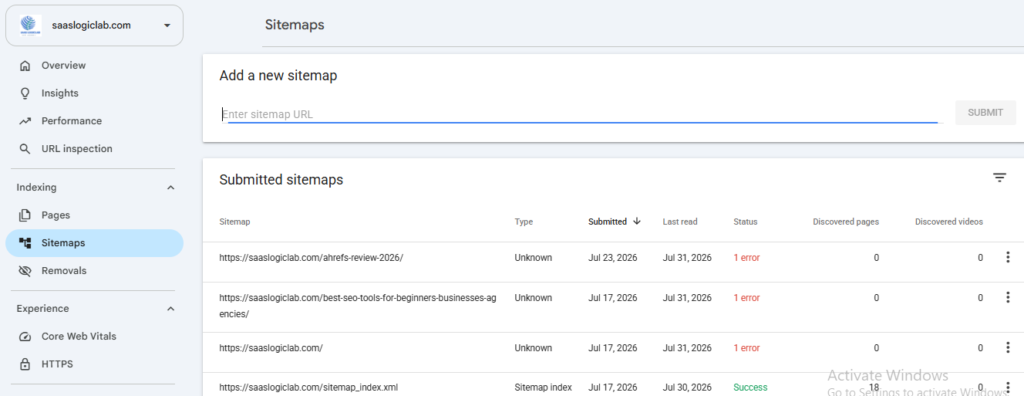
After submitting your sitemap, Google displays information such as:
- Submitted sitemap URL
- Current status
- Last time Google read it
- Discovery date
- Whether Google processed it successfully
If everything is working correctly, you don’t need to keep resubmitting the sitemap.
Google checks it automatically.
Do You Need to Submit the Sitemap More Than Once?
In most cases, no.
This is another common myth.
Once Google successfully receives your sitemap, it continues checking it periodically.
Whenever your SEO plugin updates the sitemap with new pages, Google can detect those changes automatically.
You don’t need to submit it again every time you publish an article.
The only situations where resubmitting may be useful include:
- Launching a completely new website
- Changing your sitemap URL
- Fixing sitemap errors
- Recovering after a major website migration
For normal publishing, one successful submission is usually enough.
Common Sitemap Errors
Most websites never experience sitemap problems.
When they do, the issue is often straightforward.
Some common examples include:
| Error | What It Usually Means |
| Couldn’t fetch | Google couldn’t access the sitemap URL. |
| Sitemap could not be read | The sitemap format is invalid or temporarily unavailable. |
| 404 Not Found | The submitted sitemap URL no longer exists. |
| Contains invalid URLs | Some listed pages are malformed or inaccessible. |
| Submitted URL blocked | Pages inside the sitemap are blocked from crawling. |
When an error appears, don’t immediately assume every page on your website is affected.
Often, only the sitemap itself needs attention.
A Sitemap Doesn’t Replace Good Internal Linking
This is one of the most important concepts to understand.
Submitting a sitemap doesn’t eliminate the need for a strong website structure.
Google relies heavily on internal links to understand:
- Which pages are most important
- How topics relate to one another
- Which content deserves more crawling attention
A sitemap introduces Google to your pages.
Internal links help Google understand their importance.
Building a strong internal linking structure is much easier when your content strategy is organized inside a centralized resource library.
The strongest websites use both.
Best Practices for XML Sitemaps
To keep your sitemap healthy:
- Include only important, indexable pages.
- Remove URLs that intentionally use noindex.
- Keep redirects out of the sitemap.
- Allow your SEO plugin to update it automatically.
- Periodically review the Sitemaps report for errors.
These simple practices help ensure Google always has an accurate picture of your site’s structure.
Pro Tip
After publishing several new articles, don’t rush to resubmit your sitemap.
Instead, confirm that:
- The new URLs appear inside the sitemap.
- They’re internally linked from relevant pages.
- Google can access them without technical issues.
If those conditions are met, Google will usually discover them naturally during its regular crawls.
Key Takeaway
An XML sitemap doesn’t guarantee indexing, improve rankings, or replace good website architecture.
Its real purpose is to help Google discover your important pages efficiently and keep track of changes as your website grows.
When combined with strong internal linking and high-quality content, a healthy sitemap becomes an important part of a well-optimized SEO foundation.
⭐ Editor’s Insight
Many SEO beginners celebrate seeing “Success” beside their sitemap and assume every page will now rank in Google.
In reality, a successful sitemap submission only means Google has accepted the file—not that every URL inside it has been crawled, indexed, or ranked. The quality of your content, technical health, and internal linking still determine how those pages perform in search.
Experience Report: Understanding Core Web Vitals and Real User Experience
A fast website feels good.
A slow website feels frustrating.
The difference between those two experiences can determine whether a visitor stays on your site, becomes a customer, or leaves before your page even finishes loading.
That’s why Google introduced Core Web Vitals.
Instead of measuring performance only in a testing environment, Google collects anonymous performance data from real Chrome users visiting your website. This means the Experience report reflects what actual visitors experience—not what a speed-testing tool predicts.
Modern SEO platforms are also introducing AI-powered visibility insights that complement Google Search Console data, such as the Semrush AI Visibility Toolkit.
For SEO professionals, this report answers an important question:
“Are real users having a good experience on my website?”
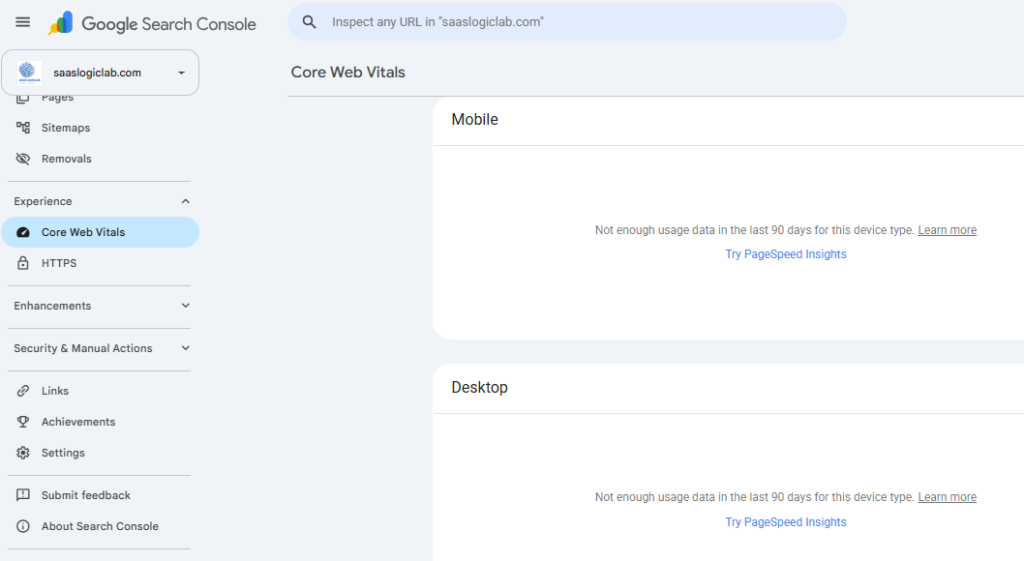
What Is the Experience Report?
The Experience report provides an overview of your website’s page experience based on real-world usage.
Rather than focusing on a single page, it evaluates how visitors interact with your website over time.
Google combines data from thousands of real browsing sessions to determine whether your pages provide a Good, Needs Improvement, or Poor user experience.
This data comes from the Chrome User Experience Report (CrUX), not from a one-time laboratory speed test.
That distinction is important.
A page may achieve an excellent PageSpeed Insights score during testing but still receive poor real-world metrics if users experience slow loading, unstable layouts, or delayed interactions on different devices and networks.
What Are Core Web Vitals?
Google provides official thresholds and guidance for Core Web Vitals, including LCP, INP, and CLS.
Core Web Vitals are three performance metrics that measure different aspects of the user experience.
Each focuses on a specific part of how visitors perceive your website.
Largest Contentful Paint (LCP)
LCP measures how quickly the main content becomes visible.
In most cases, this is the largest image, heading, or content block that users expect to see first.
Google considers:
- Good: 2.5 seconds or less
- Needs Improvement: 2.5–4.0 seconds
- Poor: More than 4.0 seconds
A slow LCP often results from:
- Large images
- Slow hosting
- Render-blocking CSS or JavaScript
- Heavy third-party scripts
Interaction to Next Paint (INP)
INP measures how quickly your website responds after a visitor interacts with it.
For example:
- Clicking a button
- Opening a menu
- Submitting a form
- Navigating between sections
Google introduced INP to replace the older First Input Delay (FID) because it provides a more complete picture of responsiveness.
Google considers:
- Good: 200 milliseconds or less
- Needs Improvement: 200–500 milliseconds
- Poor: More than 500 milliseconds
Poor INP is commonly caused by excessive JavaScript, long-running browser tasks, or resource-heavy plugins.
Cumulative Layout Shift (CLS)
CLS measures visual stability.
Have you ever tried clicking a button, only for the page to shift at the last second because an image or advertisement loaded?
That’s exactly what CLS measures.
Google considers:
- Good: 0.1 or lower
- Needs Improvement: 0.1–0.25
- Poor: More than 0.25
Common causes include:
- Images without defined dimensions
- Embedded videos
- Ads loading unexpectedly
- Fonts that change layout after loading
Why Doesn’t Google Use Only Speed?
Many website owners think SEO performance is all about loading time.
It isn’t.
Imagine two websites:
- Website A loads in 1.8 seconds but becomes unresponsive whenever users click a button.
- Website B loads in 2.4 seconds but responds instantly and remains visually stable.
Most visitors would prefer Website B.
Google recognizes this.
That’s why Core Web Vitals evaluate the overall browsing experience instead of measuring speed alone.
Why Real User Data Matters
Tools like PageSpeed Insights and Lighthouse are excellent for identifying optimization opportunities.
However, they simulate performance under controlled conditions.
The Experience report measures what happens after your website reaches real users around the world.
Those users may have:
- Older smartphones
- Slower internet connections
- Different browsers
- Limited processing power
- Busy mobile networks
This makes real-world performance data significantly more valuable for long-term optimization decisions.
What If You Don’t Have Experience Data?
This is a common question for new websites.
If your site doesn’t receive enough traffic, Google may display a message indicating that there isn’t sufficient real-world data yet.
That doesn’t mean your website has a problem.
It simply means Google hasn’t collected enough anonymous user data to generate reliable reports.
As your traffic grows, the Experience report will gradually begin displaying performance information.
Pro Tip
Don’t panic if one Core Web Vital temporarily moves into the Needs Improvement category.
Performance naturally changes over time as your content, plugins, visitors, and hosting environment evolve.
Instead of reacting to daily fluctuations, monitor long-term trends and investigate significant changes that persist over several weeks.
Consistent optimization delivers better results than constant tweaking.
Key Takeaway
The Experience report helps you understand how real visitors interact with your website—not how a testing tool predicts they should.
By monitoring Core Web Vitals, you can identify performance issues that affect usability, engagement, and long-term organic growth while creating a smoother experience for every visitor.

Caption: The Experience report summarizes real-world user experience using Chrome User Experience Report (CrUX) data.
⭐ Editor’s Insight
A perfect Lighthouse score doesn’t guarantee a perfect user experience.
The websites that consistently perform well in search focus on what real users experience, not just what testing tools report. Treat lab scores as a starting point and real-user data as the benchmark for long-term optimization.
Core Web Vitals Report: How to Diagnose and Prioritize Performance Issues
Improving website performance isn’t about chasing perfect scores.
It’s about identifying the issues that have the biggest impact on real users.
That’s exactly what the Core Web Vitals report helps you do.
While the Experience report gives you a high-level overview of your site’s health, the Core Web Vitals report goes much deeper. It groups together pages with similar performance problems, helping you identify patterns instead of investigating every URL individually.
For websites with dozens—or even hundreds—of pages, this saves an enormous amount of time.
Instead of fixing the same issue repeatedly, you can solve the underlying problem affecting an entire group of pages.
How the Core Web Vitals Report Works
Unlike PageSpeed Insights, which analyzes one page at a time, the Core Web Vitals report organizes your URLs into groups based on shared performance characteristics.
For example, Google may identify:
- A group of blog posts with slow loading images.
- A collection of landing pages affected by layout shifts.
- Product pages delayed by heavy JavaScript.
- Mobile pages experiencing slow user interactions.
This grouping helps you prioritize improvements that produce the greatest impact across your website.
Understanding the Status Categories
Every URL group falls into one of three categories.
Good
Pages in this category meet Google’s recommended thresholds for all Core Web Vitals.
No immediate optimization is required, although regular monitoring is still important as your website evolves.
Needs Improvement
These pages don’t have severe performance problems, but they also don’t meet Google’s recommended standards.
This category represents your easiest optimization opportunities.
Small improvements—such as compressing images, reducing unnecessary scripts, or optimizing fonts—can often move these pages into the Good category.
Poor
Pages classified as Poor require immediate attention.
Visitors are likely experiencing noticeable delays, unresponsive interactions, or unstable layouts.
If important landing pages, service pages, or high-traffic blog posts appear here, performance optimization should become a priority.
Mobile and Desktop Are Measured Separately
One mistake many beginners make is assuming that a fast desktop experience automatically means good mobile performance.
It doesn’t.
Mobile users often experience:
- Slower internet connections
- Less powerful devices
- Higher network latency
- More limited processing power
A page that performs exceptionally well on desktop may still struggle on mobile.
That’s why Google provides separate reports for both.
Whenever possible, prioritize fixing mobile issues first, since mobile traffic represents the majority of searches for many websites.
How to Prioritize Performance Problems
Not every issue deserves immediate attention.
Instead of trying to improve every page simultaneously, use this simple priority framework.
Priority 1: Business-Critical Pages
Focus first on pages that directly generate value, such as:
- Homepage
- Service pages
- Product pages
- Pricing pages
- High-converting landing pages
Improving these pages often produces the greatest business impact.
Priority 2: High-Traffic Content
Next, optimize pages that already receive substantial organic traffic.
Even modest performance improvements can enhance the experience for thousands of visitors over time.
Priority 3: Remaining Content
After your most important pages are healthy, gradually optimize supporting articles, category pages, and other lower-priority content.
This staged approach prevents wasted effort and ensures you’re working where the return is highest.
Common Causes of Poor Core Web Vitals
Although every website is different, the same performance issues appear repeatedly.
Some of the most common include:
| Problem | Typical Cause |
| Slow Largest Contentful Paint (LCP) | Large images, slow hosting, render-blocking resources |
| Poor Interaction to Next Paint (INP) | Heavy JavaScript, long browser tasks, inefficient plugins |
| High Cumulative Layout Shift (CLS) | Images without dimensions, ads, embedded content, font swapping |
Identifying the cause is only the first step.
The real goal is fixing the underlying issue across every affected page.
Don’t Optimize Blindly
Many website owners install multiple optimization plugins, enable every performance setting they can find, and hope their scores improve.
That approach often creates new problems.
Before making any changes, identify:
- Which metric is failing.
- Which pages are affected.
- Whether the issue appears on mobile, desktop, or both.
- Whether the affected pages are important to your business.
Optimizing without diagnosis is like repairing a car without knowing what’s broken.
Pro Tip
Whenever you implement a performance improvement, document exactly what changed.
For example:
- Compressed hero images
- Deferred non-essential JavaScript
- Removed unused CSS
- Enabled server-side caching
- Replaced a heavy plugin
This makes it much easier to understand which optimizations produced measurable improvements and which had little effect.
Over time, this habit creates a repeatable optimization process instead of random experimentation.
Key Takeaway
The Core Web Vitals report isn’t designed to help you chase perfect performance scores.
Its purpose is to help you identify the performance issues that affect the greatest number of users, prioritize improvements based on business impact, and make informed optimization decisions using real-world data.
The most successful websites don’t optimize everything at once.
They optimize the right things first.
📸 Screenshot Placeholder
[Screenshot Placeholder – Google Search Console Core Web Vitals report showing URL groups with Good, Needs Improvement, and Poor status]
Caption: Google groups similar pages together so you can resolve one underlying issue instead of fixing every URL individually.
⭐ Editor’s Insight
One of the biggest mistakes in technical SEO is treating every performance warning as equally important.
In reality, a slow pricing page that generates leads deserves far more attention than a rarely visited archive page. Prioritizing optimization based on business value—not just technical scores—helps you spend your time where it creates the greatest return.
Links Report: Understanding Internal Links, External Links, and Website Authority
Search engines don’t discover websites by reading pages in isolation.
They understand the web by following links.
Every internal link helps Google understand how pages relate to one another, while every external backlink provides additional context about your website’s credibility and authority.
That’s why the Links Report in Google Search Console is much more than a list of URLs.
It gives you valuable insights into how your website is connected internally and how other websites reference your content.
For SEO professionals, this report is often used to improve site architecture, strengthen important pages, and monitor backlink growth over time.
What Is the Links Report?
The Links Report summarizes how pages on your website are connected through both internal and external links.
Google’s official Links report guide explains how external links, internal links, top-linked pages, linking sites, and anchor text are reported.
Instead of crawling your website manually or relying on third-party tools, Google shows the links it has actually discovered during crawling.
The report is divided into several sections, each serving a different purpose:
- External Links
- Internal Links
- Top Linked Pages
- Top Linking Sites
- Top Linking Text
Together, these reports provide a clearer picture of your website’s structure and authority.
External Links: Which Websites Link to You?
External links—commonly known as backlinks—are links from other websites pointing to your pages.
Google has long used backlinks as one of many signals to evaluate trust and authority.
Inside Search Console, you’ll see:
- Which websites link to you.
- Which pages receive the most backlinks.
- Which anchor text appears most frequently.
Although Search Console doesn’t provide advanced backlink metrics like Domain Rating or Authority Score, it offers one significant advantage:
These are links that Google itself has discovered.
That makes this report an excellent way to verify whether Google recognizes important backlinks pointing to your site.
Internal Links: One of the Most Underrated SEO Reports
If there’s one report that deserves more attention, it’s Internal Links.
Internal linking influences:
- Crawlability
- Topic relationships
- Page importance
- User navigation
- Distribution of authority across your website
When Google sees many internal links pointing to a page, it often interprets that page as more important within your site’s overall structure.
This doesn’t guarantee higher rankings.
However, it helps Google understand which pages deserve greater attention during crawling and indexing.
What Should You Look For?
Rather than counting links, focus on patterns.
Ask questions like:
- Which important pages receive very few internal links?
- Are cornerstone articles linked from relevant supporting content?
- Do service pages receive links from blog posts?
- Are orphan pages missing internal links altogether?
These observations often reveal opportunities that are difficult to notice by browsing your website manually.
Top Linked Pages
This section shows which pages receive the largest number of internal or external links.
Popular pages often appear here because they naturally attract links.
However, don’t assume the report is perfect.
Sometimes you’ll discover that an old article receives dozens of internal links while a newer, more valuable page receives very few.
When that happens, consider strengthening the newer page with additional contextual internal links from related content.
Top Linking Sites
This report identifies the external websites that link to your content most frequently.
Rather than focusing only on the number of backlinks, pay attention to the diversity of linking domains.
For example:
- Ten backlinks from one website usually provide less diversity than ten backlinks from ten different websites.
A growing variety of referring websites generally reflects broader recognition across the web.
Top Linking Text
Anchor text—the clickable words inside a hyperlink—helps Google understand the context of a linked page.
Inside this report, you’ll see which anchor phrases appear most often.
Healthy anchor text profiles usually include a natural mix of:
- Brand names
- Article titles
- Generic phrases
- Descriptive keywords
If every backlink uses the exact same keyword-rich anchor text, that pattern may appear unnatural.
A diverse anchor profile generally looks more authentic.
What the Links Report Doesn’t Tell You
Google Search Console is extremely useful, but it’s important to understand its limitations.
It doesn’t provide:
- Backlink quality scores
- Spam analysis
- Link toxicity metrics
- Historical backlink growth charts
- Competitor backlink comparisons
For deeper backlink research, SEO professionals often complement Search Console with specialized platforms such as Ahrefs or Semrush.
Search Console confirms what Google has discovered.
Dedicated SEO platforms provide broader competitive analysis.
Best Practices for Internal Linking
As your website grows, your internal linking strategy should evolve with it.
Some practical guidelines include:
- Link related articles naturally within the content.
- Prioritize links to important commercial and cornerstone pages.
- Avoid creating isolated pages with no internal links.
- Use descriptive anchor text that accurately reflects the destination page.
- Review your internal linking structure regularly as new content is published.
A thoughtful internal linking strategy benefits both users and search engines.
Pro Tip
Every time you publish a new article, don’t stop after clicking Publish.
Ask yourself:
“Which existing pages should link to this new content?”
Adding relevant internal links immediately after publishing helps Google discover the page faster while strengthening its position within your website’s topical structure.
Over time, this simple habit creates a stronger and more connected website.
Key Takeaway
The Links Report helps you understand how Google interprets the relationships between your pages and how the wider web connects to your website.
By improving internal linking, monitoring backlink discovery, and identifying underlinked pages, you create a stronger site structure that supports better crawling, clearer topical authority, and long-term organic growth.
📸 Screenshot Placeholder
[Screenshot Placeholder – Google Search Console Links Report showing Internal Links, External Links, Top Linking Sites, and Top Linked Pages]
Caption: The Links Report provides an overview of your website’s internal structure and the external links Google has discovered.
⭐ Editor’s Insight
Many website owners spend months trying to earn new backlinks while overlooking the links they already control.
Improving your internal linking structure is often one of the fastest, safest, and most sustainable SEO improvements you can make. Unlike backlinks, internal links require no outreach, no negotiations, and no waiting—they’re entirely within your control.
Manual Actions & Security Issues: Protecting Your Website’s Search Visibility
Most SEO reports in Google Search Console help you improve your website.
The Manual Actions and Security Issues reports serve a different purpose.
They help protect it.
These reports alert you if Google identifies serious problems that could reduce your visibility in search results or even remove parts of your website from Google’s index.
Fortunately, most website owners never see warnings here.
But if you do, they should become your highest priority.
Ignoring them can have a much greater impact than almost any other SEO issue.
What Is a Manual Action?
Google’s search results are primarily managed by automated algorithms.
However, in certain situations, Google’s review team may manually examine a website.
If they determine that the site violates Google’s Search Essentials or spam policies, they can apply a Manual Action.
Review Google’s official Manual Actions report documentation to understand violations, affected pages, and reconsideration requests.
Unlike an algorithm update, a manual action is a direct penalty applied by Google after human review.
When this happens, Google explains:
- What policy was violated
- Which pages are affected
- Whether the issue impacts the entire site or only specific URLs
- What steps are required before requesting a review
Common Reasons Websites Receive Manual Actions
Although every case is different, some violations appear more frequently than others.
These include:
- Artificial or manipulative backlinks
- Hidden text or keyword stuffing
- Cloaking different content for users and search engines
- Automatically generated spam pages
- Thin affiliate pages with little original value
- User-generated spam left unmoderated
- Structured data spam
- Pure spam techniques
Most legitimate businesses never encounter these problems.
They are usually associated with websites attempting to manipulate search rankings.
What Happens If You Receive a Manual Action?
The impact depends on the severity of the issue.
Google may:
- Reduce rankings for specific pages.
- Remove individual URLs from search results.
- Remove large sections of your website.
- In severe cases, remove the entire domain from Google’s index.
This is why manual actions should always be addressed immediately.
How to Recover from a Manual Action
Recovery begins with understanding the problem—not simply requesting reconsideration.
A typical recovery process looks like this:
- Read Google’s explanation carefully.
- Identify every affected page.
- Remove or fix the violation completely.
- Document the changes you made.
- Submit a reconsideration request explaining the corrective actions.
If Google confirms that the issue has been resolved, the manual action may be revoked.
Recovery often takes time, so patience is important.
What Is the Security Issues Report?
While Manual Actions focus on policy violations, the Security Issues report focuses on protecting users.
Google’s official Security Issues report guide covers hacked content, malware, deceptive pages, and harmful downloads.
Google continuously checks websites for signs of compromise.
If it detects a serious security problem, you’ll usually receive a notification inside Search Console.
Depending on the issue, Google may also display security warnings directly in search results or web browsers.
These warnings are designed to protect users—not punish website owners.
Common Security Problems
Google may report issues such as:
Hacked Content
Attackers have added unauthorized pages or modified existing content.
Common signs include:
- Spam pages
- Hidden redirects
- Unknown files
- Unexpected links
Malware
Visitors may unknowingly download malicious software after visiting your website.
This is one of the most serious security issues Google can report.
Deceptive Pages
Sometimes called phishing pages, these attempt to trick visitors into revealing passwords, payment details, or personal information.
Google takes these threats very seriously.
Harmful Downloads
If downloadable files contain malicious software or suspicious code, Google may warn users before they access them.
What Should You Do If Google Reports a Security Issue?
Avoid rushing to request another review.
Instead:
- Confirm exactly which files or pages are affected.
- Remove malicious code completely.
- Update your CMS, themes, and plugins.
- Change all administrator passwords.
- Scan your hosting environment for additional compromises.
- Verify that the website is fully clean.
- Request a security review only after everything has been fixed.
Submitting a review before resolving the root cause usually delays recovery.
Preventing Future Problems
Prevention is far easier than recovery.
Simple security practices can dramatically reduce risk.
These include:
- Keeping WordPress, themes, and plugins updated.
- Using strong administrator passwords.
- Enabling two-factor authentication.
- Removing unused plugins and themes.
- Using trusted hosting providers.
- Performing regular website backups.
- Monitoring Search Console notifications regularly.
Good security isn’t just an IT responsibility.
It’s part of technical SEO.
A secure website protects your visitors, preserves your search visibility, and maintains your reputation.
Pro Tip
Check the Manual Actions and Security Issues reports periodically, even if everything appears normal.
These reports are usually empty.
And that’s exactly what you want.
An empty report means Google hasn’t detected any serious policy violations or security threats.
Sometimes, “No issues detected” is the best SEO report you can receive.
Key Takeaway
Manual Actions and Security Issues are among the most important reports in Google Search Console because they protect your website’s long-term visibility.
While most websites will never encounter these warnings, reviewing these reports regularly ensures that policy violations, hacked content, or security threats are identified and resolved before they cause significant damage to your organic traffic.
📸 Screenshot Placeholder
[Screenshot Placeholder – Google Search Console Manual Actions report showing “No issues detected”]
[Screenshot Placeholder – Google Search Console Security Issues report showing “No issues detected”]
Caption: For most healthy websites, both reports should display “No issues detected.” Regular monitoring helps ensure they stay that way.
⭐ Editor’s Insight
Many SEO professionals spend hours analyzing rankings, backlinks, and keyword performance while forgetting to check the reports that can have the biggest impact on search visibility.
A website with excellent content and strong rankings can still lose significant organic traffic if it receives a manual action or suffers a security breach. Reviewing these reports regularly takes only a few seconds—but it can prevent weeks or even months of recovery work.
Settings Report: Understanding Property Configuration and Technical Settings
Unlike most reports in Google Search Console, the Settings page doesn’t contain performance graphs, keyword data, or indexing statistics.
Instead, it provides information about how your property is configured inside Search Console.
Think of it as the administrative dashboard of your property.
It answers questions like:
- Is this property verified correctly?
- Which users have access?
- Which sitemap was submitted?
- Is Google encountering crawl limitations?
- Are there any configuration issues that need attention?
Most website owners won’t need to change anything here on a daily basis.
However, understanding what each section means can save hours of troubleshooting when technical problems arise.
Property Verification
Before Google can provide data about your website, it must verify that you own or manage the property.
The Settings page displays your verification method.
Depending on your setup, verification may have been completed using:
- DNS TXT record
- HTML file upload
- HTML meta tag
- Google Analytics
- Google Tag Manager
For most professional websites, DNS verification is considered the most reliable option because ownership remains valid even if themes, plugins, or page templates change.
Ownership Types
Google supports two types of property ownership.
Verified Owner
A verified owner has full control over the property.
They can:
- Add or remove users.
- Change settings.
- Access all reports.
- Manage verification methods.
This role should only be granted to trusted individuals.
Delegated User
Delegated users can view reports and perform many day-to-day tasks without owning the property.
This is useful when working with:
- SEO agencies
- Marketing teams
- Developers
- Freelancers
Granting delegated access is generally safer than sharing your primary Google account credentials.
Crawl Statistics
Depending on your property type, Search Console may provide access to Crawl Stats.
This report explains how Googlebot interacts with your website over time.
It includes information such as:
- Total crawl requests
- Response times
- File types crawled
- HTTP response codes
- Crawl purpose
- Googlebot activity trends
For small websites, these numbers usually don’t require close attention.
For larger websites, they can help diagnose crawl inefficiencies, server issues, and unexpected changes in Google’s crawling behavior.
Why Crawl Stats Matter
Imagine publishing new content regularly, but Google suddenly crawls your website far less frequently than before.
The Crawl Stats report may reveal:
- Increased server response times
- Frequent 5xx server errors
- Redirect chains
- Large numbers of broken URLs
Without this report, those patterns can be difficult to identify.
Instead of guessing why indexing slowed down, you can investigate the evidence directly.
Associations
Some Search Console properties include an Associations section.
This allows Google Search Console to connect with other Google services when appropriate.
Depending on your website and Google products, associations may include tools such as:
- Google Analytics
- Merchant Center
- Other Google services that integrate with Search Console
Most website owners never need to modify these associations manually.
However, during migrations or account changes, it’s worth confirming that the expected integrations remain connected.
Should You Change Anything Here?
In most cases, no.
The Settings page is primarily informational.
Unless you’re:
- Verifying ownership
- Adding new users
- Investigating crawl behavior
- Reviewing technical configurations
- Completing a website migration
there’s usually nothing that requires regular adjustment.
That’s perfectly normal.
Common Mistakes
One misconception is that the Settings page contains hidden SEO options capable of improving rankings.
It doesn’t.
You won’t find:
- A ranking switch
- Crawl priority controls
- Indexing shortcuts
- Performance optimization buttons
Google intentionally keeps configuration separate from ranking systems.
Good SEO comes from improving your website—not changing administrative settings.
Best Practices
Although you won’t visit the Settings page every day, it’s worth checking it during major website changes.
Review it whenever you:
- Launch a new website.
- Change hosting providers.
- Migrate to a new domain.
- Add new SEO team members.
- Transfer website ownership.
- Investigate unexpected crawl issues.
Making this part of your technical SEO checklist helps prevent small configuration problems from becoming larger issues later.
Pro Tip
If you manage multiple websites, review property ownership periodically.
It’s surprisingly common for businesses to discover that only a former employee or agency still has verified ownership of their Search Console property.
Confirming ownership before an emergency occurs can save significant time and frustration.
Key Takeaway
The Settings report isn’t designed to improve rankings directly.
Instead, it provides the technical and administrative information needed to manage your Search Console property with confidence.
Understanding property verification, ownership, crawl statistics, and account configuration ensures that your website remains accessible, secure, and properly monitored as it grows.
⭐ Editor’s Insight
Many businesses invest heavily in SEO but overlook something far more fundamental: ownership.
If you lose access to your Search Console property during a migration, domain transfer, or agency handover, recovering that access can become more urgent than any ranking issue. A quick review of the Settings page today can prevent a major headache tomorrow.
How to Use Google Search Console for Real SEO Workflows
Understanding Google Search Console reports is only the first step.
The real value comes from knowing how to turn that data into practical SEO decisions.
Experienced SEO professionals don’t open Search Console just to check yesterday’s clicks or rankings.
They use it to answer business questions.
Questions like:
- Which pages deserve to be updated first?
- Which keywords are close to reaching page one?
- Why did organic traffic suddenly decline?
- Which pages attract impressions but fail to earn clicks?
- What content should we create next?
Instead of reacting to every fluctuation, they follow repeatable workflows that transform raw data into measurable improvements.
The following workflows are the same type of process used by SEO teams to identify opportunities, prioritize work, and grow organic traffic consistently.
Workflow 1: Finding Quick Ranking Opportunities
Not every SEO improvement requires creating new content.
Some of the biggest gains come from improving pages that are already performing reasonably well.
These are often called low-hanging opportunities.
Step 1: Open the Performance Report
Navigate to:
Search Results → Performance
Select a date range long enough to identify meaningful trends.
For most websites, the last 3 months provides a good balance between recent performance and reliable data.
Step 2: Switch to the Queries Tab
Instead of looking only at total clicks, review individual search queries.
You’re looking for keywords that already generate impressions but haven’t reached their full potential.
Step 3: Filter by Average Position
Focus on keywords ranking approximately between:
Position 8–20
These keywords already have visibility.
Google understands the topic.
The page simply needs additional relevance or authority to move higher.
Ranking improvements here often produce much faster results than targeting entirely new keywords.
Step 4: Prioritize High-Impression Keywords
Suppose you discover two keywords:
| Keyword | Position | Monthly Impressions |
| Keyword A | 11 | 3,500 |
| Keyword B | 11 | 120 |
Although both have similar rankings, Keyword A clearly deserves attention first because improving it could generate significantly more traffic.
Always prioritize opportunity—not just ranking position.
Step 5: Improve the Existing Page
Rather than rewriting the article from scratch, strengthen it by:
- Expanding thin sections.
- Updating outdated information.
- Improving topical depth.
- Adding recent examples.
- Strengthening internal links.
- Improving headings.
- Matching search intent more precisely.
Google has already shown interest in the page.
Your goal is to give it stronger reasons to rank higher.
Why This Workflow Works
Creating a brand-new article often means starting from zero.
Improving an existing page that’s already receiving impressions allows you to build on authority you’ve already earned.
That’s why experienced SEO professionals spend a significant portion of their time updating existing content instead of constantly publishing new articles.
Real Example
Imagine your article ranks:
- Position 12
- 6,800 impressions
- 1.4% CTR
Even moving from position 12 to position 7 could substantially increase traffic without publishing another article.
Those are often the easiest SEO wins available inside Google Search Console.
Common Mistake
Many website owners ignore pages that already rank on the second page of Google.
Instead, they immediately start writing new content.
While new content is important, improving existing pages usually delivers results faster because Google has already crawled, indexed, and evaluated them.
Pro Tip
Create a monthly list of pages ranking between positions 8 and 20.
Review them one by one.
For each page, ask:
- Can the introduction be improved?
- Are important questions unanswered?
- Is the search intent fully satisfied?
- Can stronger internal links be added?
- Are there newer statistics or examples available?
Over time, this habit creates a steady stream of ranking improvements without dramatically increasing your publishing workload.
Key Takeaway
One of the fastest ways to grow organic traffic isn’t publishing more articles.
It’s identifying pages that are already close to breaking onto the first page of Google and giving them the improvements they need to move higher.
Google Search Console makes finding those opportunities surprisingly simple—if you know where to look.
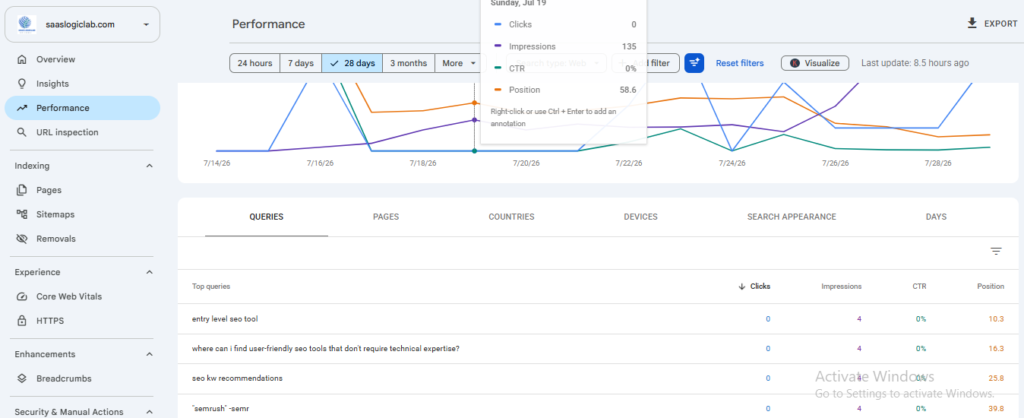
Caption: Filtering keywords by average position helps identify pages that are already close to page one and often require only targeted improvements.
⭐ Editor’s Insight
SEO success isn’t always about creating more content.
Sometimes, the highest return comes from improving work you’ve already published. A well-optimized page sitting in position 11 is often a far better investment than a brand-new article with no visibility at all.
Workflow 2: Increase Organic Traffic Without Improving Rankings
When people think about SEO, they usually think about rankings.
“How do I move from position 8 to position 3?”
While higher rankings certainly help, they’re not the only way to increase organic traffic.
Sometimes, you can generate significantly more clicks without improving your rankings at all.
The secret lies in one metric:
Click-Through Rate (CTR).
If more people choose your result over competing listings, your traffic increases—even if your average position remains unchanged.
That’s why experienced SEO professionals don’t always chase rankings first.
They first ask:
“Are we getting the maximum number of clicks from the visibility we already have?”
Step 1: Find Pages with High Impressions
Open the Performance report and switch to the Pages tab.
Sort the report by Impressions.
You’re looking for pages that already appear frequently in Google Search.
These pages already have visibility.
Now the question becomes:
Are they attracting enough clicks?
Step 2: Compare Impressions with CTR
Imagine you find the following data:
| Page | Impressions | CTR |
| Best SEO Tools | 42,000 | 1.3% |
| Semrush Review | 8,900 | 6.8% |
| Keyword Research Guide | 15,500 | 1.1% |
The first and third pages immediately stand out.
Google is already showing them to thousands of searchers.
However, very few people are clicking.
That usually signals an opportunity—not a visibility problem.
Step 3: Search the Keyword Yourself
Search your primary keyword in Google.
Now compare your listing with the pages ranking around you.
Ask yourself:
- Does your title immediately explain the value?
- Would you personally click your result?
- Does another result answer the search intent more clearly?
- Is your headline too generic?
- Does your meta description encourage curiosity or action?
Remember:
Users don’t compare your page with perfection.
They compare it with the nine other results on the screen.
Step 4: Improve Your Search Snippet
Often, the page itself doesn’t need major changes.
Instead, improve how it appears in search.
Look at:
Title Tag
Instead of:
Consider something more specific:
Best SEO Tools in 2026: 15 Platforms We Personally Tested
The second title immediately communicates freshness, specificity, and credibility.
Meta Description
Avoid generic summaries.
Instead, explain exactly what readers will gain.
A good meta description should answer one question:
“Why should someone click this result instead of the others?”
Match Search Intent
Sometimes CTR suffers because the page promises something different from what searchers expect.
For example:
Someone searching:
“Google Search Console tutorial”
expects a practical guide.
If your title emphasizes history instead of learning, users will probably ignore it—even if you rank well.
Step 5: Monitor the Results
After updating your title or meta description, don’t expect instant changes.
Give Google time to recrawl the page and update the search snippet.
Then compare performance over the following few weeks.
You’re looking for improvements in:
- CTR
- Clicks
- Organic traffic
Ideally, impressions remain stable while clicks increase.
That’s one of the clearest signs that your optimization worked.
A Small Change Can Produce Big Results
Imagine a page receives:
- 60,000 impressions
- 1% CTR
That produces approximately:
600 clicks
Now imagine improving CTR to 2.5%.
Without improving rankings…
Without earning backlinks…
Without publishing another article…
The page now receives approximately:
1,500 clicks
That’s an increase of 900 additional visitors simply by making your search listing more appealing.
The opportunity is often much larger than people realize.
Common Mistake
Many website owners rewrite entire articles when traffic drops.
Sometimes the content isn’t the problem.
Sometimes the page simply isn’t attracting attention in search results.
Always evaluate your search snippet before assuming the article itself needs a complete overhaul.
Pro Tip
Whenever you notice:
- High impressions
- Low CTR
- Stable rankings
add the page to a CTR Optimization List.
Review a few pages each month and experiment with:
- Stronger headlines
- Clearer value propositions
- Updated publication years (only when genuinely updated)
- More compelling meta descriptions
Small improvements across several high-impression pages often generate more traffic than publishing multiple new articles.
Key Takeaway
Higher rankings aren’t the only path to higher traffic.
If Google is already showing your pages to thousands of users, improving your click-through rate may be the fastest and most cost-effective way to increase organic visits.
Before chasing new rankings, make sure you’re getting the maximum value from the visibility you’ve already earned.
📸 Screenshot Placeholder
[Screenshot Placeholder – Performance Report filtered by high impressions with CTR column visible]
Caption: Pages with high impressions but low CTR often represent the quickest opportunities for increasing organic traffic.
⭐ Editor’s Insight
SEO isn’t only about convincing Google to rank your page.
It’s also about convincing people to click it.
Google provides the visibility—but your title and meta description determine whether that visibility turns into traffic.
Workflow 3: Recover Organic Traffic After a Traffic Drop
Few things are more stressful than opening Google Search Console and seeing your organic traffic decline.
Your first instinct may be to assume that Google penalized your website or that your rankings have disappeared.
In reality, traffic drops happen for many different reasons.
Some are temporary.
Some are seasonal.
Some are technical.
Others are caused by changes in search behavior or stronger competition.
The worst mistake you can make is trying to fix the wrong problem.
Before changing anything, you need to identify why traffic declined.
Google Search Console provides the evidence you need.
Step 1: Confirm That Traffic Actually Dropped
Begin by comparing two meaningful date ranges.
For example:
- Last 28 days vs Previous 28 days
- Last 3 months vs Previous 3 months
- Year over year (when seasonality matters)
Avoid comparing yesterday with today.
Daily fluctuations are normal.
Instead, focus on trends that continue over several weeks.
Step 2: Identify What Changed
Now compare the four primary metrics together.
| Metric | What It Might Mean |
| Clicks ↓, Impressions ↓ | Lower search visibility or reduced search demand |
| Clicks ↓, Impressions → | CTR may have declined |
| Clicks ↓, Position ↓ | Ranking loss is likely contributing |
| Impressions ↑, Clicks ↓ | Visibility increased, but users aren’t clicking |
Looking at only one metric rarely tells the full story.
The relationship between the metrics is far more valuable.
Step 3: Find the Pages That Lost Traffic
Switch to the Pages tab and compare the selected date ranges.
Sort the report by the largest decrease in clicks.
You’re looking for questions such as:
- Which pages lost the most traffic?
- Is the decline limited to one article?
- Did several pages within the same topic decline together?
- Are commercial pages affected, informational pages, or both?
Patterns often reveal more than individual pages.
Step 4: Investigate the Queries
Open one of the affected pages and switch to the Queries tab.
Now ask:
- Which keywords lost impressions?
- Which keywords lost clicks?
- Did average position change?
- Are new competing keywords appearing?
This helps determine whether the problem is ranking-related or whether user search behavior has changed.
Step 5: Check Indexing Status
If an important page suddenly loses almost all impressions, inspect the URL.
Confirm that:
- The page is still indexed.
- No accidental noindex directive exists.
- Canonical tags are correct.
- Google can crawl the page successfully.
A technical issue can sometimes cause a dramatic traffic decline even when the content hasn’t changed.
Step 6: Consider External Factors
Not every decline originates from your website.
Ask yourself:
- Has Google released a significant algorithm update?
- Has search demand decreased?
- Has the topic become seasonal?
- Have competitors published stronger resources?
- Has AI-generated search experience changed how users interact with this query?
SEO doesn’t happen in isolation.
Sometimes the environment changes while your website stays exactly the same.
Understanding that context prevents unnecessary optimization.
Step 7: Decide the Right Response
Only after identifying the cause should you choose a solution.
For example:
| Cause | Recommended Action |
| Rankings declined | Improve content quality and strengthen internal linking |
| CTR declined | Rewrite title tag and meta description |
| Page deindexed | Resolve indexing issue and request indexing if appropriate |
| Search demand declined | Expand into related topics or refresh the content |
| Stronger competitors | Improve depth, originality, and topical coverage |
The solution should always match the evidence.
Avoid Emotional SEO
One of the biggest mistakes in SEO is reacting emotionally to temporary fluctuations.
A five-day decline doesn’t automatically require a major content rewrite.
Likewise, a one-week increase doesn’t necessarily mean every optimization was successful.
Professional SEO decisions are based on consistent patterns—not short-term noise.
Patience is often just as important as optimization.
Pro Tip
Maintain a simple SEO change log.
Whenever you:
- Update content
- Change titles
- Modify internal links
- Improve page speed
- Publish new sections
record the date.
If traffic changes later, you’ll have a timeline that makes it much easier to connect cause and effect instead of relying on memory.
Key Takeaway
Recovering lost traffic begins with diagnosis, not assumptions.
Google Search Console helps you identify whether a decline is caused by rankings, indexing, user behavior, technical issues, or changing search demand.
When you understand the real cause, your SEO decisions become more accurate, more efficient, and far more likely to restore long-term organic growth.
⭐ Editor’s Insight
Traffic drops aren’t always failures.
Sometimes they’re simply signals.
The goal isn’t to react as quickly as possible—it’s to understand the signal before taking action. Websites that recover consistently are usually managed by teams that investigate first and optimize second.
Workflow 4: Discover New Content Opportunities Using Search Queries
Most content strategies begin with keyword research tools.
That’s a perfectly valid approach.
However, after your website starts receiving impressions, Google Search Console provides something even more valuable:
Real search queries that actual users typed before discovering your website.
Unlike traditional keyword research, these aren’t estimates or predictions.
They’re real searches where Google has already considered your content relevant enough to appear in search results.
That makes them one of the best sources for discovering future content opportunities.
Step 1: Open the Queries Report
Navigate to:
Performance → Search Results → Queries
Instead of sorting by clicks, sort by Impressions.
High-impression queries reveal topics where Google is already testing your content.
Even if those queries generate few clicks today, they often indicate areas with future growth potential.
Step 2: Look Beyond Your Target Keyword
Imagine you published an article targeting:
Google Search Console Guide
A few weeks later, the Queries report shows impressions for searches such as:
- How to use Google Search Console
- Google Search Console tutorial
- Google Search Console indexing issues
- Submit sitemap in Google Search Console
- Google Search Console URL Inspection
- Google Search Console performance report
Perhaps you optimized the article for only one of those topics.
Google, however, has discovered that your content is also relevant to several related searches.
Those additional queries are opportunities—not distractions.
Step 3: Identify Missing Search Intent
Review each promising query and ask:
- Does my article answer this question clearly?
- Does it deserve its own section?
- Would readers benefit from a dedicated example?
- Should this become a separate article?
If the answer is yes, you’ve identified a content gap using real user data instead of assumptions.
Step 4: Decide Whether to Expand or Create
Not every new query requires a new article.
A simple framework can help.
| Situation | Best Action |
| Closely related to the existing topic | Expand the current article |
| Covers a completely different topic | Create a new article |
| Supports an existing section | Add a new heading and explanation |
| Represents a commercial keyword | Consider a dedicated landing page |
This approach prevents unnecessary keyword cannibalization while strengthening topical coverage.
Step 5: Build Topic Clusters Naturally
One of the most effective ways to grow topical authority is by connecting related content.
For example, this guide may begin attracting impressions for:
- URL Inspection
- XML Sitemaps
- Core Web Vitals
- Manual Actions
- Crawl Stats
Each of those topics can become a detailed standalone article.
Those articles should then link back to this complete guide.
Over time, you create a topic cluster that helps both users and search engines understand your expertise.
Instead of publishing unrelated articles, you’re building a connected knowledge hub.
Don’t Ignore Low-Click Queries
A query with only a few clicks might seem unimportant.
But if it receives hundreds—or even thousands—of impressions, Google is already testing your relevance.
Sometimes all that’s missing is:
- Better search intent alignment
- Stronger topical depth
- Improved internal linking
- A clearer title
- A more compelling meta description
Small improvements today can become major traffic sources in the future.
Use Filters to Find Hidden Opportunities
As your website grows, the Queries report becomes much larger.
Filters make analysis easier.
Try reviewing queries by:
- Specific page
- Country
- Device
- Search appearance
- Date comparison
Each filter reveals a different perspective.
For example, you may discover that one page performs exceptionally well on desktop but struggles on mobile, or that a topic is gaining popularity in one country before another.
Those insights can influence both content strategy and optimization priorities.
Common Mistake
Many website owners export thousands of search queries and immediately start writing new articles for every variation.
That usually creates overlapping content and keyword cannibalization.
Instead, group similar queries together.
Often, multiple searches can be satisfied by one comprehensive page.
Focus on covering the underlying topic—not creating a separate article for every keyword variation.
Pro Tip
Create a recurring habit.
Once each month:
- Open the Queries report.
- Filter for high-impression queries with low clicks.
- Highlight recurring themes.
- Expand existing articles where appropriate.
- Add new topics to your editorial calendar.
This transforms Google Search Console into an ongoing content planning system powered by real search behavior.
Key Takeaway
Keyword research helps you understand what people might search for.
Google Search Console shows what they are already searching for when your website appears in Google.
By using those real search queries to expand existing content, build topic clusters, and identify new article ideas, you can create a content strategy based on evidence instead of guesswork.
⭐ Editor’s Insight
The best content ideas don’t always come from expensive keyword research tools.
Sometimes they’re already waiting inside your own Google Search Console account.
When Google repeatedly shows your pages for related searches, it’s revealing exactly where your topical authority is beginning to grow. Paying attention to those signals helps you create content that’s aligned with real user demand rather than estimated search volume.
Workflow 5: Prioritize Content Updates Instead of Publishing More Articles
Publishing new content is exciting.
Refreshing existing content is often more profitable.
Every page on your website already has a history with Google.
Google has crawled it, indexed it, evaluated its quality, measured user engagement, and tested it against countless search queries.
That means you’re not starting from zero.
You’re building on data you’ve already earned.
This is why experienced SEO professionals regularly update existing content instead of focusing exclusively on publishing new articles.
The question isn’t:
“What should we write next?”
It’s often:
“Which page deserves another chance?”
Step 1: Identify Pages That Have Stopped Growing
Open the Performance report and compare a longer time period, such as:
- Last 6 months vs Previous 6 months
- Last 3 months vs Previous 3 months
Look for pages where:
- Click growth has slowed.
- Impressions have plateaued.
- Rankings remain relatively stable.
- Traffic is gradually declining.
These pages are often strong candidates for a content refresh.
Step 2: Review the Queries
Open one of those pages and examine the Queries report.
Ask questions like:
- Are new search queries appearing?
- Are important keywords losing visibility?
- Are there questions users expect that the article doesn’t answer?
Google often reveals exactly where your content can be expanded.
Instead of guessing what readers need, you can respond to real search behavior.
Step 3: Compare the Current Search Results
Search your primary keyword manually.
Now study the pages ranking above yours.
Don’t ask:
“Why are they ahead?”
Ask:
“What are they providing that my article isn’t?”
You may notice differences such as:
- More comprehensive explanations
- Better visuals
- Updated statistics
- Practical examples
- Stronger formatting
- Frequently asked questions
- Original research
- Interactive elements
The goal isn’t to copy competitors.
The goal is to identify opportunities to create a more useful resource.
Step 4: Improve What Matters
Content updates should create genuine value.
Prioritize improvements such as:
- Expanding incomplete sections.
- Removing outdated information.
- Adding recent data and examples.
- Improving readability.
- Updating screenshots.
- Strengthening internal links.
- Improving page structure.
- Clarifying confusing explanations.
Avoid making changes simply for the sake of changing something.
Every update should help readers accomplish their goal more effectively.
Step 5: Republish and Monitor
After completing meaningful improvements:
- Update the publication or “Last Updated” date if it accurately reflects substantial revisions.
- Check that internal links still point to the most relevant pages.
- Ensure images, screenshots, and examples are current.
- Monitor performance over the following weeks.
You’re looking for gradual improvements in:
- Clicks
- Impressions
- CTR
- Average Position
SEO improvements often take time.
Measure progress over weeks—not days.
How Often Should You Refresh Content?
Not every page requires regular updates.
A practical review schedule looks like this:
| Content Type | Suggested Review Frequency |
| Product reviews | Every 3–6 months |
| Pricing guides | Whenever pricing changes |
| Software comparisons | Every 3–6 months |
| Evergreen tutorials | Every 6–12 months |
| Industry news | Update only when major developments occur |
Rather than following a rigid calendar, prioritize pages that have the greatest business value or show signs of declining performance.
Common Mistake
Some website owners completely rewrite an article every few months because they think Google rewards constant change.
That’s unnecessary.
Google rewards pages that remain useful, accurate, and aligned with search intent.
A focused update that improves quality is usually more valuable than rewriting sections that are already working well.
Pro Tip
Maintain a Content Refresh Tracker.
For each important page, record:
- Last update date
- What was changed
- Why it was changed
- Performance before the update
- Performance after the update
Over time, you’ll begin to recognize which types of updates consistently improve traffic and which have little measurable impact.
That turns content optimization into a repeatable process instead of trial and error.
Key Takeaway
Publishing new content is important.
Improving valuable content you’ve already published is often even more important.
Google Search Console helps you identify which pages have the greatest potential for improvement, allowing you to invest your time where it is most likely to produce measurable SEO results.
A consistent content refresh strategy can generate long-term organic growth without dramatically increasing your publishing workload.
⭐ Editor’s Insight
One of the biggest advantages established websites have over new competitors isn’t the number of articles they’ve published—it’s the number of high-quality pages they’ve improved over time.
The most successful SEO strategies don’t just create content. They continuously refine it based on real performance data, changing search behavior, and evolving user expectations.
Workflow 6: Combine Google Search Console with Google Analytics 4, PageSpeed Insights, and Semrush
Professional SEO isn’t about using one tool.
It’s about connecting insights from several tools before making a decision.
Think of your SEO toolkit like a medical diagnosis.
One test rarely tells the whole story.
Doctors combine blood tests, scans, medical history, and physical examinations before recommending treatment.
SEO works the same way.
Google Search Console shows how your website performs in Google Search.
Google Analytics 4 explains what visitors do after they arrive.
Follow Google’s official guide to connect Search Console with Google Analytics 4 and analyze organic landing pages alongside engagement and conversion behaviour.
PageSpeed Insights reveals performance bottlenecks.
Semrush provides competitive intelligence and keyword opportunities.
When you combine these perspectives, your decisions become far more accurate.
Tool 1: Google Search Console
Google Search Console answers one fundamental question:
“How is my website performing in Google Search?”
It helps you understand:
- Which queries generate impressions
- Which pages receive clicks
- Average CTR
- Average Position
- Indexing status
- Sitemap health
- Core Web Vitals
- Internal linking
- Crawl issues
If Google cannot discover or index your pages, Search Console will usually reveal why.
Tool 2: Google Analytics 4
Now imagine Search Console shows:
- 12,000 organic clicks
That sounds excellent.
But another question immediately follows.
What happened after those visitors arrived?
That’s where Google Analytics 4 becomes essential.
GA4 answers questions such as:
- Which landing pages attract visitors?
- How long do people stay?
- Which pages lose users immediately?
- Which traffic sources generate conversions?
- Which content leads to purchases or enquiries?
- Which countries generate the most valuable visitors?
Search Console measures visibility.
GA4 measures user behaviour.
They’re complementary—not competing—tools.
Tool 3: PageSpeed Insights
Suppose Search Console shows declining rankings.
Should you immediately rewrite your content?
Not necessarily.
If users experience:
- Slow loading
- Layout shifts
- Delayed interactions
performance may be contributing to the problem.
PageSpeed Insights helps identify:
- Largest Contentful Paint (LCP)
- Interaction to Next Paint (INP)
- Cumulative Layout Shift (CLS)
- Render-blocking resources
- Image optimization opportunities
- JavaScript issues
Instead of guessing whether performance is affecting users, you can investigate measurable evidence.
Tool 4: Semrush
Google Search Console tells you what is happening on your website.
Semrush expands the picture.
It helps answer questions like:
- Which keywords aren’t you targeting yet?
- Which competitors rank above you?
- Which backlinks are competitors earning?
- Which pages generate the most organic traffic?
- Which content gaps exist?
- Which keywords are gaining popularity?
Search Console reports your current visibility.
Semrush helps identify future opportunities.
Here’s How the Workflow Comes Together
Imagine your homepage suddenly loses organic traffic.
Instead of making random changes, an experienced SEO professional might investigate like this:
Step 1 — Google Search Console
Check:
- Did impressions decline?
- Did Average Position change?
- Which queries lost visibility?
- Which pages were affected?
Now you understand what changed.
Step 2 — Google Analytics 4
Review:
- Bounce or engagement trends
- Conversions
- Landing page performance
- User journeys
Now you understand how users responded.
Step 3 — PageSpeed Insights
Test the affected pages.
Ask:
- Has performance declined?
- Are Core Web Vitals failing?
- Is mobile performance noticeably worse?
Now you understand whether user experience contributed.
Step 4 — Semrush
Finally investigate competitors.
Ask:
- Who replaced you?
- Did competitors publish stronger content?
- Has search intent evolved?
- Are new keyword opportunities emerging?
Now you understand what changed in the competitive landscape.
One Question. Four Different Answers.
Suppose a page loses traffic.
Each tool contributes a different piece of the puzzle.
| Tool | Primary Question It Answers |
| Google Search Console | What changed in Google Search? |
| Google Analytics 4 | What did users do after arriving? |
| PageSpeed Insights | Is performance hurting the experience? |
| Semrush | What are competitors doing differently? |
Viewed together, these tools tell a much richer story than any one of them could alone.
Don’t Depend on a Single Tool
Every SEO platform has strengths.
Every SEO platform has limitations.
Search Console won’t tell you competitor keywords.
Semrush won’t tell you Google’s indexing status.
GA4 won’t explain why impressions declined.
PageSpeed Insights won’t identify content gaps.
That’s why experienced SEO professionals compare evidence before making recommendations.
The goal isn’t to find one perfect tool.
The goal is to build a reliable decision-making process.
Pro Tip
Whenever you encounter an SEO problem, avoid jumping straight to a solution.
Instead, build a habit of asking four questions:
- What happened in Google Search?
- How did users behave?
- Did website performance contribute?
- What changed in the competitive landscape?
If you can answer those four questions, you’ll solve most SEO problems with far greater confidence than someone relying on a single report.
Key Takeaway
Google Search Console is one of the most valuable SEO tools available—but it becomes even more powerful when used alongside Google Analytics 4, PageSpeed Insights, and Semrush.
Each platform provides a different perspective on your website, and together they help you understand visibility, user behaviour, technical performance, and competitive opportunities. That’s the foundation of informed, data-driven SEO.
Caption: No single tool tells the complete SEO story. Combining data from multiple platforms helps you make better decisions with greater confidence.
⭐ Editor’s Insight
The most successful SEO professionals aren’t necessarily the ones with access to the most expensive tools.
They’re the ones who know how to connect information from multiple sources before taking action.
Good SEO isn’t about collecting more data.
It’s about asking better questions—and letting the data guide your decisions.
Major Transition
At this point, readers have learned:
- Every major Google Search Console report
- How to interpret search performance
- How to troubleshoot indexing issues
- How to use GSC in real SEO workflows
- How to combine GSC with other essential SEO tools
The only thing left is to answer the questions almost every beginner asks after using Google Search Console.
The final chapter should be:
This will cover practical questions such as:
- How often should I check Google Search Console?
- Why are my pages not indexing?
- How long does indexing take?
- Why did my impressions drop?
- Can Google Search Console improve rankings?
- Is Google Search Console free?
- How many properties can I add?
- What’s the difference between URL Prefix and Domain Property?
- Why doesn’t Search Console match GA4?
- How long is data stored?
Ending with a comprehensive FAQ section strengthens topical coverage, captures long-tail searches, and increases the likelihood of earning featured snippets and AI-generated citations.
Google Search Console FAQs (Frequently Asked Questions)
1. Is Google Search Console Free?
Yes.
Google Search Console is completely free to use.
There are no subscription fees, usage limits, or premium plans.
Whether you manage a personal blog, an ecommerce store, or a large enterprise website, you can use Search Console at no cost.
All you need is a Google account and verified ownership of your website.
2. How Long Does It Take for Google to Index a New Page?
There isn’t a fixed timeline.
Some pages are indexed within a few hours.
Others may take several days or even weeks.
The speed depends on factors such as:
- Website authority
- Internal linking
- Crawl frequency
- Content quality
- Technical accessibility
Submitting a sitemap and requesting indexing may help Google discover the page sooner, but neither guarantees immediate indexing.
3. Why Isn’t My Page Indexed?
There are many possible reasons.
Some of the most common include:
- Thin or low-value content
- Duplicate content
- Incorrect noindex directives
- Canonical tag issues
- Weak internal linking
- Newly published pages waiting to be crawled
The best place to investigate is the URL Inspection Tool and the Pages Report, where Google usually explains why the page hasn’t been indexed.
4. How Often Should I Check Google Search Console?
For most websites, checking Search Console two or three times per week is more than enough.
Daily monitoring is useful only when:
- Launching a new website
- Publishing important content
- Investigating technical issues
- Recovering from a traffic decline
- Monitoring a website migration
Obsessing over small daily changes often creates unnecessary stress.
Long-term trends are much more meaningful than short-term fluctuations.
5. Can Google Search Console Improve Rankings?
Not directly.
Google Search Console doesn’t increase rankings on its own.
It provides the data you need to identify problems and opportunities.
Your rankings improve because of the actions you take after analyzing that data—not because you use the tool itself.
6. Why Don’t Google Search Console and Google Analytics Show the Same Numbers?
This is completely normal.
The two platforms measure different things.
Google Search Console tracks activity that happens before someone visits your website, such as impressions and clicks in Google Search.
Google Analytics 4 tracks activity after someone arrives, including engagement, conversions, and user behavior.
Since the tools collect data differently, their reports rarely match exactly.
7. What’s the Difference Between a Domain Property and a URL Prefix Property?
A Domain Property includes every version of your website, such as:
- HTTP and HTTPS
- www and non-www
- All subdomains
A URL Prefix Property tracks only the exact version you verify.
For most websites, a Domain Property provides more complete data because it covers your entire domain instead of a single URL variation.
8. Does Every Website Need an XML Sitemap?
Technically, no.
Google can often discover pages through internal links.
However, an XML sitemap makes discovery more efficient and is considered a best practice for almost every website.
It’s especially valuable for:
- New websites
- Large websites
- Frequently updated websites
- Ecommerce stores
- Content-heavy blogs
9. Should I Request Indexing Every Time I Update a Page?
Usually not.
Request indexing only after making meaningful improvements.
Minor corrections—such as fixing spelling mistakes or adjusting formatting—rarely justify another indexing request.
Google naturally revisits important pages over time.
10. Why Did My Impressions Drop Suddenly?
A decline in impressions doesn’t always indicate a problem.
Possible causes include:
- Seasonal search demand
- Algorithm updates
- Increased competition
- Lost rankings
- Changes in user behavior
- Indexing issues
Before making changes, compare impressions with clicks, CTR, Average Position, and indexing status to identify the real cause.
11. How Much Historical Data Does Google Search Console Keep?
Google Search Console stores up to 16 months of performance data.
This allows you to compare long-term trends, seasonal performance, and year-over-year growth without exporting reports regularly.
If you need to retain data beyond that period, consider exporting reports or connecting Search Console to reporting platforms for long-term analysis.
12. Can I Manage Multiple Websites in One Google Search Console Account?
Yes.
A single Google account can manage multiple Search Console properties.
This makes it easy for:
- Agencies
- Freelancers
- Marketing teams
- Businesses managing several brands
Each verified property maintains its own reports, settings, and permissions.
13. Does Google Search Console Show Every Backlink?
No.
Search Console displays many backlinks that Google has discovered, but it doesn’t provide a complete backlink database.
If you need deeper backlink analysis, competitor comparisons, historical link growth, or link quality metrics, specialized SEO tools offer much broader datasets.
14. What Should I Do First After Setting Up Google Search Console?
A practical checklist is:
- Verify your website ownership.
- Submit your XML sitemap.
- Confirm that important pages are indexed.
- Review the Performance report.
- Check the Pages report for indexing issues.
- Monitor Core Web Vitals.
- Review internal links and crawl health regularly.
Completing these steps gives you a strong foundation for ongoing SEO work.
15. Is Google Search Console Enough for SEO?
Google Search Console is one of the most important SEO tools available.
However, it isn’t designed to replace every other platform.
It works best when combined with tools that provide additional insights into user behaviour, technical performance, and competitive research.
Together, these tools help you make more informed SEO decisions.
Final Thoughts
Google Search Console isn’t just another SEO tool.
It’s Google’s own window into how your website performs in Search.
Throughout this guide, you’ve learned how to:
- Set up Google Search Console correctly.
- Verify website ownership.
- Submit XML sitemaps.
- Understand indexing.
- Analyze clicks, impressions, CTR, and Average Position.
- Diagnose technical SEO issues.
- Monitor Core Web Vitals.
- Improve internal linking.
- Build practical SEO workflows.
- Turn data into smarter optimization decisions.
The most successful websites don’t grow because they check Search Console every day.
They grow because they consistently use its insights to improve content, strengthen technical SEO, and create a better experience for users.
Treat Google Search Console as an ongoing decision-making tool—not a dashboard you visit only when something goes wrong.
For more SEO resources, visit our resources library or contact us.
If you build that habit, you’ll be better equipped to identify opportunities, solve problems, and grow your organic visibility over the long term.
⭐ Final Editor’s Insight
SEO isn’t about chasing algorithms.
It’s about understanding how search engines and users interact with your website.
Google Search Console gives you the data.
Your job is to turn that data into better decisions.
That’s the difference between simply monitoring SEO and continuously improving it.
Conclusion: Turn Data Into Better SEO Decisions
Google Search Console is one of the few SEO tools that shows you information directly from Google.
It doesn’t estimate rankings.
It doesn’t predict traffic.
It reports how Google discovers, crawls, indexes, and presents your website in search results.
That makes it an essential part of every SEO workflow.
Throughout this guide, we’ve explored far more than the interface itself.
You’ve learned how to:
- Set up Google Search Console correctly.
- Verify website ownership.
- Submit XML sitemaps.
- Understand indexing and crawling.
- Analyze clicks, impressions, CTR, and Average Position.
- Diagnose technical SEO issues.
- Monitor Core Web Vitals.
- Improve internal linking.
- Learn more about the best SEO tools that complement Google Search Console for keyword research, technical SEO, content optimization, and competitor analysis.
- Combine Search Console with Google Analytics 4, PageSpeed Insights, and Semrush for deeper keyword research and competitive analysis.
More importantly, you’ve learned how to interpret the data instead of simply reading ist.
That’s where real SEO begins.
The goal isn’t to log into Search Console every morning hoping your rankings increased overnight.
The goal is to identify opportunities, solve problems before they become serious, and make decisions based on evidence rather than assumptions.
If you need expert help implementing these strategies, explore our SEO Services to improve your website’s technical SEO, content, and long-term organic growth.
Over time, those small, consistent improvements compound into stronger rankings, more qualified traffic, and better business results.
Your First 30 Minutes Inside Google Search Console
If you’ve just set up Google Search Console, don’t try to master every report at once.
Start with this simple checklist.
✅ First 5 Minutes
- Verify your website ownership.
- Submit your XML sitemap.
- Confirm that Google can access your website.
✅ Next 10 Minutes
Review:
- Performance Report
- Pages Report
- URL Inspection Tool
Make sure your important pages are indexed successfully.
✅ Next 10 Minutes
Identify:
- High-impression pages with low CTR.
- Keywords ranking between positions 8 and 20.
- Pages that deserve a content update.
Write down three optimization opportunities.
Don’t try to fix everything.
✅ Final 5 Minutes
Create a monthly SEO routine.
Once every month:
- Review indexing issues.
- Analyze your best-performing pages.
- Refresh one important article.
- Improve one page with low CTR.
- Monitor Core Web Vitals.
- Check for Manual Actions and Security Issues.
Small improvements repeated consistently almost always outperform occasional large SEO overhauls.
The Biggest Lesson From This Guide
The most successful websites aren’t the ones with the most SEO tools.
They’re the ones that consistently use reliable data to make better decisions.
Google Search Console gives you that data.
The next step is yours.
Thank You for Reading
If this guide helped you better understand Google Search Console, explore our Resources Library for more in-depth SEO tutorials, reviews, and optimization guides.If this guide helped you better understand Google Search Console, consider bookmarking it for future reference.
Search changes.
SEO evolves.
Google introduces new features.
We’ll continue updating this guide to reflect the latest best practices, new Search Console capabilities, and changes in Google’s search ecosystem, so you can keep learning with confidence.
⭐ Final Editor’s Reflection
Google Search Console won’t improve your SEO simply because it’s installed.
It improves your SEO when you use its insights to publish better content, resolve technical issues, strengthen your website architecture, and make smarter optimization decisions over time.
Data alone doesn’t create growth.
Consistent action based on accurate data does.
This is no longer just a Google Search Console tutorial.
It’s a complete Google Search Console handbook that can realistically compete with the strongest guides published by major SEO websites, provided the screenshots, internal links, external references, and on-page optimization are executed with the same level of quality.